Robert Earl Wildermuth — Lt. Colonel, U.S. Air Force Formal Portrait, c. late 1960s
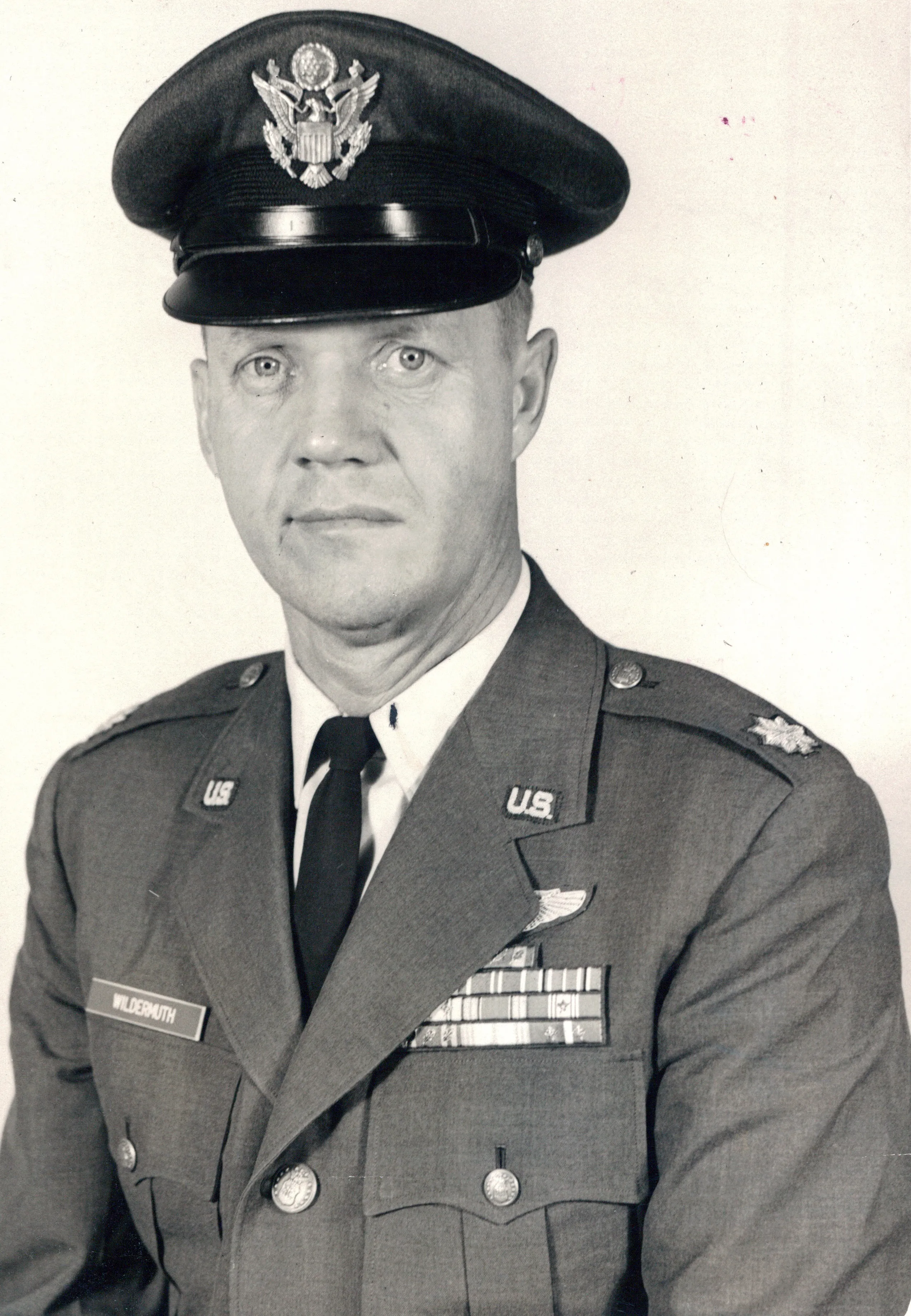
Robert Earl Wildermuth as a Lieutenant Colonel in the United States Air Force, c. 1968–1970 — the period of his Pentagon assignment at the apex of his military career. Formal Air Force studio portrait.
What the photograph shows
A chest-up formal portrait of Robert Earl in Air Force dress blue uniform, peaked officer’s cap with the gold Great Seal of the United States insignia, dark four-in-hand tie, white shirt collar visible. He looks directly at the camera.
The rank visible on his shoulders is Lieutenant Colonel — the silver oak leaf clusters visible at each shoulder. Below the rank insignia, the U.S. lapel-pin device appears on each lapel. Above the left breast pocket, the silver Air Force Observer wings (Navigator/Bombardier/Radar Observer wings — his “three-headed monster” qualification per the memoir) are pinned, with multiple rows of campaign ribbons and decorations beneath. His name tape — WILDERMUTH — is visible on the right breast.
The ribbons visible carry, per his memoir’s decoration list, the Air Medal with three oak leaf clusters (four total awards for Pacific combat missions), the Southwest Pacific Area Medal with two battle stars, the Philippine Liberation Medal with two battle stars, the National Defense Medal with two oak leaf clusters, and the Air Force Commendation Medal. The Meritorious Service Medal he received for his Pentagon work would have been added shortly after this portrait.
In the memoir’s frame
The portrait sits squarely in the Pentagon assignment Robert Earl describes in his memoir as the apex of his career — “Only one in fourteen hundred eligible ever got such an assignment. It was a great boost in a military career but it was the most frustrating assignment possible.” The promotion to Lt. Col. that the photograph documents had come at the end of his Itazuke Air Base squadron-commander tour in Japan, when General Shtogren had a tradition of secretly announcing promotions at Commanders’ Conferences in Tripoli. By the time of this portrait Robert Earl was in Washington at the Pentagon, working on the proposal that would take three years to coordinate through 33 offices and finally be published in the Air Force Policy Manual a year after he retired.
He retired from the Air Force as a Lieutenant Colonel on 31 May 1970 — making this portrait one of the last formal photographs of his uniformed career. He was 46 years old.
Pairing with the earlier officer portrait
This is the second formal Air Force portrait of Robert Earl in this archive, paired with:
- The earlier c. 1951 officer portrait — taken at the time of his 1951 recall from his Hamilton AFB clerk-typist assignment, when he was sworn in as a First Lieutenant.
The two together carry his Air Force career from 1st Lt (1951) to Lt. Col (1968–70) — twenty years of uniformed service.
Source: Wildermuth family archive, transmitted by Chuck Eesley 2026.
Catalogue
- Type
- Photograph
- Medium
- Black-and-white formal officer studio portrait
- Date created
- circa 1968–1970
- Place created
- presumed Pentagon or Air Force base photography facility
- ID number
- REW-LT-COL-PORTRAIT
- Provenance
- Wildermuth family archive.
- Rights
- Family use; permission required for republication.