Stanford · California · United States
Stanford University
The campus that links Chuck and his grandfather Robert Earl across more than seventy years. Robert Earl took his Bachelor of Arts in Biological Sciences here on October 1, 1948, on the GI Bill, after coming home from flying B-24s over the Pacific. Chuck joined the Stanford faculty in the next generation. The two photographs of family return visits here — Memorial Church in the 1960s and the White Memorial Fountain in the 1980s — bracket the years between.
Why this place matters
The site of the project's clearest generational rhyme. Robert Earl's Stanford BA (1948) and Chuck's Stanford appointment (the present) are the two endpoints of a thread the rest of the archive is, in some sense, written to connect.
Across generations
 is the formal record; these are the personal one.](/_astro/IMG_3874.BYFEc8mA_FSLC9.webp)
 is the formal record; these are the personal one.](/_astro/IMG_2649.BOTJ1hpZ_1oH5jP.webp)
Robert Earl in the suit he wore for graduation day — B.A. in Biological Sciences, conferred 1 October 1948; and Dot & Bob's photo Christmas card from the following December, signed *Love, Dot + Bob — 1949,* with the pencil annotation reading 'Stanford senior.' His [diploma](/archive/robert-earl-wildermuth-stanford-ba-1948/) is the formal record; these are the personal one.
Alignment: No photographs of Bob on campus during his student years exist in the archive beyond these two portraits, which were taken nearby. The architecture of his Stanford years is in the diploma; the face of them is here.
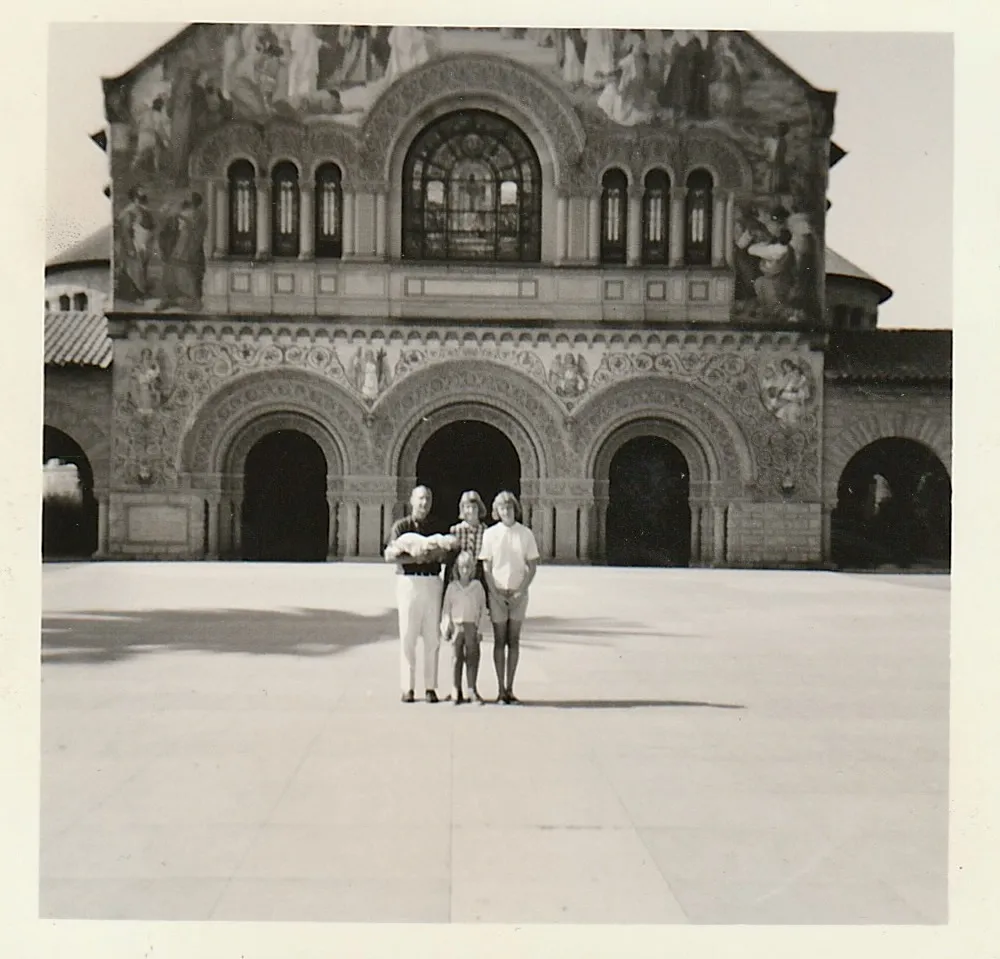
Family at the façade of Stanford Memorial Church — likely a return visit to campus after Robert Earl had moved on to the rest of his career. People not yet fully identified; tentatively Robert Earl holding the youngest Wildermuth child (Uncle Rob as a toddler), Dottie, Terrie Lee, and one other child. Chuck to confirm.
Alignment: The Stanford Memorial Church mosaic on the façade visible behind the family is the original 1903 facade restored after the 1906 earthquake.
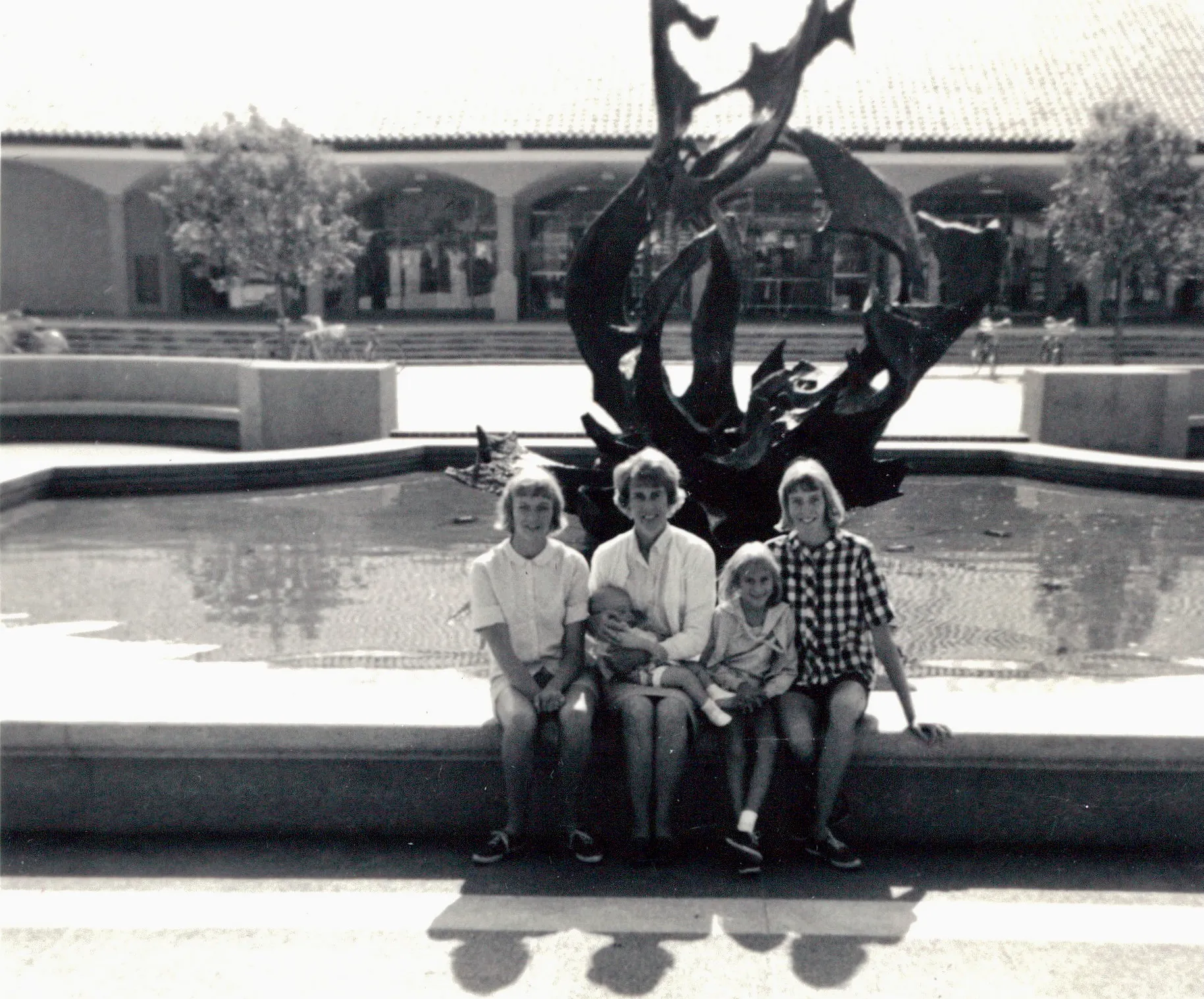
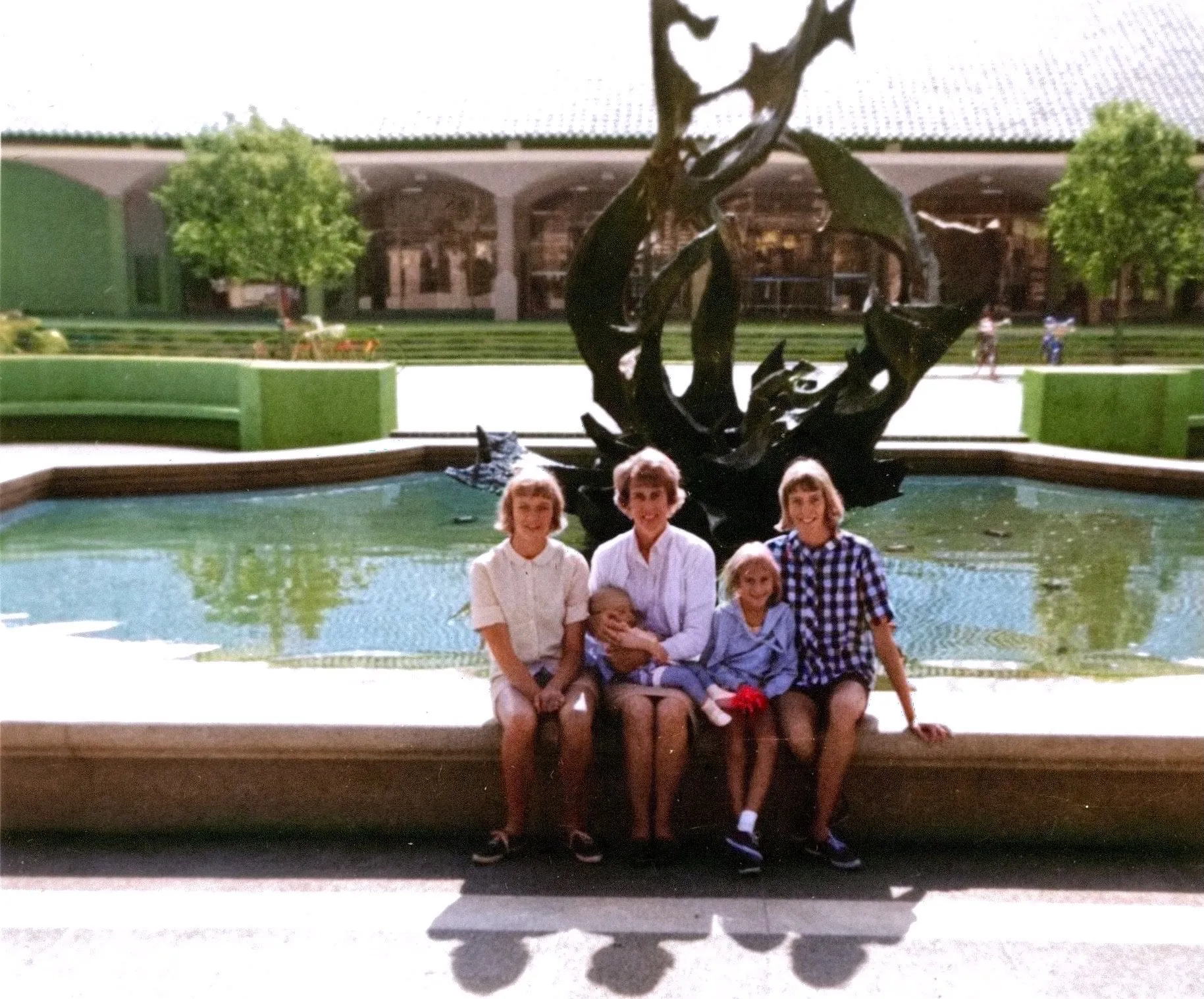
Family at the White Memorial Fountain (the bronze 'Claw' by Aristides Demetrios, installed only a year earlier in 1964) in the heart of campus, on **24 August 1965**. Identified by Chuck: Uncle Rob Wildermuth, Chuck's mother Terrie Lee (then about sixteen), Sandy (Sandra Sue Wildermuth Clement), and Debbie Wildermuth, with their mother Dorothy 'Dottie' Davis Wildermuth holding the youngest. Both the **original black-and-white print** and Chuck's **AI-colorized rendering** are below — the B&W is the documentary record; the colorization is an interpretive aid for picturing the day.
Alignment: The fountain and the open arches behind are unchanged in present-day Stanford — a re-shootable frame at any future generation's distance.
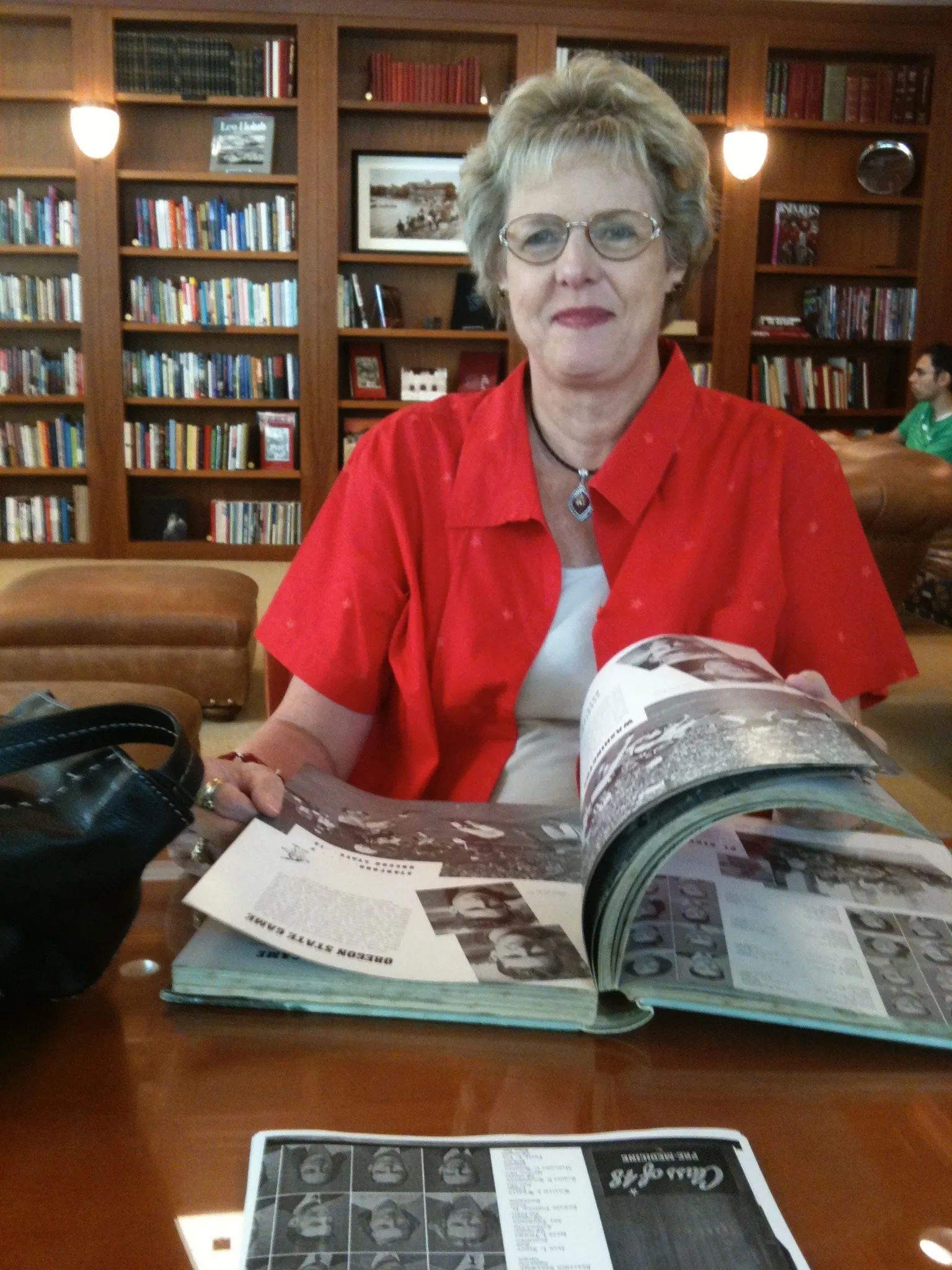
Terrie Lee at the Stanford Alumni Center, looking through her father Robert Earl Wildermuth's *Class of '48* yearbook — the volume that holds his graduation from Stanford on the GI Bill. The photograph is the family's quietest single statement of why Stanford matters to it: the daughter, on the same campus, with her father's record open in front of her, in the same room where her son had become a faculty member. Three generations meet across the open page.
Alignment: This is the photograph that turns the Stanford thread from a coincidence into a passage. Set as the portrait image on Terrie's person page.
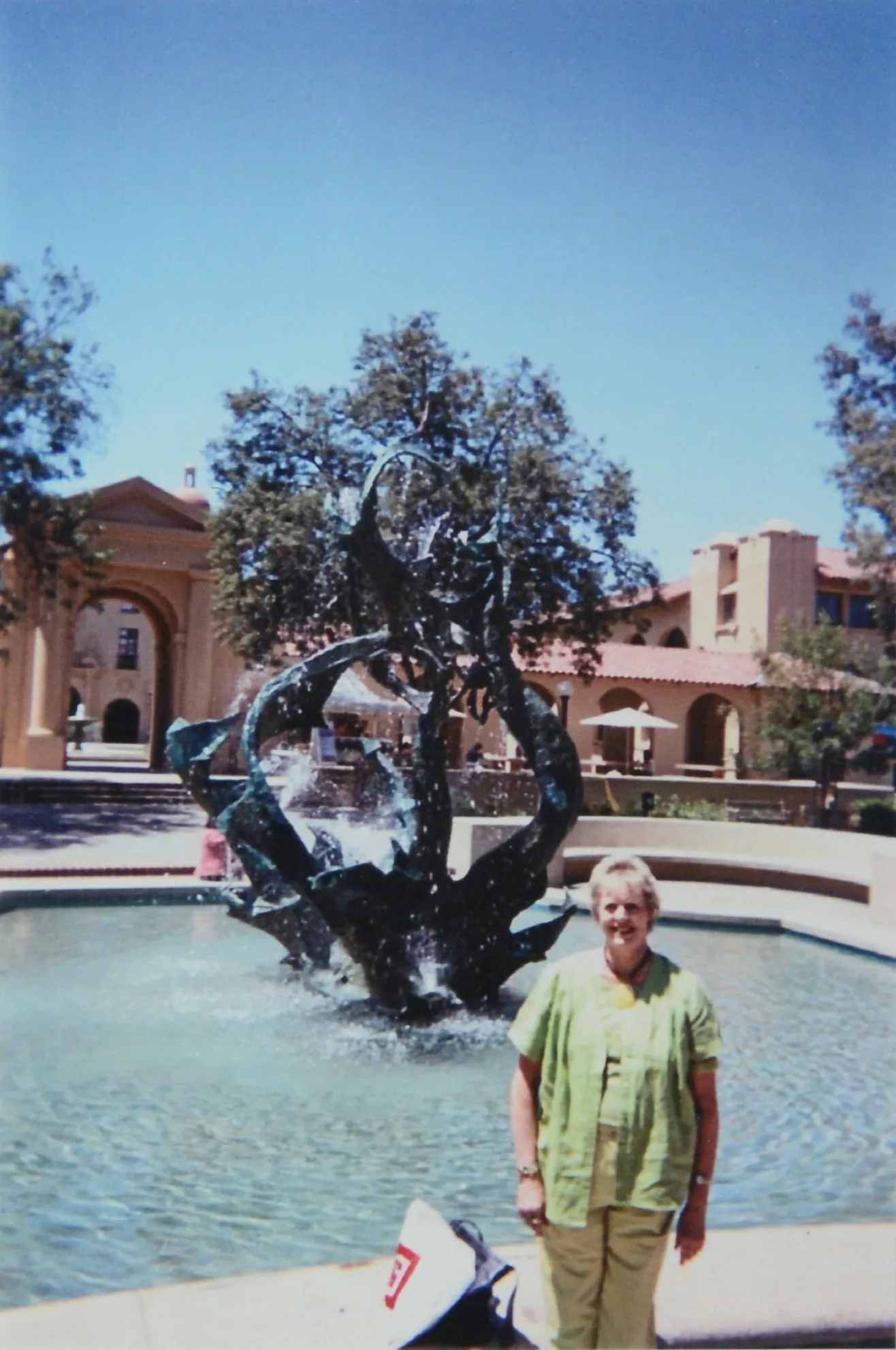
Terrie alone at the **White Memorial Fountain** in a green blouse, Memorial Court behind her — the same fountain her mother Dottie had stood at on 24 August 1965 holding **Terrie's own youngest brother Rob** as a toddler. The single frame of Terrie by herself on the Stanford campus, on a later visit to see her son in the years he had joined the faculty.
Alignment: Re-shoots the same fountain frame as the 1965 family photograph one generation later — Terrie now the elder rather than the teenager in the earlier picture.
Stanford is not an ancestral village or a wartime objective. It is a school. But this is also the place where, by the project’s own framing, the family record turns into a continuous line: Robert Earl came home from the Pacific, finished his BA here in 1948, sent out a Christmas card from the campus the next year with his fiancée Dot — and a long arc later, his grandson Chuck is on the faculty.
There is also a third generation on campus at present. Chuck’s first cousin Briana (Massaro) Lockett — daughter of Chuck’s Aunt Debbie (and so Robert Earl’s granddaughter) — is a physician’s assistant at Stanford in the same years Chuck is on the faculty. Robert Earl’s GI-Bill BA in 1948, Chuck’s faculty appointment in the present generation, and Briana’s medical-staff role in the same years bring three Wildermuth-descended people to the Stanford campus across roughly seventy-five years. The thread the rest of this page describes as a generational rhyme has, in this generation, become two voices in unison.
The two visit photographs on this page were taken on family return trips between those two endpoints. They are the only known images in the archive of the Wildermuths and their descendants on the campus — Robert Earl never appeared in any photographs of his own undergraduate years that survived.
When Robert Earl closed his “Big One” combat log and his memoirs by addressing himself to “future genealogists,” this is the address he was writing to.
Robert Earl on his Stanford years — in his own voice
The photographs above are the visual record. The voice record sits inside Robert Earl’s 1989 memoir, where he gave the Stanford chapter the longest and most affectionate passage of his post-war life. Five pieces of that passage are worth lifting onto this place page in his own words.
How he got in. Two years of pre-med at Marietta after the war, then three medical-school rejections — Ohio State, Western Reserve, Cincinnati. His advisor told him Ohio State had had 1,400 applicants for about sixty spots that year, and suggested he look west. UC and USC were limited to three out-of-state students each per year. Stanford accepted him conditionally. He took it.
What he knew about Stanford going in.
“I really didn’t know much about Stanford except that their football team had played in the last Rose Bowl before the war and that wasn’t much of a recommendation to head west for.”
Driving west in a used 1939 car. No new cars had been built during the war. His name had worked up to number three on a Marietta dealer’s waitlist, then stayed there — “I found that men were paying dealers ‘under the table’ to get delivery on cars.” In disgust he bought the best 1939 used car he could find and drove Dottie west.
The Harvard of the West. Once he was on campus, the assessment shifted entirely. The memoir paragraph is the single best piece of Robert Earl’s adult voice on his own class consciousness and on the campus that became his alma mater:
“Stanford University turned out to be a dream. It is one of the most beautiful universities in America… It is situated on the outskirts of Palo Alto, California, a small city of about 30,000 people, thirty miles south of San Francisco. Its architecture is Spanish with two story, sandstone buildings with red tiled roofs… Academically Stanford was rated number three in the United States when I attended and it is known as the ‘Harvard of the West’. Millionaire’s sons and daughters go there and movie star’s children strived for admission — and here I was a young guy from rural Ohio and from the wrong side of town at that. All during my stay there however, I never felt inferior and since white tee shirts and blue jeans were the accepted student attire I fit right in.”
The line “never felt inferior” is the small piece of class-aspiration honesty that the rest of the maternal-side family record is, in a sense, written underneath. The Marietta-Harmar-Street boy whose father Earl Adam ran a working-class household in 1930s Ohio was, by 1947, on a sandstone campus with movie stars’ children and not feeling inferior. The white-tee-shirts-and-blue-jeans detail is the small piece of post-war Stanford material culture that made the class adjustment possible — veterans returning on the GI Bill outnumbered the prep-school undergraduates of the prewar era badly enough to reset the dress code. The class-aspiration passage and the white-tee-shirt detail are inseparable.
The Stanford golf-course house, and Dottie at the Hoover Library. “They rented a house on the Stanford golf course. Dottie worked at the Hoover Library.” The young couple’s life in those years was anchored in two Stanford institutions — the campus golf course on the western edge of campus, and the Hoover Institution Library and Archives where Dottie was earning the household’s living while Robert Earl finished pre-med. The Marietta High School graduate keeping Citizen’s Bank books just three years earlier was now on the librarian-staff of one of Stanford’s signature research libraries. Her Hoover Library year (1947-1948) is recorded with the same precision on her own page.
The denial that closed the chapter. Robert Earl’s conditional admission was lifted after his first semester. His senior-year medical-school application was, in the end, again denied — even with the Stanford record. He took the Bachelor of Arts in Biological Sciences, conferred 1 October 1948, “thoroughly discouraged,” and went looking for full-time work. The Stanford years closed without the medical degree he had come for — but with the BA that opened all the doors that followed: the trainee job at Container Corporation of America in Oakland, the Korean recall, the Pentagon, the Lieutenant Colonel commission, the long Florida retirement, and a class-mobility arc that his grandchildren would build on.
Further reading
- The G.I. Bill on Wikipedia — the policy that put Robert Earl on this campus in two years.
- When Dreams Came True: The GI Bill and the Making of Modern America by Michael J. Bennett (Brassey’s, 1996) — the social history of how the program reshaped American education.
- Stanford Stories from the Archives — Stanford’s digital archive of university-history exhibits and primary documents.
- Stanford Department of Special Collections and University Archives — the institutional archive that holds the WWII-era student and faculty records, the campus photographs, and the documentary context for what the post-war GI Bill cohort encountered in 1946-1948.
- Stanford University war records, 1917-1945 (SearchWorks catalog) — the cataloged collection of WWI and WWII Stanford records, including the student and faculty service rosters.