The 1795 will of John Fleming Senior of Montgomery County, Maryland
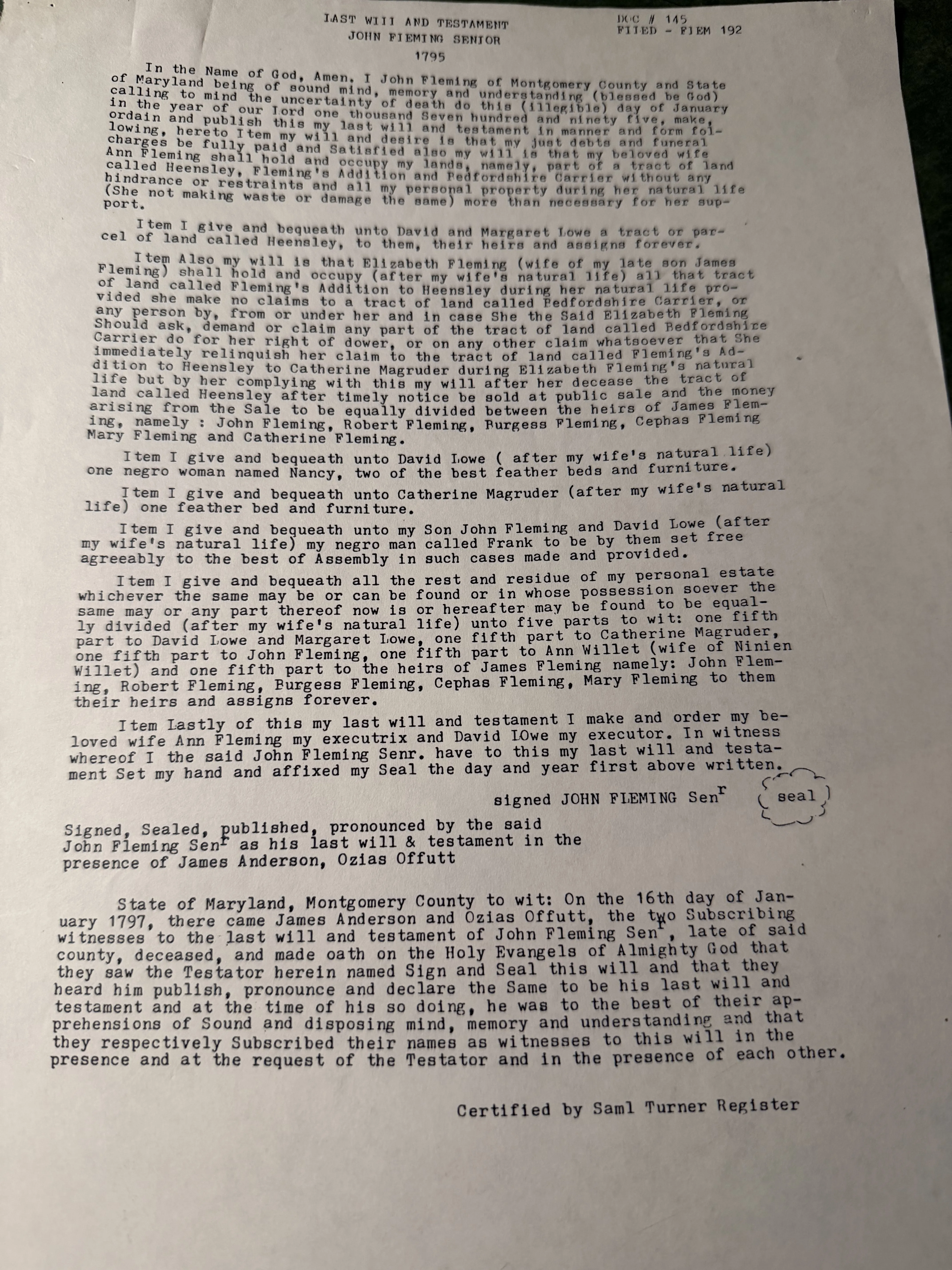
This is the will he spent years hunting — and it is not quite the will he thought he was hunting.
He had chased a “John Fleming Sr.” said to have died at Derry, Pennsylvania in 1777, and eventually obtained a will through a Chester County archivist. This is a different and much fuller document: John Fleming of Montgomery County, Maryland, who styles himself “John Fleming Senr” in his own signature, made in January 1795 and proved 16 January 1797.
The date matches the man the Family Legacy typescript calls John Fleming Jr. — “died on Christmas Day, 1796 … His will was probated on 16 January 1797.” The “Senior” in the heading is his own, to distinguish himself from his son John. It is a compact illustration of why five generations of Johns defeated everyone who tried to sort them out.
A caution that governs this whole page. In November 1998 Robert Earl withdrew this branch from the family’s ancestry, concluding that “our John IV was not the son of John III of Pennsylvania.” This will is a real document about real people; whether they are Chuck’s people is exactly what he retracted. Read it as evidence, not as lineage.
What the will says
The testator provides first for his wife Ann Fleming, who is to hold his lands and personal property for her natural life and whom he names executrix; David Lowe is executor. Three named tracts recur: Heensley, Fleming’s Addition to Heensley, and Bedfordshire Carrier.
The people named:
| Named in the will | Matching the typescript’s family of John Fleming Jr. |
|---|---|
| wife Ann Fleming | Anne White ✓ |
| David and Margaret Lowe | daughter Margaret m. David Lowe ✓ |
| Catherine Magruder | daughter Catherine m. Joseph Magruder ✓ |
| Ann Willet, “wife of Ninien Willet” | daughter Ann m. Ninien Willet ✓ |
| son John Fleming | John Fleming III ✓ |
| Elizabeth Fleming, “wife of my late son James Fleming” | son James m. Elizabeth Burgess ✓ — and already dead by 1795 |
Independent confirmation, from a probate record, of five of the six children the typescript lists. It also settles something Robert Earl had noted as a loose end: he wrote that James had died before the will was written, and here is the will saying so — “my late son James Fleming.”
The six grandchildren, and why they matter now
The will twice enumerates the heirs of James Fleming:
John Fleming, Robert Fleming, Burgess Fleming, Cephas Fleming, Mary Fleming and Catherine Fleming
That list is worth more than anything else on the page. Robert Earl’s retraction concluded that the line runs not through John but through a James Fleming — and this document names a James Fleming’s children, from probate, in 1795. If the retraction is right, the connection this archive is missing may be somewhere in that sentence.
Slaveholding, stated plainly
The will disposes of two enslaved people, and the archive records it without softening:
- A woman named Nancy is bequeathed to David Lowe, together with two feather beds and furniture — listed among the household goods.
- A man named Frank is left to the testator’s son John Fleming and to David Lowe “to be by them set free” under the relevant Maryland assembly provisions.
So the household held people in slavery, and the will freed one man and passed on a woman as property in consecutive clauses. Nancy and Frank are named here because they were named in the document, and because they are the only trace of them this archive has. Nothing else about either of them is known — not their ages, their kin, whether the manumission was carried out, or what became of Nancy in the Lowe household.
Execution and proof
Signed and sealed by John Fleming Senr in the presence of James Anderson and Ozias Offutt, who appeared at Montgomery County on 16 January 1797 and swore to the signature. Certified by Saml Turner, Register.
Where the original is
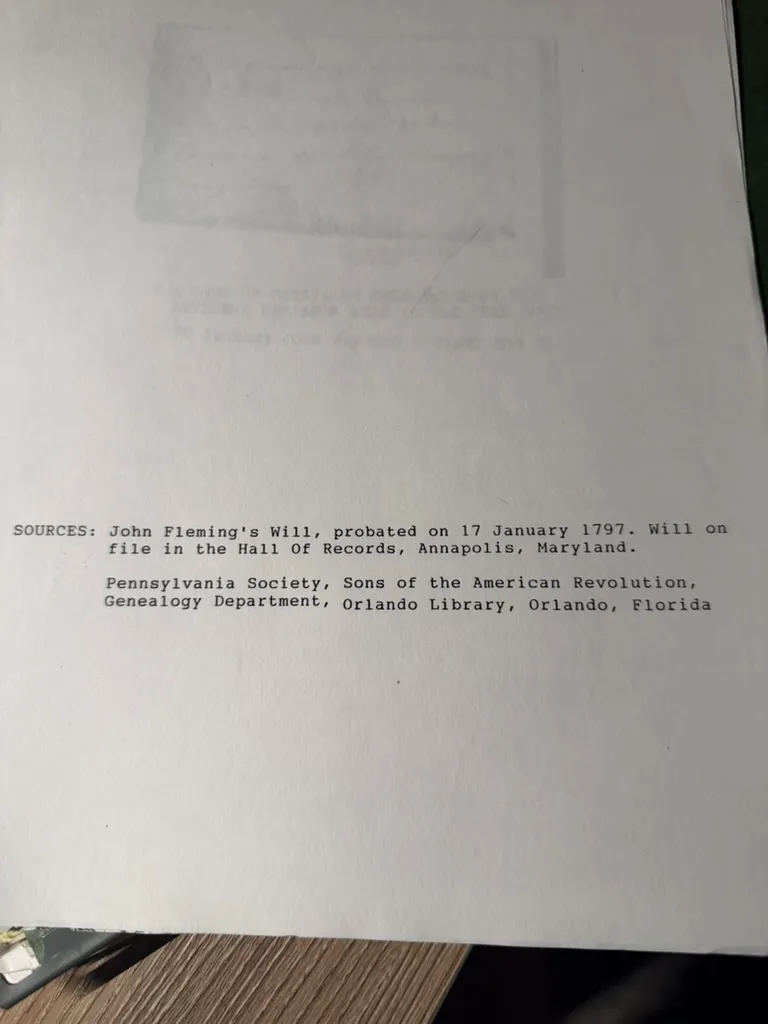
His own sources note, on the back of the marriage-banns sheet, gives the repository:
“John Fleming’s Will, probated on 17 January 1797. Will on file in the Hall Of Records, Annapolis, Maryland.”
That is the Maryland State Archives — so the original is in a public repository and can be consulted today. He also credits the Sons of the American Revolution genealogy collection at the Orlando public library, which is where a good deal of his Maryland and Pennsylvania work was actually done, half an hour from his house.
(He writes the probate as the 17th there; the transcript above has the witnesses appearing on the 16th. A one-day inconsistency in his own papers, unresolved.)
Source: typed transcript of the last will and testament of John Fleming Senior, Montgomery County, Maryland, January 1795, proved January 1797; marked Doc #145 / FLEM 192 in Robert Earl Wildermuth’s research papers, in Chuck’s keeping. Photographed 2026.
Catalogue
- Type
- Document
- Medium
- Typed transcript of a probated will, Montgomery County, Maryland
- Date created
- January 1795; proved 16 January 1797
- Place created
- Montgomery County, Maryland
- ID number
- Doc #145 · Filed FLEM 192
- Provenance
- Original on file at the Hall of Records (Maryland State Archives), Annapolis; transcript obtained by Robert Earl Wildermuth, in his research papers, in Chuck's keeping. Photographed 2026.
- Rights
- Family use; permission required for republication.