"Dear Cousins" — how the Fleming research was actually done, 29 September 1998
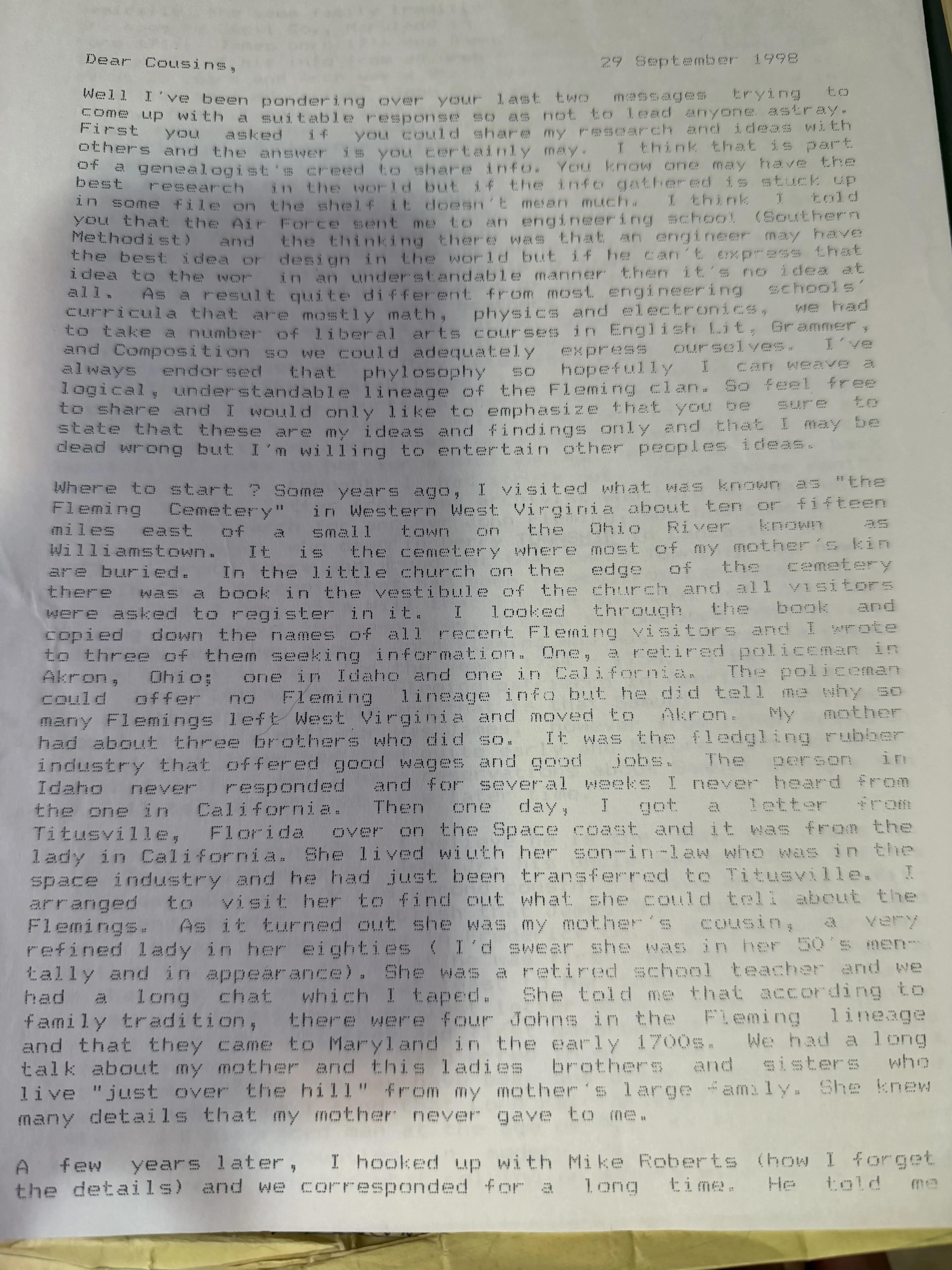
Three typed pages to Fleming cousins, signed BOB — and the most useful methodological document in the papers. The charts show what he concluded; this shows how he worked, what he doubted, and what he got wrong on purpose.
Two months later he would retract the lineage it defends.
The creed
They had asked whether they could pass his research on. His answer:
“You certainly may. I think that is part of a genealogist’s creed to share info. You know one may have the best research in the world but if the info gathered is stuck up in some file on the shelf it doesn’t mean much.”
He explains where that came from: the Air Force sent him to engineering school at Southern Methodist, on the principle that “an engineer may have the best idea or design in the world but if he can’t express that idea … in an understandable manner then it’s no idea at all.” So the curriculum included English literature, grammar and composition alongside the maths and electronics — “I’ve always endorsed that phylosophy so hopefully I can weave a logical, understandable lineage of the Fleming clan.”
Then the condition he attaches, which this archive has quietly been operating on all along:
“I would only like to emphasize that you be sure to state that these are my ideas and findings only and that I may be dead wrong but I’m willing to entertain other peoples ideas.”
Two months later he proved he meant it.
The visitors’ book
The whole Fleming line came out of one improvised move. At the Fleming Cemetery near Williamstown, Wood County, he found no legible stones — so he went into the little church, found the visitors’ register in the vestibule, and copied down every recent Fleming name.
He wrote to three of them:
- A retired policeman in Akron, Ohio. No lineage — but he explained something better: why so many West Virginia Flemings ended up in Akron. It was the fledgling rubber industry, and its wages. “My mother had about three brothers who did so.”
- Someone in Idaho. Never replied.
- Someone in California — and weeks later a letter came instead from Titusville, Florida, an hour from his house, because her son-in-law worked in the space industry and had just been transferred to the Cape. She was his mother’s cousin, in her eighties, a retired schoolteacher, “a very refined lady … I’d swear she was in her 50’s mentally and in appearance.” He taped a long conversation. She “knew many details that my mother never gave to me.”
This is Josephine Fleming Cox, and that tape is where the log-cabin recollections in this archive come from. She also gave him the four-Johns tradition — “there were four Johns in the Fleming lineage and … they came to Maryland in the early 1700s” — the thing he would later discard, with a blunt note about her age and her lack of paper.
The will hunt
The best sequence in the letter, because it is three failures and a piece of luck.
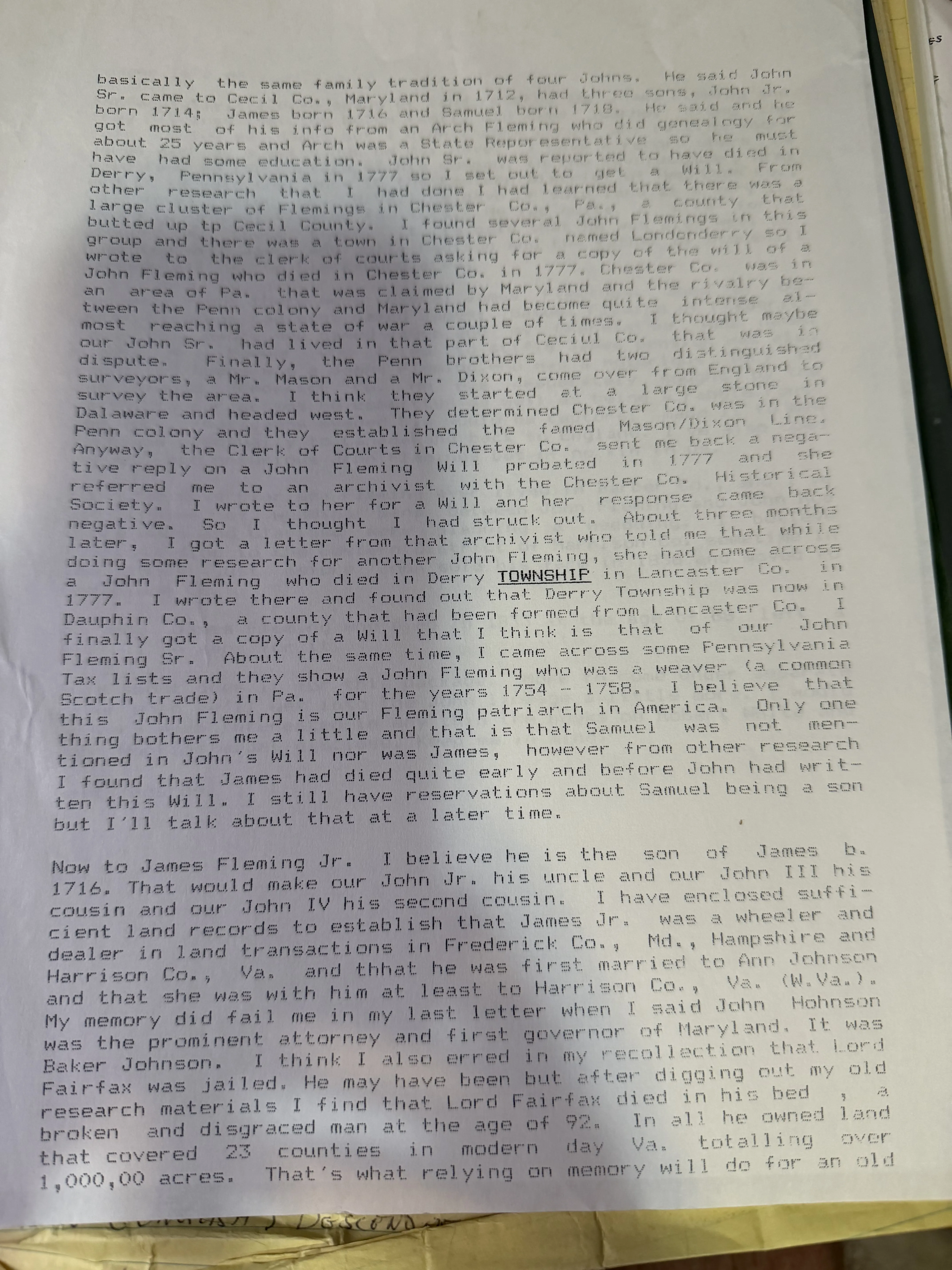
Family tradition said John Fleming Sr. died at “Derry, Pennsylvania” in 1777. He knew of a large cluster of Flemings in Chester County, which borders Cecil County, Maryland, and a Chester County town called Londonderry — so he wrote to the Chester County clerk of courts for the will.
(He digresses, happily, into why Chester County was ambiguous at all: it lay in territory claimed by both Maryland and the Penn colony, a rivalry that “almost reach[ed] a state of war a couple of times,” until the Penns brought over “a Mr. Mason and a Mr. Dixon” from England, who started at a stone in Delaware, headed west, and settled it with the Mason–Dixon Line.)
The clerk: nothing. She referred him to an archivist at the Chester County Historical Society. The archivist: nothing. “So I thought I had struck out.”
Three months later the archivist wrote to him unprompted. While working on a different John Fleming she had come across one who died in Derry TOWNSHIP — he underlines the word — in Lancaster County, in 1777. Derry Township is now in Dauphin County. He wrote there and got the will.
The tradition had said a town; it was a township, in a county that no longer existed under that name. That single misread word had cost him years.
Around the same time, Pennsylvania tax lists for 1754–1758 turned up a John Fleming who was a weaver — “a common Scotch trade.” On that basis: “I believe that this John Fleming is our Fleming patriarch in America.”
And immediately, the doubt:
“Only one thing bothers me a little and that is that Samuel was not mentioned in John’s Will nor was James … I still have reservations about Samuel being a son but I’ll talk about that at a later time.”
Page 2 is where that whole sequence sits, with TOWNSHIP underlined in the middle of it:
James Fleming — the man who would soon replace the Johns
He devotes much of page 3 to a James Fleming, then believed to be a collateral relative: “I believe he is the son of James b. 1716. That would make our John Jr. his uncle and our John III his cousin and our John IV his second cousin.”
Within two months this man became the direct ancestor. What he had already gathered on him:
-
“A wheeler and dealer in land transactions” across Frederick County, Maryland and Hampshire and Harrison Counties, Virginia; first married to Ann Johnson.
-
A record of him selling land to the captain of his own company in the Revolutionary Army.
-
In the Eastern District of Harrison County “he gave or sold land at a very low price to several Fleming families” — a man settling his relatives on the ground.
-
“He led quite a life for a pioneer in those times. It is said that he was also well acquainted with James and Dolly Madison and the father of Stonewall Jackson all of the Clarksburg area.” Said — he marks it as tradition.
-
His will: “James Fleming who died in 1833 at the age of 88 left a Will. I’ve sent for it.”
-
A contested pension. The cousins had raised a “Mr. Redder who tried to stifle James pension,” and Robert Earl allows that Redder had a point — “there was a James Fleming who was a notorious Tory in and around Frederick Co.”, desperately sought by the colonists, who “evaded his would be captors; made it to New York and eventually to Canada and back to England.”
This is the most substantial untried lead in the papers. A disputed Revolutionary War pension claim generates a file — affidavits, service statements, the objector’s grounds, and often a rebuttal naming relatives. If James Fleming applied for a pension and someone contested it on the strength of a Tory namesake, that file should survive in the federal pension applications. Nobody in this archive has looked.
He is careful throughout that the name is a trap: “Some of our John Flemings had sons named James; Samuel Fleming of Frederick Co., Md. had a son named James and my Grandfather was named James” — James Wesley Fleming — and “I’ve also come across some notorious John Flemings but of no kin to us.”
He corrects himself three times in one letter
Small, and the reason the papers are trustworthy:
- “My memory did fail me in my last letter when I said John Hohnson was the prominent attorney and first governor of Maryland. It was Baker Johnson.”
- On Lord Fairfax: “I think I also erred in my recollection that Lord Fairfax was jailed … after digging out my old research materials I find that Lord Fairfax died in his bed, a broken and disgraced man at the age of 92.”
- And the moral, in his own voice: “That’s what relying on memory will do for an old codger like me.”
One correction that stands
“Don’t believe Clarissa Fleming ever lived in Barber Co., and I’ve got copies of wedding bans between John Fleming and John Roe where John and Clarissa were planning a wedding. I believe Clarissa died in the Eastern District of Harrison Co. sometime in the 1930s [1830s] just before John sold his farm in 1838 and moved to Doddridge Co.”
So the 1803 marriage banns survive in copy, naming both fathers — and Clarissa’s death is placed in the Eastern District shortly before the 1838 move, rather than left as a bare “about 1838.”
Two smaller things on the last page
A geography note that matters for reading the rest of the papers. He locates James Fleming’s cheap land sales to Fleming families in “the Eastern District of Harrison Co., Va. (now Taylor Co. W.Va.)” — which is why his census abstracts treat Harrison and Taylor as one field of search. They are the same ground at two dates.
An unpursued surname. “I have scads of land records for James Fleming and they disclose that the Welch family did also journey along the same route as James but I didn’t come across any records where James married a Welch but he may have.” A guess he declined to promote to a finding — and, if the retraction is right about James, the sort of guess worth testing.
He closes asking for anything the cousins can find on Robert White and John Hopkins — two of the lines he would abandon eight weeks later.
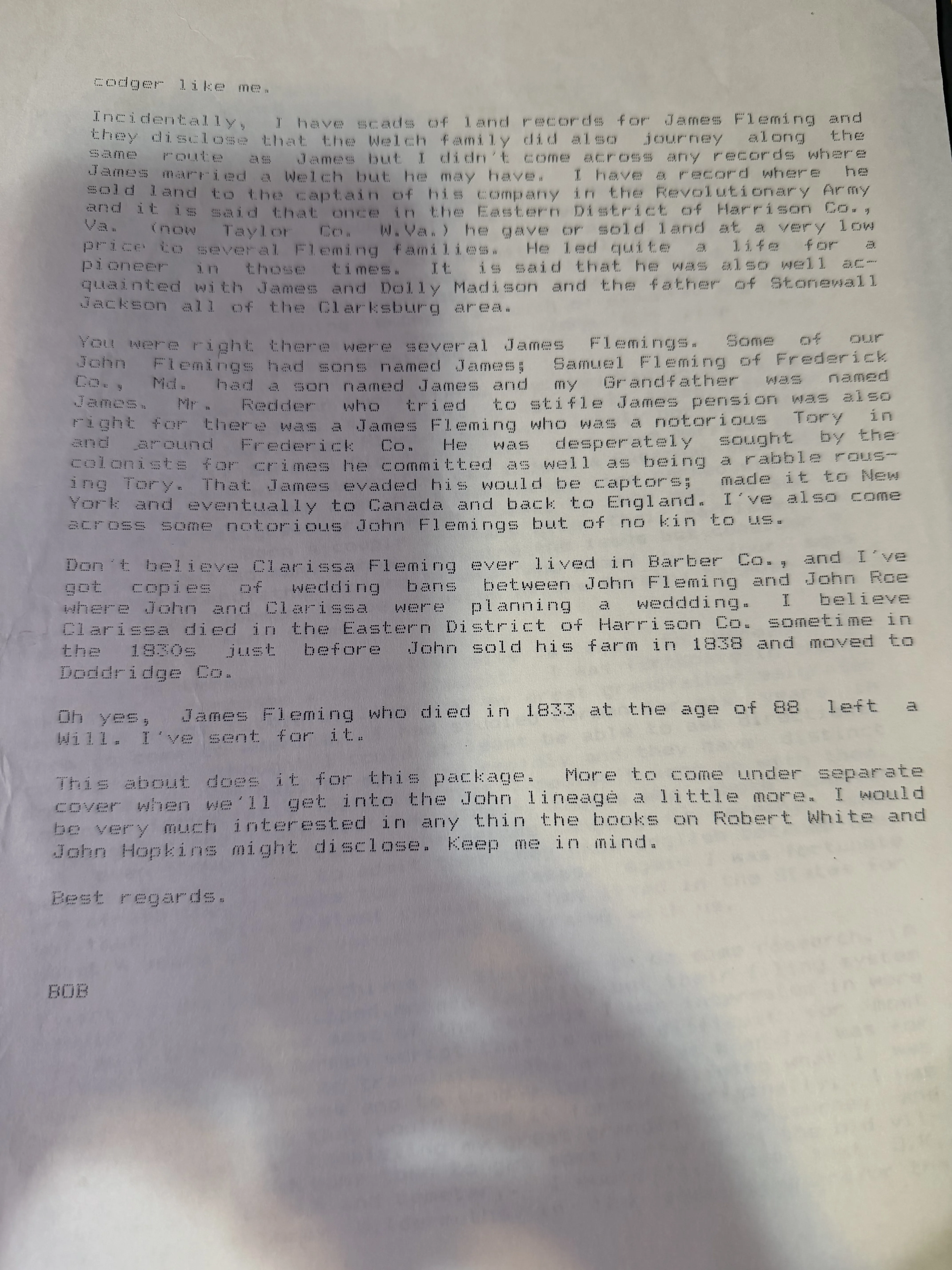
Source: typed letter, three pages, 29 September 1998, signed “BOB”; from Robert Earl Wildermuth’s research papers, in Chuck’s keeping. Photographed 2026.
Catalogue
- Type
- Correspondence
- Medium
- Typed letter, three pages, signed "BOB"
- Date created
- 29 September 1998
- Place created
- Casselberry, Florida
- ID number
- FLEMING
- Provenance
- Robert Earl Wildermuth's genealogical research papers; in Chuck's keeping. Photographed 2026.
- Rights
- Family use; permission required for republication.