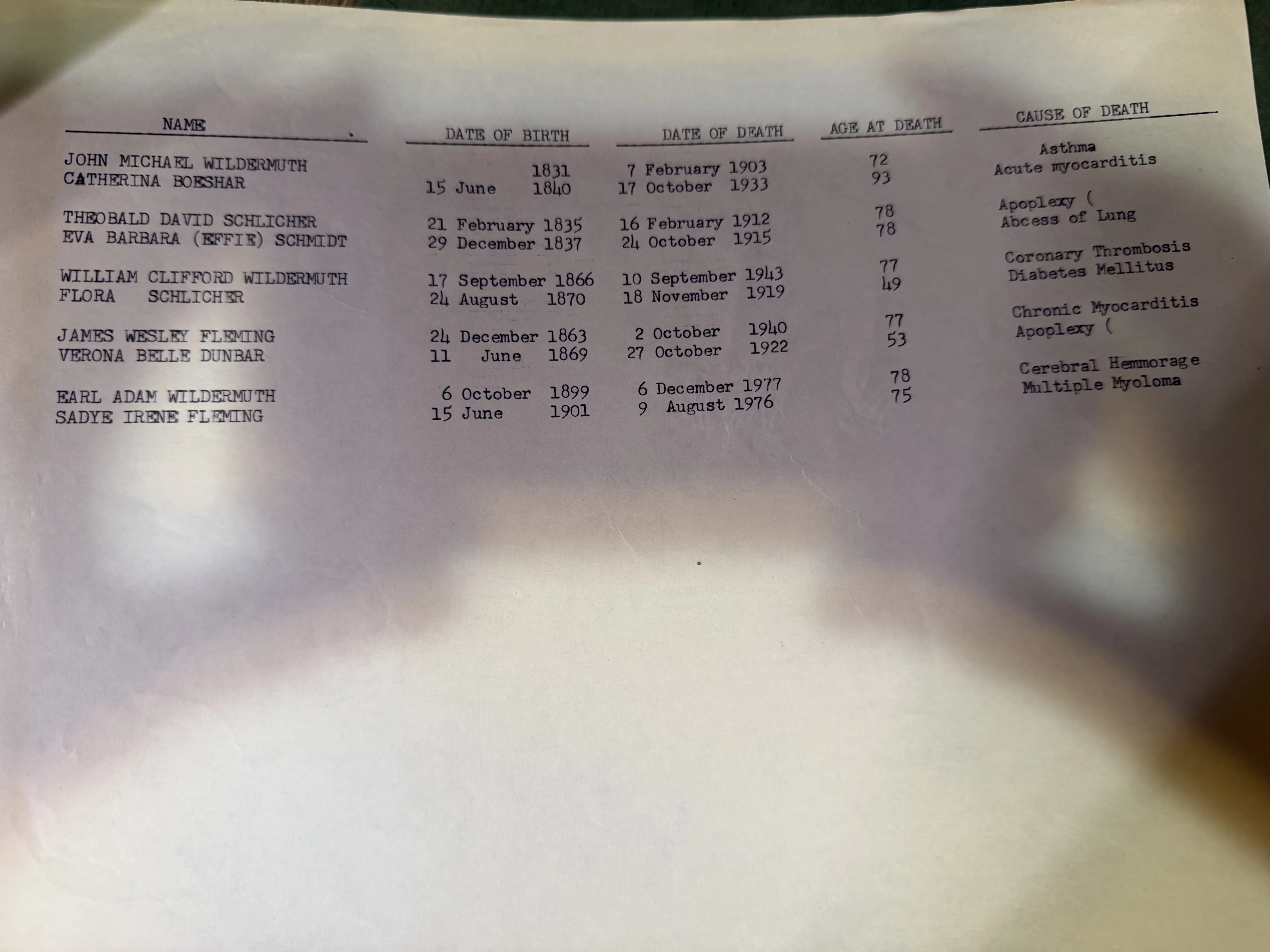
Verona Belle (Dunbar) Fleming
also known as born Verona Belle to Martha Kelley; raised by the Sheppards (adoptive surname, not a marriage); married Wesley Fleming as 'Mary V. Sheppard'
b. 1869-06-11, Wood County, West Virginia
d. 1922-10-27, Marietta, Washington County, Ohio
Verona’s tangle of surnames — Kelley, Dunbar, Sheppard, Fleming — confused this archive’s earlier readings, which treated Sheppard as an early married name. Robert Earl Wildermuth’s own genealogy of the family settles it, in his own words: Verona was “born out of wedlock to Martha Kelley. The father was Seth Dunbar.” When her mother left, the infant was taken in by Martha’s sister Deborah (Kelley) Sheppard and Deborah’s husband Levi Sheppard, who raised her as their own. “Sheppard” was therefore her adoptive family’s name, not a marriage — and it was under the name “Mary V. Sheppard” that she married Wesley Fleming at sixteen. (The two accounts of the father are one man: the family GEDCOM identifies him as Seth Grosvenor Dunbar, born in Kennebec County, Maine in 1836, who had migrated south to Wood County, West Virginia — where he died in 1870 and where Robert Earl knew the Dunbars as an established local family. A New England man settled among the Wood County Dunbars, in other words, which reconciles his own note with the record.)
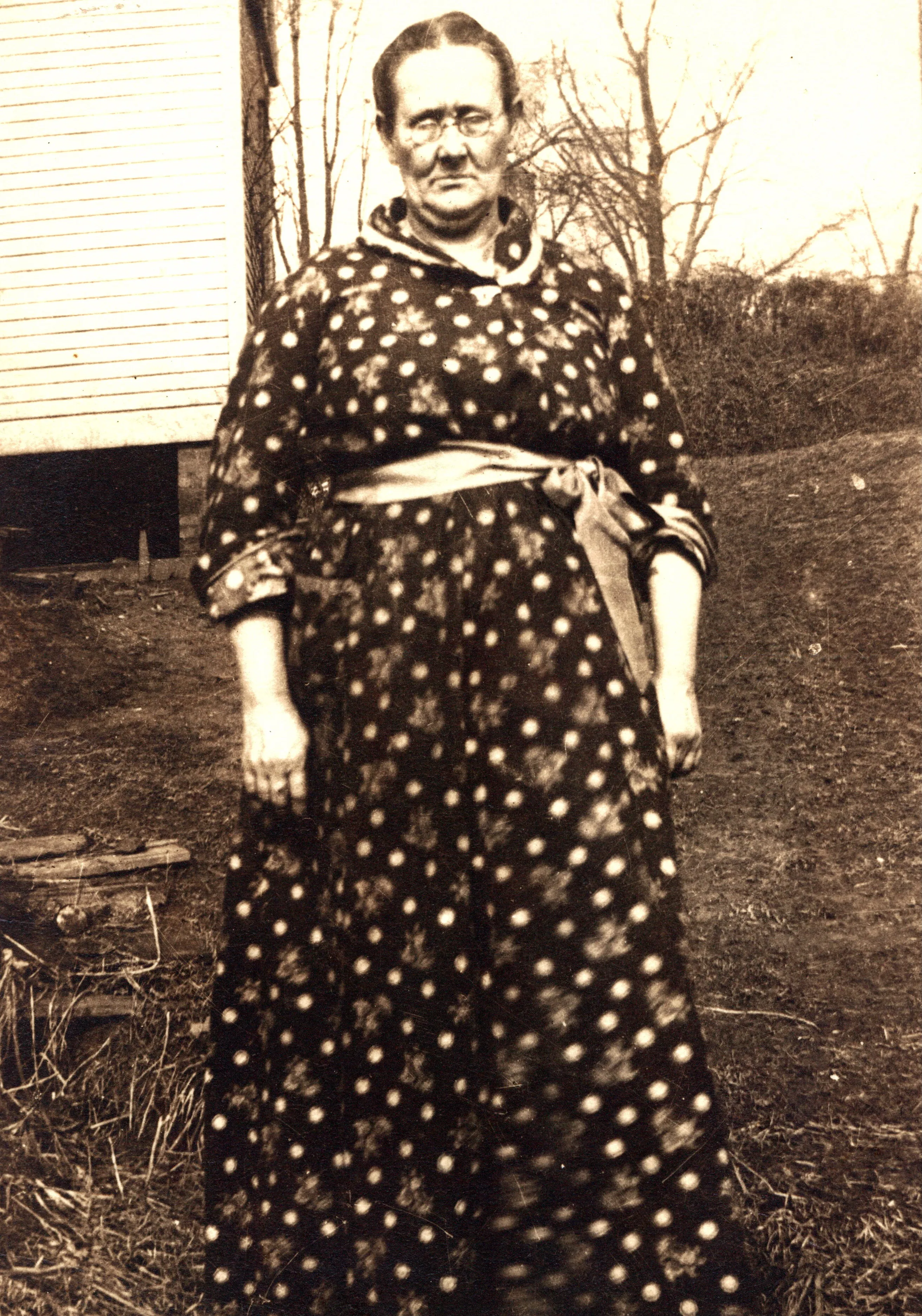
A late-life portrait, c. 1920-1922
The first photograph of Verona to surface in this archive arrived in June 2026 from Chuck’s keeping. She stands outdoors next to a white clapboard farmhouse — in a dark long-sleeved polka-dot dress with a small white collar, a dark belt at the waist, glasses, hair pulled back, hands at her sides. The trees behind her are bare; the season reads as late autumn or early spring. The composition is the kind of plain hand-held family snapshot that survived from the early 1920s era of small folding cameras and home photography.
She was in her early fifties here and within a year or two of her death — she died 27 October 1922 in Marietta. The bare trees in the background fit late October. The portrait may, in fact, be one of the last photographs taken of her.
Origin — the Maine-and-Kelley crossing
Verona was born 11 June 1869 in Wood County, West Virginia, out of wedlock to Martha Kelley and Seth Grosvenor Dunbar. Martha had come west from Preston County with her younger sister Rebecca to live near their sister Deborah (Kelley) Sheppard; after Verona’s birth, Martha left the infant with Deborah and her husband Levi Sheppard, who raised her as their own about a hundred miles from her mother’s home. By the 1870 census Verona is a one-year-old in the Sheppard household in the Williams District; by 1880 she is listed as the eleven-year-old daughter of Levi (age 70) and Deborah (age 50) Sheppard. Martha and Rebecca had moved on by 1880, leaving Verona behind.
Her father, Seth Grosvenor Dunbar, was a Maine man — born 7 October 1836 in Kennebec County — who had migrated south to Wood County, West Virginia, where Verona was born and where he died on 26 October 1870, when she was sixteen months old. That migration reconciles the two family accounts of him: Robert Earl remembered the Dunbars as an established Wood County family (which is where Seth had settled), while the GEDCOM preserves his New England origin. Verona grew up knowing neither parent in her own household — her father dead before she was two, her mother gone by 1880.
The name — Kelley, Dunbar, Sheppard, Fleming
Because Robert Earl’s research corrects an old confusion, it is worth stating plainly: “Sheppard” was Verona’s adoptive-family surname, not a married name. She grew up a Sheppard because Levi and Deborah Sheppard raised her, and it was as “Mary V. Sheppard” that, on 7 October 1885 at Parkersburg, age sixteen, she married James Wesley Fleming — twelve years her senior, and the surname she carried the rest of her life.
Fourteen children, and a life of hard labor
Verona bore fourteen children across roughly a quarter-century (ten still living at the 1910 census), most delivered without a physician in the family’s log cabin in the red-clay hills of Wood County. Robert Earl’s account is unsparing about what her life cost: “All of Verona’s adult life was spent in hard labor cleaning other people’s homes… to buy flour, material and shoes for her children.” Her children, in birth order, were Walter George (1886), Della Deborah (1888), Lenora “Nora” (1890), Mary (1892), Howard Morgan (1895), Frank (1897), May (1899, died in infancy), Sadye Irene (1901 — Robert Earl’s mother), Etha May (1904), Diatha Faye (1904, Etha’s twin), Belle (1905, died at 14 days), Genevieve (died in infancy), LaVerna (1907), and Grace (c. 1910, died in infancy). The three who outlived Sadye — named in Sadye’s 1976 obituary — were her sisters Mrs. LaVerna Raison and Mrs. Etha Becker.
Death and burial
She died 27 October 1922 in Marietta, Ohio at age 53 (the family had moved across the Ohio River to Marietta about eleven years earlier). Her death certificate gives the cause as apoplexy — after a roughly two-month illness that the record also ties to typhoid fever — and Robert Earl’s account adds the stark image that she collapsed as she climbed the steps of the Washington County Courthouse in Marietta. Burial was on 30 October back across the river at Mount Pleasant, West Virginia, the informant her husband Wesley. The West-Virginia burial is one of the small signals that the Fleming side kept identifying with West Virginia even after relocating to Ohio for work.
The obituary reconciles the courthouse story
The contemporary notice in the Marietta Times of 28 October 1922, headed “Mrs. Fleming Taken,” had looked at first as though it contradicted the family account. It reports that she died at her home on Putnam Avenue in Harmar, at 6 a.m. Friday, “following a twelve weeks’ illness of apoplexy,” born 11 June 1869 in Wood County, and that the family had lived in Marietta for the last eleven years.
Both are true, and together they make sense of each other. Apoplexy is a stroke. Twelve weeks before 27 October 1922 is early August — so the collapse on the courthouse steps was the onset, not the death: she had the stroke there, was ill for three months, and died at home in the early hours of a Friday. (27 October 1922 was indeed a Friday.)
The notice also settles her age. It gives 11 June 1869, matching this archive, against the 14 June in Robert Earl’s own typescript — and 53, where his typescript says 52.
Seven surviving children are named, and the list is a small map of where the family had scattered by 1922: Walter at Columbus, Howard at Newark, Ditha and Laverna still at home, Mrs. E. A. Wildermuth — Sadye, married ten months — and Mrs. George Becker at Marietta, and Mrs. W. L. Eagle at Parkersburg. “Funeral plans are not announced.”
Seven of fourteen surviving, and she was fifty-three.
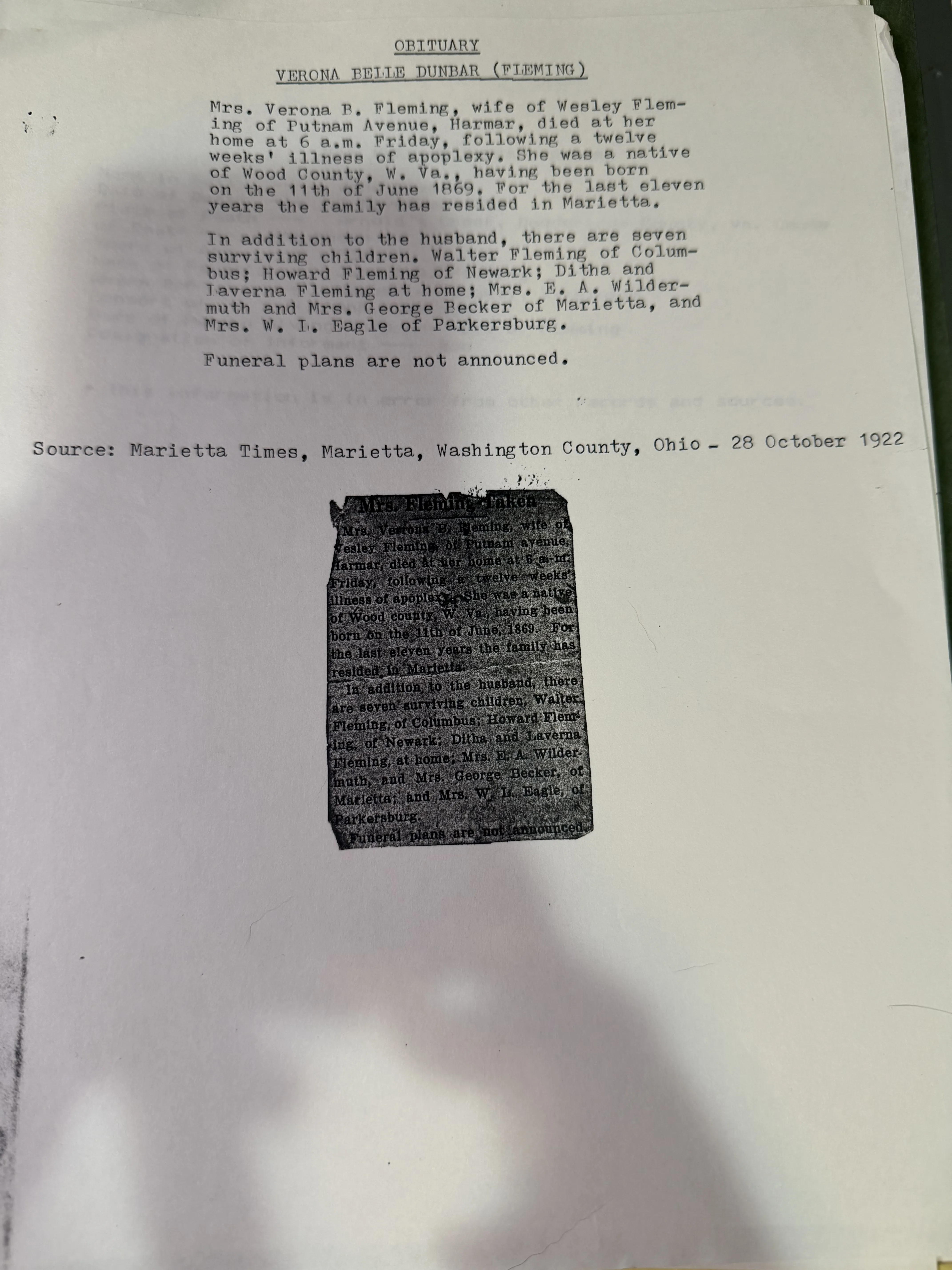
The sheet in Robert Earl’s papers carries both: his own clean transcription at the top, and the clipping itself pasted below it — cut narrow, creased down the middle, and darkened with age. He typed it out because he could see the paper would not last.
Robert Earl Wildermuth was born 6 October 1924 — two years after Verona’s death. He never met her.
The lament — the only memoir trace of Verona
Robert Earl’s 1989 memoir carries one substantive passage on Verona, and it is an absence-passage rather than a story about her life. In the middle of an extended sketch of his paternal great-grandmother Catharina Boeshar Wildermuth (who lived to 1933 and was the only “grandmother” figure Robert Earl ever knew), he stops to record what his father Earl Adam used to lament across the rest of his life:
I recall throughout my young adult hood that my father used to lament the fact that neither my mother’s mother nor his mother lived until my sister and I were old enough to remember them. He was saddened by the fact that we never had any grandmothers to get to know and love — yet here was this lovely old lady who was our great-grandmother, an original from Germany, and my dad never really emphasized that she belonged to us. She was or could have been our grandmother and great-grandmother all in one.
Earl Adam’s two grieved-for grandmothers were Verona (Sadye’s mother, d. 27 October 1922) and Flora Schlicher Wildermuth (Earl Adam’s own mother, d. 18 November 1919 — both gone before Robert Earl’s October 1924 birth). Catherina Boeshar — the German-immigrant great-grandmother on the Wildermuth side — outlived both by a generation and stepped, partially, into the absence. Verona did not.
The lament is not the whole of what he left about her. Robert Earl devoted several careful pages to Verona in his own family genealogy — reconstructing her out-of-wedlock birth, the Sheppard adoption, the 1885 marriage, the fourteen children, and the courthouse-steps death. It is from that research, not the memoir, that the fuller picture above is drawn.
“She loved kids” — a Fleming cousin’s memory (1985)
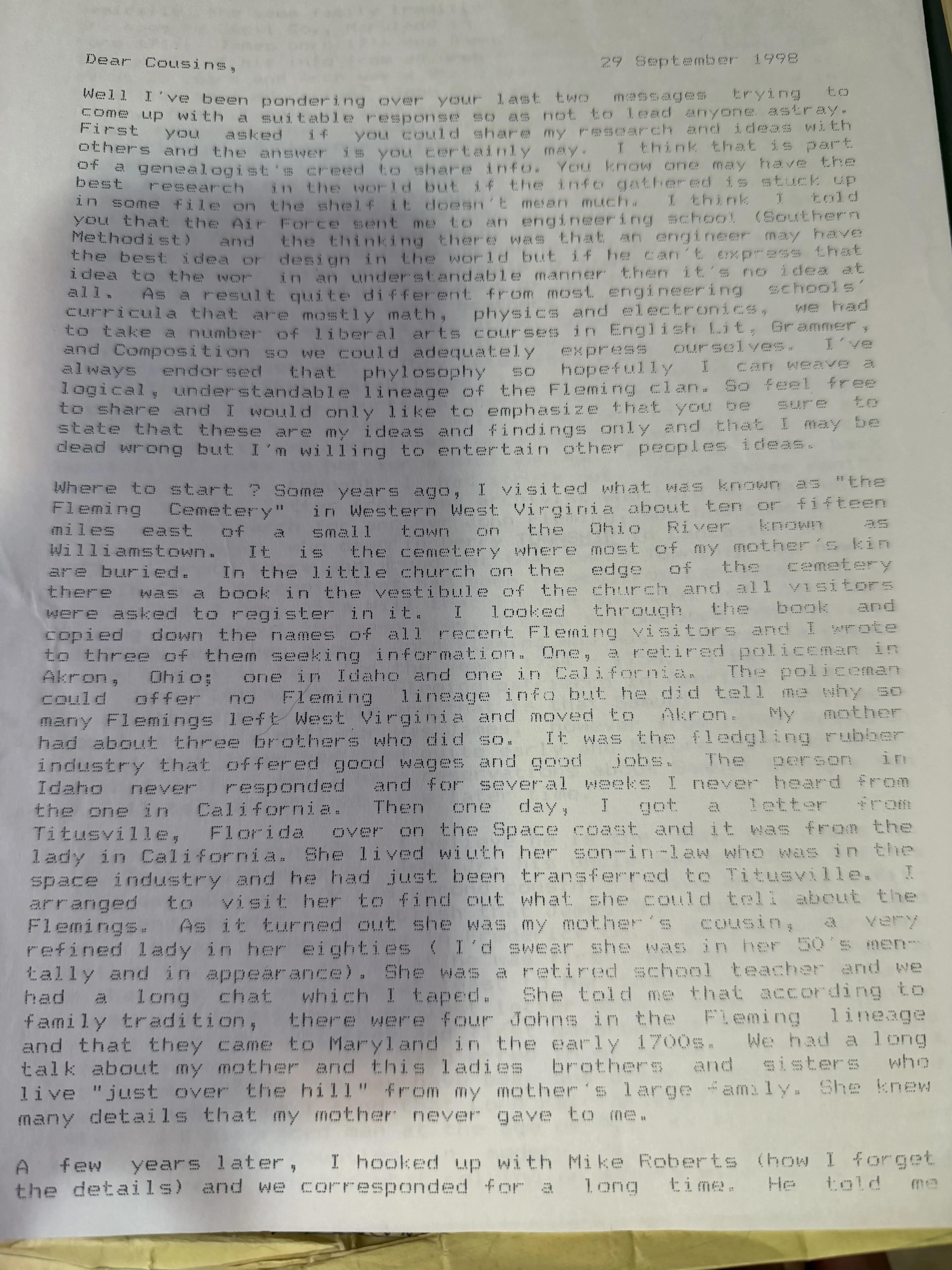
The warmest surviving portrait of Verona comes not from Robert Earl’s own memory (he never met her) but from a 1985 letter to him from Josephine (Fleming) Cox of Titusville, Florida — a Fleming cousin, born in 1900 near the old Burnt Hill Cemetery a few miles east of Williamstown in Wood County, West Virginia, who as a girl lived close enough to Wesley and Verona’s household to remember it firsthand. She and her siblings, she wrote, “used to love to go over to Uncle Wesley and Aunt Verona’s … house and play with their cousins.” Robert Earl set down what she told him:
She liked Aunt Verona because she loved “kids” and she would let them play, and she wasn’t nearly as strict with them as was her own mother. She said that one of their favorite pastimes was going way out in the Ohio River in a big johnboat that Uncle Wesley had. The Fleming boys would load the girls in the boat and then push it while wading and partially swimming clear out to the steamer channel, which was almost over to the Ohio side of the river… She also tells how she and the other Fleming girls put their names and addresses in old fruit jars and threw them in the river, hoping that someone downstream would find the bottles and get in touch with them.
The home Josephine remembered was “a big old log cabin just up the road and over on the Ohio River” near Burnt Hill Cemetery — Sadye’s childhood home, the household Verona ran. It is the one place in the record where Verona appears not as an absence or a casualty of hard labor but as the aunt the neighborhood children preferred: the one who let them play. (Josephine’s exact kinship to Wesley — she called him “Uncle” — is not pinned down in this archive; she was a Fleming cousin of the Burnt Hill–Williamstown Flemings among whom Wesley’s family lived.)
What’s still open
- The Fleming-and-Dunbar oral history — if Sadye told Robert Earl stories of her own mother beyond the genealogical record, they may sit in her own letters and any photograph captions she annotated.
- Seth Grosvenor Dunbar’s migration — resolved (July 2026) from the Wildermuth & Bain book: Seth did not migrate alone or for the Civil War. His father, John V. Dunbar, a steam-mill owner, moved the whole family from Readfield, Kennebec County, Maine to Bull Run in Wood County between the 1850 and 1860 censuses — which is exactly how the New England Dunbars came to be the “established Wood County family” of Robert Earl’s memory. Seth’s mother was Ann Dunbar (b. 1812, Maine); her maiden name is the one remaining gap in this corner of the parentage.
Her birth parents, newly named
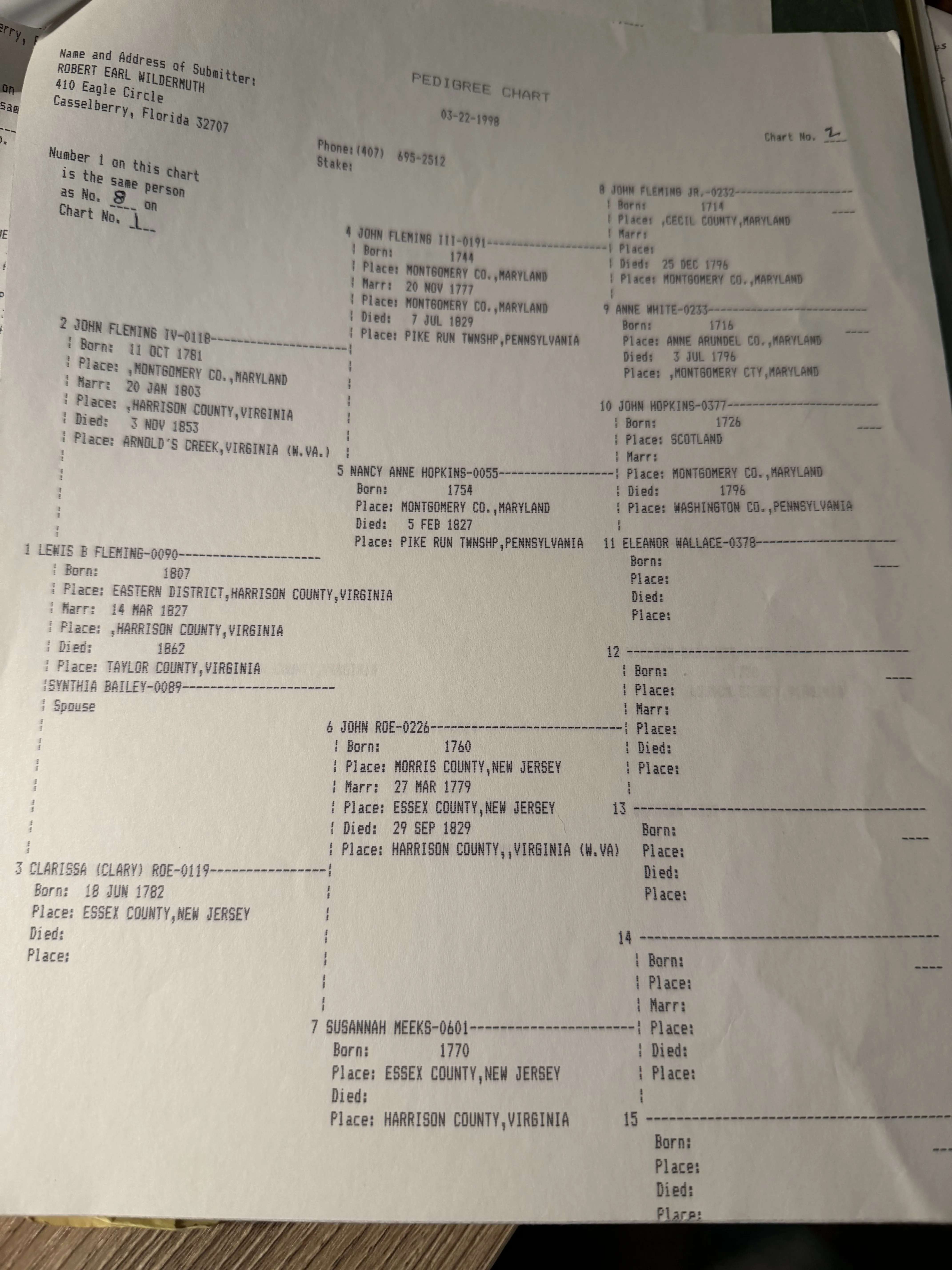
The archive has long known she married under Mary V. Sheppard, her adoptive family’s surname. Robert Earl’s printed ancestor charts now supply the other two names in the sequence: her birth parents were Seth Dunbar, born 1837 in Kennebec County, Maine (the charts spell the town “Readyville” and “Readville”; the 1850 census town is Readfield), and Martha Kelley, born 1844 in Barbour County. That accounts for the triple surname Kelley / Dunbar / Sheppard that heads her box on the charts — born Kelley, Dunbar by her father, Sheppard by adoption.
A later chart names a different mother
Robert Earl’s 1998 pedigree chart puts Sarah J. Henry (b. 1841, Jefferson County, Ohio) in the mother’s box, and gives Seth as married 29 December 1860 in Wood County. Martha Kelley is not on the sheet.
Verona’s parentage is not being changed, and the reason is that Robert Earl contradicts himself. In his own genealogy of the family he wrote plainly that Verona was “born out of wedlock to Martha Kelley. The father was Seth Dunbar” — and backed it with the 1870 and 1880 censuses showing her in the Sheppard household, and with Deborah (Kelley) Sheppard’s relationship to Martha. That is prose with evidence behind it. The chart is a form with two boxes.
The reconciliation that costs nothing: pedigree software prints a man’s wife in the mother’s slot, and where the two are different women, this is exactly what you see. On that reading Sarah J. Henry was Seth’s wife, married in 1860 — a person this archive knew nothing about — while Verona was still Martha Kelley’s daughter, born outside that marriage in 1869. Everything in the book survives, and Seth gains a wife.
Seth’s page carries the full question. The 1860 Wood County marriage record would answer it.
Behind them the charts run further: John V. Dunbar (b. 1804 in Maine, died in Wood County) and Ann; and on the Kelley side Johnson Kelley (1810–1886), Ebenezer Kelley (b. 1763, Somerset County), Rachel Johnson (b. 1769, New Jersey), Robert Johnson, Mary, and Sarah Yoke. None of them have pages here yet.
Sources: Wildermuth Family of Marietta, Ohio (Wildermuth & Bain), the “Fleming, Verona Belle (Kelley)” section — Robert Earl’s own research, quoting the 1870/1880/1900/1910 censuses, the 1922 Marietta Times obituary, and Verona’s death certificate; GEDCOM — Dale Eesley / FamilySearch (downloadable); the earlier reading (Sheppard as maiden name) came from Sadye’s c. 1976 Marietta Times obituary and has been corrected here. The “she loved kids” recollection is from the 1985 letter of Josephine (Fleming) Cox to Robert Earl Wildermuth and his 20 November 2003 comment on it, both in the Bain book’s Fleming section (pp. 98–99).