Catharina (Boeshar) Wildermuth
also known as Catherina Boeshar (Robert Earl's memoir spelling, 'grandma Catherina Boeshar'); Catharina Boeshar, maiden
b. 1840-06-15, Breitenbach, Pfalz, Bavaria (christened 21 June 1840 at Breitenbach, BA. Homburg, Bayern, Germany)
d. 1933-10-17, Marietta, Washington County, Ohio (buried 19 October 1933)
She was born 15 June 1840 in Breitenbach, Pfalz, Bavaria — a Rhineland Palatinate village in what is now southwestern Germany, in the historical region the family called the Pfalz. Her christening followed within a week, on 21 June 1840 at the Breitenbach BA. Homburg parish church, Bayern. The Rhineland Palatinate was a Catholic-and-Protestant patchwork in the 1840s, with strong American-emigration patterns toward Ohio, Pennsylvania, and Iowa — communities of Pfalzer immigrants settled in Washington County, Ohio, in numbers, and Catharina’s eventual Marietta life fits that pattern.
The Atlantic crossing and the Ohio marriage
The German village she was born in — Breitenbach — sits about 250 miles northwest of her future husband’s Württemberg birthplace at Grossaspach. That she and Johann Michael Wildermuth met and married in Washington County, Ohio (on 7 September 1862 per the @F57@ family record) means both had to have emigrated separately and converged in Marietta — two German-speaking emigrants from regions 250 miles apart at home who found each other in a Pfalzer-and-Württemberger immigrant community on the Ohio River.
Her parents were Christian Boeshar (1810–1843), a Breitenbach miner, and Maria Margaretha Jung (b. 1814) of nearby Frohnhofen, who married in Breitenbach in 1836; Catharina had an older brother, Jacob (b. 1837). Her father died in May 1843, when she was not yet three, so she grew up in a widowed household — context that sits behind a young Pfälzerin leaving for Ohio.
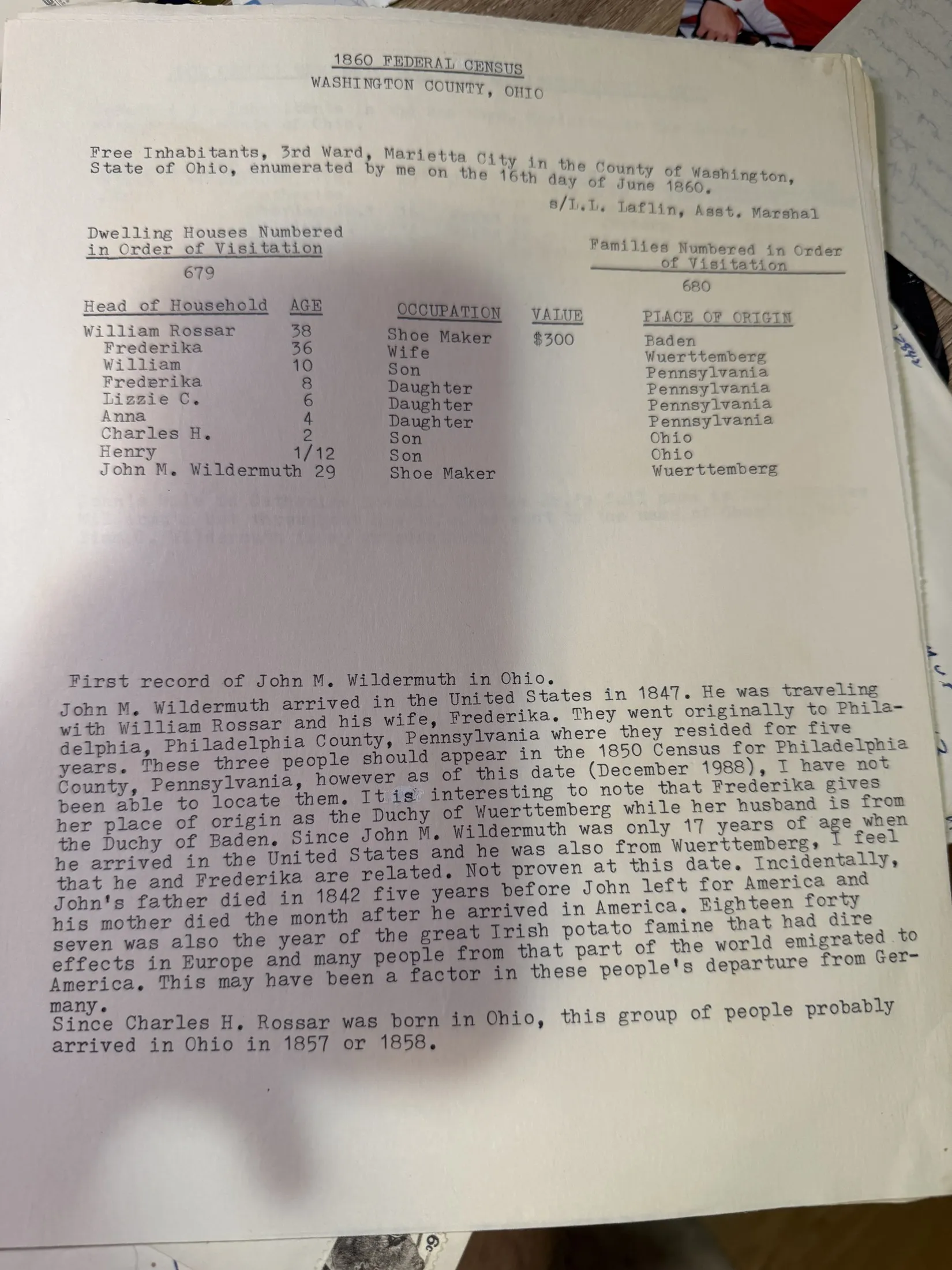
Johann Michael’s 1853 Philadelphia naturalization petition documents him arriving at the Port of New York in 1847 as a boy under eighteen, and being in Pennsylvania by 1852. Catharina’s own crossing is still undocumented — the date, the port and the route are open research — but she had to be in Washington County by 1862. The Pfalz-to-Ohio path in those years typically went through New York or Baltimore and then overland to the Ohio Valley.
She was coming to Boeshars, not to strangers
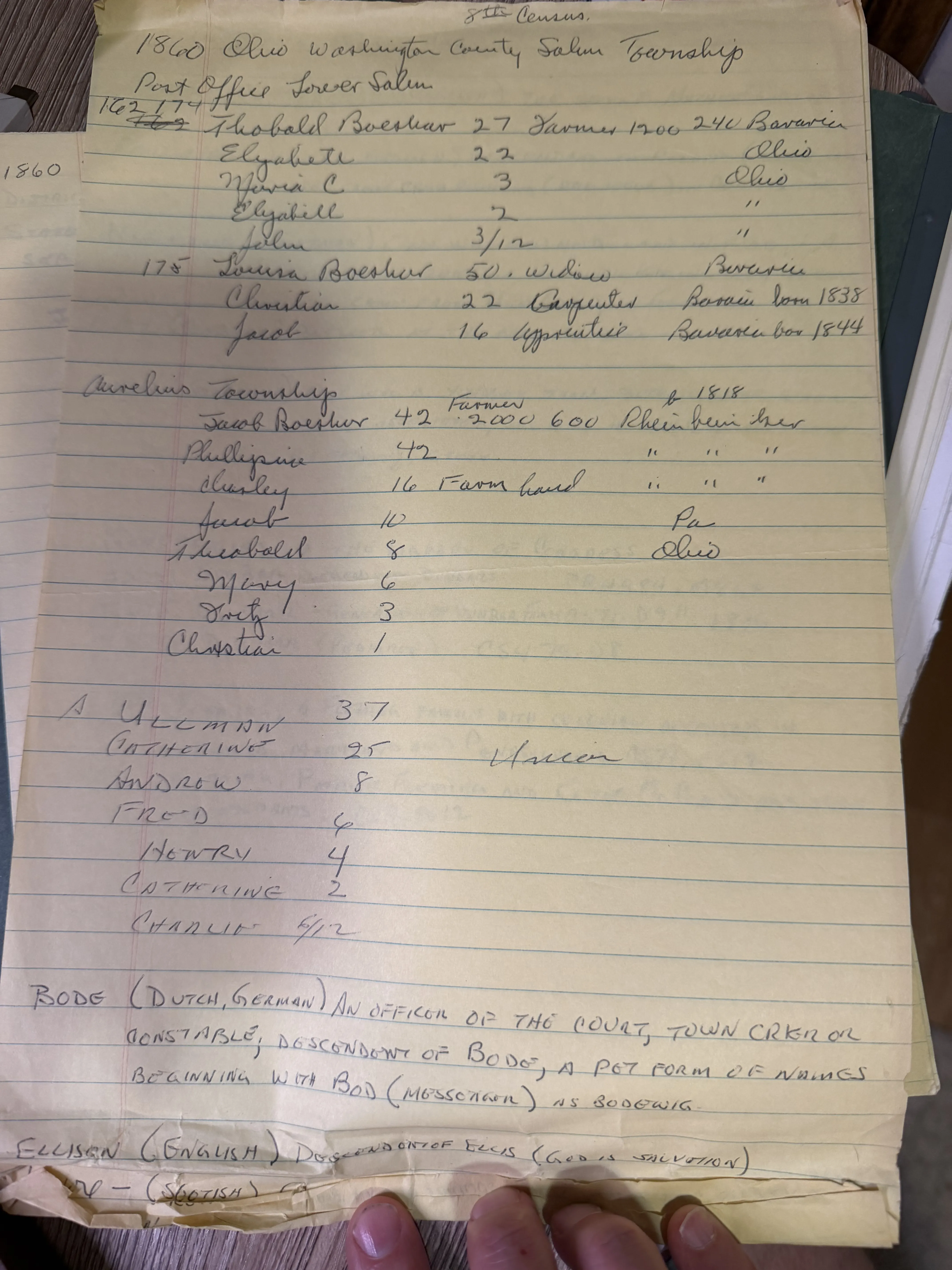
The 1860 census for Washington County, abstracted in Robert Earl’s papers, finds three Boeshar households in Salem and Aurelius Townships two years before her marriage:
- Thobald Boeshar, 27, a farmer at Lower Salem with $1,200 in land, born in Bavaria, with an Ohio-born wife and three small children
- Louisa Boeshar, 50, a widow, born in Bavaria, with sons Christian (22, a carpenter, born 1838) and Jacob (16, apprenticed, born 1844) — both born in Bavaria
- Jacob Boeshar, 42, a farmer in Aurelius Township with $2,000 in land, from the Rhine country
And Jacob’s children map the route. Their birthplaces run Rhineland → Pennsylvania → Ohio: the eldest two born in Germany, one son born in Pennsylvania about 1850, and everyone from the eight-year-old down born in Ohio. That family crossed around 1849, paused in Pennsylvania, and reached Washington County about 1852 — the same path Johann Michael took.
This changes the shape of the question. A girl orphaned of her father before she was three, leaving a widowed household in the Pfalz, did not step off a boat into an Ohio river county at random. There were Boeshars here already.
None of them is yet demonstrated to be her kin. The widow Louisa is the household to check first — born about 1810, she is her mother’s generation exactly, and her son Christian (1838) is close to Catharina’s own brother Jacob (1837). But Louisa is not Margaretha, and the names are common ones. Which Boeshar household she was coming to is now the live question — and a passenger list carrying a family group is far easier to find than one carrying a lone young woman.
The long Marietta life
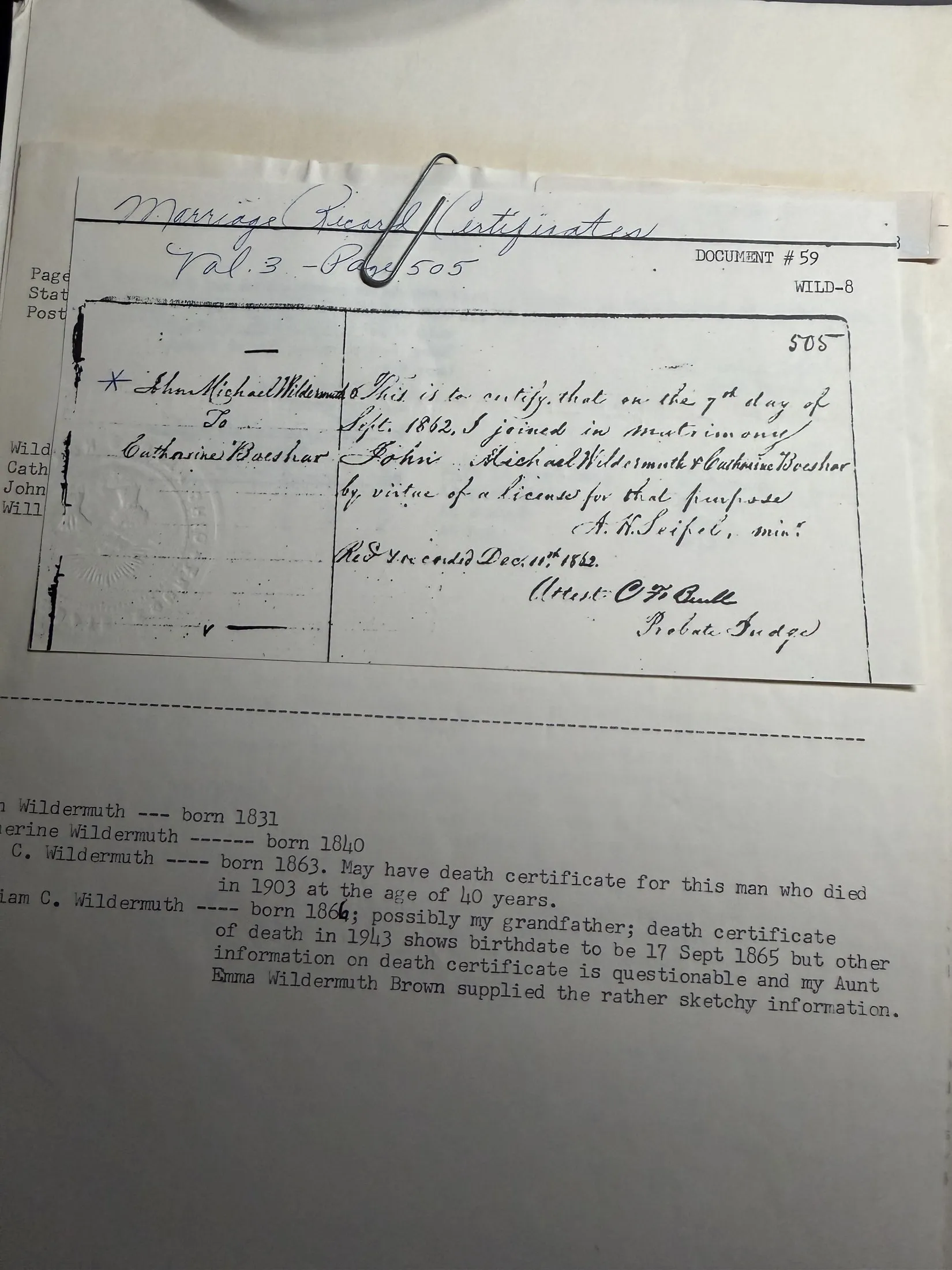
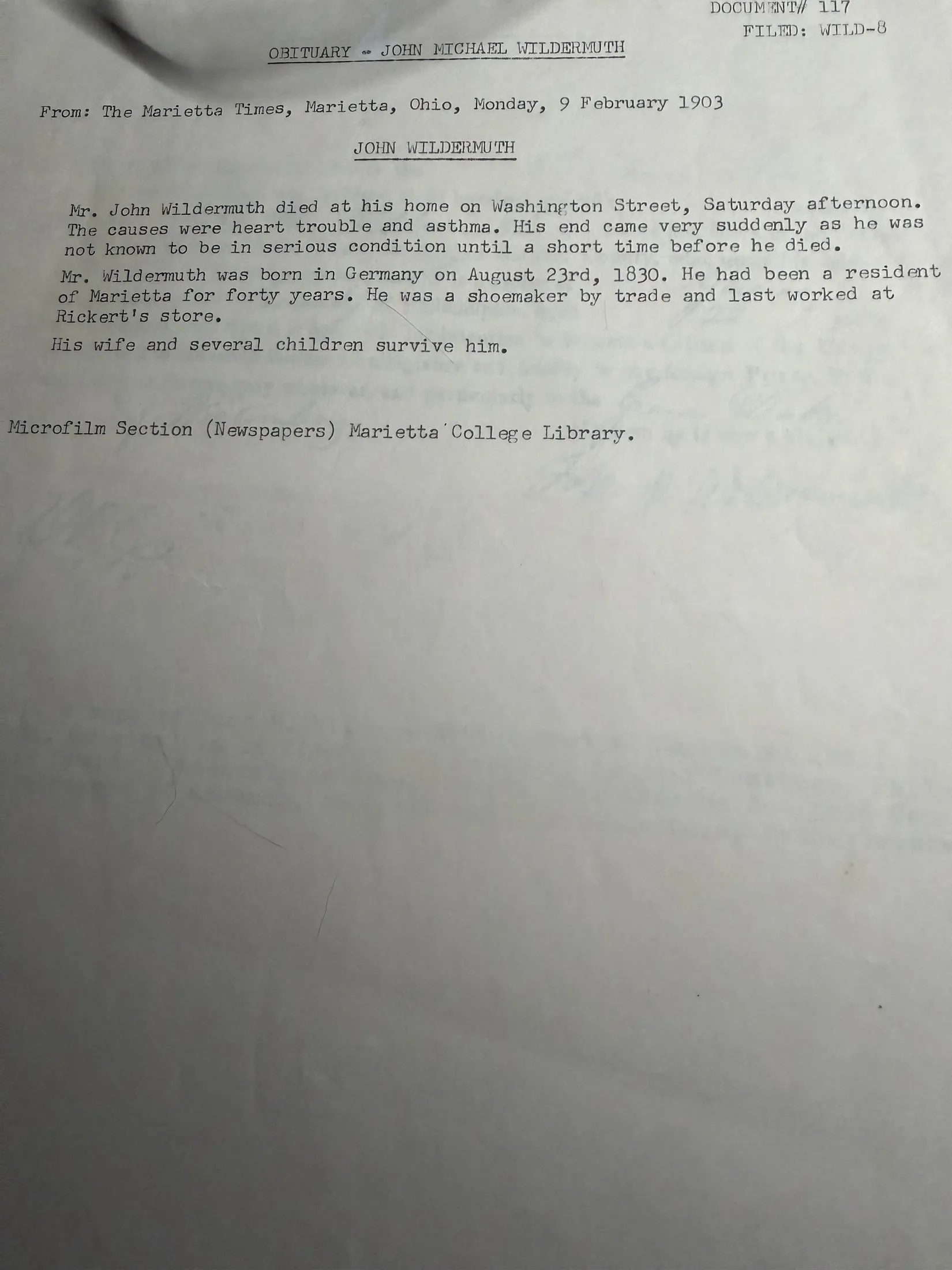
Johann Michael made the marriage application on 3 September 1862 and they were married four days later, on the 7th, by the Reverend A. H. Seipels. She married him at age 22; she gave birth to three documented sons over the next eleven years — John Charles (b. September 1865), William Clifford (b. 17 September 1866 — the patriarch of the c. 1896 family group portrait), and Edward Frederick (b. 17 February 1873, lived to 1964 in Marietta) — and she raised them at Marietta. She was widowed in February 1903 at age 62 when Johann Michael died at their house at 611 Washington Street and was buried at Oak Grove Cemetery.
Thirty years a widow
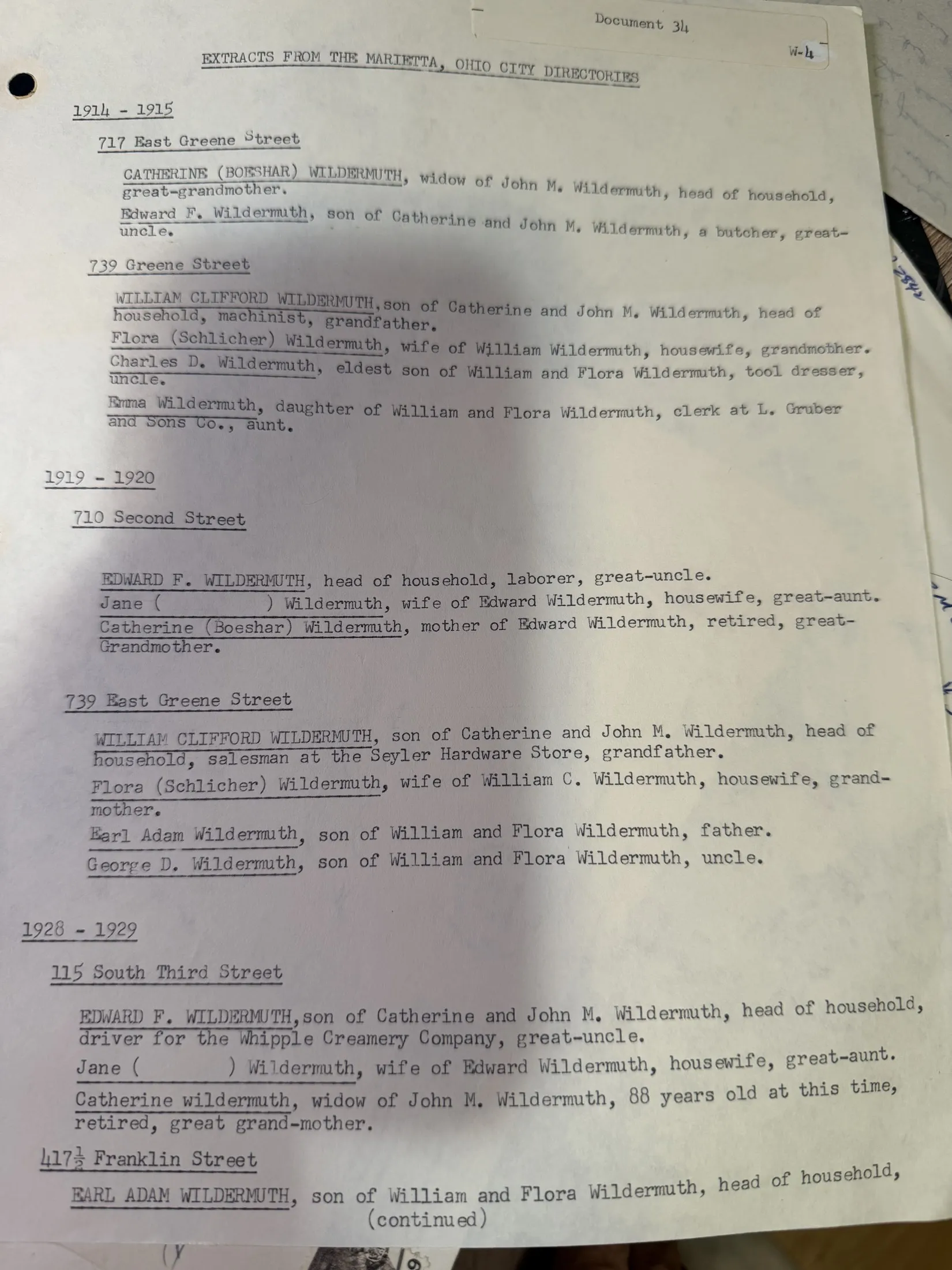
The Marietta city directories follow her through it, and she is never alone: her youngest son Edward Frederick is in every entry.
- 1914–15 — head of her own household at 717 East Greene Street, with Edward, then a butcher. Her son William Clifford and his family were eleven houses along at 739.
- 1919–20 — 710 Second Street, listed as retired, living in Edward’s household with his wife Jane.
- 1928–29 — 115 South Third Street, still with Edward and Jane, and recorded as 88 years old.
She had come from Breitenbach in the Bavarian Palatinate, married a Württemberger in an Ohio river town, and ended up on a third street with a son who kept her for the last twenty-five years of her life. She was buried 19 October 1933.
She lived another thirty years as a widow.
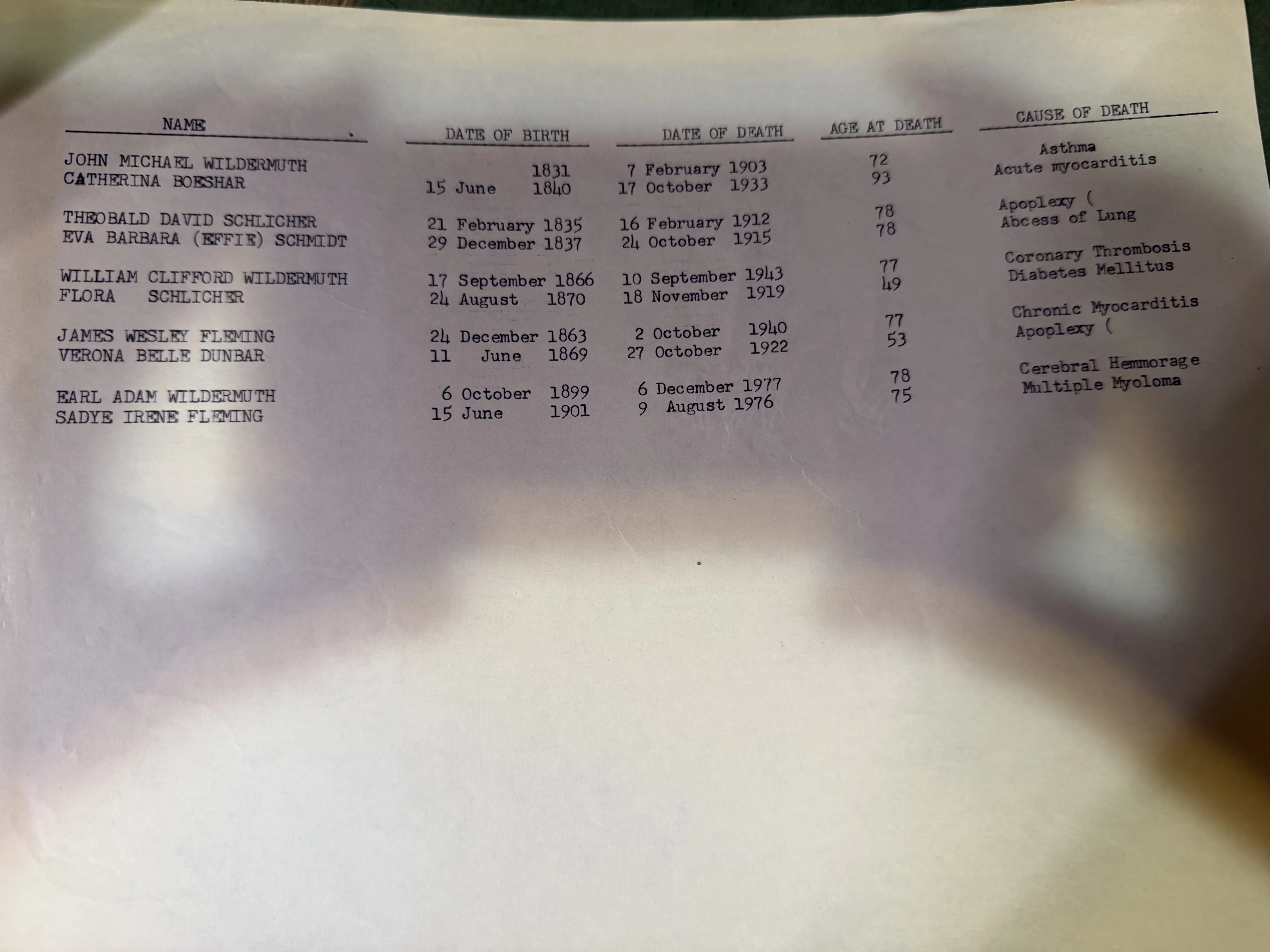
She died on 17 October 1933 in Marietta at age 93.
What she meant to Robert Earl
Robert Earl Wildermuth, born 2 May 1924 at 123 Franklin Street in Marietta, was nine years and five months old when his great-grandmother Catharina died. He would have known her as the family elder through his first nine years — the great-grandmother in the house, the German-accented voice at family gatherings, the Pfalzer matriarch who had been a young woman in 1850s Bavaria.
In his 1989 memoir Robert Earl closed his Germany travelogue with the line:
“I hope to return to the home towns of grandma Catherina Boeshar and hopefully that of Johann Peter Schlicher at some later date.”
The “grandma Catherina Boeshar” of that sentence is this great-grandmother — Robert Earl using “grandma” in the everyday-family form he had grown up with, even though strictly the relationship was great-grandmother. The hometown he was still trying to visit at age 65 was Breitenbach — sixty-five miles from Stuttgart, in the Rhineland Pfalz near the French border. The 1993 follow-up trip he and Sandra eventually made got to the Württemberg side of the family (Rielingshausen, Grossaspach, Marbach); the Pfalz side he never reached. Catharina’s hometown remained the open research thread when he died.
Her clearest likeness — an outdoor family snapshot
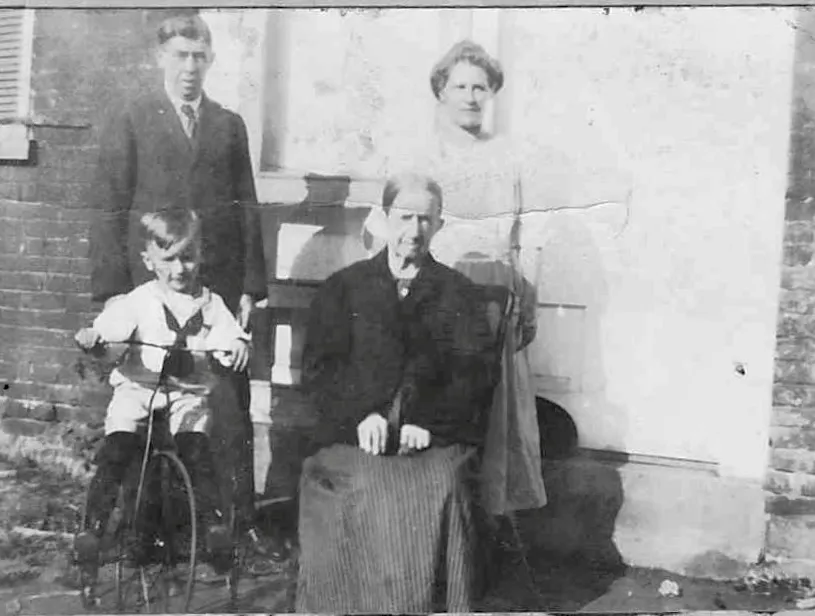
The archive’s clearest image of Catharina’s face is an outdoor family snapshot, c. early 1920s, in which she sits front and center as the matriarch — elderly, in a dark high-necked dress with a long striped skirt over her lap, against the brick-and-stone wall of a house. With her (per Chuck’s July 2026 face-tagging) are her youngest son Edward Frederick Wildermuth standing at left, his wife Arminda Jane Hayes at right, and their small son William on a tricycle — her grandson. She would have been in her early eighties.
In the 1896 family group portrait — her earlier likeness
The c. 1896 family group portrait is the archive’s earlier likeness of Catharina: she is the elderly woman standing second from the left, beside her son William Clifford Wildermuth and near her three-year-old granddaughter Emma, who is held up at her shoulder. She was about 56. This is the face of the Pfalzer matriarch Robert Earl remembered as “grandma Catherina Boeshar.”
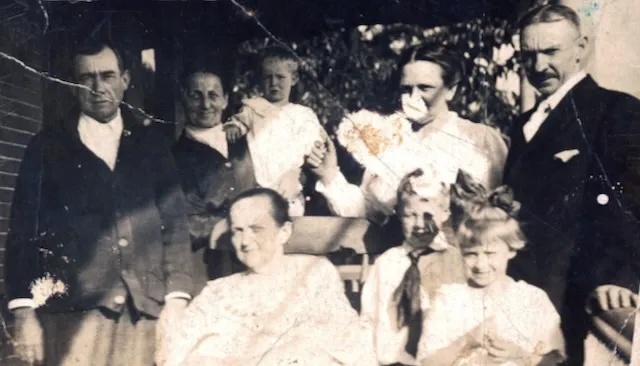
She is also the figure in the back row of the William Clifford Wildermuth family group portrait holding her three-year-old granddaughter Emma Wildermuth high on her shoulder — confirmed by Chuck Eesley 2026. The grandmother–granddaughter pose at the center of the family portrait is the only known visual record of her in this archive. She was 56 in 1896 — or 59–63 if the photograph dates to the revised c. 1899–1903 range that the Arminda Hayes identification would imply. The “grandma Catherina Boeshar” of Robert Earl’s 1989 memoir is no longer just a name; her face is in the family record.
She is Chuck’s great-great-great-grandmother through Catharina → William Clifford Wildermuth (b. 1866 — Robert Earl’s grandfather, confirmed June 2026 against Dale’s tree) → Earl Adam Wildermuth → Robert Earl → Terrie → Chuck.
Robert Earl’s 1989 sketch
The fullest single piece of writing about Catharina in this archive is the chapter Robert Earl wrote about her in his 1989 “Little Histories” project — the Whistler’s Mother, peeling apples in her rocking chair passage. It is the most affectionate single page in the entire memoir, written by an eighty-five-year-old man remembering a great-grandmother he had visited at Uncle Ed’s house when he was three. The sketch also reproduces the German-script birth certificate Marlis Smith’s roundabout France-and-Germany chain of contacts eventually translated — the document that confirmed both Christian Boeshar’s miner-by-trade occupation and Margaretha Jung’s name. Read in full at Robert Earl Wildermuth’s “Little Histories”.
Sources: Dale Eesley / FamilySearch — Catharina Boeshar (KLPR-G45); Johann Michael Wildermuth’s 1853 naturalization petition; Robert Earl Wildermuth’s 1989 memoir — the “grandma Catherina Boeshar” line; Robert Earl Wildermuth’s “Little Histories” — the full Catharina sketch.
Appears in
- Robert Earl Wildermuth's 'Little Histories' (1988–1993) — ancestor-sketch
- John Michael Wildermuth — Robert Earl Wildermuth's finished account — ancestor-sketch
Pictured in