Johann Michael Wildermuth
also known as John M. Wildermuth (American name, used in his 1853 Philadelphia naturalization petition); the Wildermuth who left Württemberg
b. 1830-08-23, Großaspach, Backnang, Württemberg, Germany
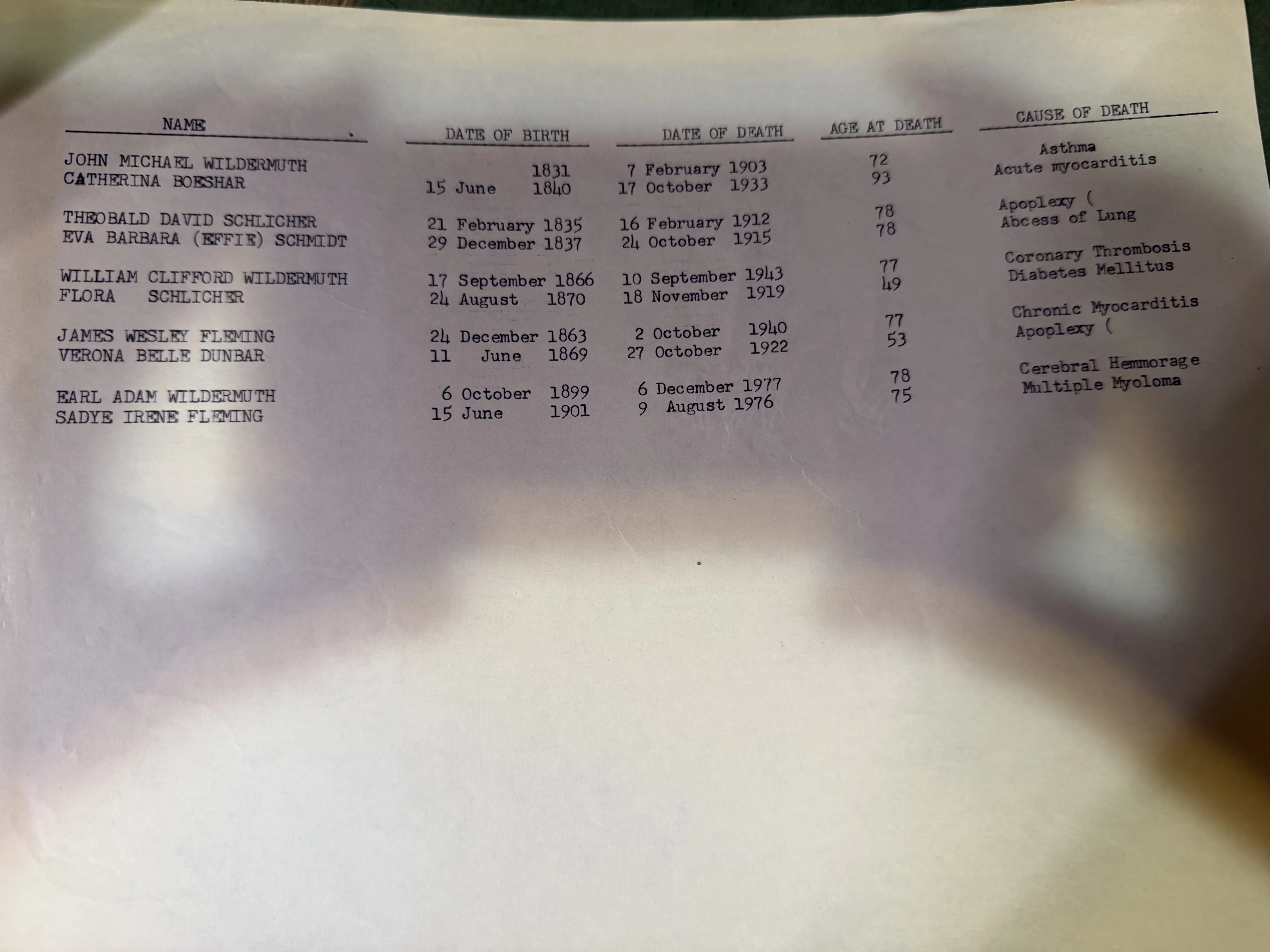
d. 1903-02-07, Marietta, Washington County, Ohio (buried Oak Grove Cemetery)
He was the Wildermuth who left.
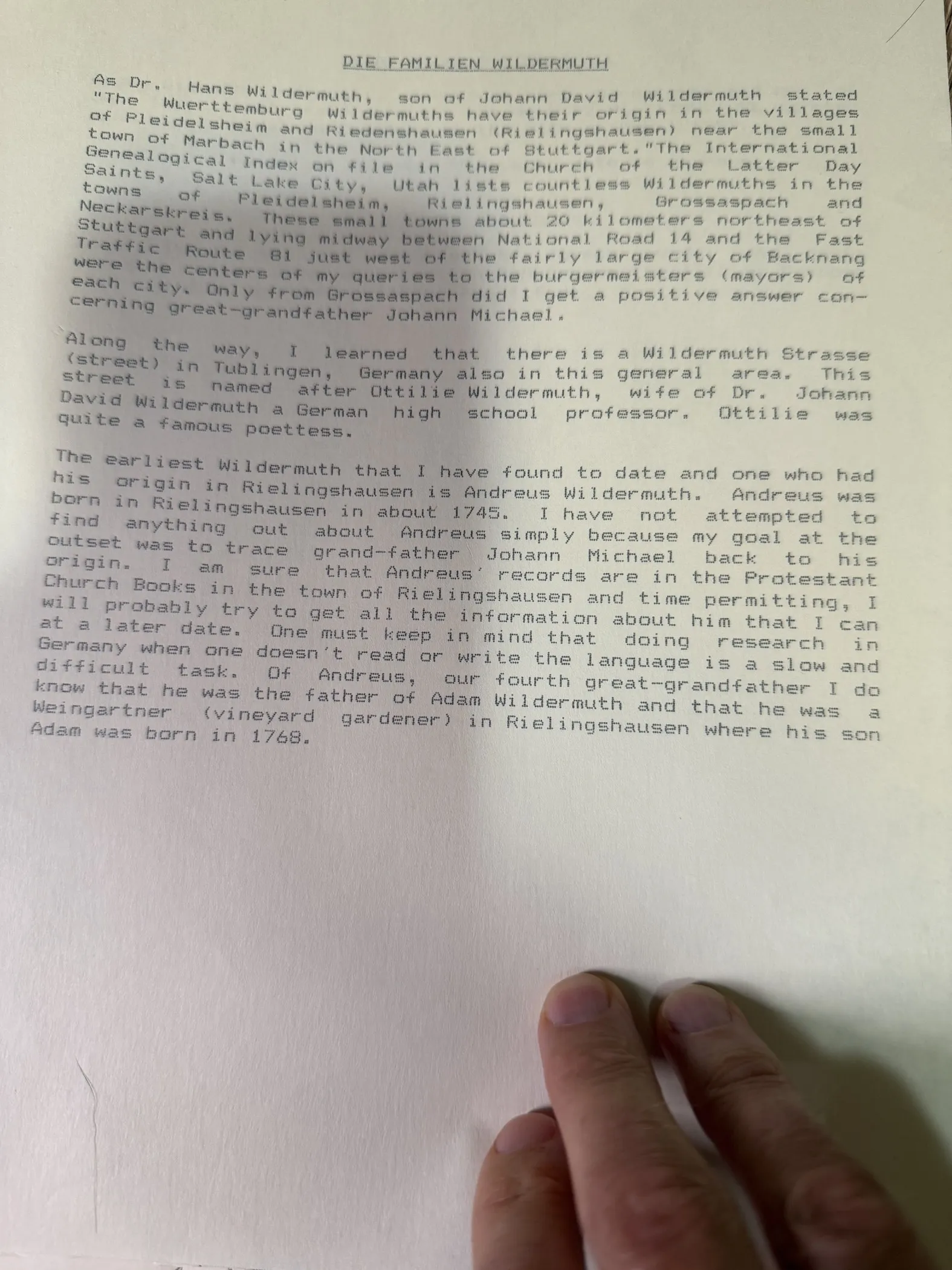
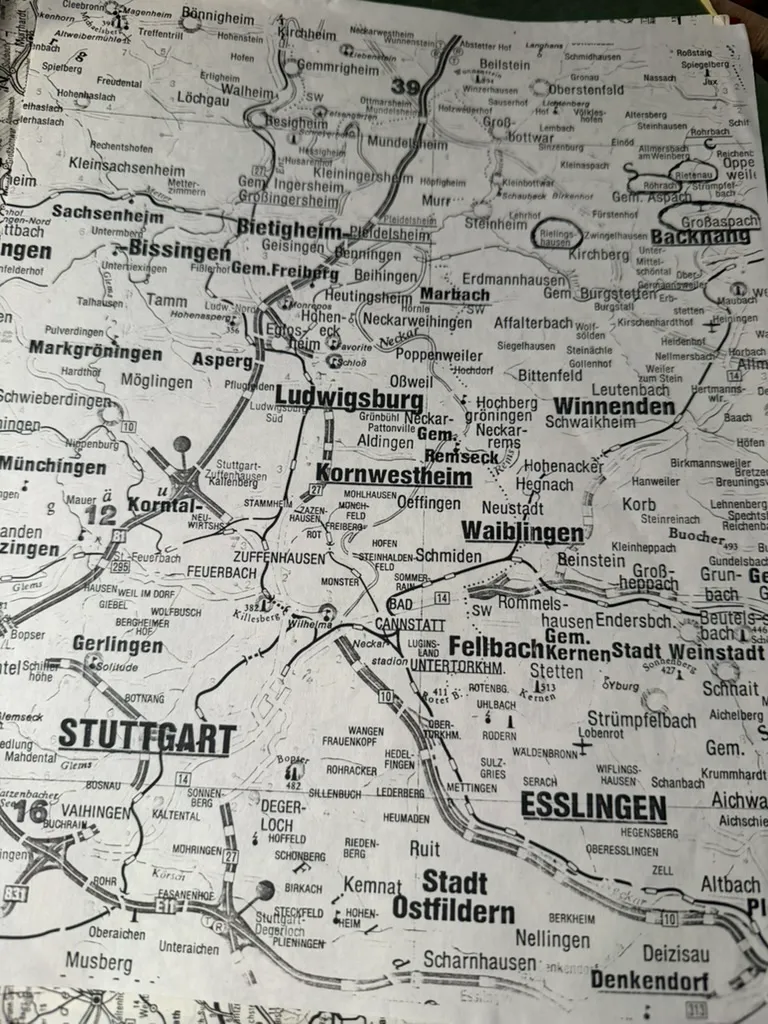
He was born 23 August 1830 in Großaspach (Grossaspach), in the Backnang district of Württemberg, Germany — one of the small Neckar-valley wine villages, ten kilometers from Rielingshausen where his great-great-great-grandfather Andreus the Gartner had tended the vineyards eighty years earlier. The Wildermuths had been in this part of Württemberg by the time he was born for at least six documented generations running back to Johannes Wildermuth in 1650.
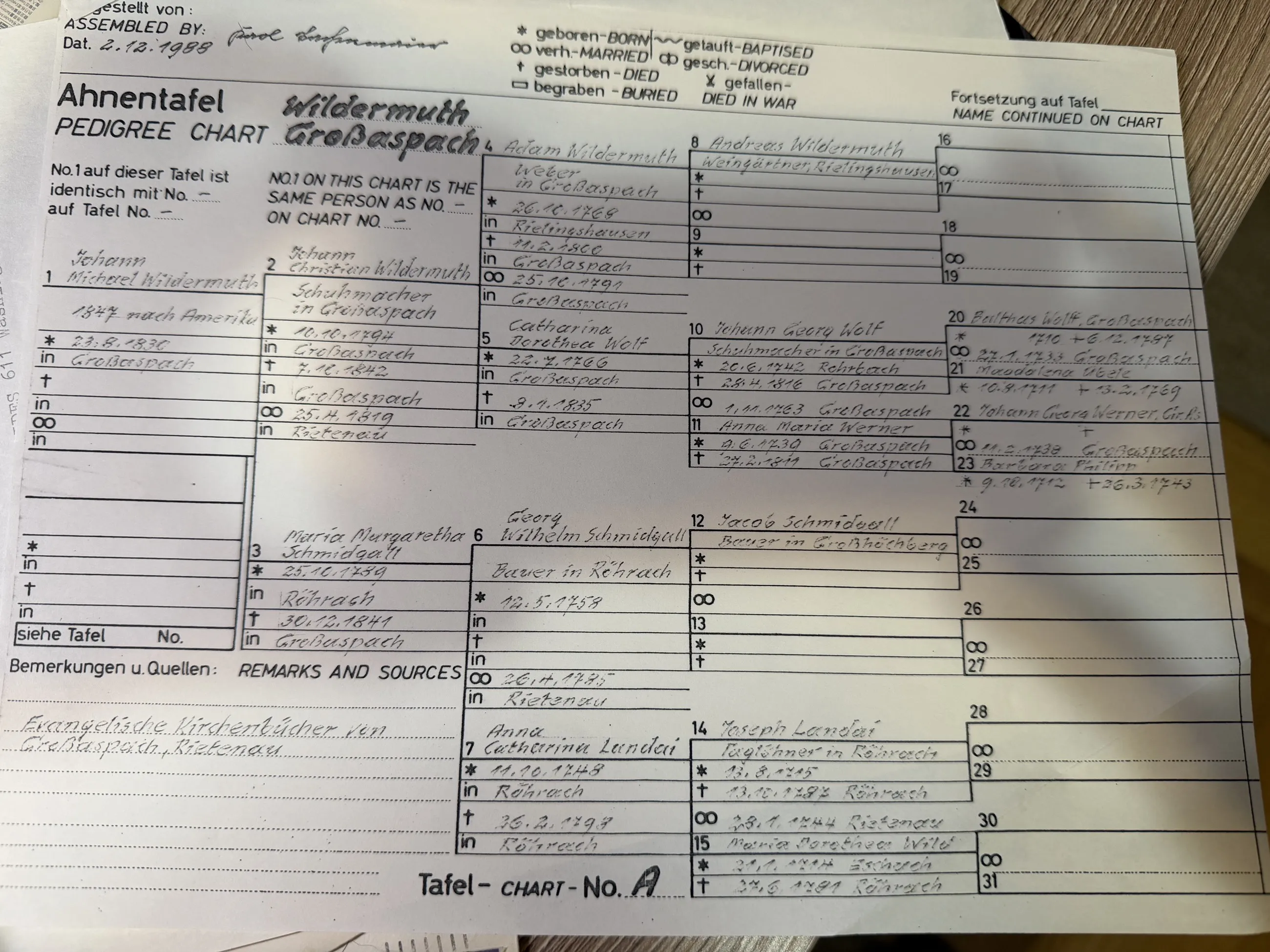
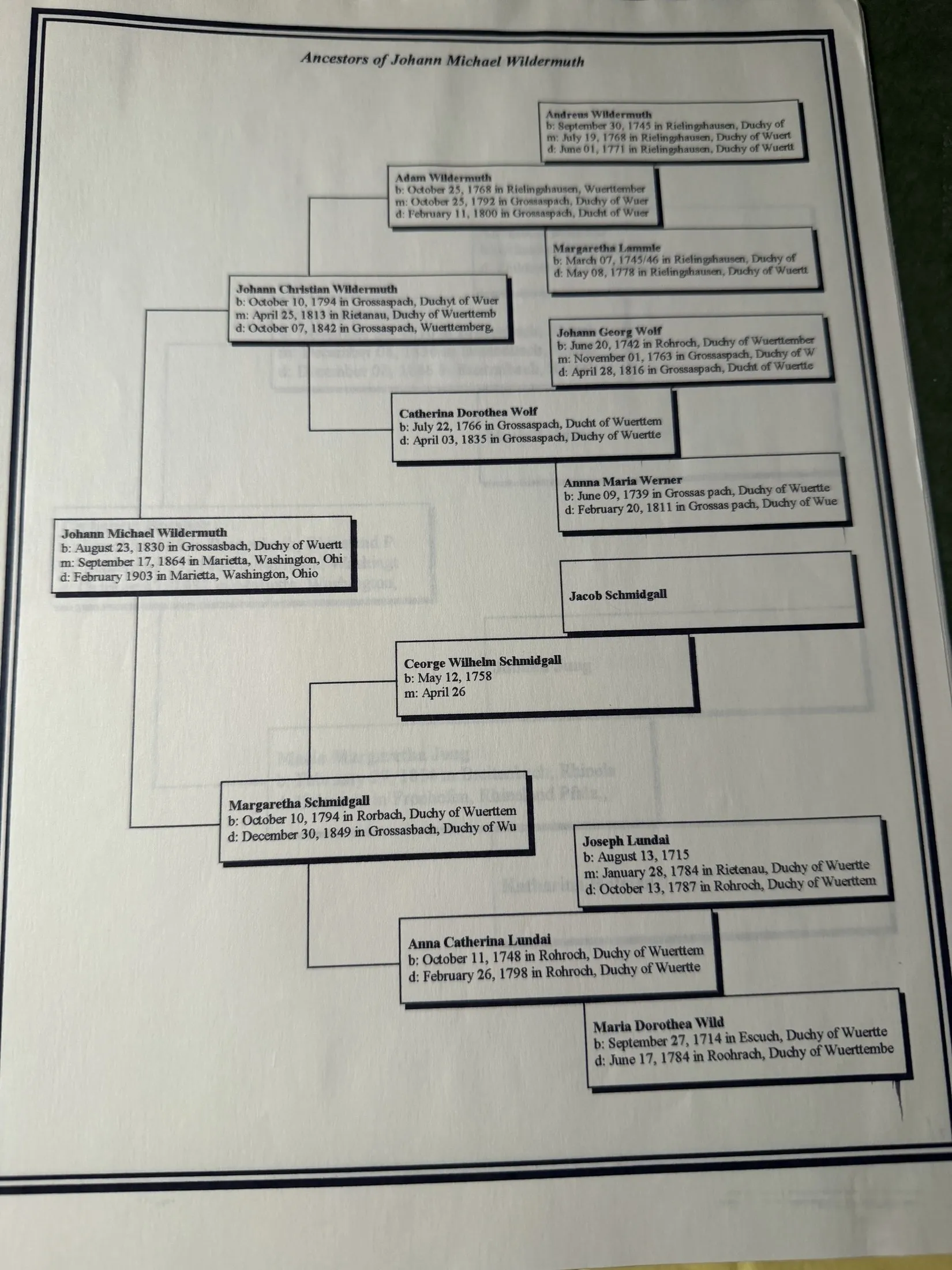
His parents were Johann Christian Wildermuth (b. 1794, Großaspach) and Maria Margaretha (Schmidgall) Wildermuth (b. 1789) — and through his mother the line also reaches back into the Schmidgall and Landai families of the Aspach villages. The documented descent to him runs, unbroken, from Johannes Wildermuth (1682) → Johann Adam (1720) → Andreas Adam (1745) → Adam (1768) → Johann Christian (1794) → Johann Michael — the six generations this page’s “at least six documented generations” refers to.
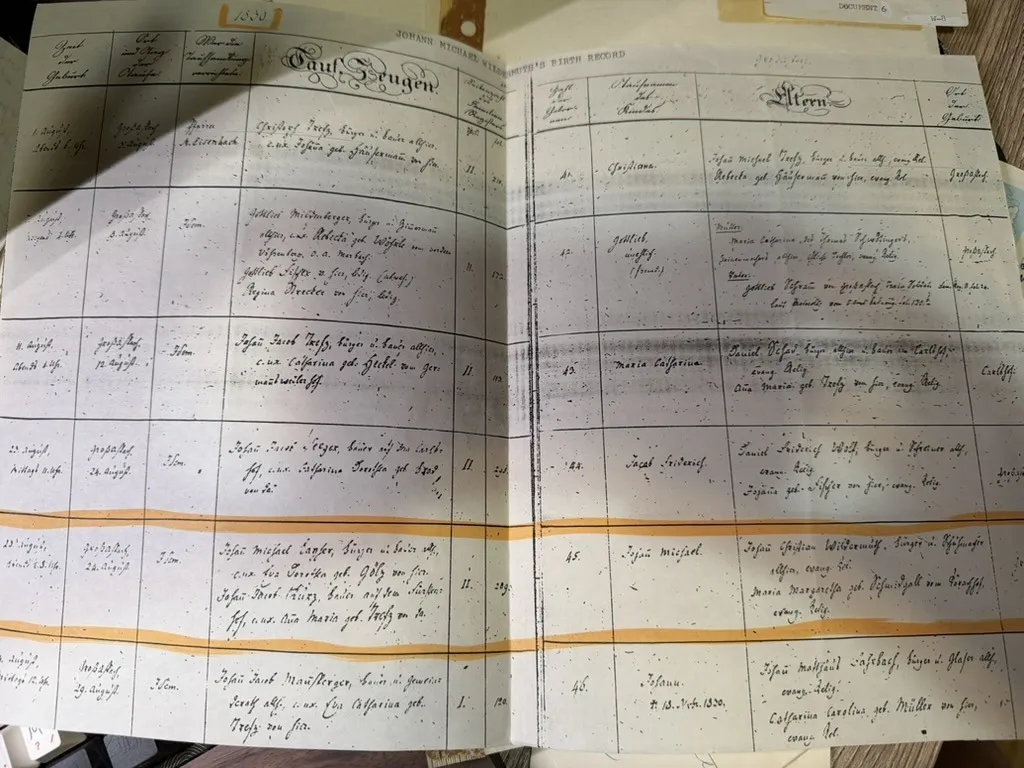
The register recorded him the day after he was born. Entry no. 45 in the Großaspach Taufregister: born 23 August in the evening, baptised at Großaspach on 24 August, baptismal name Johan Michael, son of “Johan Christian Wildermuth, Bürger u. Schuhmacher allhier” and “Maria Margaretha geb. Schmidgall von Röhrach,” both evangelisch. It is the only original German parish register page in this archive.
He sailed in 1847, age sixteen — per his own sworn statement six years later in Philadelphia.
Why a sixteen-year-old was free to go
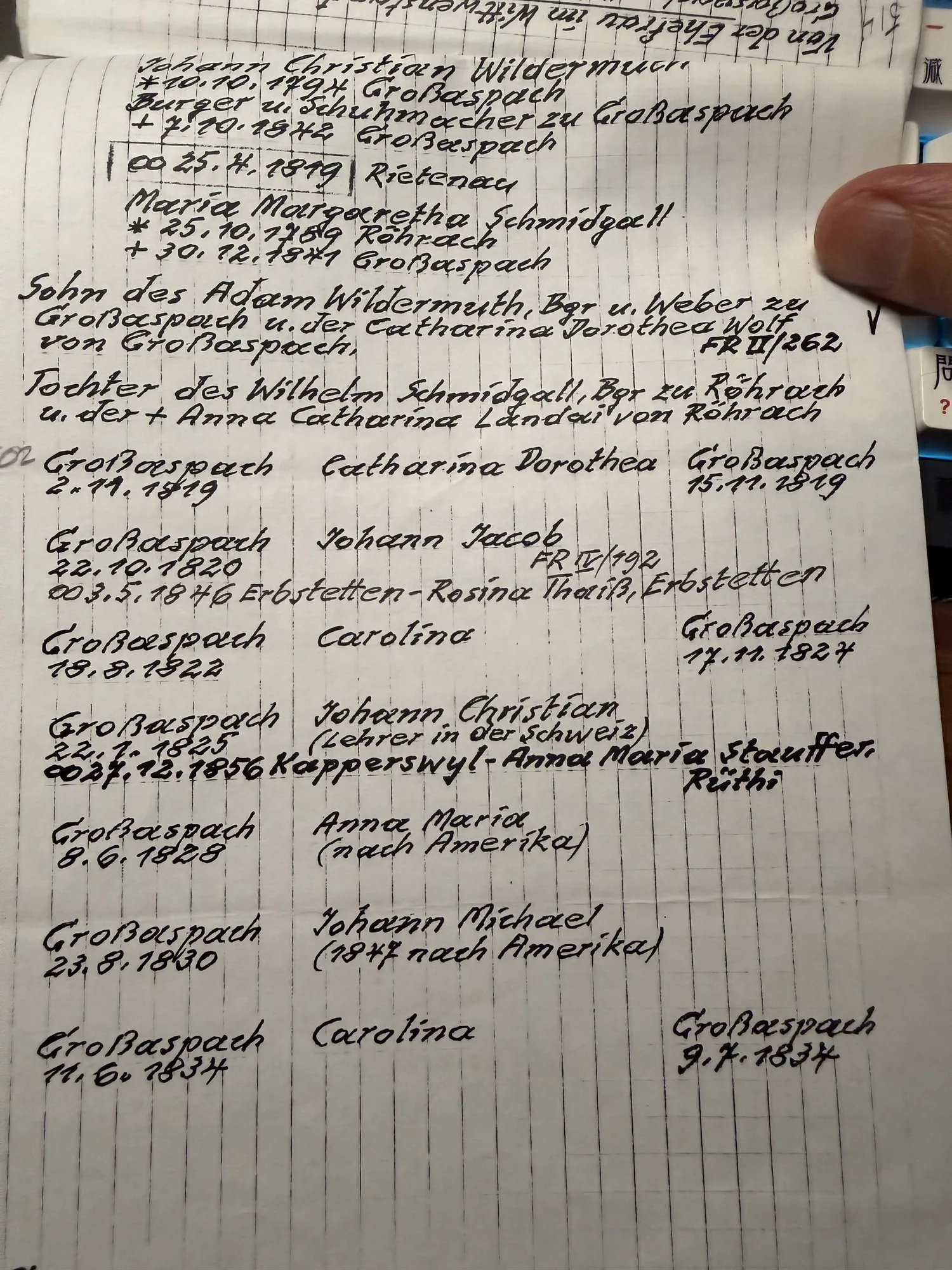
He was an orphan. The Großaspach Familienregister gives his mother’s death as 30 December 1841 and his father’s as 7 October 1842 — ten months apart, when he was twelve.
The same page lists his six siblings, and shows how thin the household was by then: Catharina Dorothea (1819) died at thirteen days, the first Carolina (1822) at five, the second Carolina (1834) at four weeks. Of the four who lived, Johann Jacob (1820) married at Erbstetten in 1846, Johann Christian (1825) became a schoolteacher in Switzerland — and Anna Maria (b. 8 June 1828), two years Johann Michael’s elder, is marked nach Amerika.
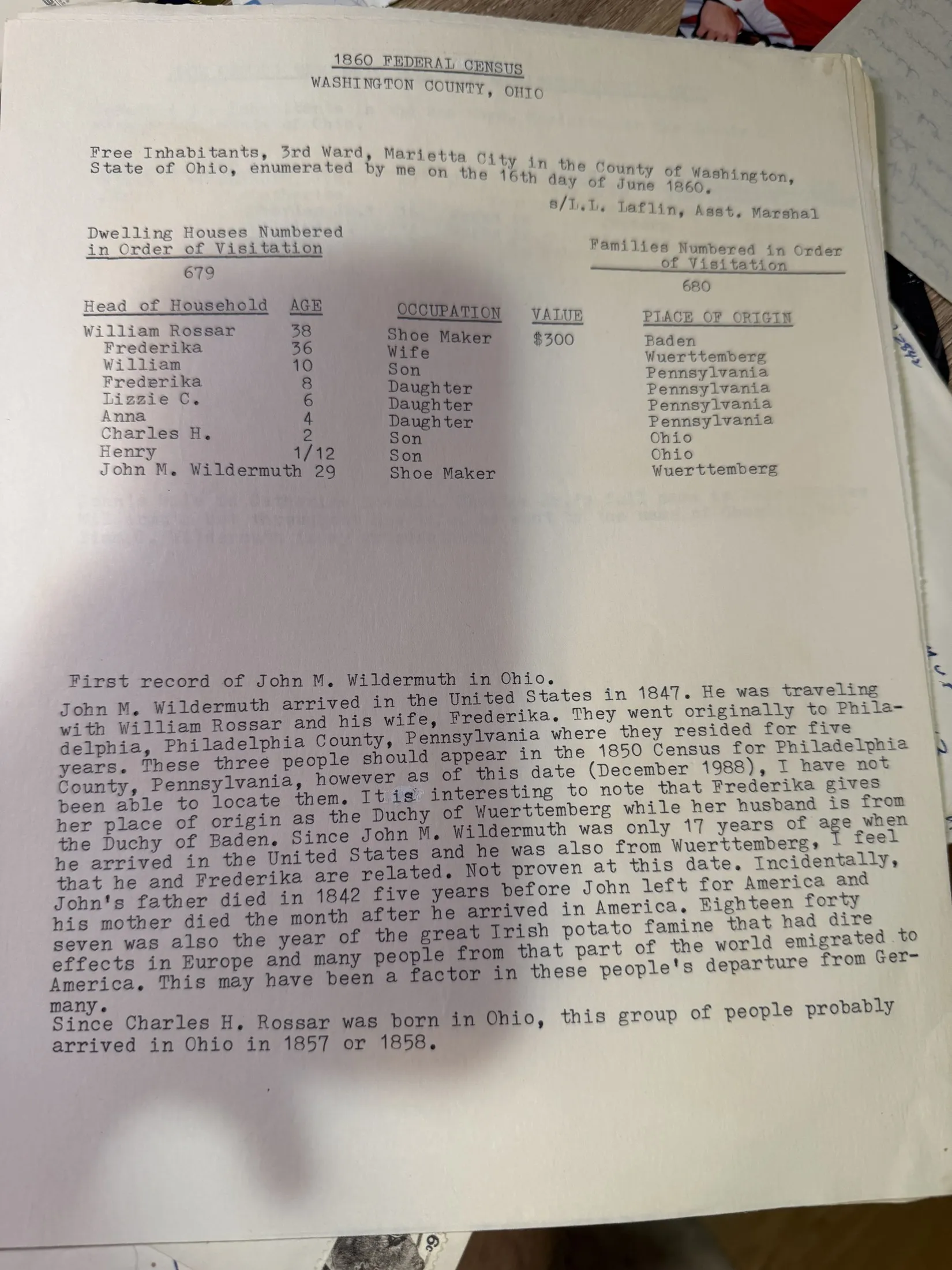
That last entry bears on a long-standing question. Robert Earl wondered whether Frederika Roessar — wife of the Baden shoemaker in whose Marietta household Johann Michael appears in 1860 — was his sister. His reasoning, written in December 1988, was good: “Frederika gives her place of origin as the Duchy of Wuerttemberg while her husband is from the Duchy of Baden … I feel that he and Frederika are related. Not proven at this date.”
The register confirms a Wildermuth sister did emigrate. But the arithmetic now argues against her being Frederika: the 1860 census gives Frederika as 36 in June 1860, so born about 1823–24, while Anna Maria would have been exactly 32 that month. Four years is a wide miss even for a census age, and the given names differ. Probably not the same woman — though a cousin or more distant kinswoman from the same corner of Württemberg would fit everything on the page.
(The register also corrects this page’s parentage note: his mother was Maria Margaretha Schmidgall, married to his father at Rietenau in 1819 — not, as the archive once had it, a second wife married in 1842.)
What the 1853 naturalization petition records
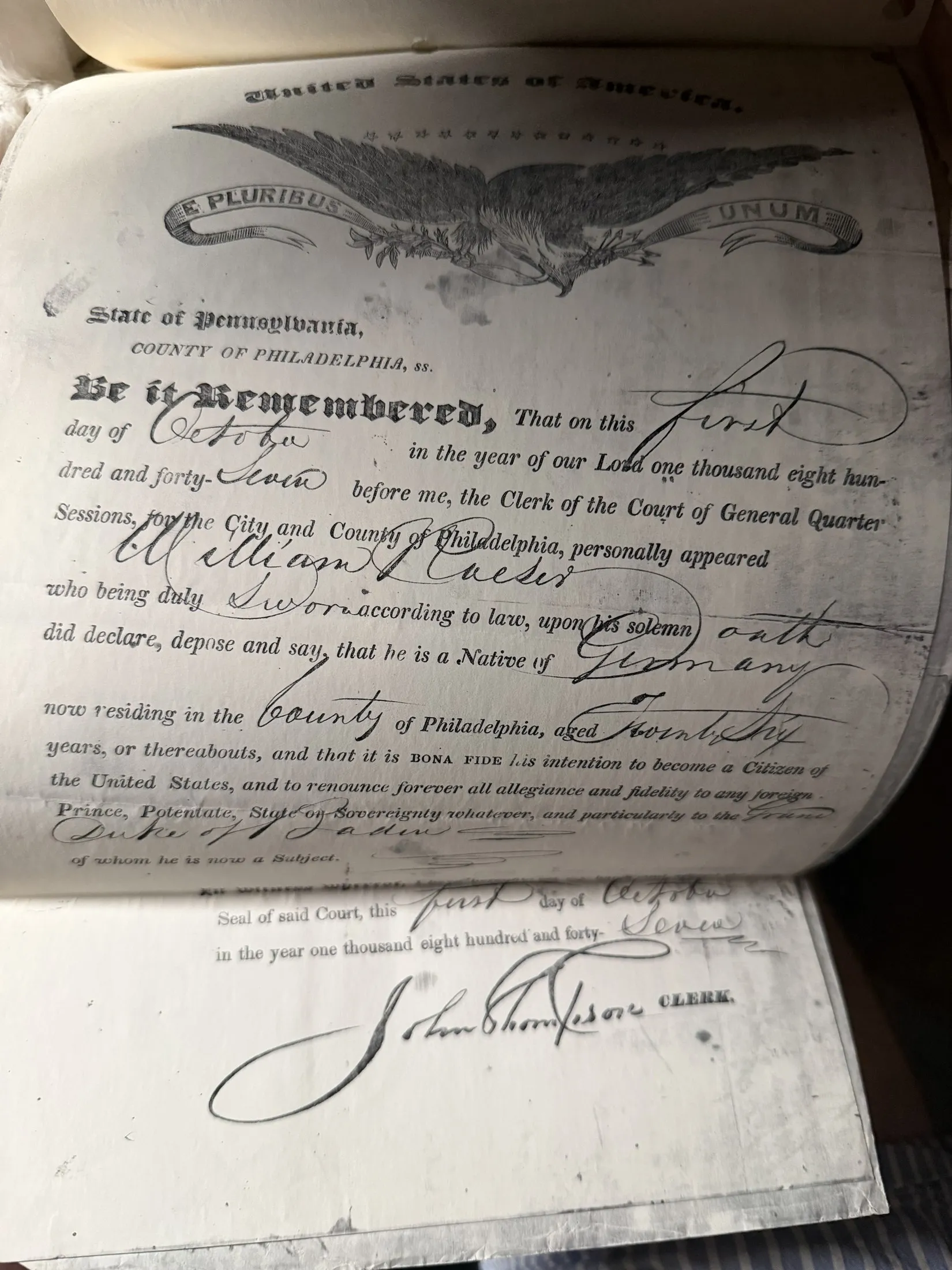
The single most consequential document this archive holds on his emigration is his 1 November 1853 Philadelphia naturalization petition — a primary-source document Robert Earl Wildermuth had been researching for decades. The petition, filed in the County of Philadelphia Court of Quarter Sessions before the Honorable Oswald Thompson, settles several facts in his own words:
- Year of arrival: 1847 (his own sworn statement)
- Port of arrival: New York
- Age at arrival: under eighteen — fitting the 23 August 1830 birth date for a 16-year-old landing in 1847
- Subject of: the Grand Duke of Wirtemberg (renounced under oath)
- Pennsylvania residence: at least one year before November 1853 — meaning he had spent some of his early American years in Pennsylvania before the Ohio move
- American name: “John M. Wildermuth” — already in use as his everyday formal identity by 1853
- Witness: Michael Dreher, a citizen of the United States — a fellow German emigrant who attested to having known Johann Michael long enough to vouch for his good character
The sheet carries the petition, the witness affidavit and the oath of allegiance, and opens by reciting a declaration made before the clerk of the same court “on the first day of November” — with the year left blank on the printed form. That declaration was 1 November 1852, a year earlier to the day. Johann Michael was 23, six years past his arrival and three past his majority.
What it would have meant to leave
To be sixteen in Württemberg in 1847 was to have grown up inside a particular set of pressures: a population that had recovered from the Napoleonic wars and was now larger than the available farmland could comfortably feed; an agricultural economy that depended on dwindling new vineyard land in already-tight valleys; an inheritance system (partible inheritance under Württemberg customary law) that split holdings smaller and smaller; and a German political world about to convulse in the revolutions of 1848 / 49. He left a year before those revolutions broke, a year before the failed revolutions sent the much larger wave of Forty-Eighter German political refugees to America. He was an economic emigrant, not a political one.
The journey he made — Grossaspach across to the Atlantic coast (probably Bremen or Hamburg, the two main embarkation ports for German emigrants of that era), six to eight weeks across the Atlantic in steerage, arrival in New York on a date in 1847 that the surviving New York passenger arrival manifests should still record — would have been the great event of his life. He arrived with a family from a neighboring German region, the Rossars of Baden — William Rossar, a shoemaker, and his wife Frederika of Württemberg. Robert Earl’s 1990 research suggested Frederika may have been Johann Michael’s sister, in which case the Rossar journey was an extended-family undertaking: a married older sister, her husband, and the teenage younger brother.
What a crossing like his was. For a sixteen-year-old from the Neckar valley in 1847, the journey began overland: down through the German states to a seaport. Most emigrants from Württemberg and the neighboring southwest German lands went in that decade by way of Le Havre — reachable by the new railways and cheaper to sail from — or through Bremen, whose packet line to New York had run since 1826. The ship itself was a cargo sailing vessel fitted for steerage, often carrying three hundred or more passengers berthed on rough plank platforms in the ’tween-deck, and the westbound passage took six to eight weeks. Landing in New York in 1847 meant something John Eesley’s 1856 arrival would not: there was no immigrant reception depot yet — Castle Garden opened only in 1855 — so emigrants came ashore directly onto the crowded South Street wharves, into the crush of boardinghouse “runners” and baggage-men who preyed on newcomers with no English. The disorder that greeted Johann Michael at the docks was exactly what Castle Garden would later be built to end.
The Marietta shoemaker
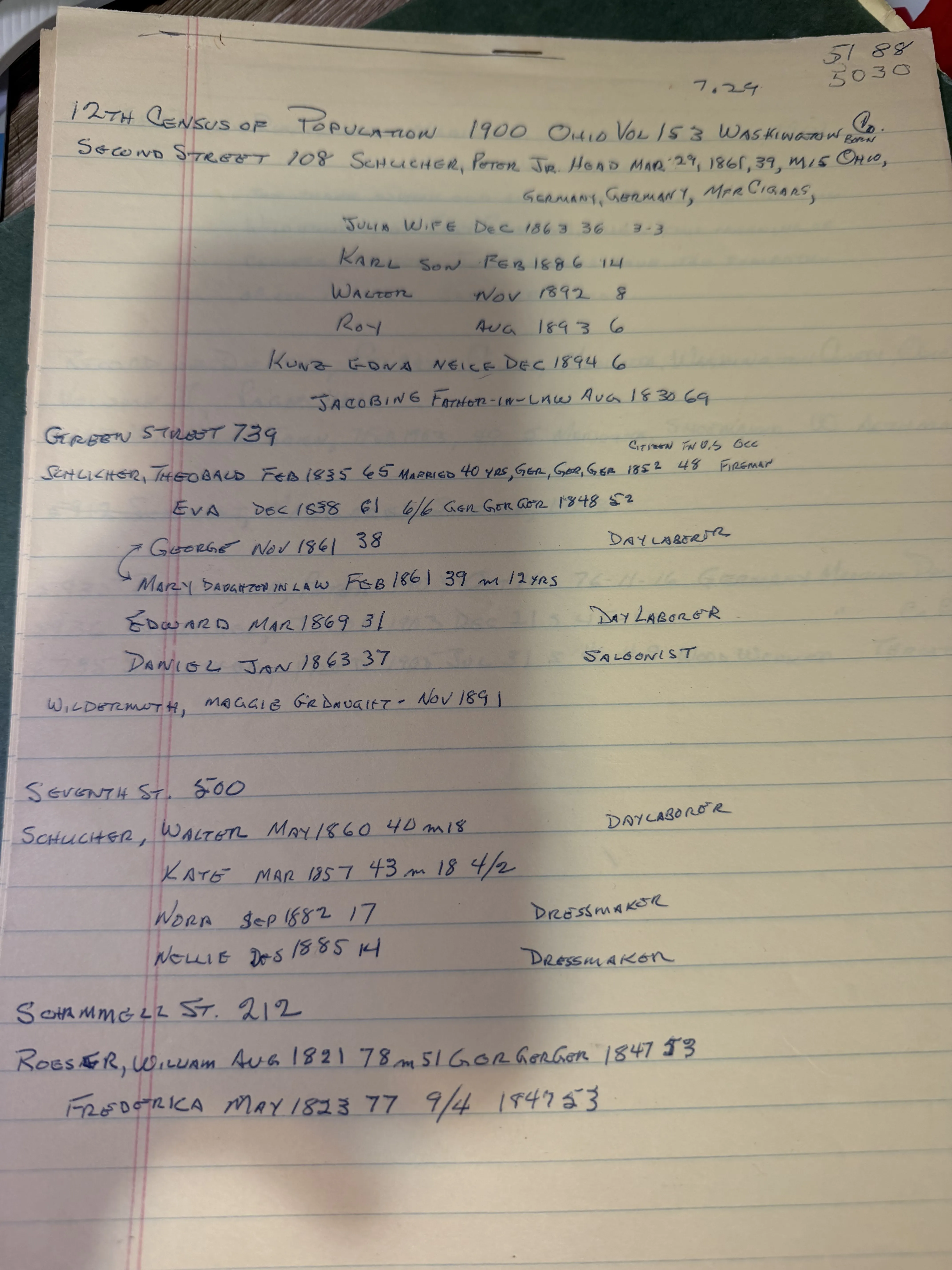
By the 1860 census he was twenty-nine and recorded as John M. Wildermuth, age 29, a shoemaker from Wuerttemburg, Germany, living in the household of William Rossar (38, shoemaker, Baden) and Frederika Rossar (Württemberg). The two men were working the shoe trade together. To be a small-town shoemaker in mid-19th-century Marietta was a trade with steady demand. Pre-factory shoes were custom-made, the leather worked over wooden lasts to fit each customer’s feet, the soles hand-stitched in waxed thread. His customers were river boatmen, dock workers, hill-country farmers, and Marietta’s merchants and ministers.
The marriage to Catharina Boeshar
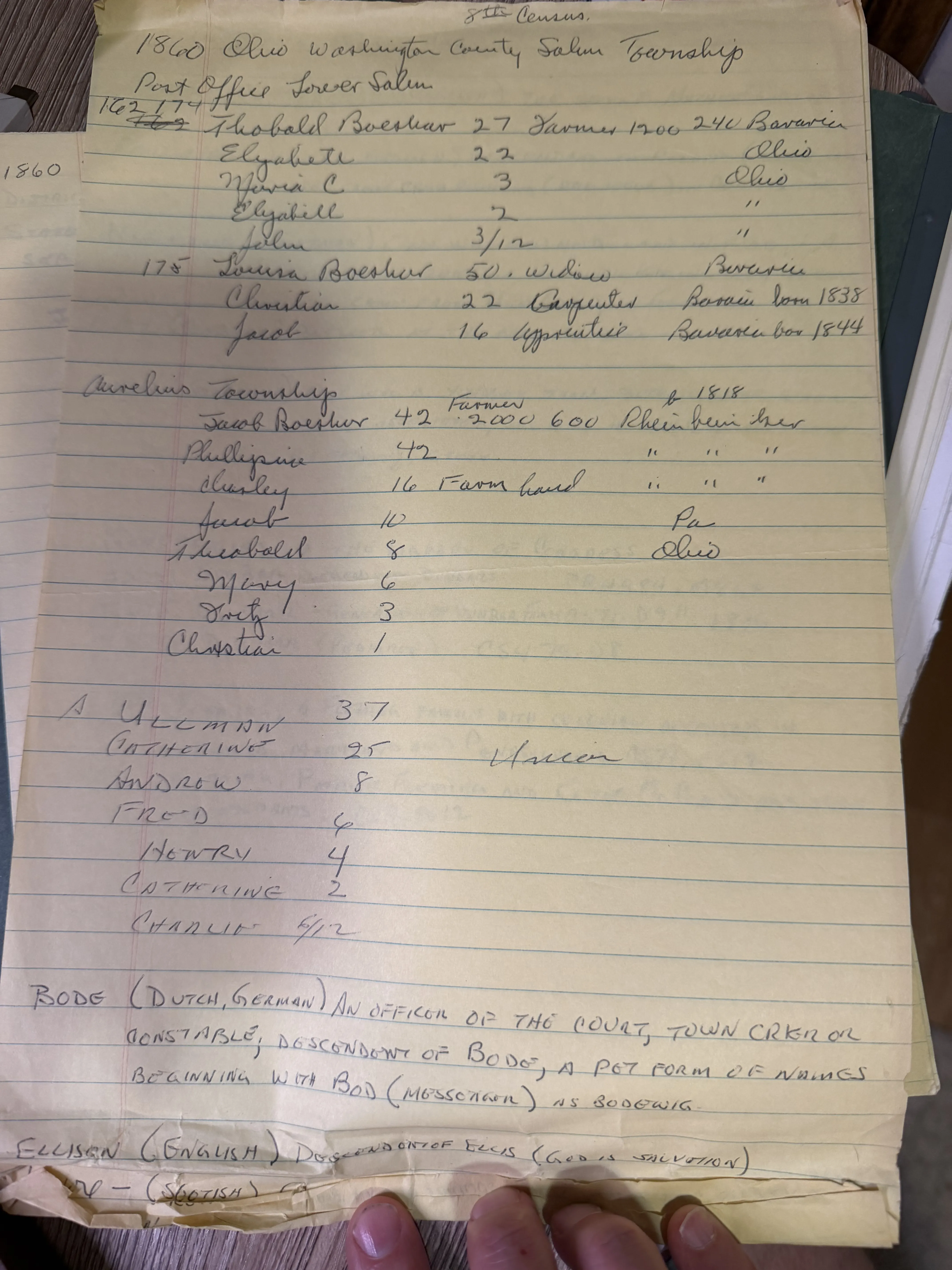
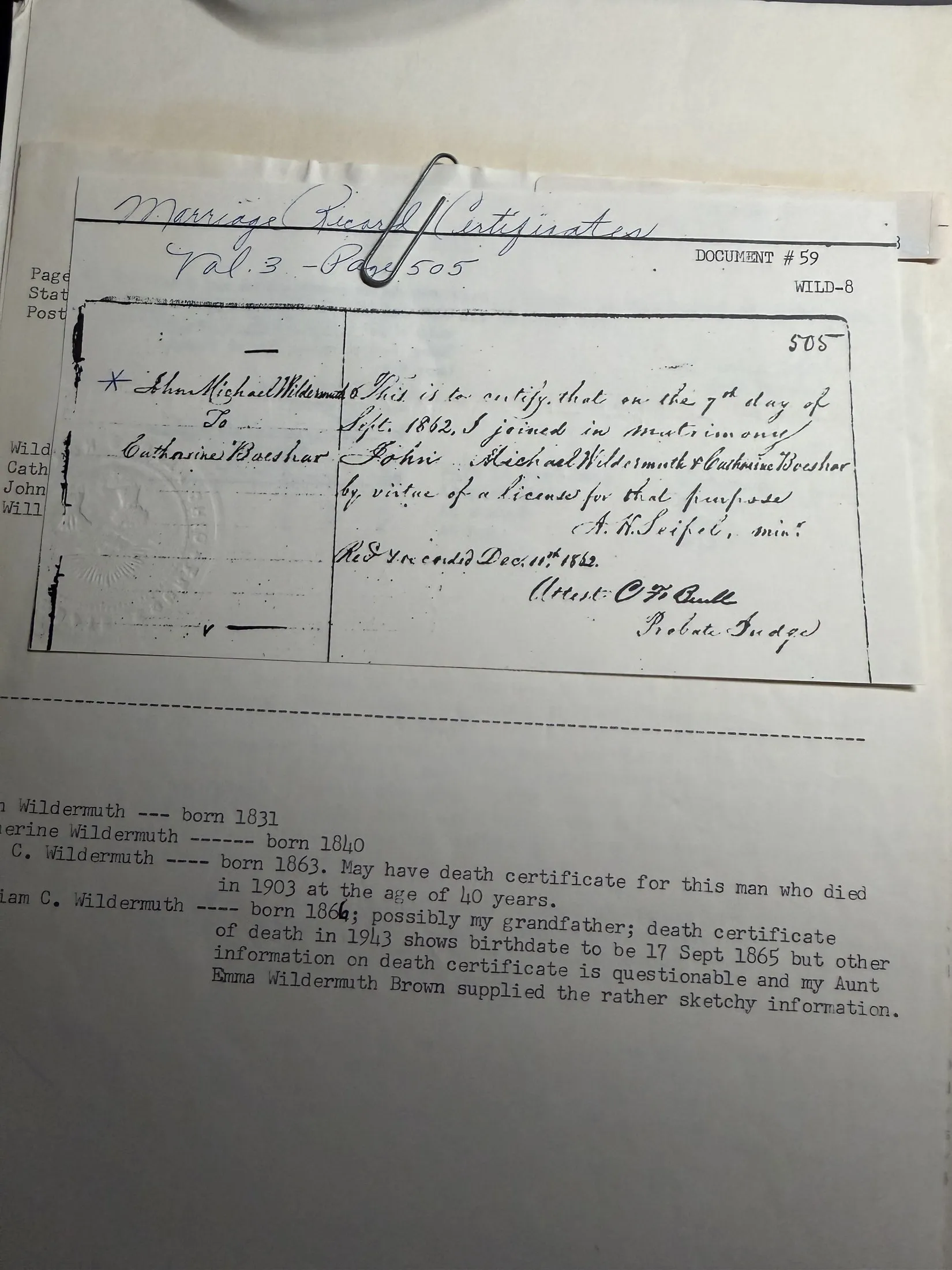
He married Catharina Boeshar of Breitenbach, Pfalz, Bavaria (b. 15 June 1840) around 1862 in Washington County, Ohio — per the @F57@ family record marriage of 7 September 1862. She was ten years younger and had come from a Pfalz village 250 miles north of his Württemberg one; they had converged in Marietta in the small German-speaking immigrant community that had formed there.
They raised three documented sons in Marietta:
- John Charles Wildermuth (b. September 1865) — the eldest. The “John Wildermuth” Robert Earl’s 1990 Heritage referred to as his grandfather — though Dale’s tree settles that as a memory error; John Charles was Robert Earl’s great-uncle, brother of his actual grandfather William Clifford.
- William Clifford Wildermuth (b. 17 September 1866) — the middle son. Robert Earl Wildermuth’s actual paternal grandfather through Earl Adam, settled in Dale’s tree (June 2026). The patriarch of the c. 1896 family group portrait.
- Edward Frederick Wildermuth (b. 17 February 1873) — the youngest, who lived to 91, dying at Marietta in 1964.
The death, the burial, and an impossible age
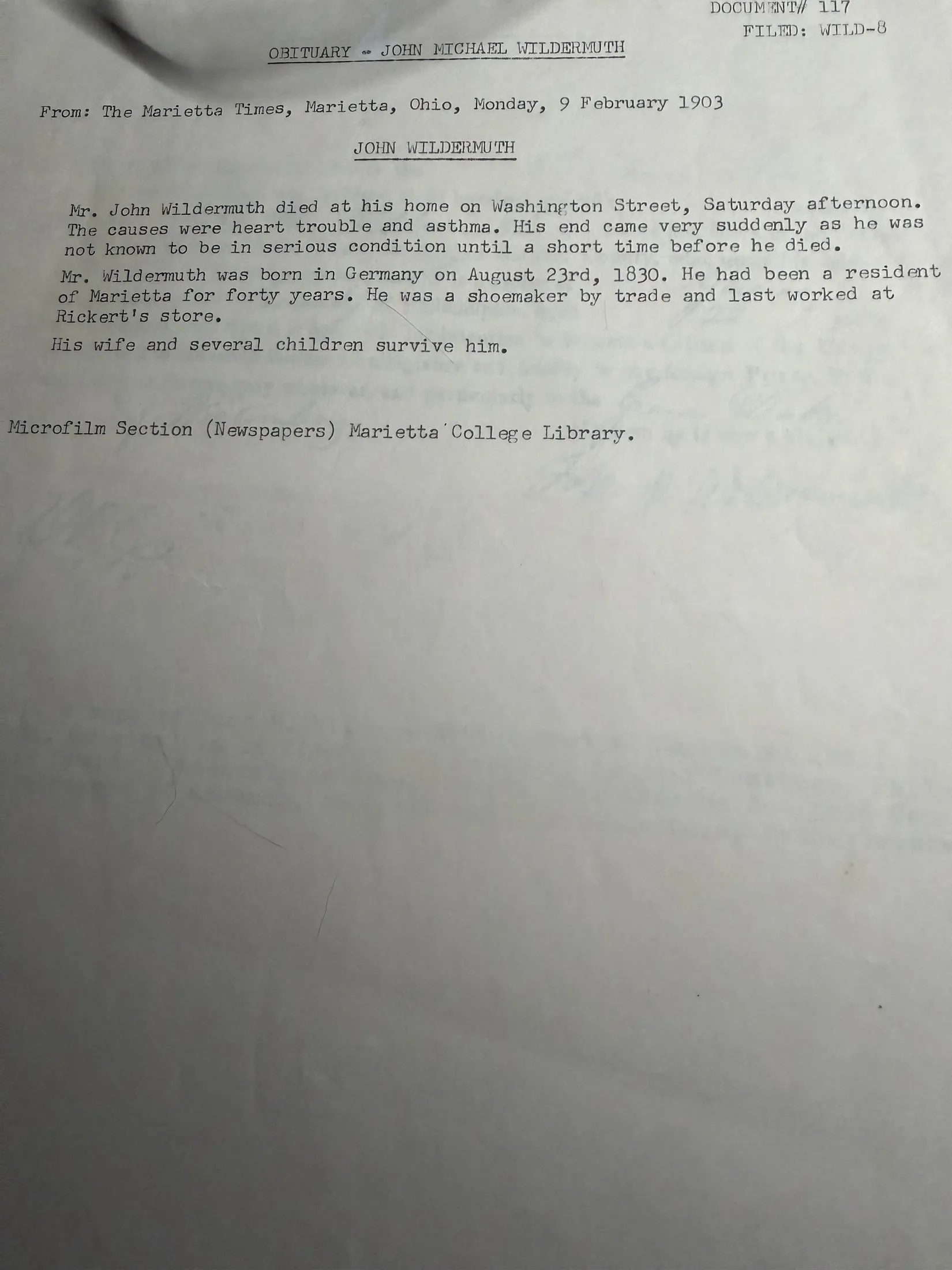
He died in Marietta on 7 February 1903 at age 72, and was buried at Oak Grove Cemetery, Marietta.
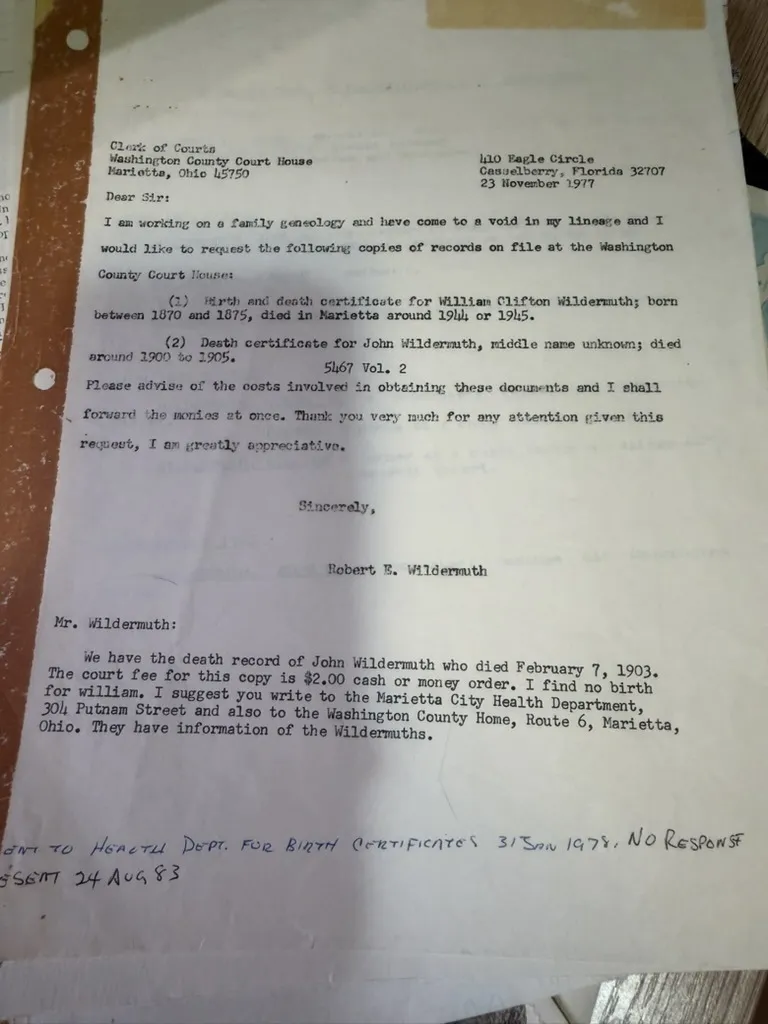
The certified death record — no. 5467, Volume 2, page 144, recorded 31 March 1903 — was obtained from the Washington County Probate Court in December 1977 by Robert Earl Wildermuth, who read it and immediately saw that it was wrong. It gave the dead man’s age as forty. His son William was thirty-eight at the time. Robert Earl wrote back to the clerk:
“This of course would rule out John’s age at the time of his death as being only 40 years. Do you think there could have been an error in recording John’s age? Perhaps he was in this country only 40 years.”
The same letter preserves a detail recorded nowhere else: he was “the German shoemaker who had a shop on lower Front Street in Marietta.”
Where he actually lived and worked
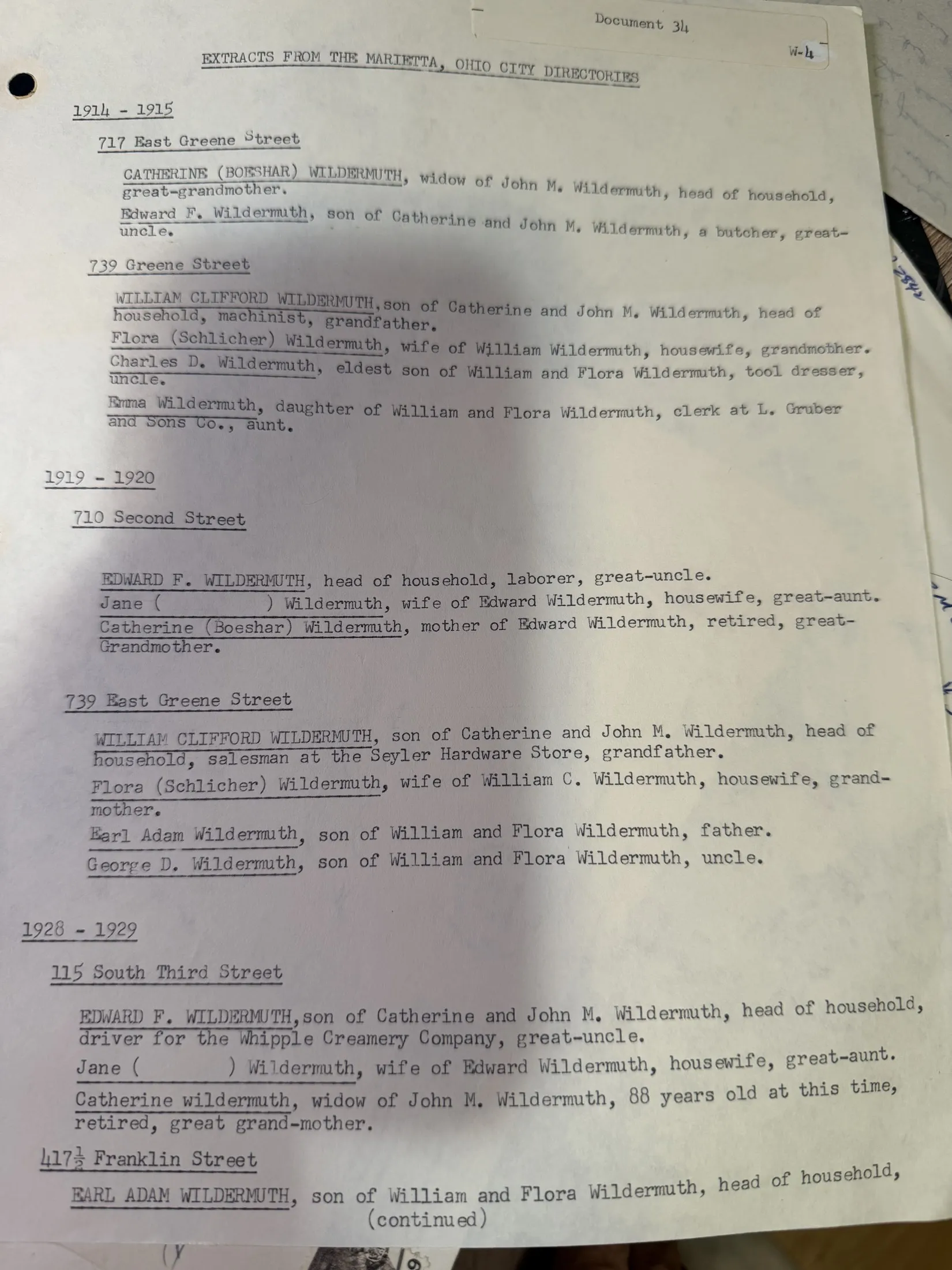
The Marietta city directories put addresses to all of it:
| Shop | Home | |
|---|---|---|
| 1873–74 | 30 Front Street | Sixth Street, between Warren and Montgomery |
| 1880 (census) | works in a shoe shop | Sixth Street |
| 1897–98 | 134 Front Street | 708 Sixth Street |
| 1899–1903 | shoemaker | 611 Washington Street |
Two different shops on Front Street — 30 and later 134 — twenty-four years apart — and 611 Washington Street is the house the obituary means when it says he “died at his home on Washington Street.”
The 1860 census catches him earlier than any of that: twenty-six years old, a shoemaker, still lodging in the William Roessar household in the Third Ward, thirteen years after the crossing and still unmarried. By 1880 he had his own house on Sixth Street, a wife from Bavaria, and two sons of sixteen and fourteen already working in a chair factory.
He was right about the error. Seven years later the Oak Grove Cemetery register, independent of the certificate, gave the age at burial as 72 years, 6 months, 16 days — consistent with the 1830 birth and not with anything like forty.
The grave
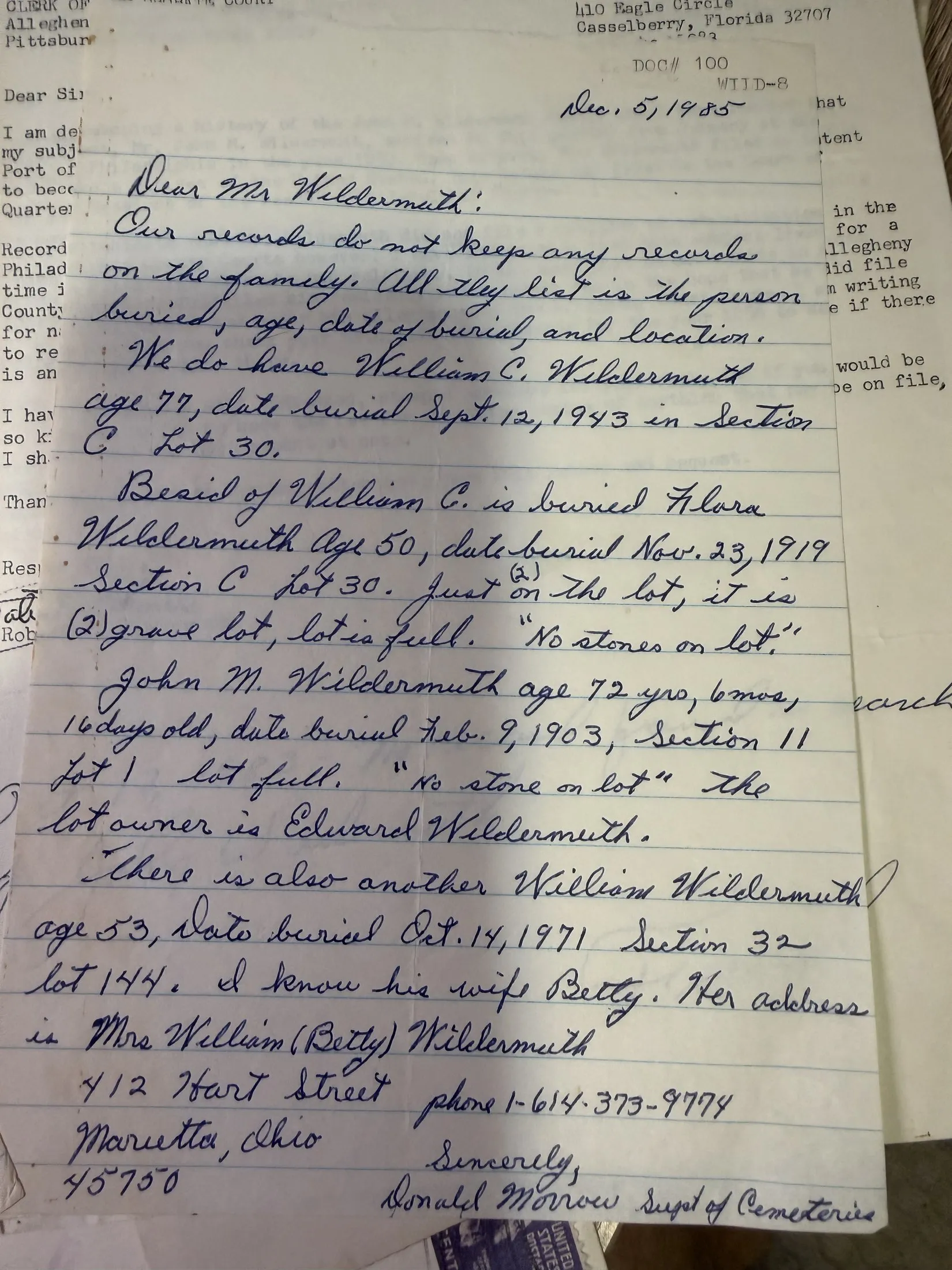
The cemetery superintendent’s 1985 reply places him in Section 11, Lot 1 — “lot full,” the lot owner his youngest son Edward Frederick Wildermuth, who outlived him by sixty-one years. Buried 9 February 1903, two days after his death.
And, in the superintendent’s own three words: “No stone on lot.” His son William Clifford and daughter-in-law Flora lie unmarked in the same cemetery.
The ship was never found — and why
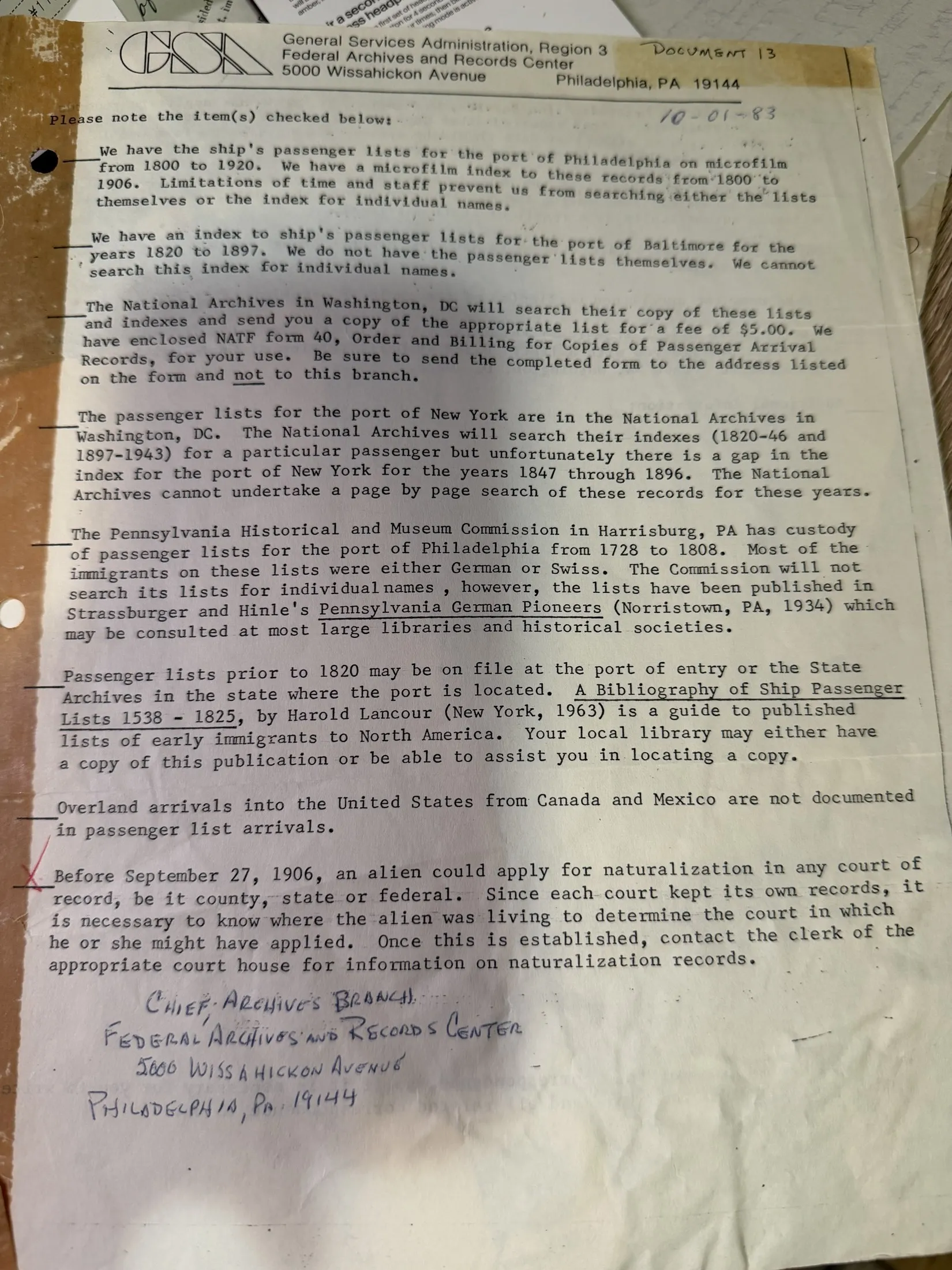
Robert Earl spent the autumn of 1983 trying to name the vessel. He was looking at Philadelphia, on a belief that the arrival was there in 1850 or 1851. The Federal Archives and Records Center wrote back with the fact that closed the door:
“There is a gap in the index for the port of New York for the years 1847 through 1896. The National Archives cannot undertake a page by page search of these records for these years.”
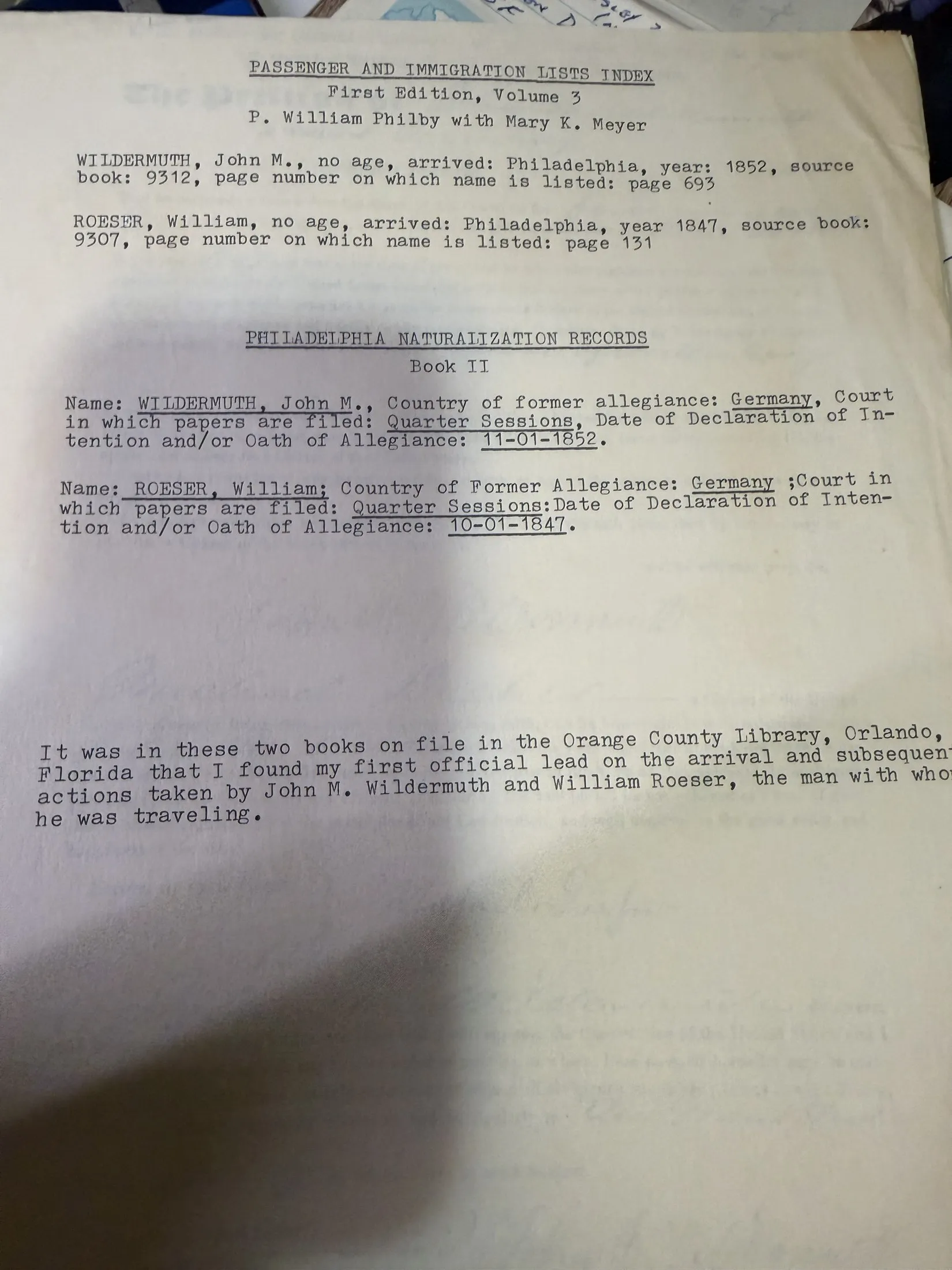
Johann Michael landed at New York in 1847 — the first year of the gap. Even had he searched the right port, the index would have missed him by one year. The full 1983 exchange is here.
The manifests themselves survive and are now name-indexed online, so the crossing is findable today in a way it was not then.
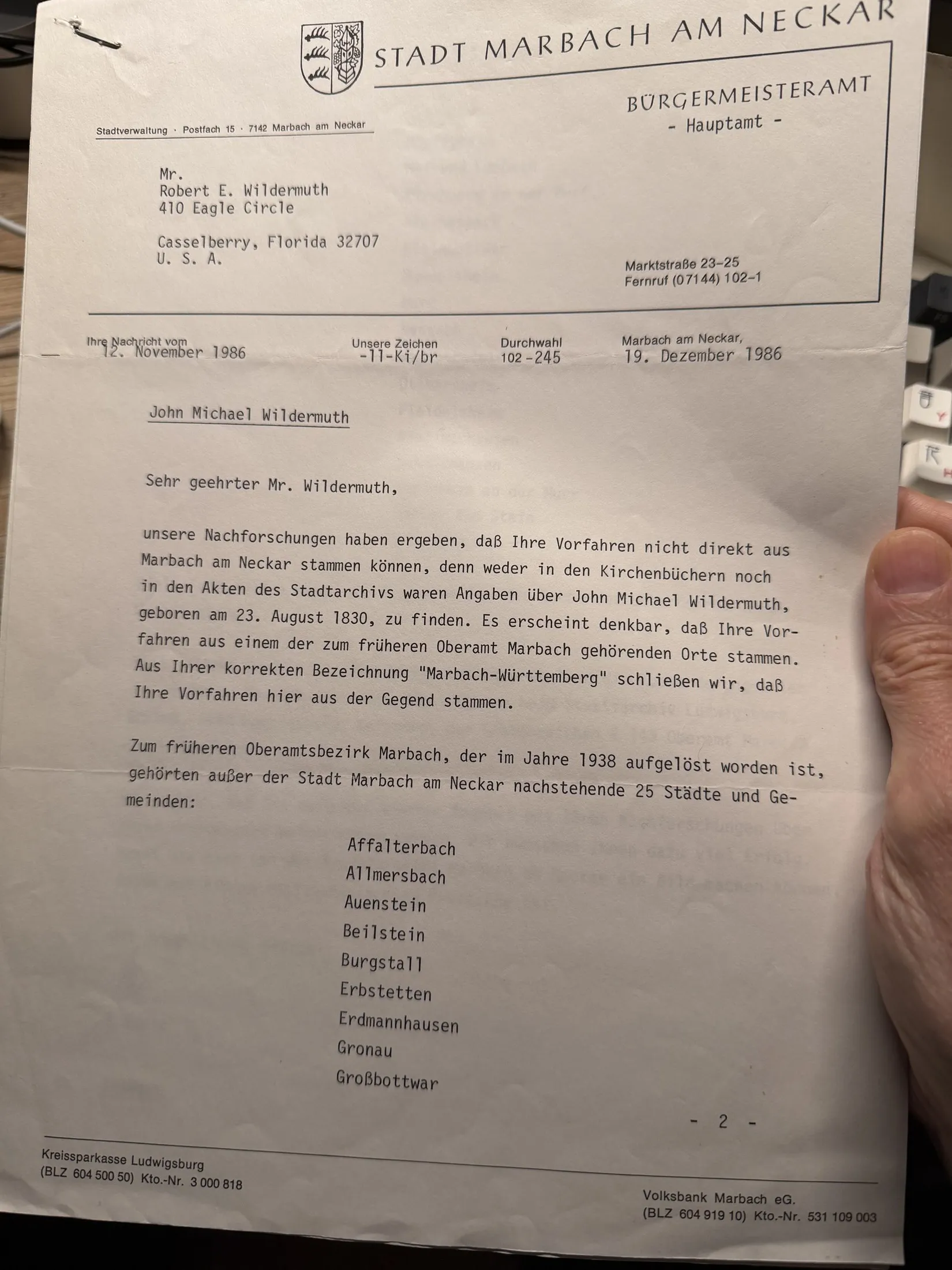
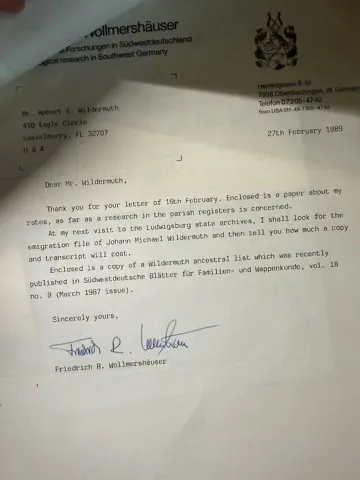
There is also a lead he was handed and never used. In December 1986 the town hall at Marbach am Neckar pointed him to the emigration files of the former Oberamt Marbach, held at the Staatsarchiv Ludwigsburg under reference E 143 Oberamt Marbach Auswanderungen — Württemberg required official permission to leave, and the district kept the application. The letter is here. He acted on it: in February 1989 he engaged the accredited genealogist Friedrich R. Wollmershäuser, who undertook to look for the emigration file at Ludwigsburg. Whether it was ever found is not recorded in the surviving papers. Since Großaspach sat in Oberamt Backnang, the Backnang emigration series is the one to ask for alongside Marbach’s.
Naturalized in two appearances, a year apart
Resolved. It took two documents to see it, and for a long time they looked like one.
| 1 November 1852 | Declaration of intention, Court of Quarter Sessions, Philadelphia — renouncing allegiance to the Grand Duke of Württemberg. Indexed in Philadelphia Naturalization Records, Book II as 11-01-1852, and the document the City of Philadelphia sold Robert Earl a photocopy of in 1983. |
| 1 November 1853 | Petition, witness affidavit and oath of allegiance sworn in open court — the sheet in the family’s keeping, before the Hon. Oswald Thompson, witnessed by Michael Dreher. |
The 1853 petition recites that he “declared on oath before the Clerk of this Court, on the first day of November” — and the printed form leaves the year blank. That blank is why the two appearances collapsed into one, and why a completed naturalization could look like an unfinished intention.
Robert Earl reached the same reading in his finished account, describing both appearances and ending: “He took the oath of allegiance that same day and thus became JOHN Michael Wildermuth, AMERICAN.”
And the parallel case proves the structure. In 1983 he also ordered the Philadelphia papers of William Röeser, the man he crossed with — and the City sent “the declaration of intention and petition of naturalization,” two physically different forms. Set side by side, the declaration is headed Be it Remembered, sworn before the Clerk and signed by the Clerk; the petition is addressed to the Justices, headed The Petition of, and prays for admission. Johann Michael’s 1853 sheet is unmistakably the second kind. The question is closed.
The Philadelphia arrival that never happened
The reason he spent a decade writing to the wrong offices is a line in a reference book. Filby’s Passenger and Immigration Lists Index carries an entry reading “WILDERMUTH, John M. … arrived: Philadelphia, year: 1852” — which is not a ship arrival at all. Filby indexes published name lists, and this entry’s source is the naturalization compilation: the court date of 1 November 1852, reported as a port of entry. The same thing happened to William Roeser, whose “arrival: Philadelphia 1847” is his own declaration date.
So every letter that began “Mr. John M. Wildermuth arrived in this country at the Port of Philadelphia in the year 1850” rested on a courthouse date misfiled as a landing. He arrived at New York in 1847, as his own oath says. The index page is here.
Is there a picture of him?
For a time this archive floated the possibility that the older mustachioed man at the back-left of the c. 1896 William Clifford Wildermuth family group portrait might be Johann Michael himself, age 66. That identification has been withdrawn. The typed caption card that accompanies the photograph — and Chuck’s 2026 reading of it — identify that man as his son William Clifford Wildermuth, and Johann Michael is not believed to be in the picture at all. (His wife Catharina Boeshar very likely is — the grandmother holding the youngest child at the back — but he is not.)
So the archive still holds no confirmed image of Johann Michael Wildermuth. Robert Earl’s lament from his 1989 research stands unanswered:
“Someday, time permitting, perhaps I can check through the ship arrivals in New York City to find the ship and its port of debarkation in Germany. Sometimes ship’s passenger lists give a physical description of the passenger. That would be interesting for I have no picture of Johann.”
What is settled is the documentary record, not the visual one: the 1853 Philadelphia naturalization petition fixes his emigration in his own sworn words — but his face is still unrecorded.
See also — family threads
Johann Michael is an anchor for two of the ten threads in the Family threads synthesis essay:
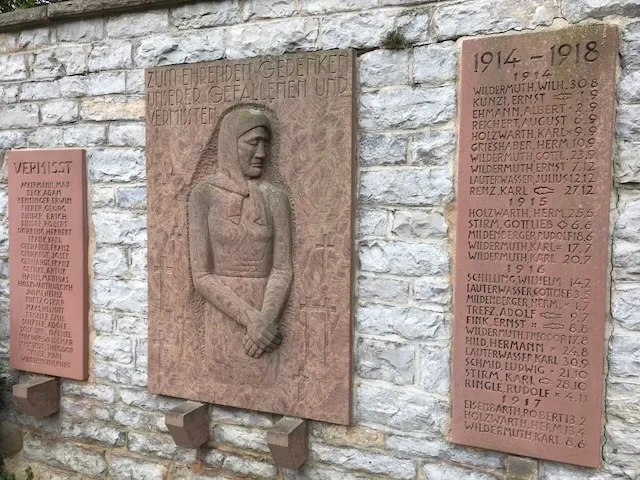
- Thread #9 — Crossing for what’s next — the founding instance: sailed from Großaspach, Württemberg in 1847, age sixteen, per his own 1853 Philadelphia naturalization petition. “He was the Wildermuth who left.” The Wildermuths who stayed are carved into the Rielingshausen war memorial — a dozen of them killed in the two world wars, the family that emigration spared his own line. The village’s wider story — its famous Wildermuths and Robert Earl’s own return visit — is told in The Wildermuth Clan of Rielingshausen.
- Thread #10 — Building things (entrepreneurship across four generations) — built up the shoe trade with William Rossar of Baden in Marietta, the immigrant Wildermuth-side founding-entrepreneur instance parallel to John F. Eesley’s Plainwell flour mill (1887) and Zhou Zhaoxiang’s first Qingdao photography studio (mid-20th-century).
Robert Earl’s 1989 sketch
Robert Earl wrote a one-page sketch of Johann Michael as part of his 1989 “Little Histories” project — the same project that produced the chapters on Catharina Boeshar, Johann Christian, and the deeper Schmidgall-Landai-Werner-Phillipp Württemberg ancestors. The Johann Michael sketch carries the same factual spine as this page but in Robert Earl’s own voice and as he understood it three years before publishing the 1990 Heritage. Read it at Robert Earl Wildermuth’s “Little Histories” — Johann (John) Michael Wildermuth section.
Sources: Dale Eesley / FamilySearch — John Michael Wildermuth (9S57-FW4); Johann Michael Wildermuth’s 1853 Philadelphia Naturalization Petition; The Wildermuth/Fleming Heritage by Robert Earl Wildermuth, 1990; c. 1896 William Clifford Wildermuth family group portrait; Robert Earl Wildermuth’s “Little Histories”. Voyage context: 19th-century German emigration via Le Havre and Bremen, and the pre-1855 New York wharves (before the Castle Garden depot) — general emigration history.
Appears in
- Johann Michael Wildermuth's Naturalization Petition, Philadelphia, 1 November 1853 — ancestor-sketch
- The Wildermuth/Fleming Heritage (Robert Earl Wildermuth, 1990) — ancestor-sketch
- Robert Earl Wildermuth's 'Little Histories' (1988–1993) — ancestor-sketch
- John Michael Wildermuth — Robert Earl Wildermuth's finished account — ancestor-sketch
- The Wildermuth Clan of Rielingshausen — the Famous Cousins, and Robert Earl's Return — essay
Pictured in