The 'Little Histories' — the original typed pages, and Die Familien Wildermuth
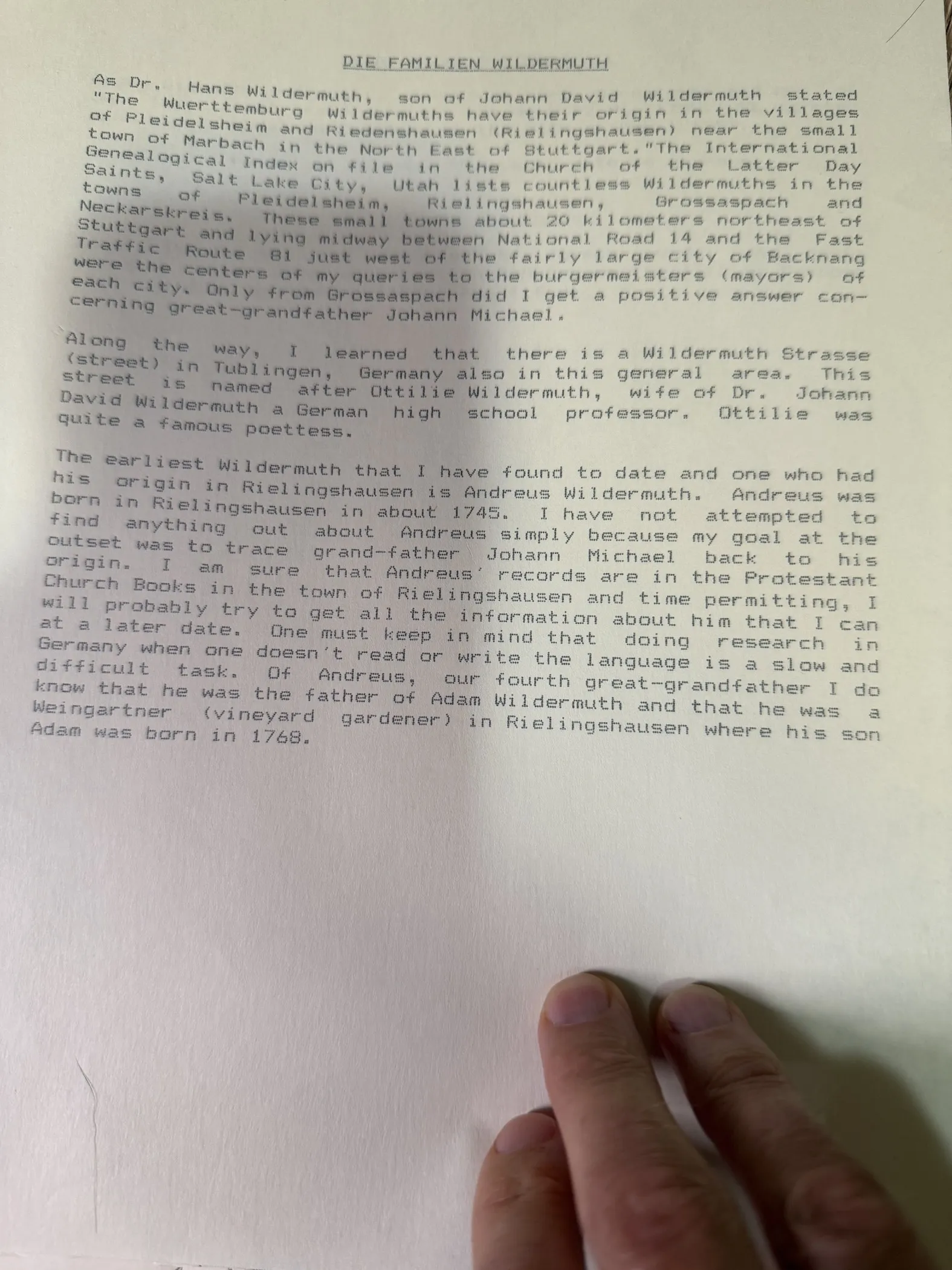
The archive already held the Little Histories — the one-page ancestor sketches Robert Earl Wildermuth wrote after retiring, transcribed from an OCR’d scan of his memoir. These are the pages themselves, photographed from his file. They add two ancestors the archive never had, correct several OCR readings, and include a research essay the transcription did not cover.
Die Familien Wildermuth — the research essay
His account of the German search, in his own voice — and it contains the single most useful correction in the batch.
“Dr. Andreus, our fourth great-grandfather, was the father of Adam Wildermuth and … he was a Weingartner (vineyard gardener) in Rielingshausen where his son Adam was born in 1768.”
Weingärtner, not Gärtner. Andreas’s page has long described him as a Gartner glossed as vineyard gardener. The word Robert Earl actually used is the precise Württemberg term for a vine-dresser — a man who worked vines, not gardens. The gloss was right; the word was imprecise.
The essay also records:
- How the German breakthrough happened. “These small towns … were the centers of my queries to the burgermeisters (mayors) of each city. Only from Grossaspach did I get a positive answer concerning great-grandfather Johann Michael.” Four town halls written to; one answered usefully. That is where the Familienregister came from.
- Dr. Hans Wildermuth’s line, quoted directly: the Württemberg Wildermuths originate “in the villages of Pleidelsheim and Riedenshausen (Rielingshausen) near the small town of Marbach in the North East of Stuttgart.”
- The Wildermuthstrasse in Tübingen, named for Ottilie Wildermuth, “quite a famous poetess” — wife of Dr Johann David Wildermuth, a high-school professor.
- And an honest note on method: “One must keep in mind that doing research in Germany when one doesn’t read or write the language is a slow and difficult task.”
Two ancestors the archive did not have
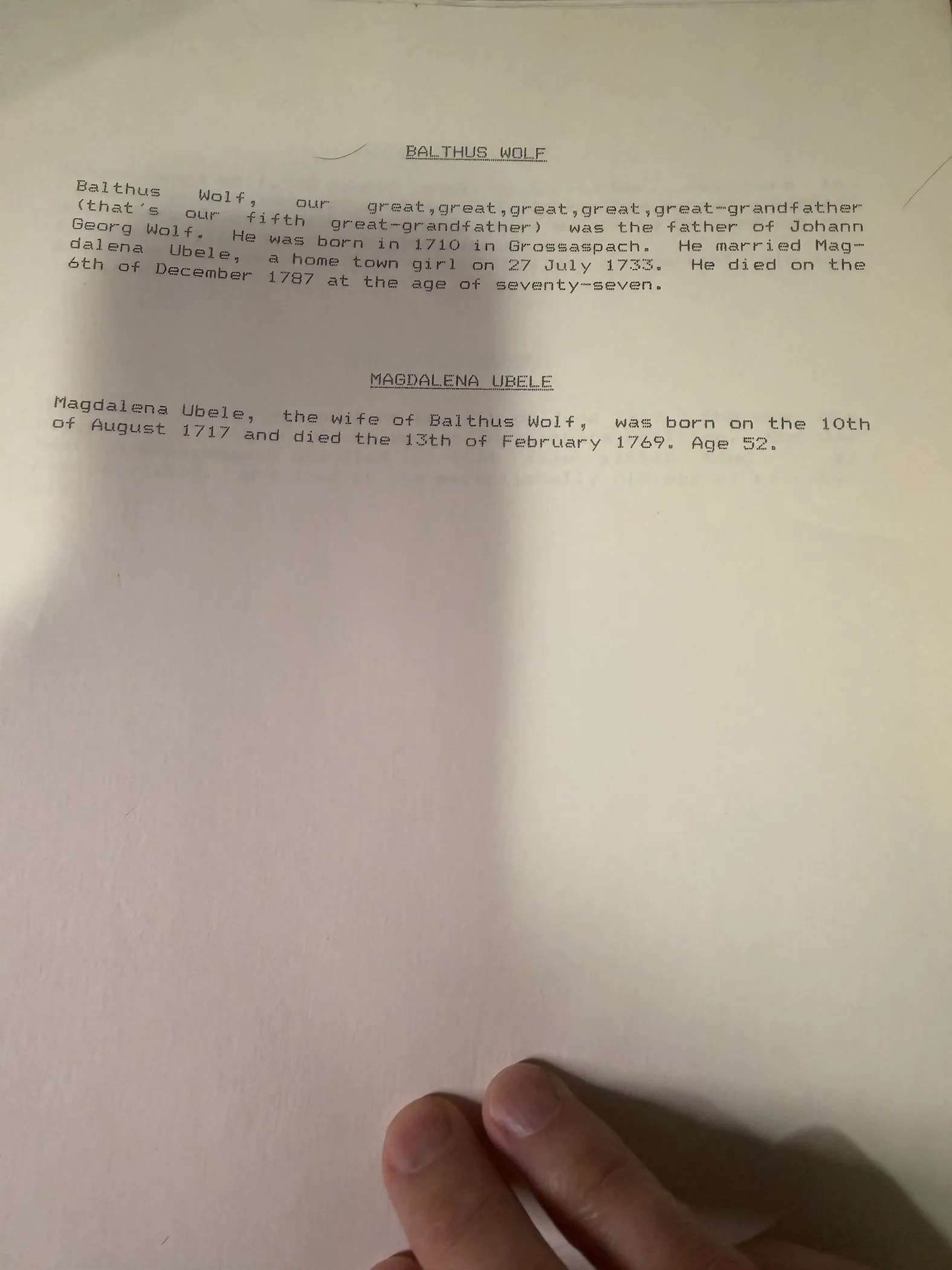
Balthus Wolf — “our great, great, great, great, great-grandfather (that’s our fifth great-grandfather)” — born 1710 in Grossaspach, married Magdalena Ubele “a home town girl” on 27 July 1733, died 6 December 1787 at seventy-seven. Magdalena was born 10 August 1717 and died 13 February 1769, aged fifty-two.
They are the parents of Johann Georg Wolf, and they push the Wolf line back a generation.
Where the shoemaking actually started
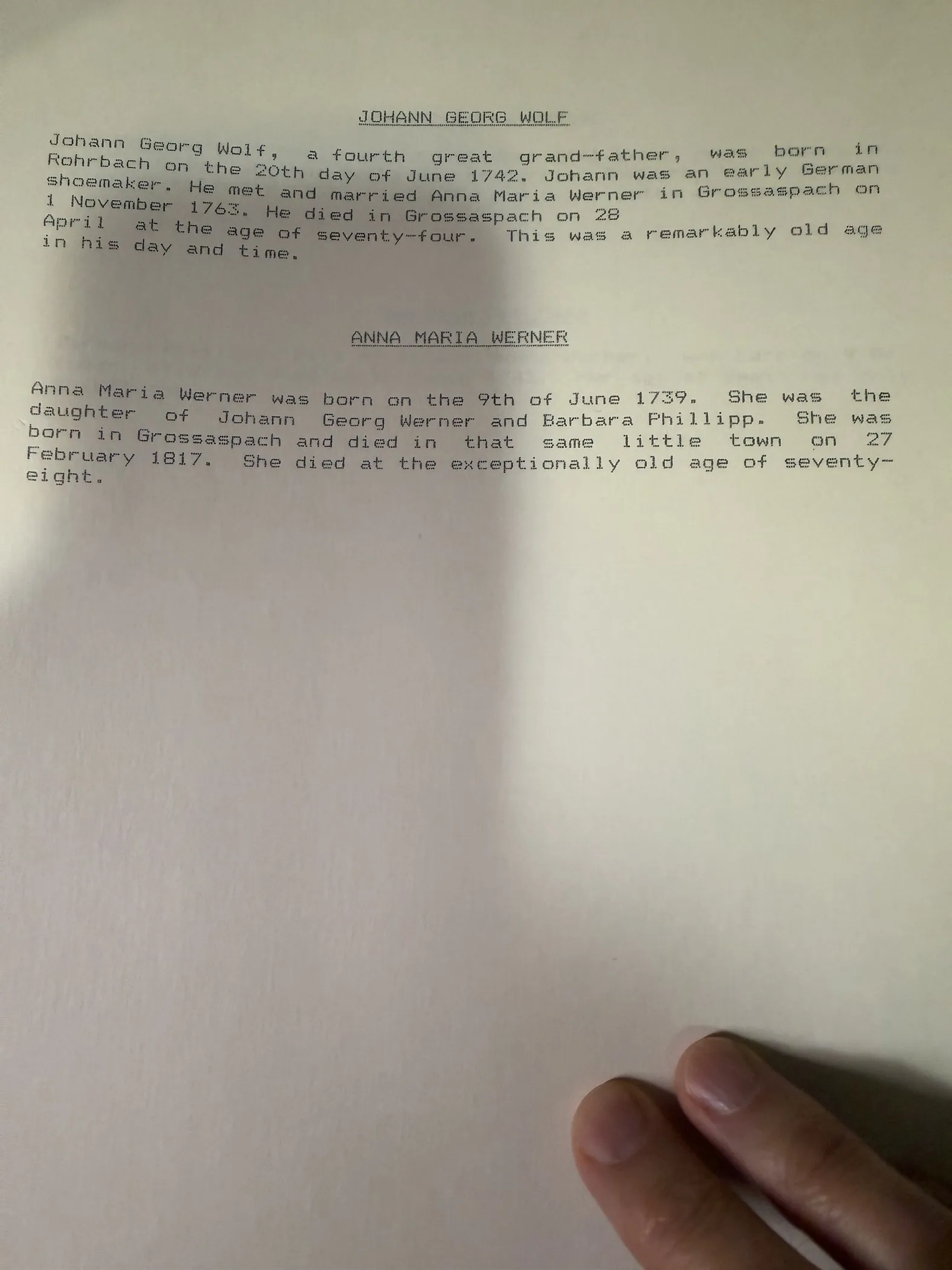
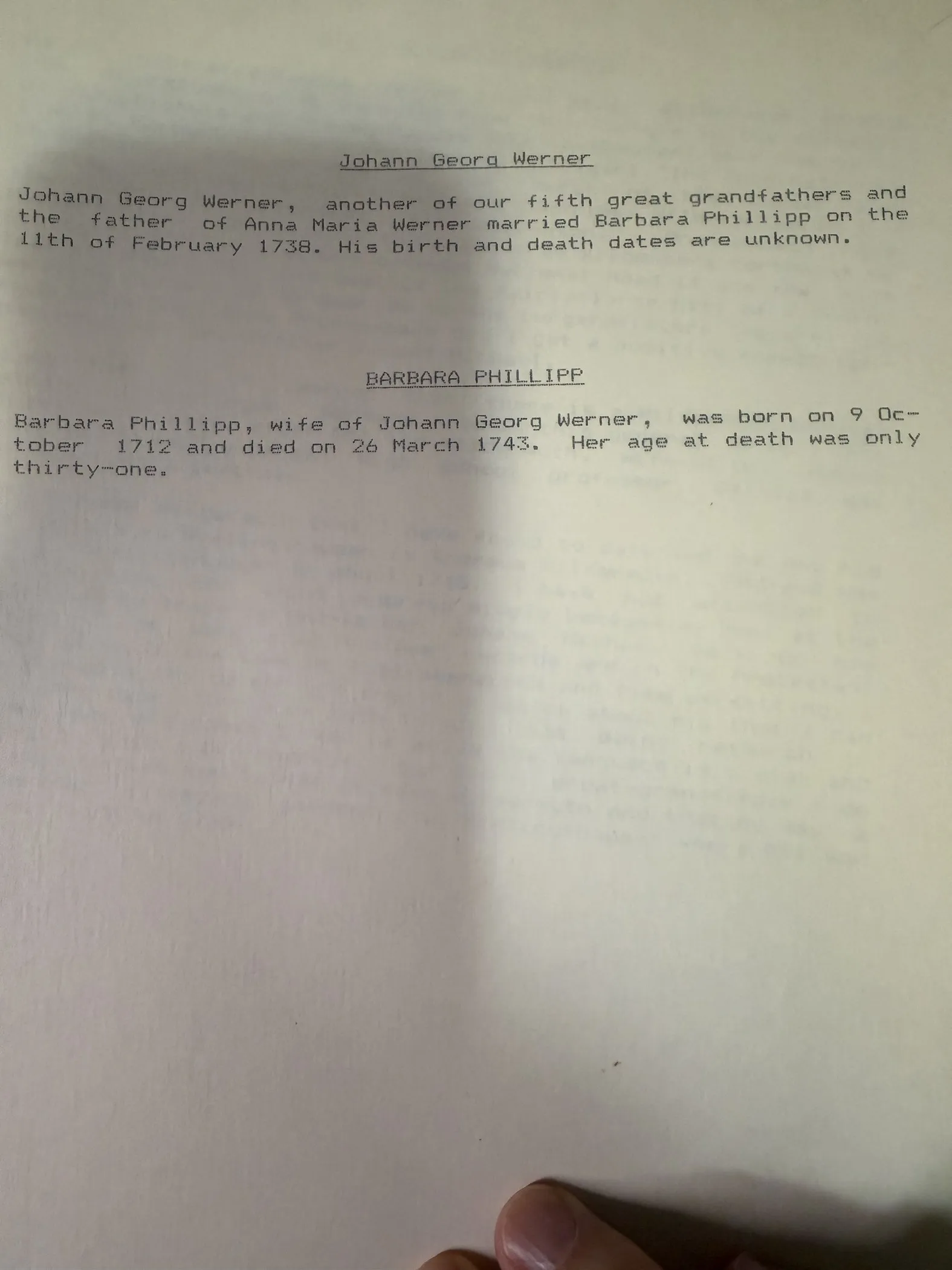
“Johann Georg Wolf, a fourth great grand-father, was born in Rohrbach on the 20th day of June 1742. Johann was an early German shoemaker.”
The archive has treated shoemaking as a Wildermuth trade running from Johann Christian (b. 1794) to his emigrant son. It goes back further and enters from the other side: Johann Georg Wolf (b. 1742) was a shoemaker, and his daughter Catharina Dorothea Wolf married Adam Wildermuth the weaver. Their son Johann Christian took up his maternal grandfather’s trade, not his father’s — and his son carried it to Ohio, where he worked at it for fifty years.
Four generations of shoemakers, and the line runs Wolf → Wildermuth.
The other sketches
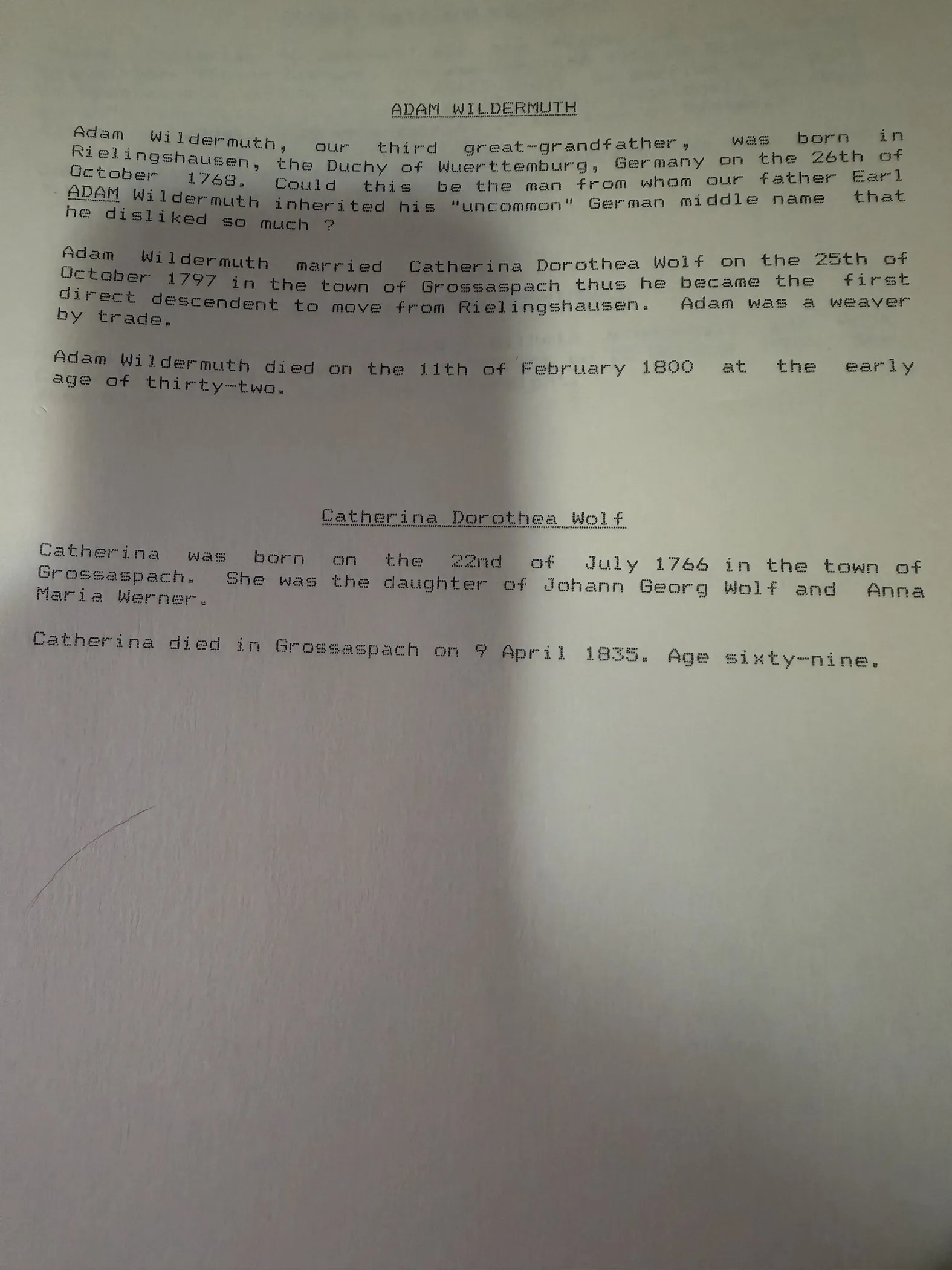
Adam Wildermuth — “Adam was a weaver by trade”, confirming what the Familienregister says, and “thus he became the first direct descendent to move from Rielingshausen.” Robert Earl also asks a question worth keeping: “Could this be the man from whom our father Earl Adam Wildermuth inherited his ‘uncommon’ German middle name that he disliked so much?”
One conflict: he gives the marriage as 25 October 1797. The annotated chart and the FamilySearch tree both say 1791 — which must be right, since Johann Christian was born in 1794.
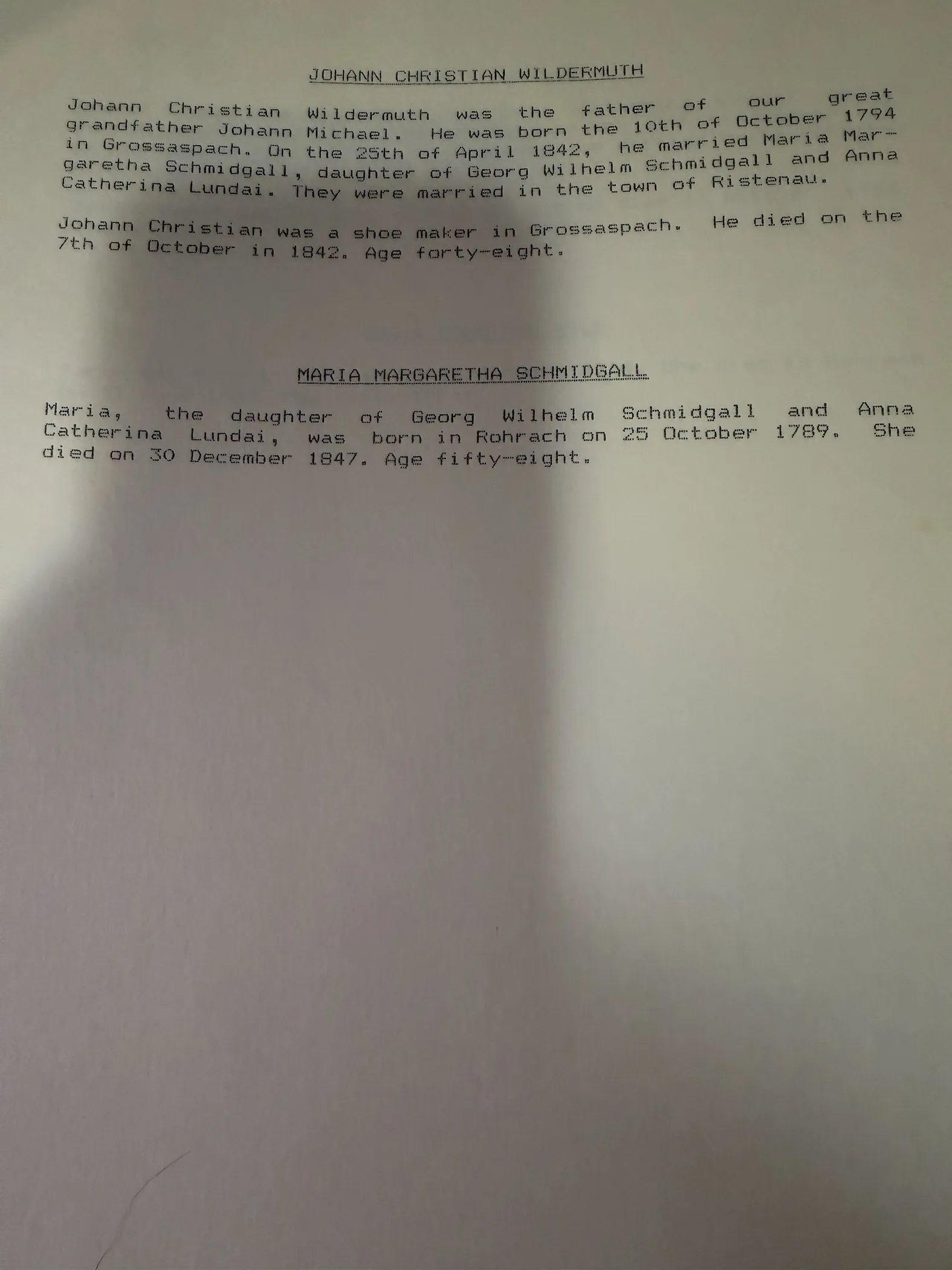
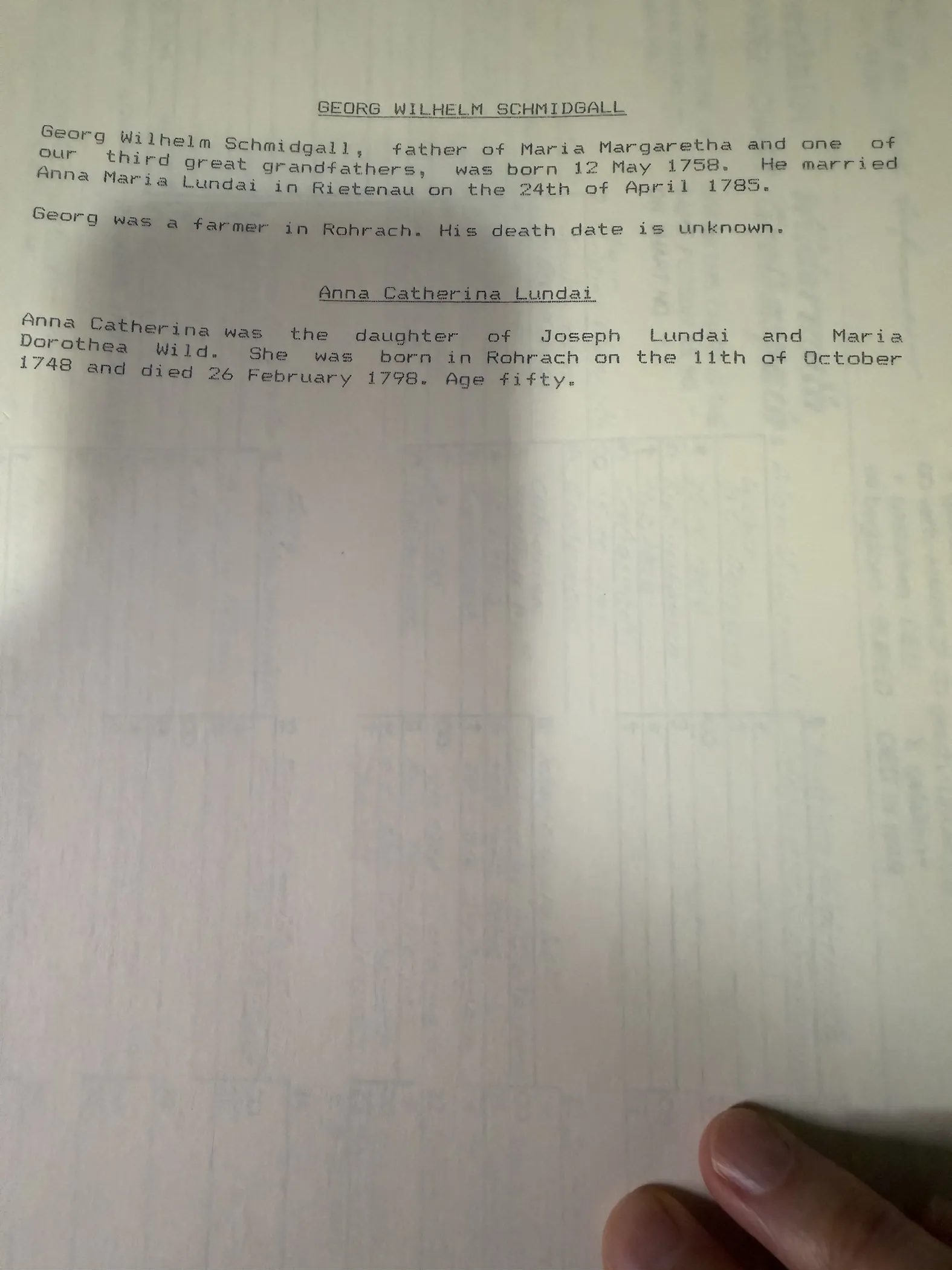
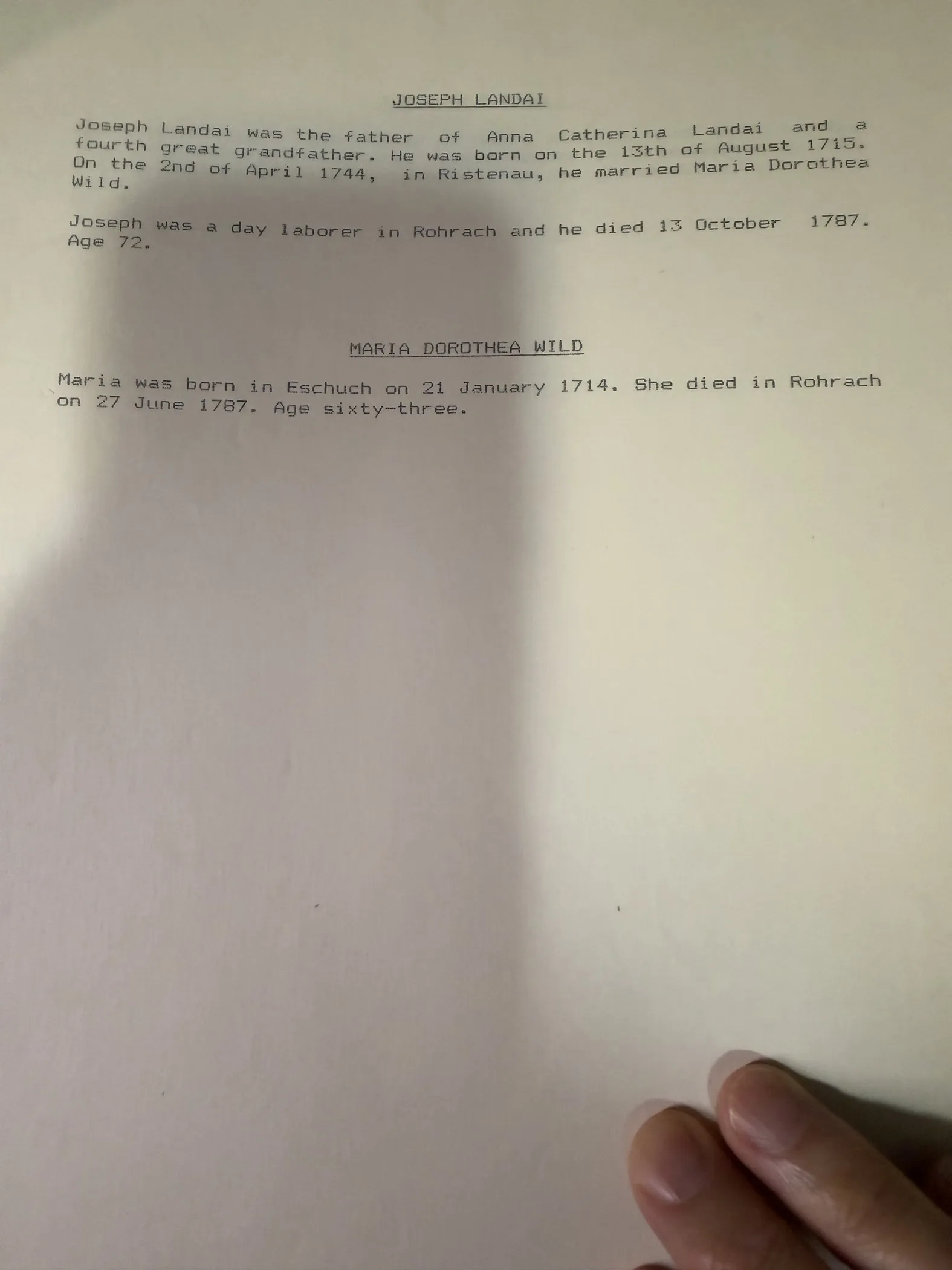
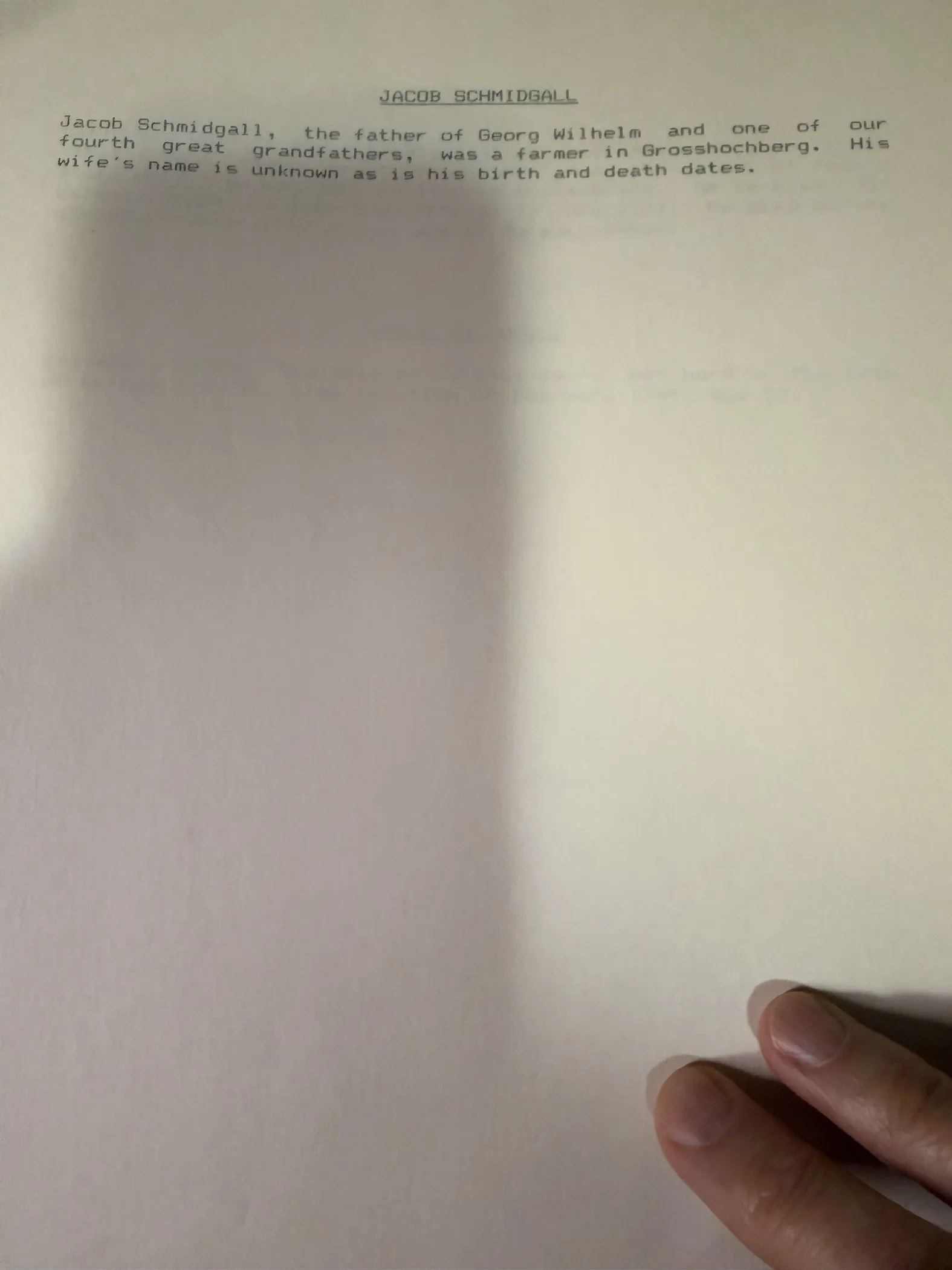
One spelling settled. Johann Christian’s marriage place is typed “Ristenau” on his sheet and “Rietenau” on Georg Wilhelm Schmidgall’s — both in the same hand, days apart. Rietenau is the real village, and the Familienregister confirms it. “Ristenau,” which the archive carried for years, was his own typo.
The John Michael sketch, in an earlier draft
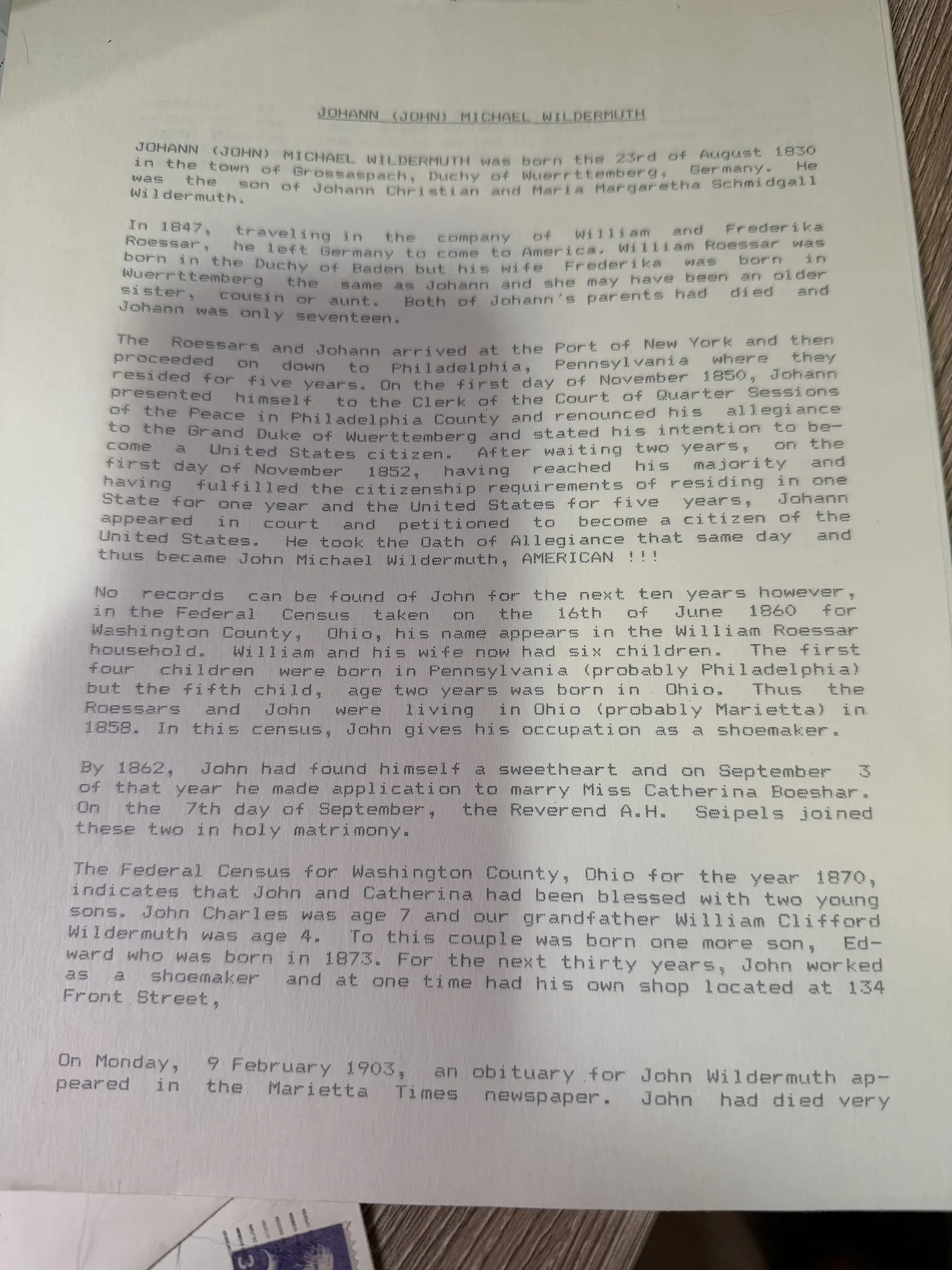
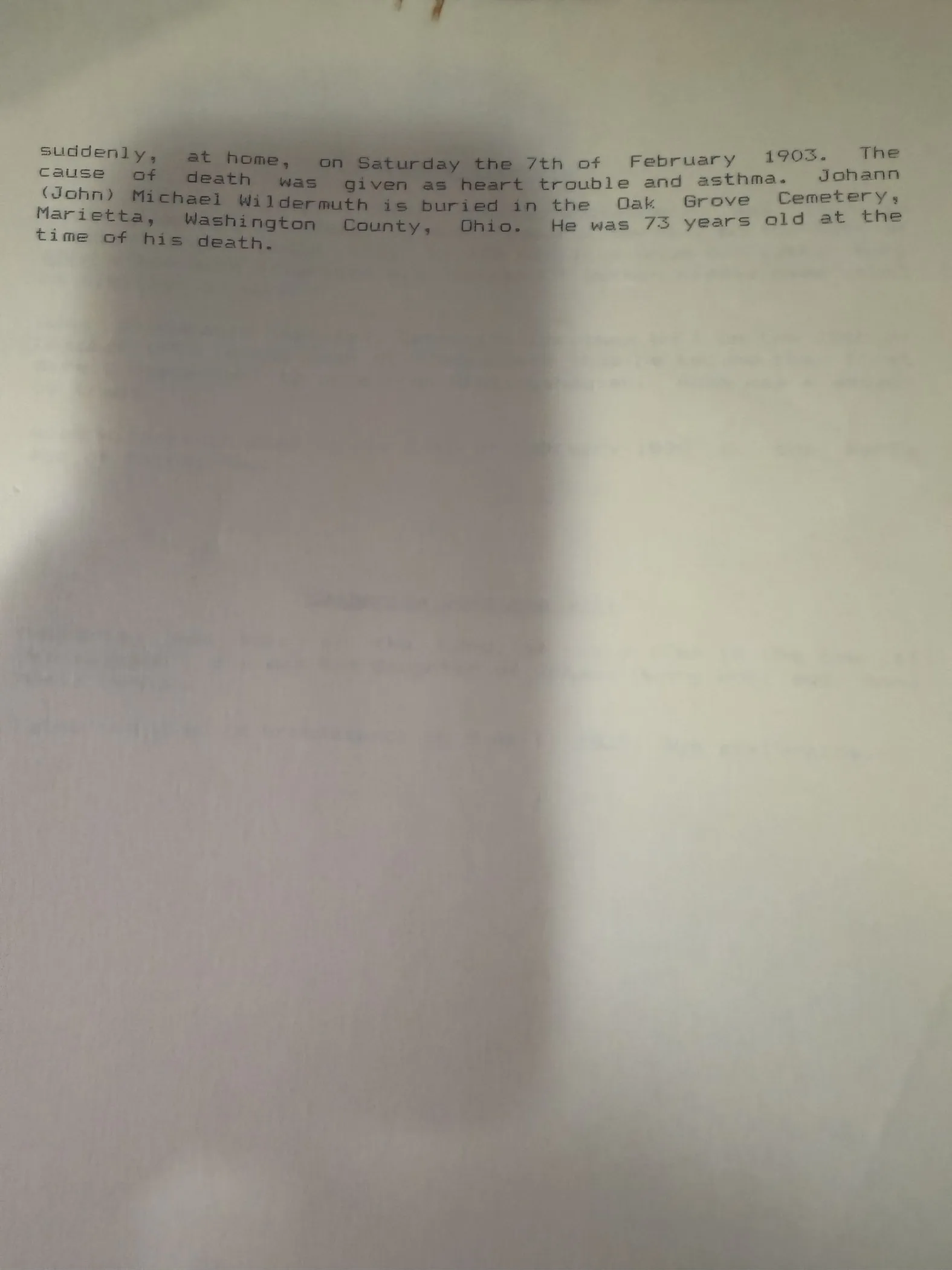
This is an earlier draft of the finished account, and its dates are different again. Across his drafts the two Philadelphia court appearances drift:
| Draft | Declaration | Petition and oath |
|---|---|---|
| This one | 1 Nov 1850 | 1 Nov 1852, “after waiting two years” |
| The finished account | 1 Nov 1852 | 1 Nov 1852 (second date a slip) |
| The documents | 1 Nov 1852 (index) | 1 Nov 1853 (the petition itself) |
He had the structure right from the start — declaration, wait, petition and oath the same day — and never quite pinned the years. The documents settle them.
This draft also gives his age at death as 73; the finished one says 72. Born 23 August 1830 and dead 7 February 1903, he was 72.
Two details here are better than the transcription the archive was working from: the marriage application is dated September 3 (matching the application itself, where the OCR’d text had “September 6”), and the minister is the Reverend A. H. Seipels. And Robert Earl is more careful about Frederika than later summaries suggest — “she may have been an older sister, cousin or aunt.”
Source: Robert Earl Wildermuth’s genealogical research papers, c. 1988–93; photographed 2026. Transcribed text: the Little Histories.
Catalogue
- Type
- Document
- Medium
- Typed one-page ancestor sketches and a research essay, from a genealogical file
- Date created
- c. 1988–1993
- Place created
- Casselberry, Florida
- ID number
- WILD
- Provenance
- Robert Earl Wildermuth's genealogical research papers; in Chuck's keeping. Photographed 2026.
- Rights
- Family use; permission required for republication.
Pictured
- Robert Earl Wildermuth
- Johann Michael Wildermuth
- Andreas Adam Wildermuth
- Adam Wildermuth
- Catharina Dorothea (Wolf) Wildermuth
- Johann Christian Wildermuth
- Maria Margaretha Schmidgall
- Johann Georg Wolf
- Anna Maria (Werner) Wolf
- Georg Wilhelm Schmidgall
- Anna Catherina Landai
- Joseph Landai
- Maria Dorothea Wild
- Jacob Schmidgall
- Johann Georg Werner
- Barbara Phillipp