The two index books in the Orlando public library — the first official lead
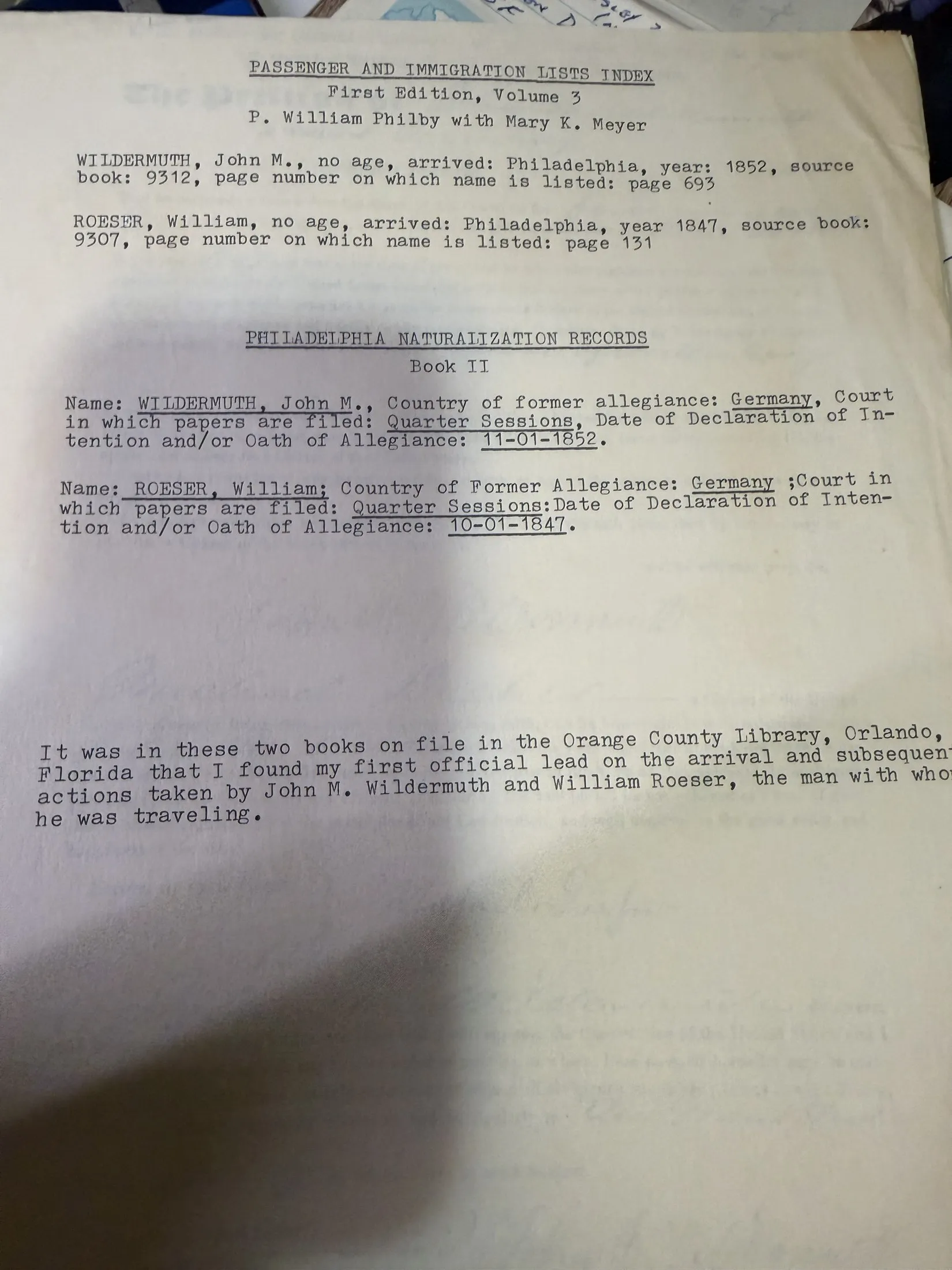
Two typed entries copied out of two reference books on the shelf of a public library in Florida. In Robert Earl Wildermuth’s own words at the foot of the page:
“It was in these two books on file in the Orange County Library, Orlando, Florida that I found my first official lead on the arrival and subsequent actions taken by John M. Wildermuth and William Roeser, the man with whom he was traveling.”
What the entries say
Passenger and Immigration Lists Index, First Edition, Volume 3 — P. William Filby with Mary K. Meyer:
WILDERMUTH, John M., no age, arrived: Philadelphia, year: 1852, source book 9312, page 693 ROESER, William, no age, arrived: Philadelphia, year: 1847, source book 9307, page 131
Philadelphia Naturalization Records, Book II:
WILDERMUTH, John M. — former allegiance Germany — court Quarter Sessions — Date of Declaration of Intention and/or Oath of Allegiance: 11-01-1852 ROESER, William — former allegiance Germany — court Quarter Sessions — Date of Declaration of Intention and/or Oath of Allegiance: 10-01-1847
This is where the wrong premise came from
For years Robert Earl told courthouses and the National Archives that his great-grandfather had “arrived in this country at the Port of Philadelphia in the year 1850” — or 1851, or 1852. Here is the source of that belief: Filby’s index says “arrived: Philadelphia, year: 1852.”
But Filby’s Passenger and Immigration Lists Index is an index to published lists of names, and its source books here are the naturalization compilations, not ship manifests. The “arrival” column has taken the court date and reported it as an arrival. The same thing happened to Roeser, whose 1847 entry is his declaration date, not a landing.
So the Philadelphia arrival never existed. Johann Michael landed at New York in 1847, as his own 1853 petition swears. He spent a decade hunting Philadelphia shipping records for a voyage that had docked in another state — because a reference book turned a courthouse date into a port of entry.
And this is what resolves the naturalization
The Book II entry gives 11-01-1852 — 1 November 1852. The petition in the family’s keeping is dated 1 November 1853, exactly one year later.
Those are two separate court appearances, and together they make the sequence plain:
| 1 November 1852 | Declaration of intention, Court of Quarter Sessions — indexed in Book II, and the document the City of Philadelphia sold him a photocopy of in 1983 as “the declaration of intention” |
| 1 November 1853 | Petition, witness affidavit, and oath of allegiance sworn in open court — the sheet Chuck holds |
The 1853 petition recites that he “declared on oath before the Clerk of this Court, on the first day of November” — with the year left blank on the printed form. It is pointing back at 1852. That blank is what made the two documents look like one, and made a completed naturalization look like an unfinished intention.
He was naturalized on 1 November 1853. Robert Earl reached the same conclusion in his own narrative of his great-grandfather’s life: “He took the oath of allegiance that same day and thus became JOHN Michael Wildermuth, AMERICAN.”
(One caveat kept in view: the Book II column is headed “Declaration of Intention and/or Oath of Allegiance,” so the index itself does not distinguish which of the two it recorded. The court’s own docket for either date would put it beyond argument.)
Source: Robert Earl Wildermuth’s genealogical research papers, filed WILD-8; entries transcribed by him from the Orange County Library, Orlando. Photographed 2026.
Catalogue
- Type
- Document
- Medium
- Typed transcription of two published index entries
- Date created
- c. 1980s
- Place created
- Orange County Library, Orlando, Florida
- ID number
- WILD-8
- Provenance
- Robert Earl Wildermuth's genealogical research papers; in Chuck's keeping. Photographed 2026.
- Rights
- Family use; permission required for republication.