Andreas Adam Wildermuth
also known as Andreus (in Robert Earl's 1990 Heritage); the Weingärtner of Rielingshausen
b. 1745-11-30, Rielingshausen, Backnang, Württemberg, Germany
d. 1771-06-01, Rielingshausen, Marbach, Württemberg, Germany
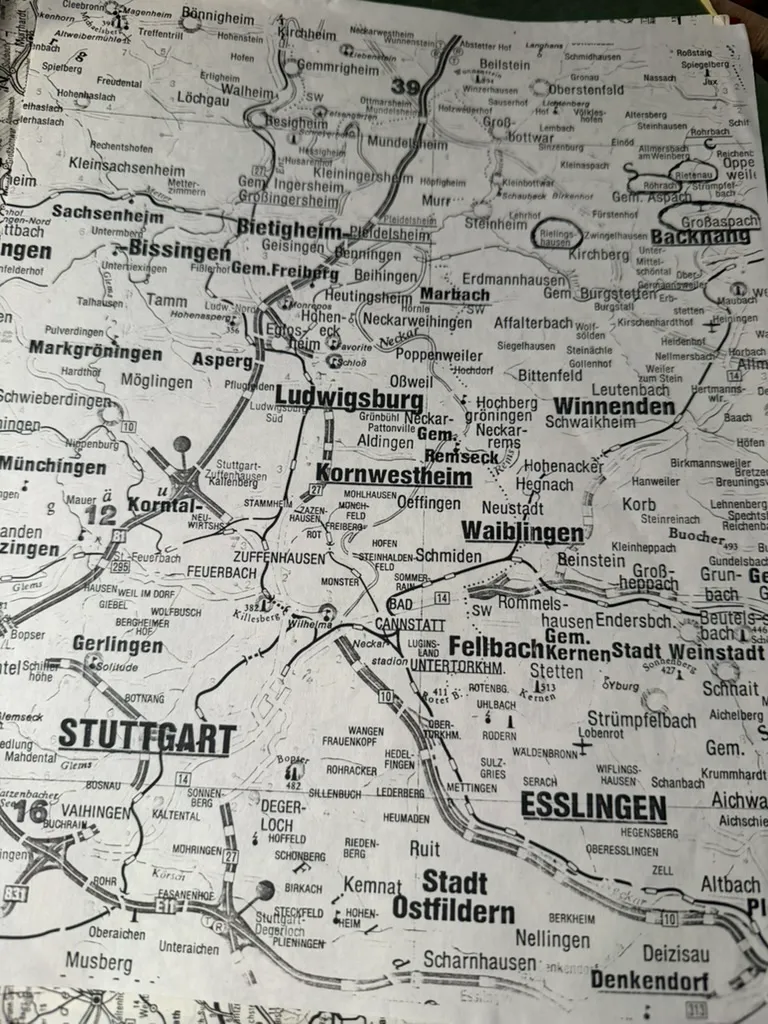
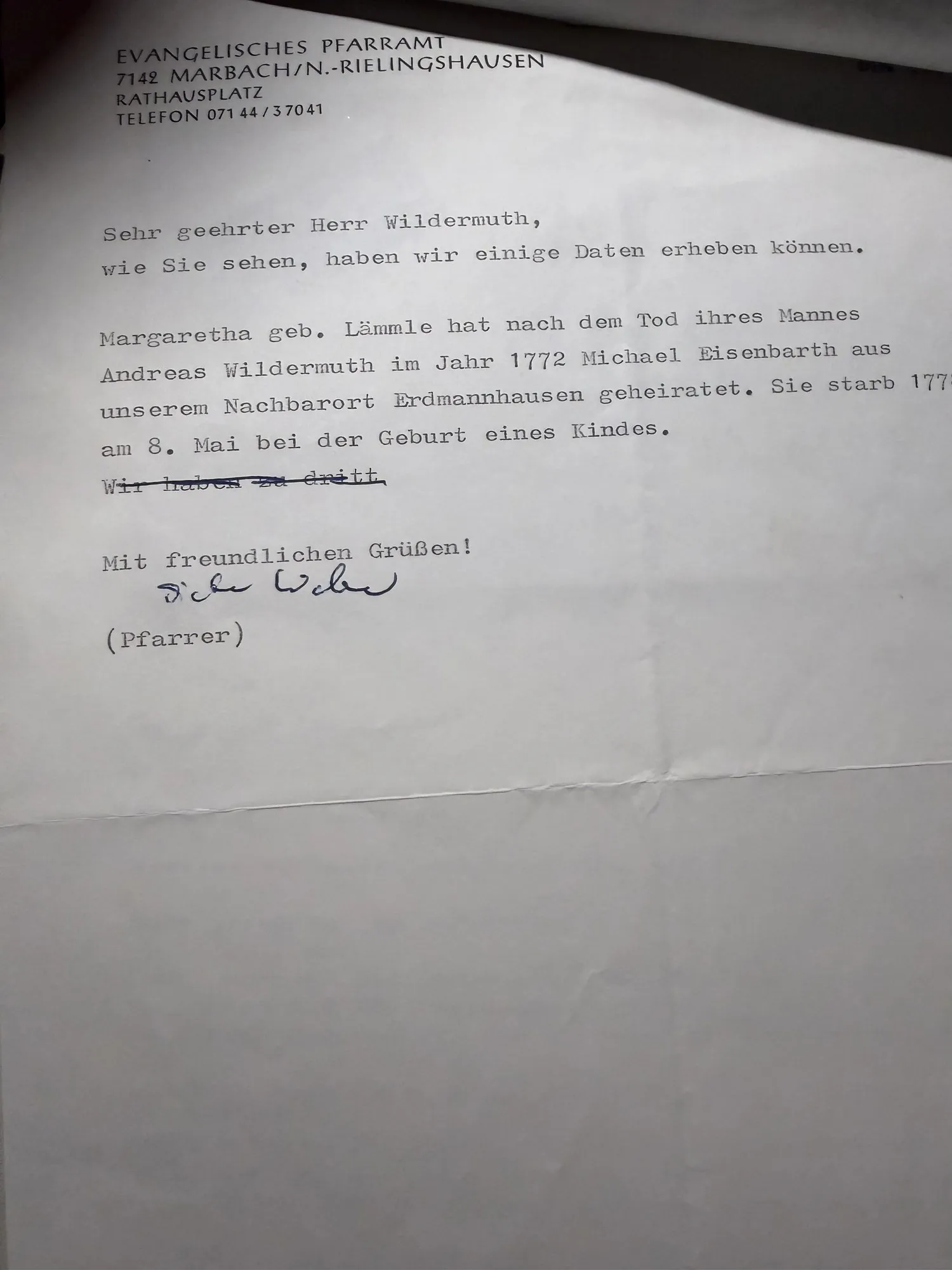
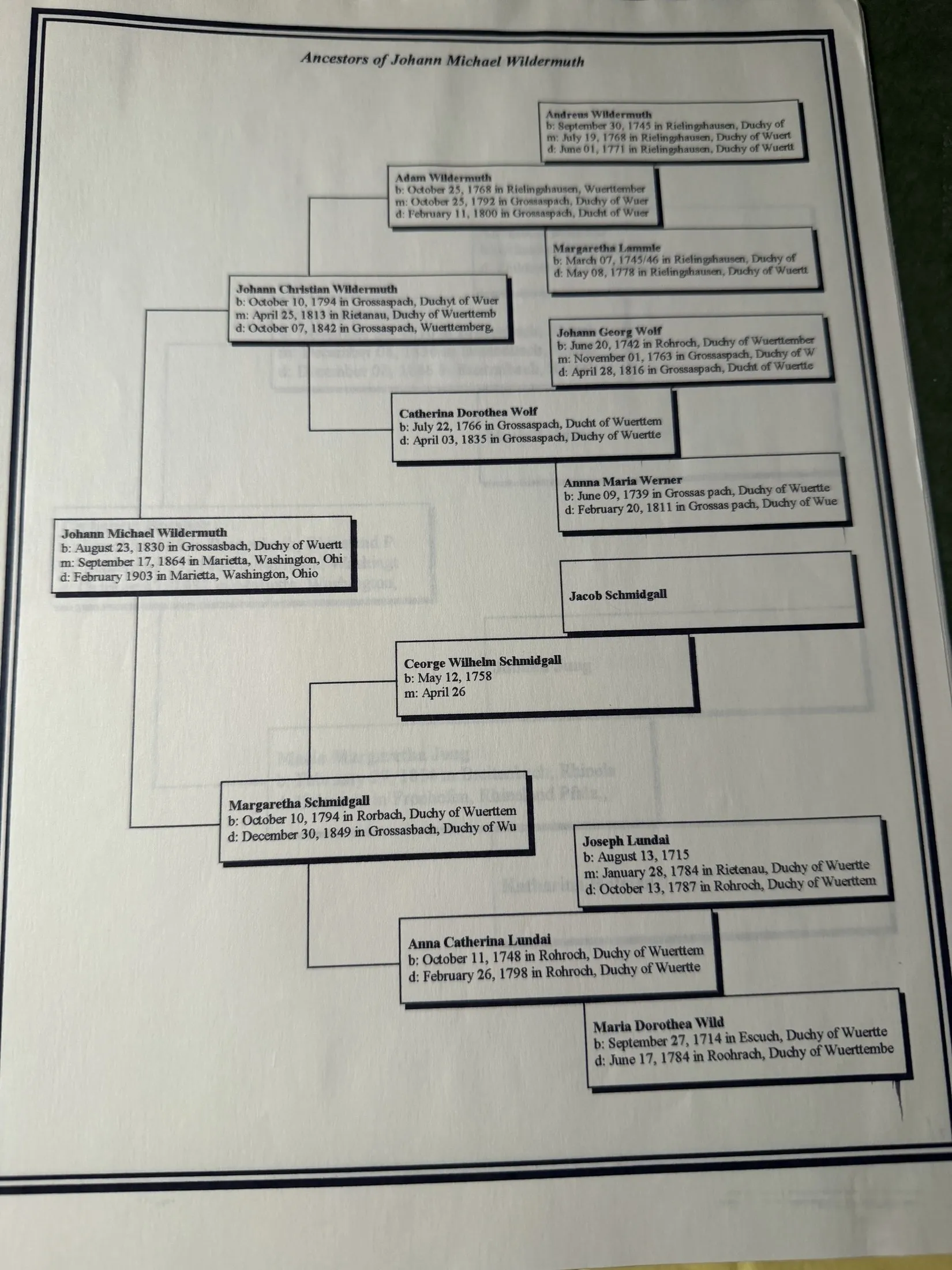
He was born 30 November 1745 in Rielingshausen — the small Württemberg village 20 kilometers northeast of Stuttgart, on the Neckar river, in the heart of the German wine country. His parents were Johann Adam Wildermuth (1720–1768) and Rosina Kreher (b. 2 June 1721, Kirchberg an der Murr). He married Margaretha Lämmle (b. 7 March 1746, Rielingshausen) on 19 July 1768 in the same village. When his father Johann Adam died later that same year, Andreas was twenty-two — newly married, expecting his first child — and that child, born just after, was named Adam after the just-deceased grandfather. Robert Earl’s 1990 Heritage knew him as Andreus, an Anglicized spelling that has carried in the family record; the parish register at Rielingshausen has him as Andreas Adam Wildermuth. He died young, on 1 June 1771 at twenty-five, leaving his three-year-old son Adam and the still-young Margaretha in the village. She remarried the following year — Michael Eisenbarth of neighbouring Erdmannhausen — and died in childbirth in 1778.
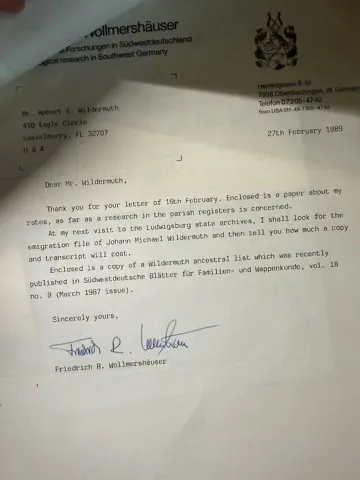
His four Rielingshausen dates — birth, marriage, death, and his parents’ names — were independently confirmed from the parish registers themselves when the village pastor annotated and returned the ancestor chart Robert Earl mailed him. They are not resting on a database alone.
A Weingärtner in the Neckar vineyards
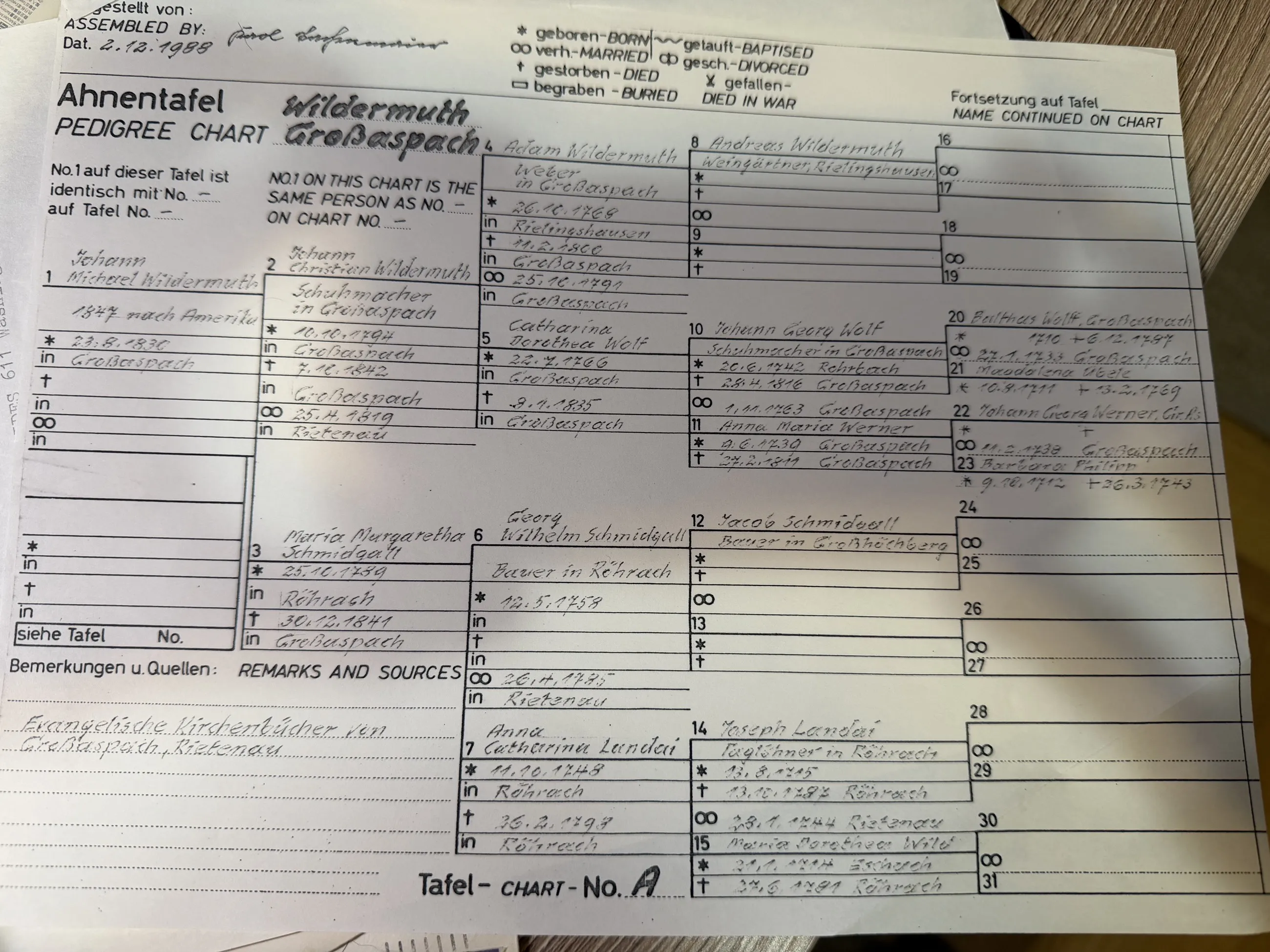
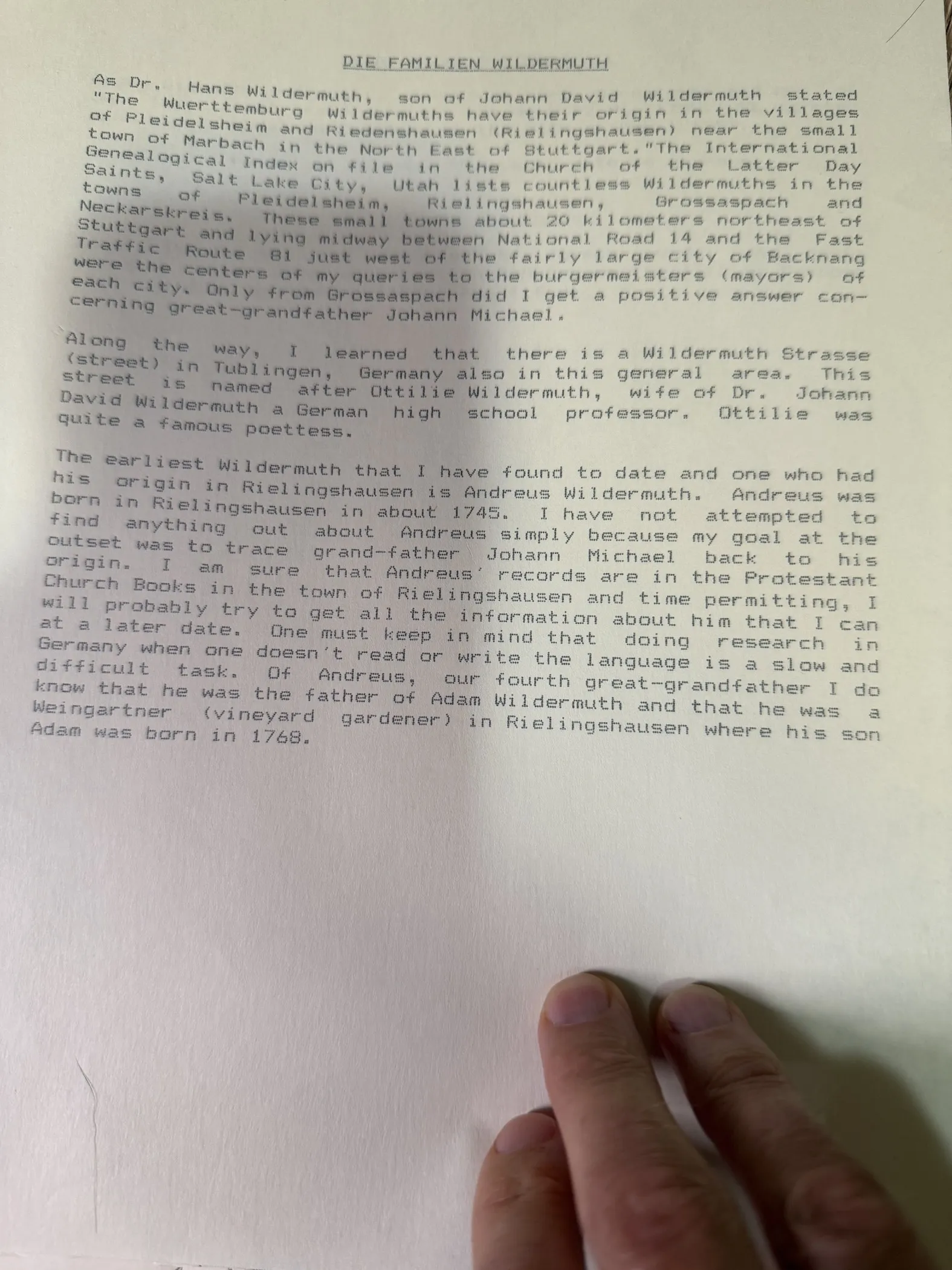
His trade was Weingärtner, and it is written that way in a German hand: the 1988 Ahnentafel compiled from the Großaspach parish registers gives him as “Andreas Wildermuth — Weingärtner, Rielingshausen”, and Robert Earl typed the same word into his research essay. Modern German spells it Weingärtner, and it is not a general gardener at all but the specific Württemberg term for a vine-dresser: the man who works the vines, tending the steep south-facing slopes along the Neckar and its tributary streams. The wine country between Marbach, Backnang, and Rielingshausen had been planted in grapes since the medieval period; the Trollinger and Riesling vines his hands managed grow there to this day. A Weingärtner was the village’s specialist in the long, slow seasonal arc of viticulture: pruning the vines in March, training the new shoots in May, thinning the canopy in July, watching for mildew through the wet weeks of August, and bringing in the harvest in late September or October. The work was done largely by hand, with simple tools — pruning knives, hoes, baskets — and the long days were structured by the small village’s bells and the position of the sun on the slopes.
The wine the vines produced was almost entirely for local consumption. Württemberg’s wine industry would not become widely export-oriented until the 19th century. Andreus’s work fed the local taverns, the church communion table, the household tables of village families who drank their wine from earthenware mugs and the cellar windows of the merchant houses in nearby Marbach. Whatever Andreus knew about the work — how to read the soil, how to time the harvest by the changing weight of the grapes in his hands — he had learned from his father Johann Adam, who had learned it from his father, and so back to Johannes Wildermuth in the year of the Peace of Westphalia.
What he passed on
He fathered at least two documented children with Margaretha Lämmle. The line that descends to Marietta runs through Adam Wildermuth, born 26 October 1768 in Rielingshausen — the village his family had lived in for at least four generations by the time he was born. Adam moved fifteen kilometers north to Großaspach, where he took up a different trade — the Familienregister names him Bürger und Weber, citizen and weaver — and where he died young (11 February 1800). The vineyard work does not appear to have passed down; the move out of Rielingshausen was also a move out of the trade. Adam’s grandson Johann Christian Wildermuth (1794–1842) — actually Adam’s son, born only four years before Adam died — would father in turn Johann Michael Wildermuth, born 23 August 1830 in Großaspach, who in 1847 became the first of this line in nearly two hundred years to leave Württemberg.
Robert Earl Wildermuth, doing the genealogical research in Orlando in the 1980s, identified Andreas as the deepest ancestor he could reach. His 1990 note, the closing summary of what he had found:
I have not attempted to go back any farther than Andreus — my goal at the start was to find the first Wildermuth in America…. I don’t know who his father was or his mother. Andreus, our fourth great-grandfather. I do know that he was the father of Adam Wildermuth, and that he was a gartner (vineyard gardener) in Rielingshausen.
The June 2026 GEDCOM cross-check (Dale Eesley / FamilySearch) carried Robert Earl’s open question two generations further: Andreas’s parents were Johann Adam Wildermuth (1720–1768) and Rosina Kreher (b. 1721 Kirchberg an der Murr, married 11 June 1743 Rielingshausen); Johann Adam’s parents in turn were Johannes Wildermuth (b. 28 December 1682 Rielingshausen) and Margaretha Grayers (b. ~1685 Rielingshausen, married 27 September 1708). Earlier still, Johannes Wildermuth (b. ~1650) sits in the same village in the year of the Peace of Westphalia. The Rielingshausen parish ledgers are documented from 1521, so further generations beyond the existing tree are recoverable from the Kirchenbücher in the Landeskirchliches Archiv Stuttgart.
A telling blank. On that 1988 Ahnentafel his row carries his name and his trade and no dates at all — because Andreas belonged to Rielingshausen, a different parish from the Großaspach and Rietenau registers the compiler was working. The empty line is the shape of the gap Robert Earl then spent four years closing, by writing to the Rielingshausen parish.
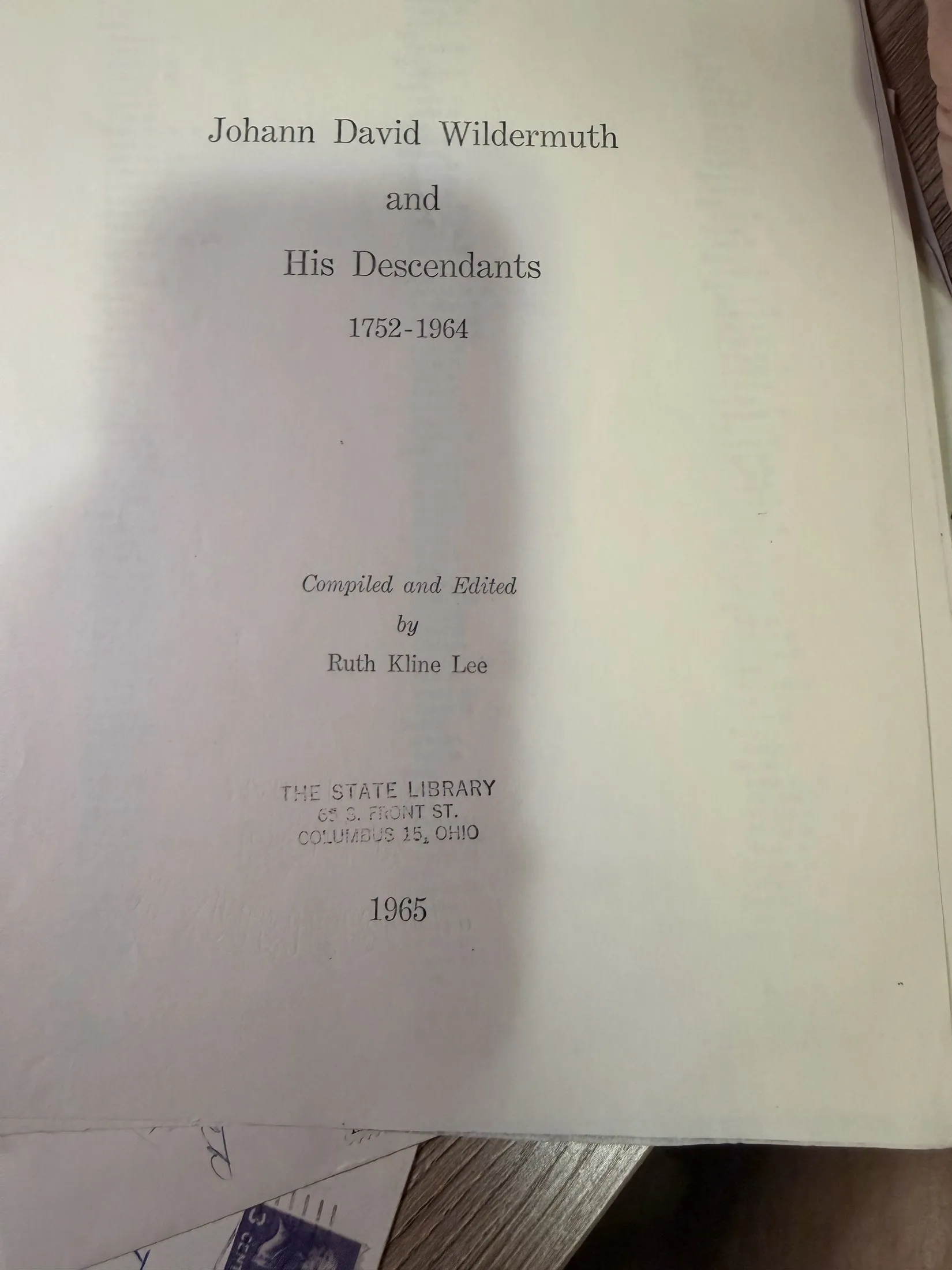
Sources: The Wildermuth/Fleming Heritage by Robert Earl Wildermuth, 1990; the 1988 Ahnentafel and the original ‘Little Histories’ pages, both giving the trade as Weingärtner; FamilySearch family tree (Chuck Eesley, 2026).
Appears in
- The Wildermuth/Fleming Heritage (Robert Earl Wildermuth, 1990) — ancestor-sketch
Pictured in