Ahnentafel Wildermuth, Großaspach — compiled from the parish registers, 2 December 1988
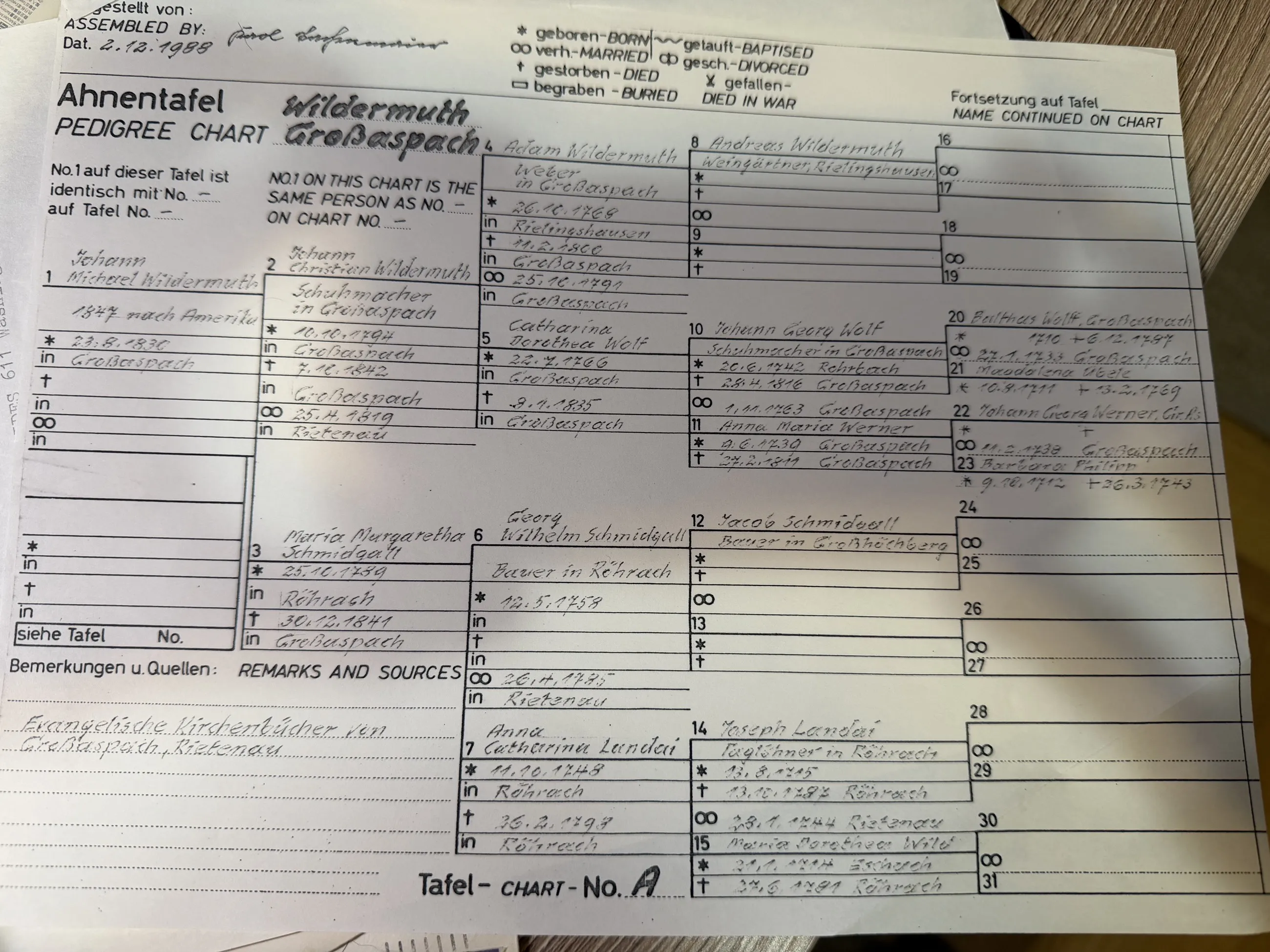
This is the document all the others were copied from — and the archive has been working from its descendants for years without having seen it.
A printed bilingual Ahnentafel form, headed “Ahnentafel Wildermuth Großaspach”, filled out by hand and signed by Karl Lachenmaier of Großaspach, dated 2 December 1988. Its source line is the important part:
Bemerkungen u. Quellen / REMARKS AND SOURCES: Evangelische Kirchenbücher von Großaspach, Rietenau (the Protestant parish registers of Großaspach and Rietenau)
Somebody in Germany went to the church books and wrote the family out. This is the “positive answer” Robert Earl mentioned getting from Großaspach, and it is the origin of the Little Histories he began writing that same month — his census notes are dated December 1988 too.
The man who compiled it: Karl Lachenmaier
The signature at the top of the form is his, and a covering note in the same file gives the name and the whole exchange.
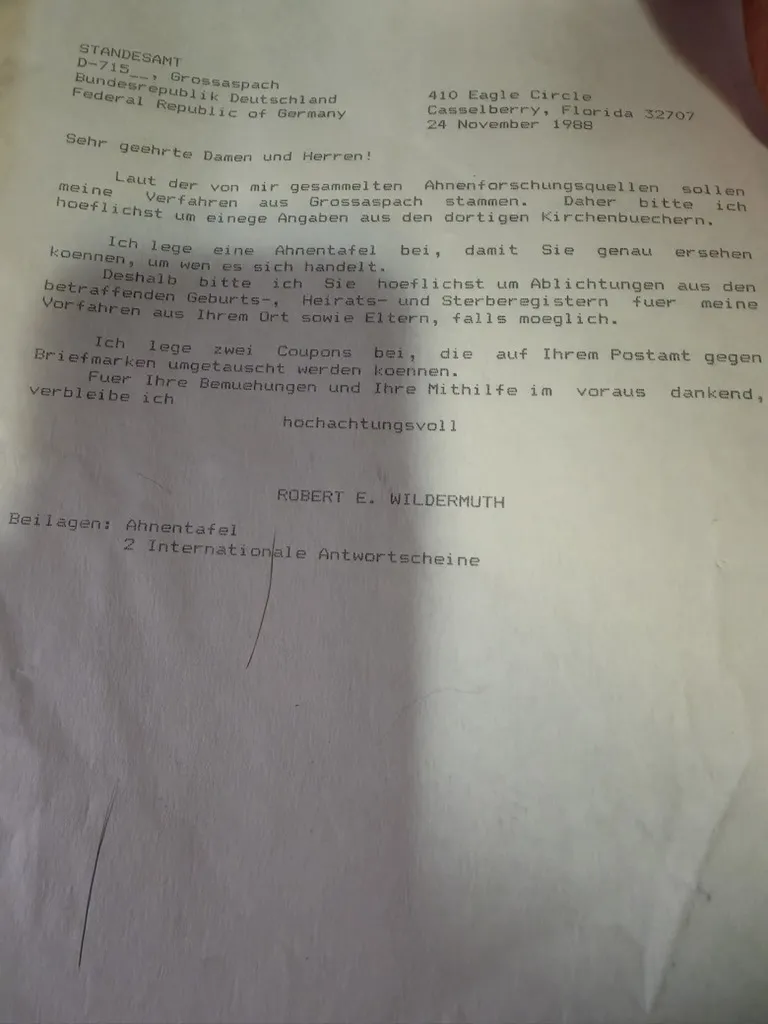
24 November 1988 — Robert Earl writes, in German, to the Standesamt (civil registry) at Großaspach:
“Laut der von mir gesammelten Ahnenforschungsquellen sollen meine Vorfahren aus Grossaspach stammen … Deshalb bitte ich Sie hoeflichst um Ablichtungen aus den betreffenden Geburts-, Heirats- und Sterberegistern fuer meine Vorfahren aus Ihrem Ort sowie Eltern, falls moeglich.”
(“According to the genealogical sources I have collected, my ancestors are said to come from Grossaspach … I therefore most politely request photocopies from the relevant birth, marriage and death registers for my ancestors from your town, and their parents if possible.”)
Beilagen: Ahnentafel · 2 Internationale Antwortscheine — enclosures: an ancestor chart, and two international reply coupons.
The town hall passed it to Karl Lachenmaier, who did the work: dated this chart 2 December, wrote a covering letter on 3 December, and enclosed a photocopy of the baptismal register page.
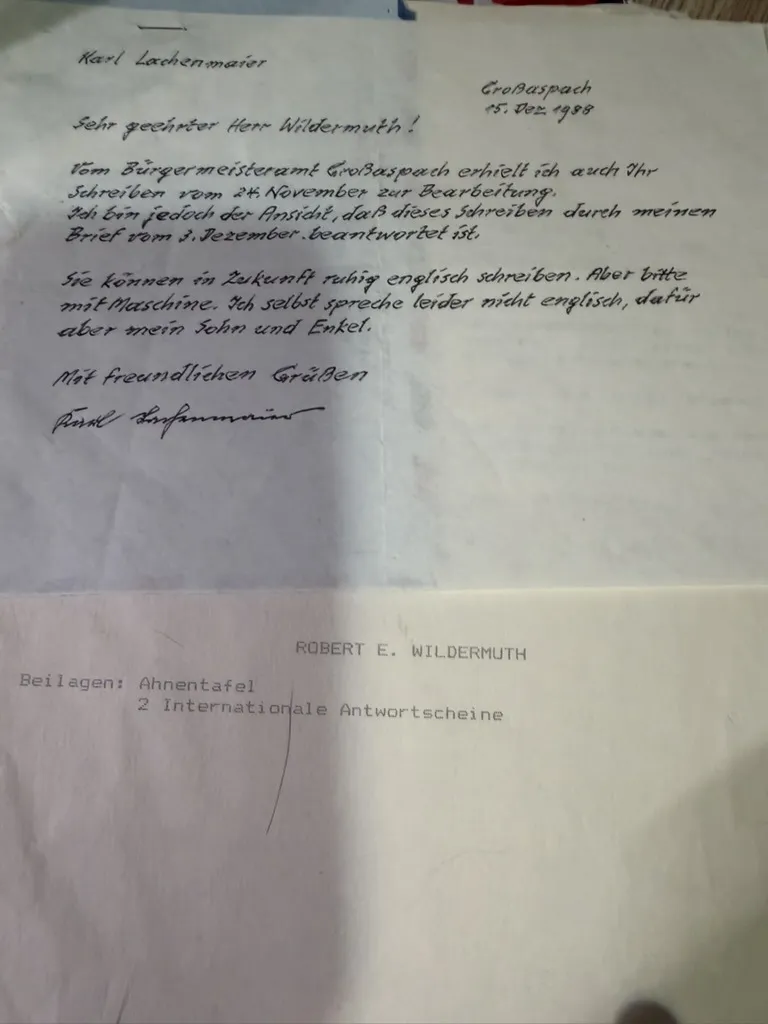
Then, on 15 December 1988, a second note in his own hand — because the town hall had forwarded a duplicate:
“Vom Bürgermeisteramt Großaspach erhielt ich auch Ihr Schreiben vom 24. November zur Bearbeitung. Ich bin jedoch der Ansicht, daß dieses Schreiben durch meinen Brief vom 3. Dezember beantwortet ist.
Sie können in Zukunft ruhig englisch schreiben. Aber bitte mit Maschine. Ich selbst spreche leider nicht englisch, dafür aber mein Sohn und Enkel.“
(“From the mayor’s office at Großaspach I also received your letter of 24 November for handling. I am however of the view that this letter is answered by my letter of 3 December. You may quite happily write in English in future. But typed, please. I myself unfortunately do not speak English — but my son and grandson do.”)
Two strangers, one of whom “understands only a little German” and the other no English, arranging to correspond through the second man’s grandson. That is how the German half of this archive was recovered — and it dates the breakthrough to a fortnight in December 1988.
What it records
| No. | Person | Trade | Dates |
|---|---|---|---|
| 1 | Johann Michael Wildermuth | 1847 nach Amerika | * 23.8.1830 Großaspach |
| 2 | Johann Christian Wildermuth | Schuhmacher in Großaspach | * 10.10.1794 · † 7.10.1842 · ∞ 25.4.1819 Rietenau |
| 3 | Maria Margaretha Schmidgall | * 25.10.1789 Röhrach · † 30.12.1841 Großaspach | |
| 4 | Adam Wildermuth | Weber in Großaspach | * 26.10.1769 Rielingshausen · † 11.2.1800 · ∞ 25.10.1791 |
| 5 | Catharina Dorothea Wolf | * 22.7.1766 · † 9.4.1835 Großaspach | |
| 6 | Georg Wilhelm Schmidgall | Bauer in Röhrach | * 12.5.1758 · ∞ 26.4.1785 Rietenau |
| 7 | Anna Catharina Landai | * 11.10.1748 Röhrach · † 26.2.1798 | |
| 8 | Andreas Wildermuth | Weingärtner, Rielingshausen | no dates |
| 10 | Johann Georg Wolf | Schuhmacher in Großaspach | * 20.6.1742 Rohrbach · † 28.4.1816 · ∞ 1.11.1763 |
| 11 | Anna Maria Werner | * 9.6.1739 · † 27.2.1817 Großaspach | |
| 12 | Jacob Schmidgall | Bauer in Großhöchberg | no dates |
| 14 | Joseph Landai | Taglöhner in Röhrach | * 13.8.1715 · † 13.10.1787 Röhrach · ∞ 23.1.1744 Rietenau |
| 15 | Maria Dorothea Wild | ||
| 20 | Balthus Wolf, Großaspach | * 1710 · † 6.12.1787 · ∞ 27.1.1733 | |
| 21 | Magdalena Übele | * 10.8.171? · † 13.2.1769 | |
| 22 | Johann Georg Werner | ∞ 11.2.1738 Großaspach | |
| 23 | Barbara Philipp | * 9.10.1712 · † 26.3.1743 |
What it settles
Three trades, in the German original.
- Andreas Wildermuth — Weingärtner, Rielingshausen. Not Gärtner. A vine-dresser, written by a German compiler reading a German register. The archive’s long-standing “Gartner (vineyard gardener)” was a good gloss on an imprecise word; this is the word.
- Johann Georg Wolf — Schuhmacher in Großaspach. The shoemaking trade, in the parish register, a generation before the Wildermuths took it up. Confirms what his sketch said in English and settles that the trade came in through the Wolf line.
- Adam Wildermuth — Weber. Weaver, matching the Familienregister exactly.
Also Georg Wilhelm Schmidgall — Bauer (farmer) at Röhrach, Jacob Schmidgall — Bauer at Großhöchberg, and Joseph Landai — Taglöhner (day labourer) at Röhrach. Farmer, farmer, day labourer, vine-dresser, weaver, shoemaker: six trades across four generations, all of them in villages within about twenty kilometres of each other.
Two dates the archive had wrong, now confirmed from the registers.
- Johann Christian’s marriage: 25 April 1819 at Rietenau. Not 1842, not “Ristenau.” Third independent confirmation, and the strongest.
- Maria Margaretha’s death: 30 December 1841. Not 1849 (the GEDCOM), not 1847 (his own sketch). This is the reading that makes Johann Michael an orphan at twelve.
- And Adam’s marriage: 25 October 1791, not the 1797 his sketch gave.
Why Andreas is blank
Row 8 carries his name and his trade and not one date. The German compiler working the Großaspach and Rietenau registers in 1988 could go no further back on the Wildermuth male line, because Andreas belonged to Rielingshausen — a different parish, in a different district.
That is exactly what Robert Earl wrote at the time: “I have not attempted to find anything out about Andreus … I am sure that Andreus records are in the Protestant Church Books in the town of Rielingshausen.” He was right, and it took him until about 1992 — and a letter to that parish — to fill the row in. The blank line here is the shape of the gap he then went and closed.
Small discrepancies, left open
The handwriting is confident but the photograph is a photograph, and a few digits are readings rather than certainties:
- Adam’s birth looks like 26.10.1769; the archive and the GEDCOM have 1768, and Robert Earl’s own 1989 chart has 28 October 1768. Three values for one day.
- Balthus Wolf’s marriage reads 27.1.1733 here (27 January, in German day-first order) against 27 July 1733 in the sketch — the kind of slip a reader unused to German date order would make.
- Magdalena Übele’s birth could be 1711 or 1717; her sketch says 1717.
- Joseph Landai’s marriage reads 23.1.1744; his sketch says 2 April 1744 and the 1989 chart 2 August 1744.
- Johann Georg Wolf’s birthplace is written Rohrbach while the rest of the family is Röhrach — possibly the same village, possibly not.
None of these touch the direct line’s structure. They are noted so that whoever holds the sheet next can settle them from the paper rather than from a photograph.
Source: Ahnentafel “Wildermuth Großaspach,” Chart No. A, compiled by Karl Lachenmaier, 2 December 1988 from the Evangelische Kirchenbücher of Großaspach and Rietenau; in Robert Earl Wildermuth’s research papers. Photographed 2026.
Catalogue
- Type
- Document
- Medium
- Printed bilingual German/English Ahnentafel pedigree form, completed by hand in ink
- Date created
- 2 December 1988
- Place created
- Großaspach, Baden-Württemberg
- ID number
- Tafel/Chart No. A
- Provenance
- Compiled by Karl Lachenmaier of Großaspach and sent to Robert Earl Wildermuth, December 1988; in his research papers, in Chuck's keeping. Photographed 2026.
- Rights
- Family use; permission required for republication.
Pictured
- Robert Earl Wildermuth
- Johann Michael Wildermuth
- Johann Christian Wildermuth
- Maria Margaretha Schmidgall
- Adam Wildermuth
- Catharina Dorothea (Wolf) Wildermuth
- Andreas Adam Wildermuth
- Johann Georg Wolf
- Anna Maria (Werner) Wolf
- Georg Wilhelm Schmidgall
- Anna Catherina Landai
- Jacob Schmidgall
- Joseph Landai
- Maria Dorothea Wild
- Balthus Wolf
- Magdalena Ubele
- Johann Georg Werner
- Barbara Phillipp