John Eesley
also known as John Easley (1851 census spelling); 'John Early' (American records); 'John Sr.' to distinguish from his son John (d. 1874)
b. 1799-01, bap. Hanwell, Oxfordshire (Jan 1799)
d. 1870-02-04, Newark, Essex County, New Jersey, United States
John Eesley was baptized at Hanwell, Oxfordshire, on 6 January 1799 — the parish register records him as “John, Son of Joseph & Frances Eesly.” He was the only child of Joseph Eesley and Frances “Fanny” Ayris recorded at Hanwell, and married Susannah Bubb at Charlecote, Warwickshire, on 10 May 1819 — a marriage the Charlecote register preserves with his own signature.
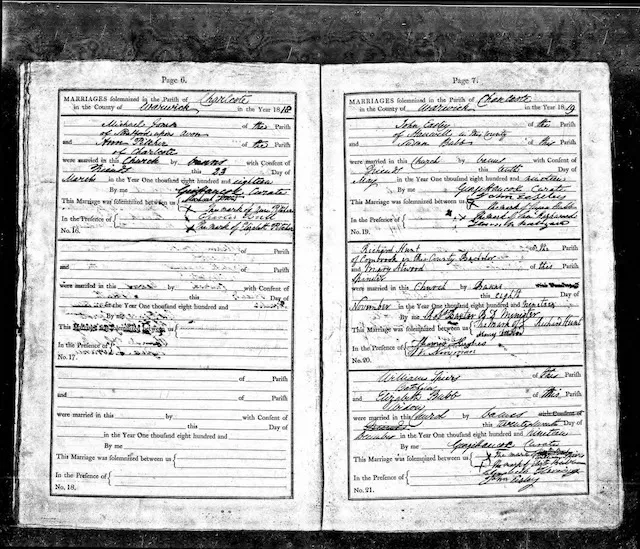
The Charlecote parish marriage register, 1818–19 — the Warwickshire church where John Eesley and Susannah Bubb were married on 10 May 1819. Photographed on the family’s England research trip. (His father Joseph had been baptized a generation earlier at St Mary’s, Banbury, the family’s market town four miles east — see Joseph’s page for the church.) The 1851 census placed him at Rother Street in Old Stratford, age 51, a journeyman miller, with Susannah (50, born Charlecote) and several of their eleven children.
Across the Atlantic — 1856
John did not stay in England. Per the family’s FamilySearch record, he emigrated in 1856, sailing from Liverpool aboard the Antarctic and arriving at New York on 7 July 1856, at about fifty-seven. By the 1861 census he was at North Dumfries, Waterloo County, Ontario — the same Ayr-area township where his son Albert Robert was working in the Goldie family’s mill and married Jennie Goldie that same year. He later settled at Newark, Essex County, New Jersey, where he died on 4 February 1870, age 71 — the same New Jersey city where Mary Eesley Bean’s 1985 register placed an Eesley emigrant family with a bakery.
What a crossing like his was. The Antarctic was a sailing packet — a wind-powered emigrant ship of the kind that still carried most transatlantic passengers in 1856, in the last years before steamers took over the Liverpool run. A westbound passage under sail, beating against the prevailing Atlantic westerlies, typically ran five to six weeks (a fast steamer of the day could already do it in about two); rough weather could stretch it longer. Most emigrants traveled steerage — the crowded ’tween-deck below the main deck, fitted with tiers of rough wooden bunks, poorly lit and poorly ventilated, where families were packed together for the whole voyage, cooked in shifts at shared galley fires, and rode out the seasickness and storms of the open ocean. By 1856 the British Passenger Acts (tightened in 1855) set minimum standards for space, provisions, and ventilation, so the ships were better regulated than the notorious famine-era “coffin ships” of the late 1840s — but a steerage passage was still weeks of hard, close, uncomfortable travel. John made it at about fifty-seven, well past the age of the young single adults who made up most of the emigrant stream. Arriving in New York on 7 July 1856, he would have come ashore at Castle Garden — the immigrant receiving depot that had opened at the Battery in August 1855, the first of its kind in the country, where new arrivals were sheltered, given onward-travel information, and (at least in principle) shielded from the “runners” who preyed on bewildered newcomers. Ellis Island was still more than thirty years away.
This reframes the emigration thread: it was not only the sons who crossed. John Sr. himself made the Atlantic passage in middle age, following the milling family to Ontario and ending his life in New Jersey. (He appears in some American hands as “John Early,” and he and his son John, 1832–1874, are easily conflated in the New Jersey records; the Bean register’s spouse-name “Hannah Bubb” looks like a blend of John Sr.’s wife Susannah and their daughter Hannah.)
His occupation as a miller is not incidental: the trade ran through the line and across the Atlantic. Albert Robert went to Canada to work in the Goldie family’s flour operation (the Goldies had emigrated from Ayrshire Scotland to Ontario in 1841) — so what can look like an emigration to Scotland was in fact a move to a Scottish-Canadian firm in Ontario. Albert’s son John Franklin Eesley would be born in Hamilton, Ontario in 1859 and eventually found the Sunshine Flour Mill in Plainwell, Michigan — so the milling thread runs Hanwell → Old Stratford → Ontario → Michigan, with John Sr. himself among those who crossed.
Spellings vary across the records: “Eesley” in parish registers, “Easley” in some American census hands. Dale’s tree standardizes to Eesley.
Sources: Dale Eesley / FamilySearch — John Eesley (MS7P-DQ7). Voyage context: the 1856 Liverpool–New York emigrant arrivals (TheShipsList); the Castle Garden emigrant depot, opened August 1855; and the British Passenger Acts that governed steerage conditions in the 1850s.
Appears in
- Eesley Family History (1985) — register
- Eesley Line Research Notes — Oxford Public Library — ancestor-sketch