The Rielingshausen War Memorial — the Wildermuths Who Stayed (1914–18 & 1939–45)
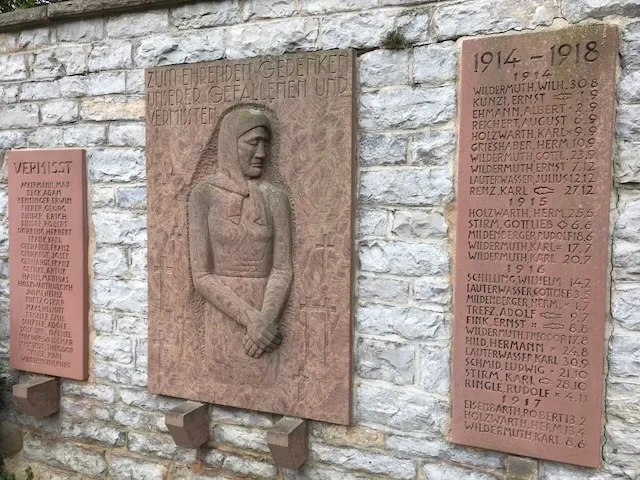
Set into the churchyard wall at Rielingshausen — the documented cradle of the Wildermuth clan — is the village’s memorial to its dead of the two world wars. A carved relief of a mourning woman stands between the tablets, above the inscription “ZUM EHRENDEN GEDENKEN UNSERER GEFALLENEN UND VERMISSTEN” — “to the honored memory of our fallen and missing.” A separate “Vermisst” (missing) tablet lists those never recovered.
The Wildermuth name recurs down every panel — the cost of the two wars to the village’s most populous family. This is the mirror image of Chuck’s own line: while these men stayed in Württemberg and died in the trenches and on the Eastern Front, Johann Michael Wildermuth had left Rielingshausen’s neighbor-village Großaspach for Marietta, Ohio in 1847 — two or three generations before these names were carved. His American descendants fought in the same two wars from the other side of the ocean (Robert Earl as a B-24 navigator in the Pacific).
The Wildermuth war dead
1914–1918 — Wildermuth Wilhelm (30.8.1914), Gottlieb (23.9.1914), Ernst (7.12.1914), Karl (17.7.1915), Karl (20.7.1915), Theodor (17.8.1916), Karl (8.6.1917), Albert (26.9.1918).
1939–1945 — Wildermuth Walter, Wildermuth Walter, Wildermuth Herbert (8.5.1945), Wildermuth Ernst (12.12.1945).
Missing (Vermisst) — Wildermuth Kurt, among the village’s unrecovered.
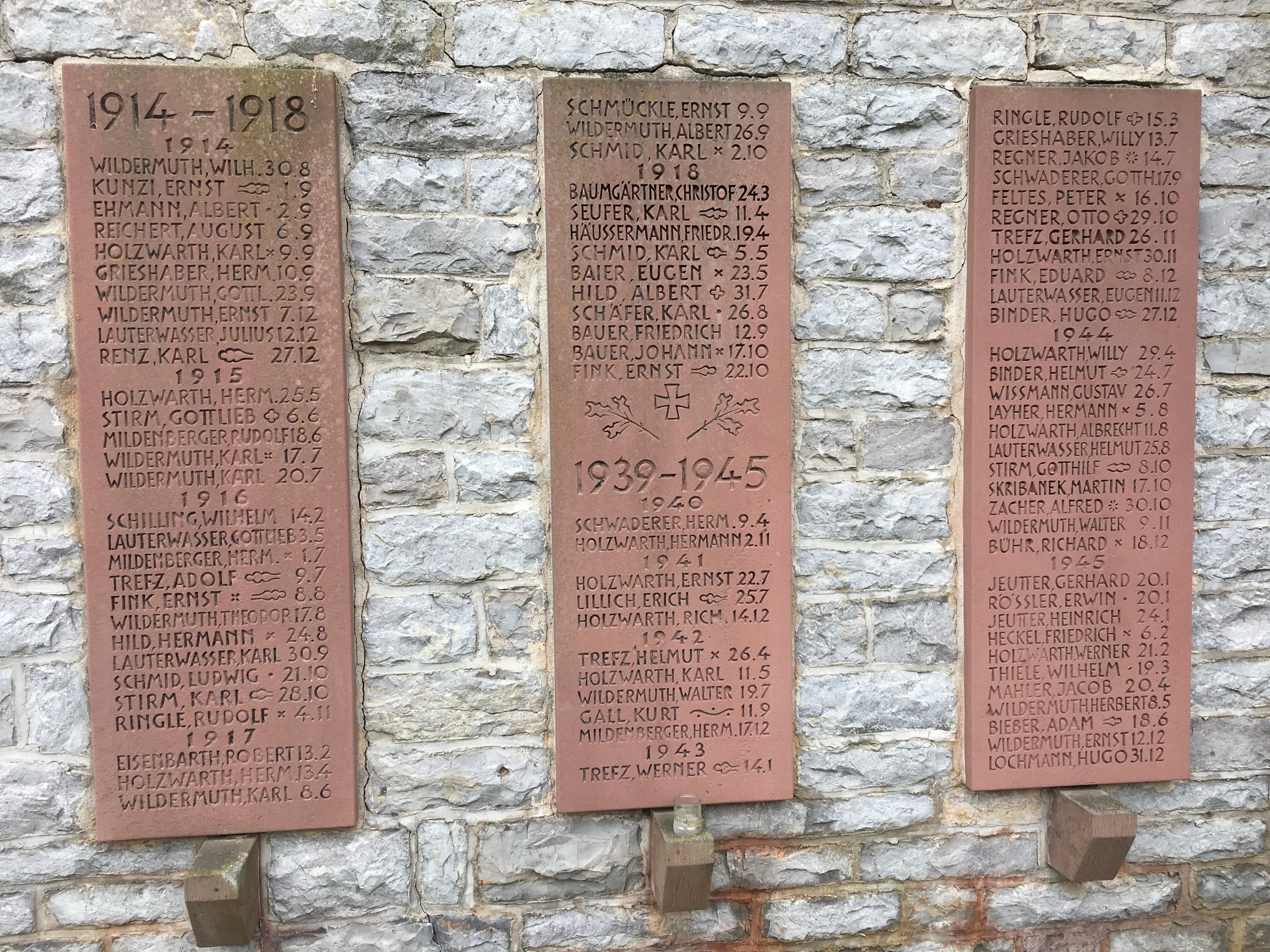
Robert Earl Wildermuth’s 1989 manuscript counted “23 Wildermuths” on the village memorial; reading the tablets, that figure looks conservative.
The clan behind the names
Rielingshausen is not incidental to the Wildermuths — it is their origin. Per Heinz Erich Walter’s “Members of the Wildermuth-Clan,” the village was the clan’s cradle, and Wildermuths served as its mayors across more than a century (Zacharias, 1640–1672; Jakob, 1721–1740; Adam, 1740–1762 — the last murdered by highway robbers in 1768). The same clan produced the 19th-century writer Ottilie Wildermuth, the psychiatrist Dr. Hermann Wildermuth, and Eberhard Wildermuth — decorated commander of Le Havre in WWII and the first housing minister of the Federal Republic of Germany under Adenauer. The men on this wall are of that same deep Rielingshausen stock — the family that ran the village, and paid for two wars in its sons.
Source: Photographed by Chuck Eesley, 2018 (Rielingshausen cemetery); names transcribed from the tablets. Clan context from Heinz Erich Walter, “Members of the Wildermuth-Clan” — told in full in The Wildermuth Clan of Rielingshausen.
Catalogue
- Type
- Monument
- Medium
- Carved red-sandstone tablets and a relief sculpture, set into the churchyard wall
- Date created
- photographed 2018 (memorial erected after each war)
- Place created
- Rielingshausen, Marbach am Neckar, Baden-Württemberg, Germany
- ID number
- RIELINGSHAUSEN-WAR-MEMORIAL
- Provenance
- Photographed by Chuck Eesley on the 2018 Württemberg research trip.
- Rights
- Family use; permission required for republication.