Clarissa Roe
also known as Clary Roe
b. 1782-06-18, Essex County, New Jersey
d. 1838, Eastern District of Harrison County, Virginia (approximate — 'in about 1838')
Clarissa Roe — Clary on her husband’s chart — was born 18 June 1782 in Essex County, New Jersey, three years into her parents’ wartime marriage. Her father John Roe was away with Colonel Dayton’s Third New Jersey Regiment for much of it; her mother Susannah Meeks had stayed behind at Westfield to nurse an invalid mother.
Carried over the mountains
She was the eldest of six. The family left Westfield for New York City in the spring of 1784, stayed six years, and in 1790 set out for Fayette County, Pennsylvania — the western frontier, diagonally across the whole state. Robert Earl Wildermuth described the party plainly:
“three young children under the age of 8 and a pregnant wife journied that long, tortous route through the forests and over the Allegheny Mountains.”
Clarissa was one of those three children, and she was eight. From Fayette County the Roes moved on into the Eastern District of Harrison County, Virginia, where her father died in 1829.
The woman who broke the chain of Johns
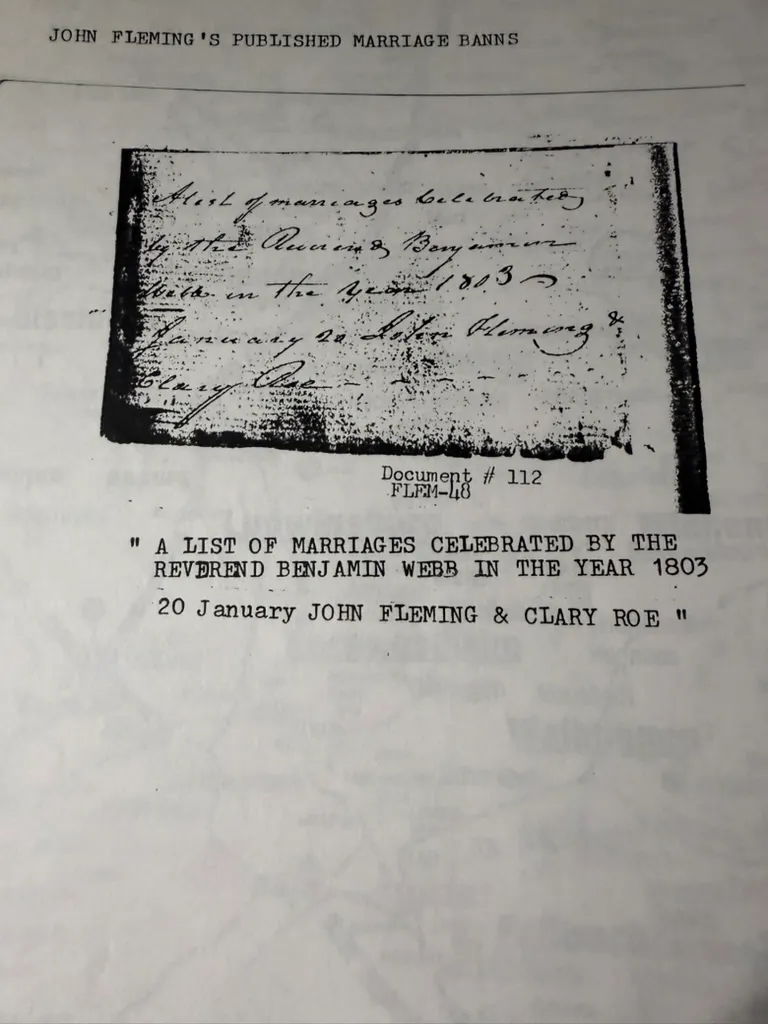
On 20 January 1803 she married John Fleming IV in the Eastern District of Harrison County — and the minister’s own return survives, in his hand, in a photograph among the papers:
“A list of marriages celebrated by the Reverend Benjamin Webb in the Year 1803 — January 20 John Fleming & Clary Roe”
She is Clary in the record itself. The familiar form on the charts was not a modern gloss; it is what she was called. This is the only contemporary document in the archive that names her.
They had thirteen children — and it is here that she leaves her mark on the record.
The Flemings had named their eldest son John for five straight generations. Clarissa’s eldest son was called Lewis. Robert Earl puzzled over the break for years before he found her family:
“For a long time, I was perplexed by this for the Scottish custom was always to name the first born male John. After finding John Roe’s family it’s easy to understand how it came about for John and Clarissa named their children after Clarissa’s brothers and sisters. Guess who ‘wore the pants’ in that family when it came to naming children.”
Her brother Lewis Roe was born 23 August 1784. Her sister Elizabeth in 1788, her brother Edward in 1791, her brother James in 1797 — and John and Clarissa’s own children include an Elizabeth, an Edward and a James. A century-old Scottish naming custom gave way to a New Jersey woman’s family, and Lewis Fleming carried a Roe name into West Virginia because of it.
Her parents’ own handwriting
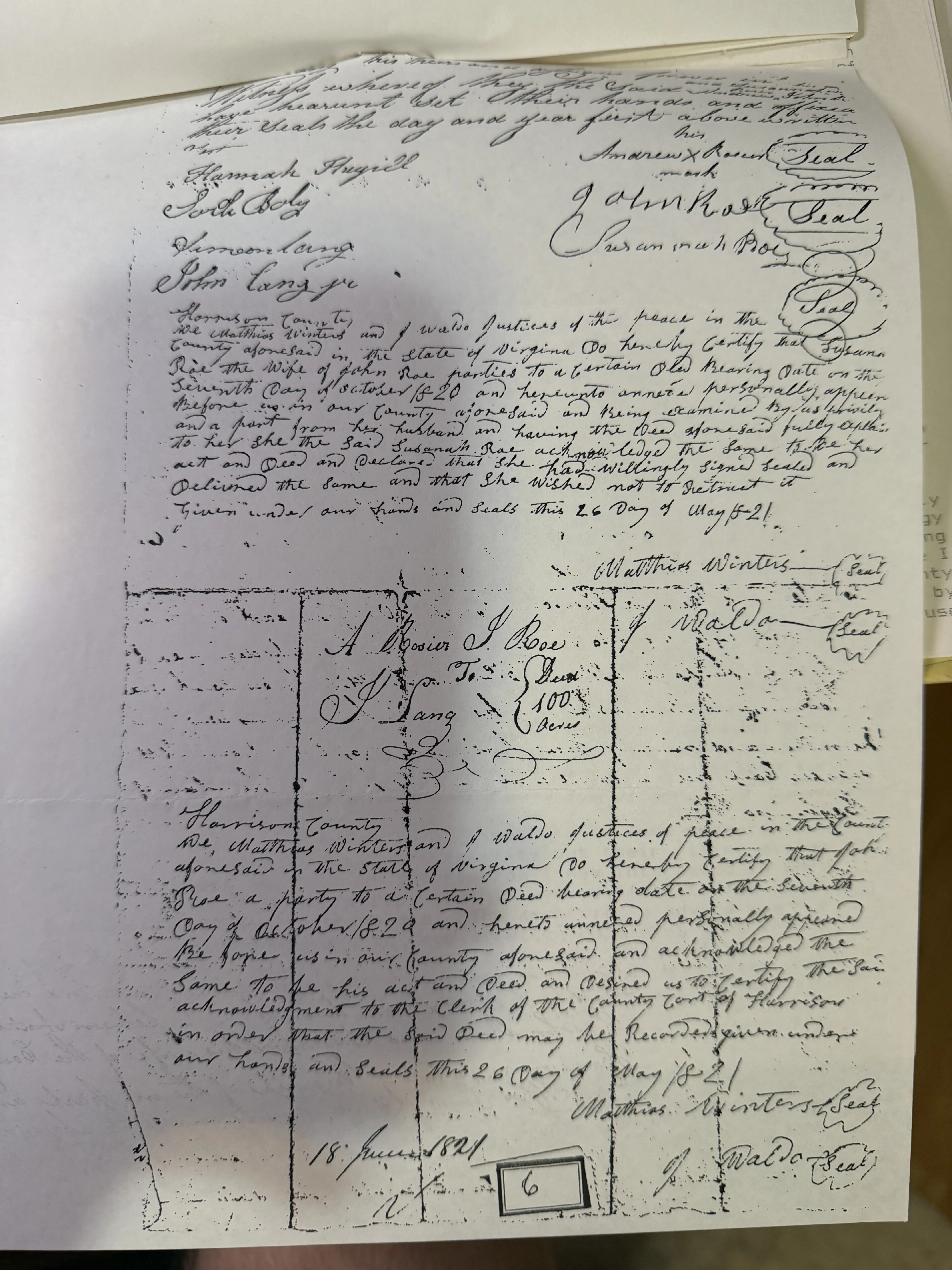
The one document in this archive that touches her family directly is a deed of 7 October 1820 — a hundred acres in Harrison County conveyed by Andrew Rosier and John Roe to a J. Lang. At the foot of it, both her father and her mother signed their own names, each with a seal, where their co-grantor Rosier could manage only a mark.
Robert Earl Wildermuth thought that the most telling thing he had found about them: “A personal seal was a sign of a refined, cultured person … [the Scotch-Irish] first built a church (Presbyterian) and then a school.”
The deed also puts Susannah alive in May 1821, when the justices examined her “privily and apart from her husband” to confirm she had signed the dower release willingly — the only glimpse of Clarissa’s mother as a person acting in the record.
Her death, and how many children were hers
She is usually given as dying about 1838, on the reasoning that her husband sold the eastern Harrison County farm that year and moved west. No death date and no burial place survive, and no birth record beyond the chart’s precise 18 June 1782.
Robert Earl came to a harder and more specific conclusion, after searching the Doddridge County marriage books to test a cousin’s rival theory:
“I think Clary Roe was Eli Sr’s mother and she probably died in childbirth when her last daughter, Sarah, was born in 1835 thus prompting John to sell his farm and move to Doddridge County where he had a son, Lewis, my second great grandfather.”
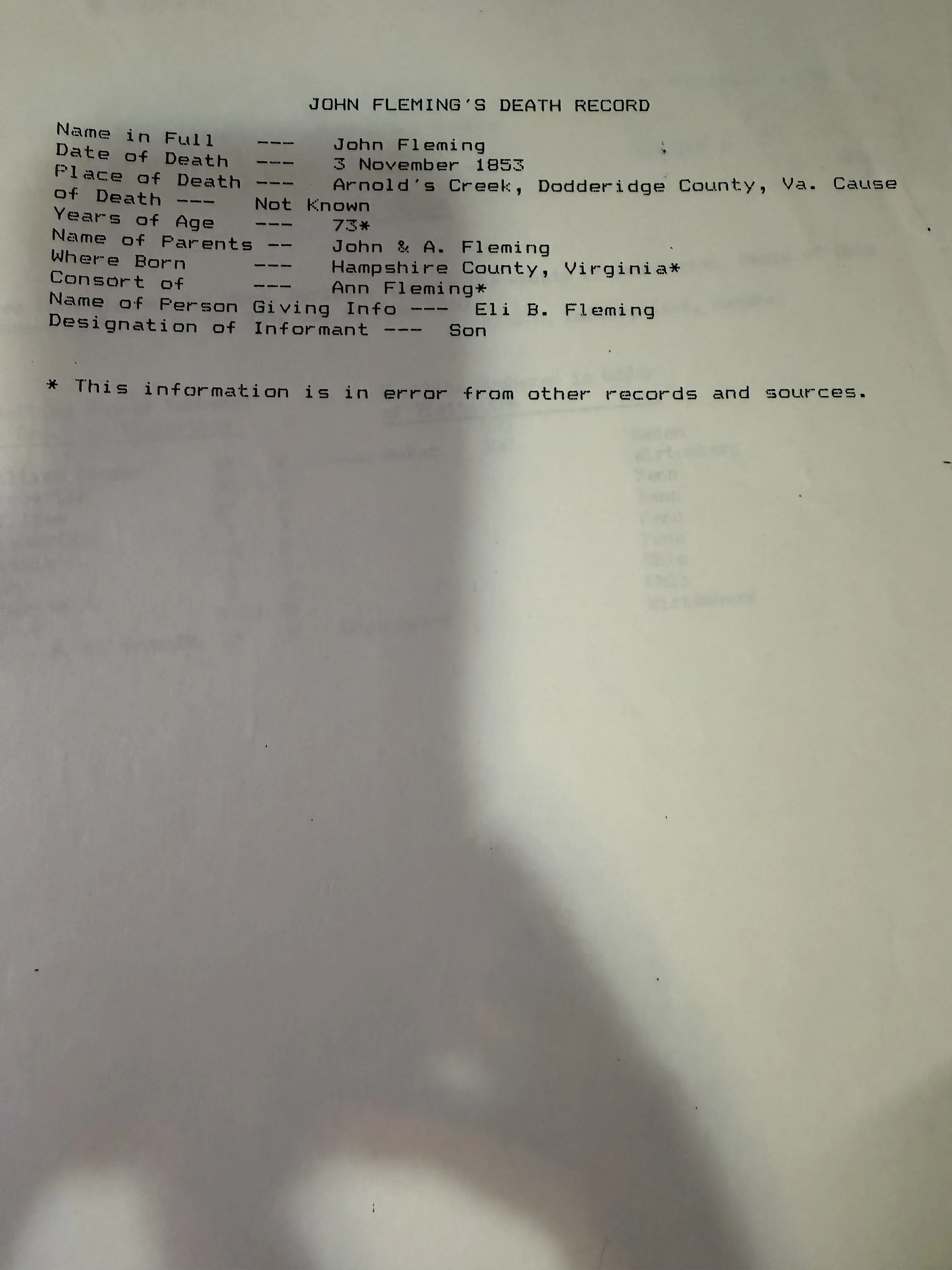
On that reading she bore thirteen children over thirty-one years — Elizabeth in 1804, Sarah in 1835 — and the last of them killed her, at about fifty-three. Everything that follows in her husband’s life reads as consequence: the farm sold to two sons in 1838, the move west to where Lewis already was, and a second marriage nine years later.
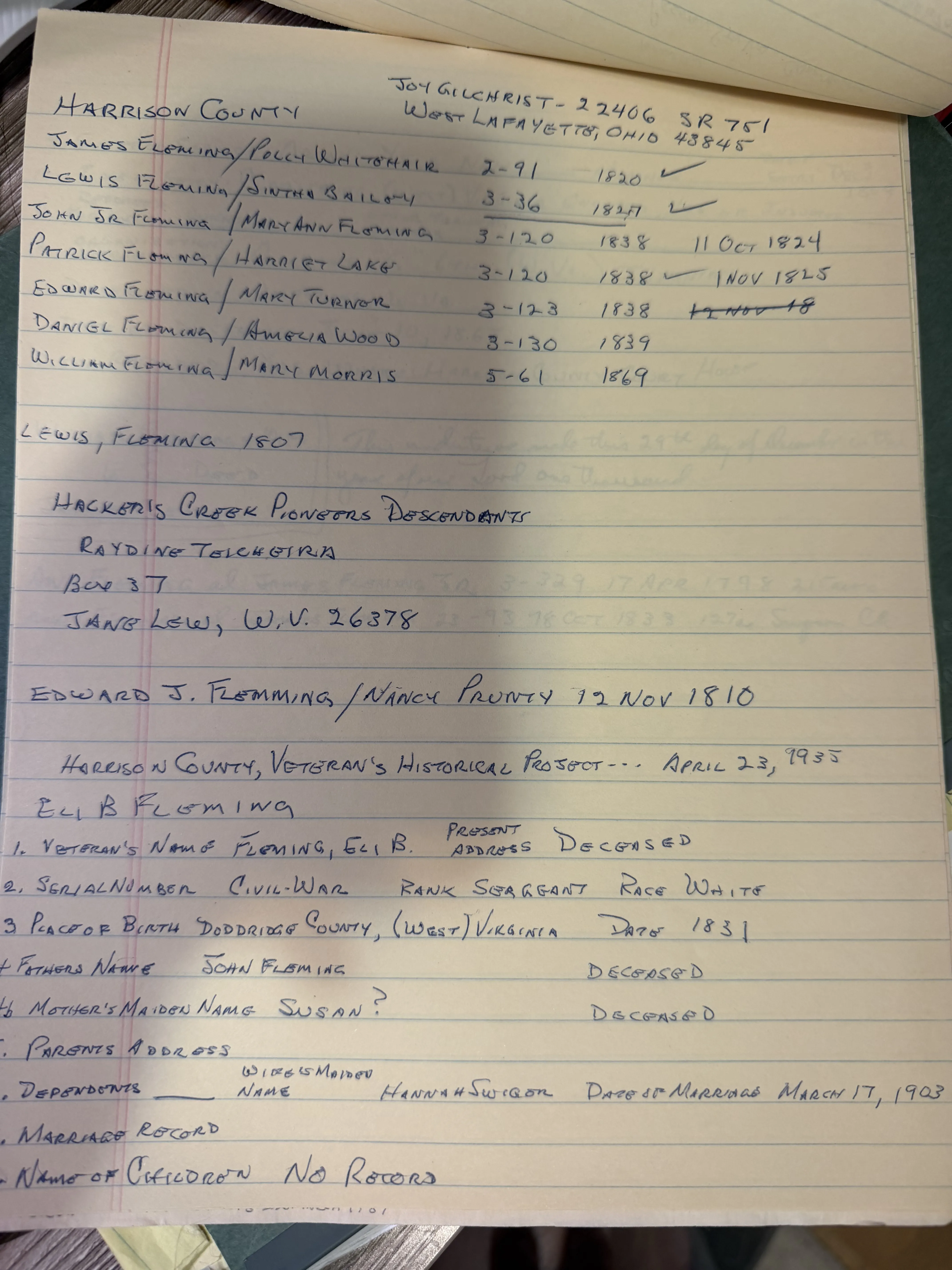
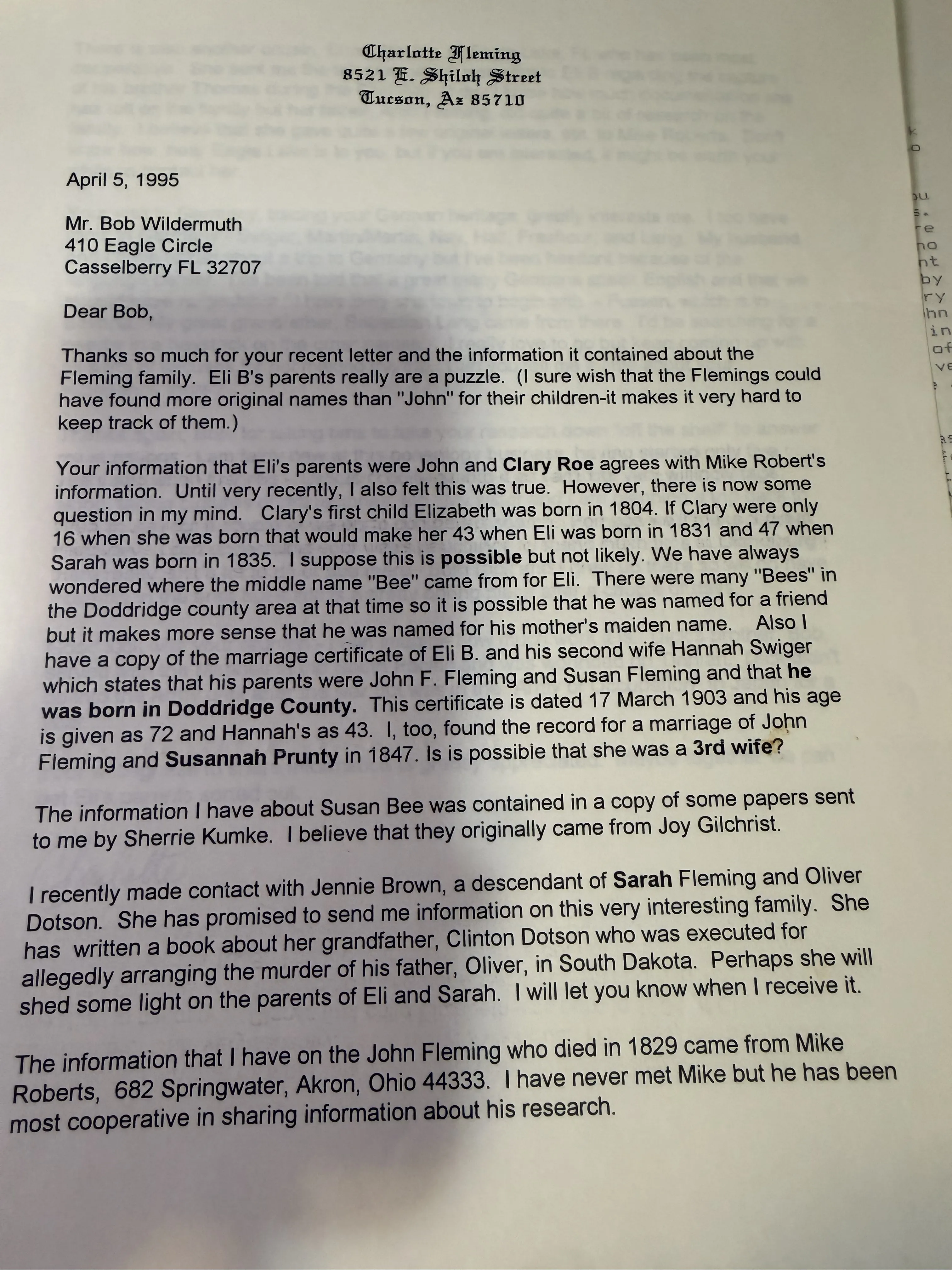
A cousin’s alternative, and why it is still open. Charlotte Fleming argued in 1995 that the youngest two were not Clarissa’s, since Eli B. Fleming’s 1903 marriage certificate names his mother as Susan. Robert Earl agreed at first, then found in Marriage Book I that the candidate Susanna Bee married David Jacobs in 1847 and stayed married to him through three censuses — “I cannot support a John Fleming/Susanna Bee marriage.” He kept Clarissa, and kept the doubt: “I could be wrong.”
He was right about Bee and possibly wrong about Susan. A 1955 veteran’s questionnaire also gives Eli’s mother’s maiden name as “Susan?” So what he disproved was one specific candidate, not the name. Whether Eli (1831) and Sarah (1834) were Clarissa’s is unresolved, and this page does not claim them with confidence.
Her line to Chuck runs through Lewis regardless — as he put it, “Lewis B. who was the son of John and Clary. Born a couple of years after their marriage.”
A courthouse names her
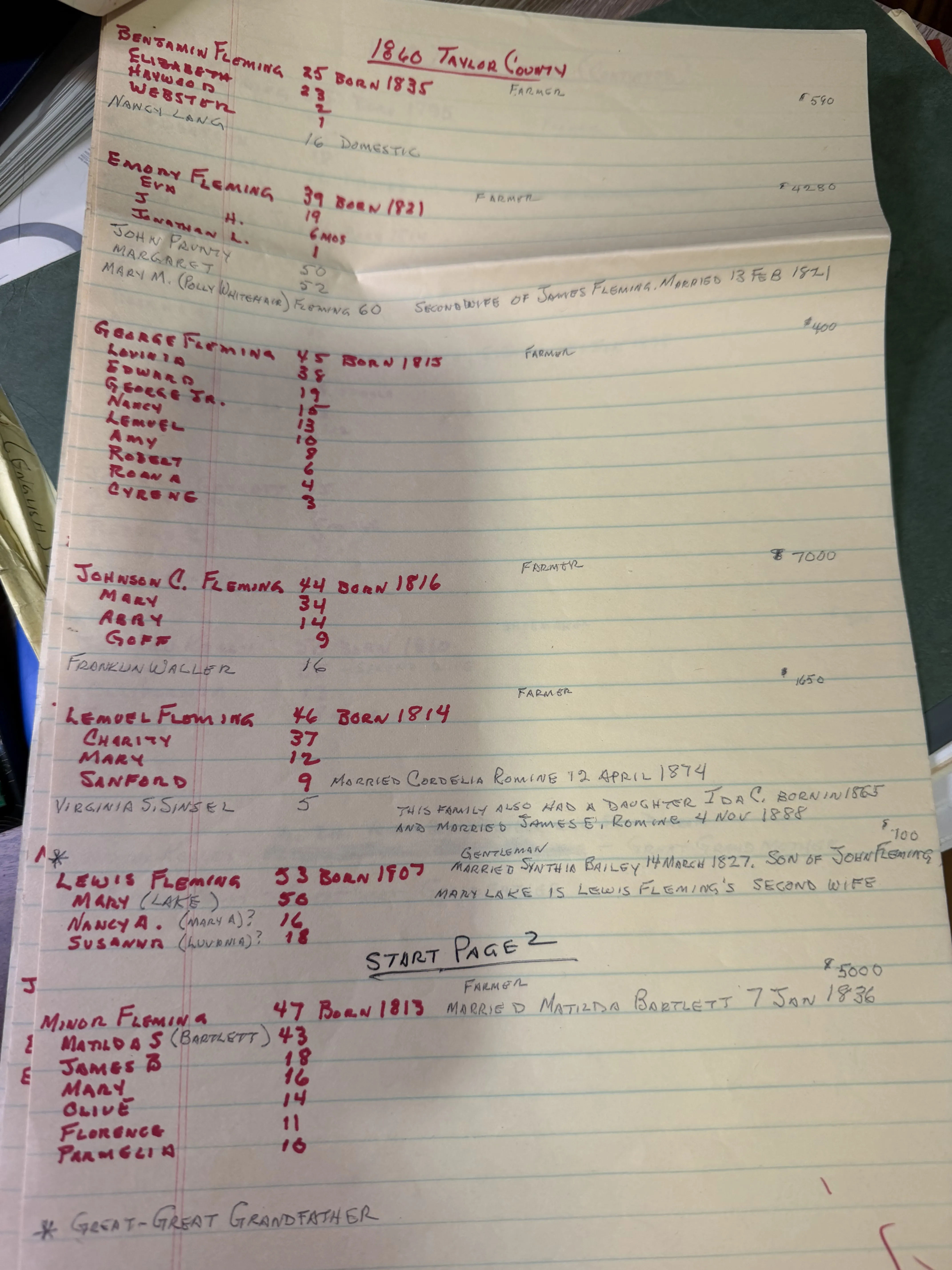
Beyond the marriage return, one civil record names her as a mother. The Taylor County Death Book entry for her son Patrick Fleming — who died of scarlet fever on 31 March 1865 — records him as “son of John and Clara Fleming.” Robert Earl copied it onto his census abstract.
Clara again, not Clarissa — the same familiar form the 1803 minister used. Patrick named a daughter Clarissa, born about 1844, for a grandmother who had died before she arrived.
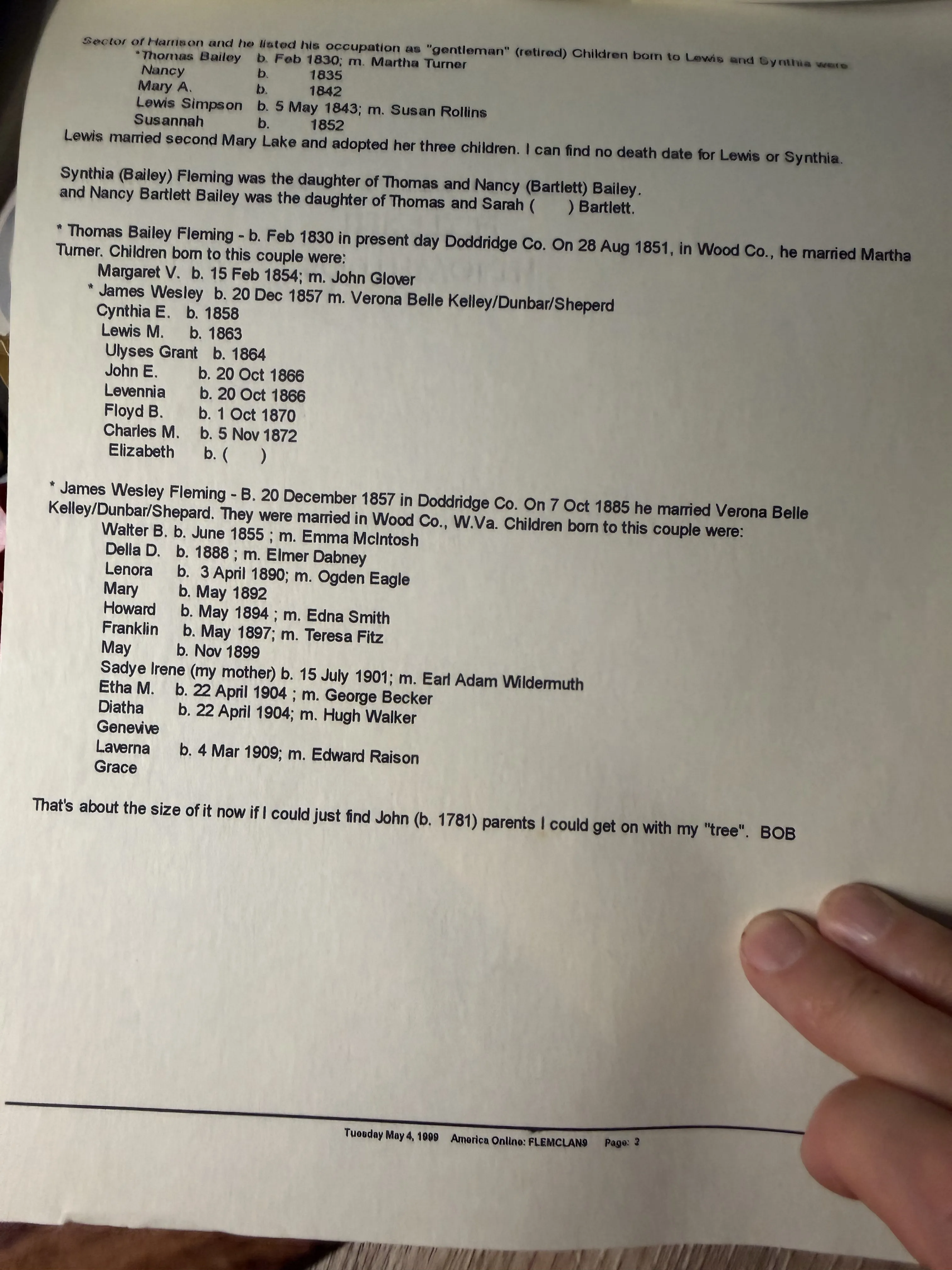
She is Chuck’s maternal 5×-great-grandmother: Clarissa → Lewis → Thomas Bailey Fleming → James Wesley → Sadye → Robert Earl → Terrie → Chuck.
A date that was wrong, and one that still is
An earlier chart gave her birth as 1762, which made her the daughter of a father born in 1758. This archive flagged it as impossible. The 1998 chart and the typescript both give 1782, against her parents’ 1779 marriage — consistent, and the 1762 is withdrawn.
Her mother’s date is still broken. Susannah Meeks is entered on the 1998 chart as born 1770, which would make her nine at her own marriage and twelve at Clarissa’s birth. Something nearer 1760 is meant. Recorded, not adopted.
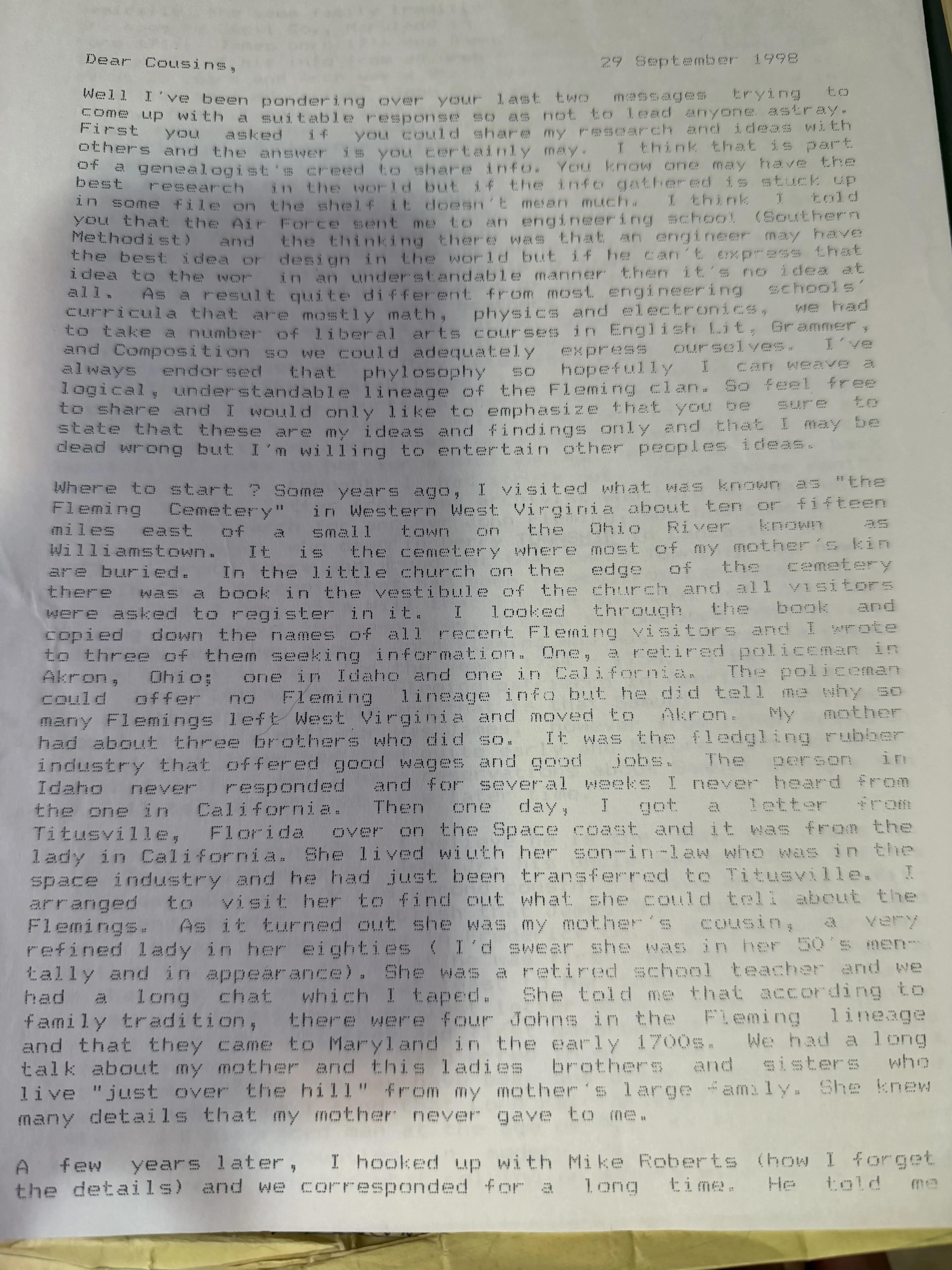
Source: “John Fleming Family Legacy”, Robert Earl Wildermuth’s typescript, c. 1998, pp. 4–5; and Chart No. 2 of his 22 March 1998 pedigree charts.
Appears in
Pictured in