Thomas Bailey Fleming
also known as Thomas B. Fleming (county records)
b. 1830-02, Western District of Harrison County, Virginia (now Doddridge County)
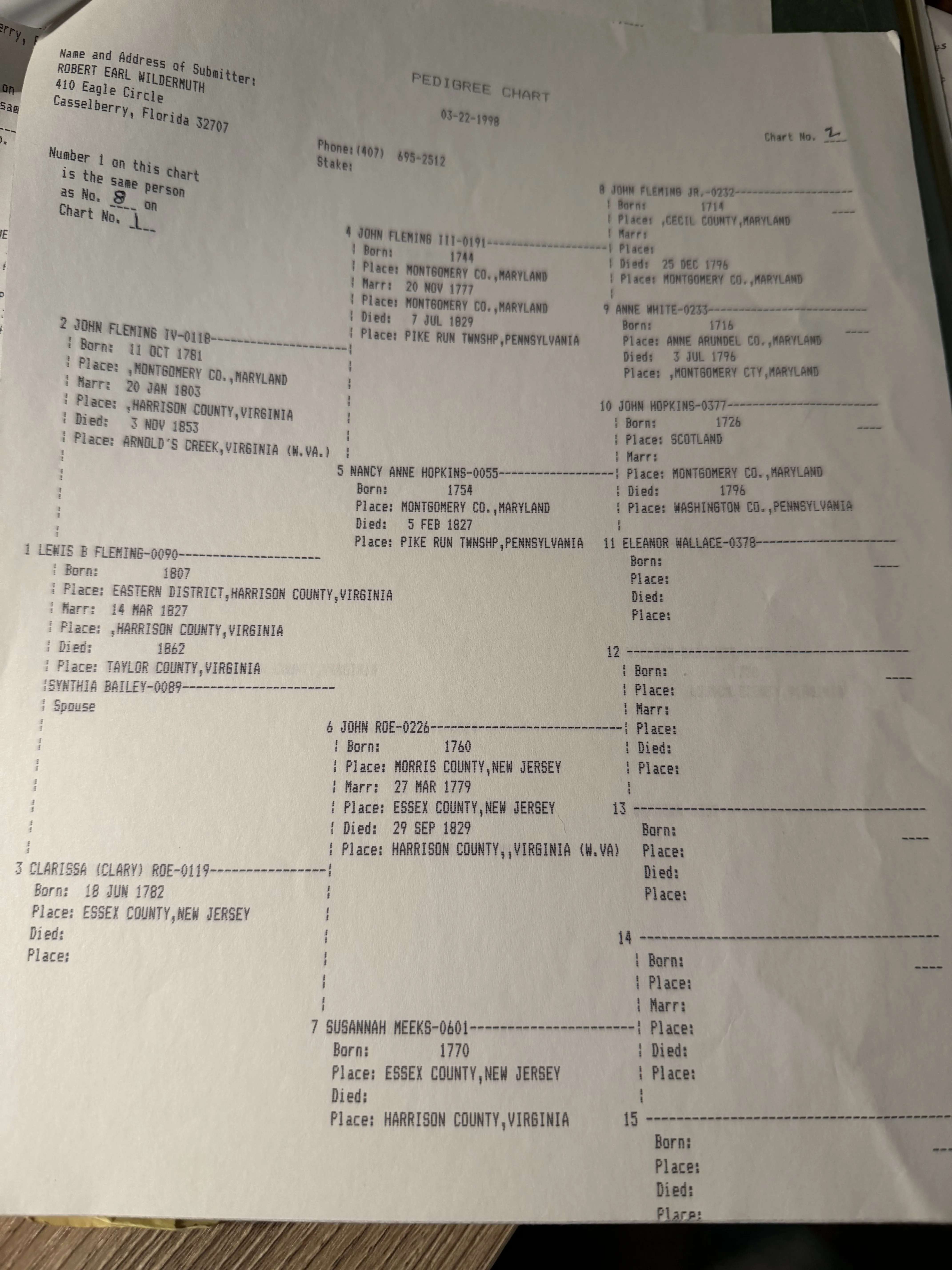
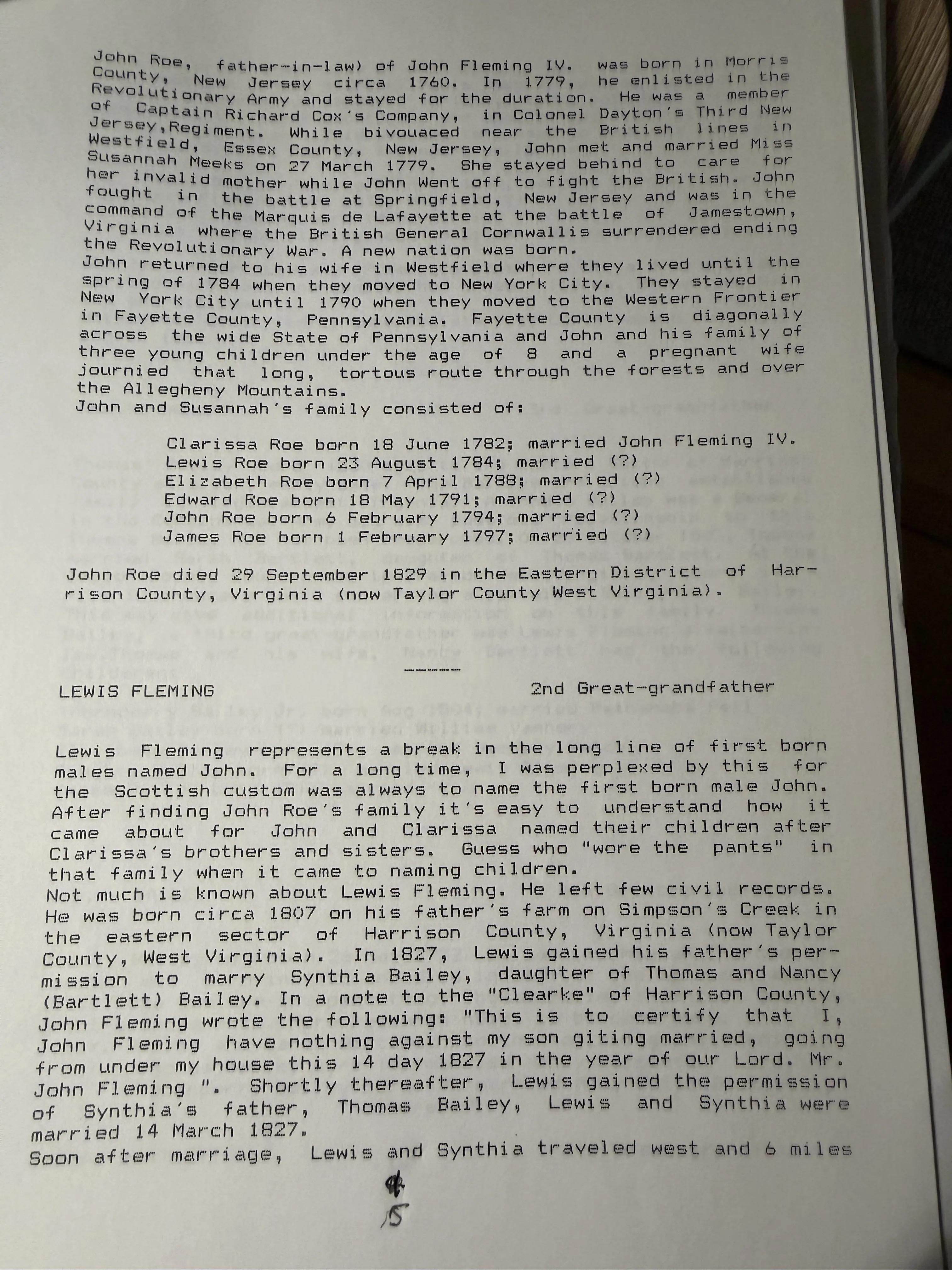
Thomas Bailey Fleming carries his mother’s family name in his own. He is the son of the Arnold’s Creek settler Lewis Fleming and Synthia Bailey, and the B in the county records — Thomas B. Fleming — is Bailey. Without it, the Bailey and Bartlett lines behind him would be much harder to see.
He is Chuck’s maternal 3×-great-grandfather: Thomas Bailey → James Wesley Fleming → Sadye → Robert Earl → Terrie → Chuck.
Born in a county that did not exist
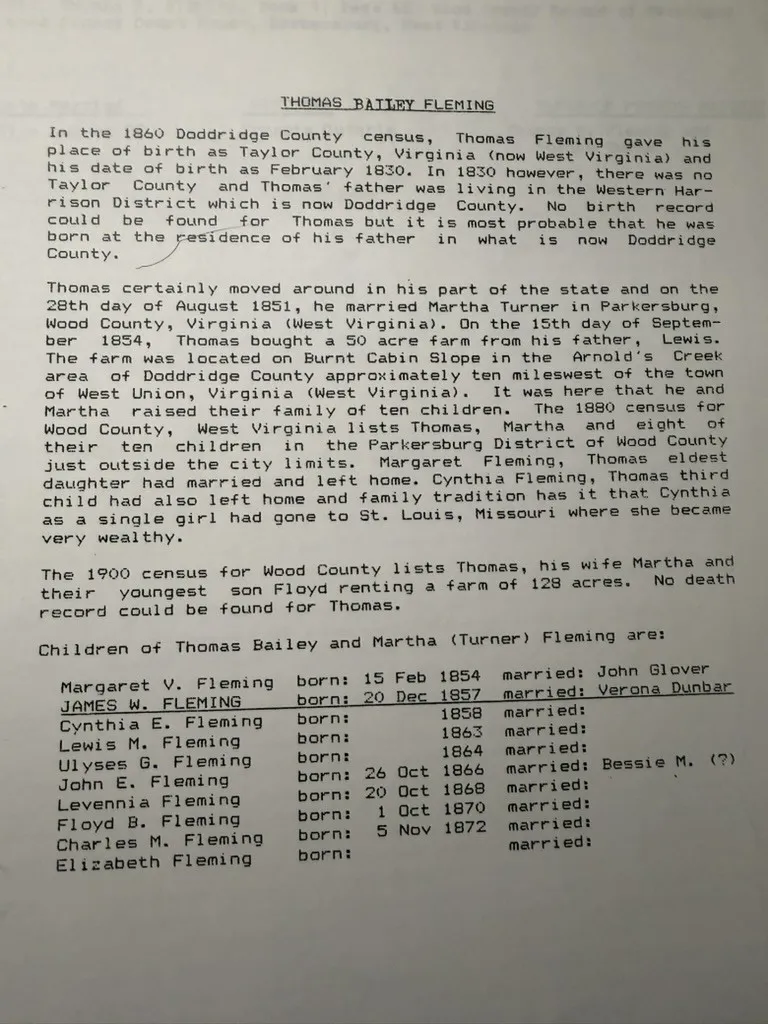
Asked by the 1860 Doddridge County enumerator where he was born, Thomas answered Taylor County, Virginia, February 1830.
He was wrong, and Robert Earl Wildermuth caught it a hundred and thirty years later. Taylor County was not created until 1844 — fourteen years after Thomas’s birth. In 1830 his father was living in the Western District of Harrison County, the district that became Doddridge County in 1863. No birth record survives. Robert Earl’s conclusion, and the archive’s:
“It is most probable that he was born at the residence of his father in what is now Doddridge County.”
The answer is a small window into how people held their own geography. Thomas had lived through two county lines being drawn across the same hills and a state splitting in two; by 1860 he named the county the land was in then, not the one it had been in when he was born.
Martha Turner, 1851
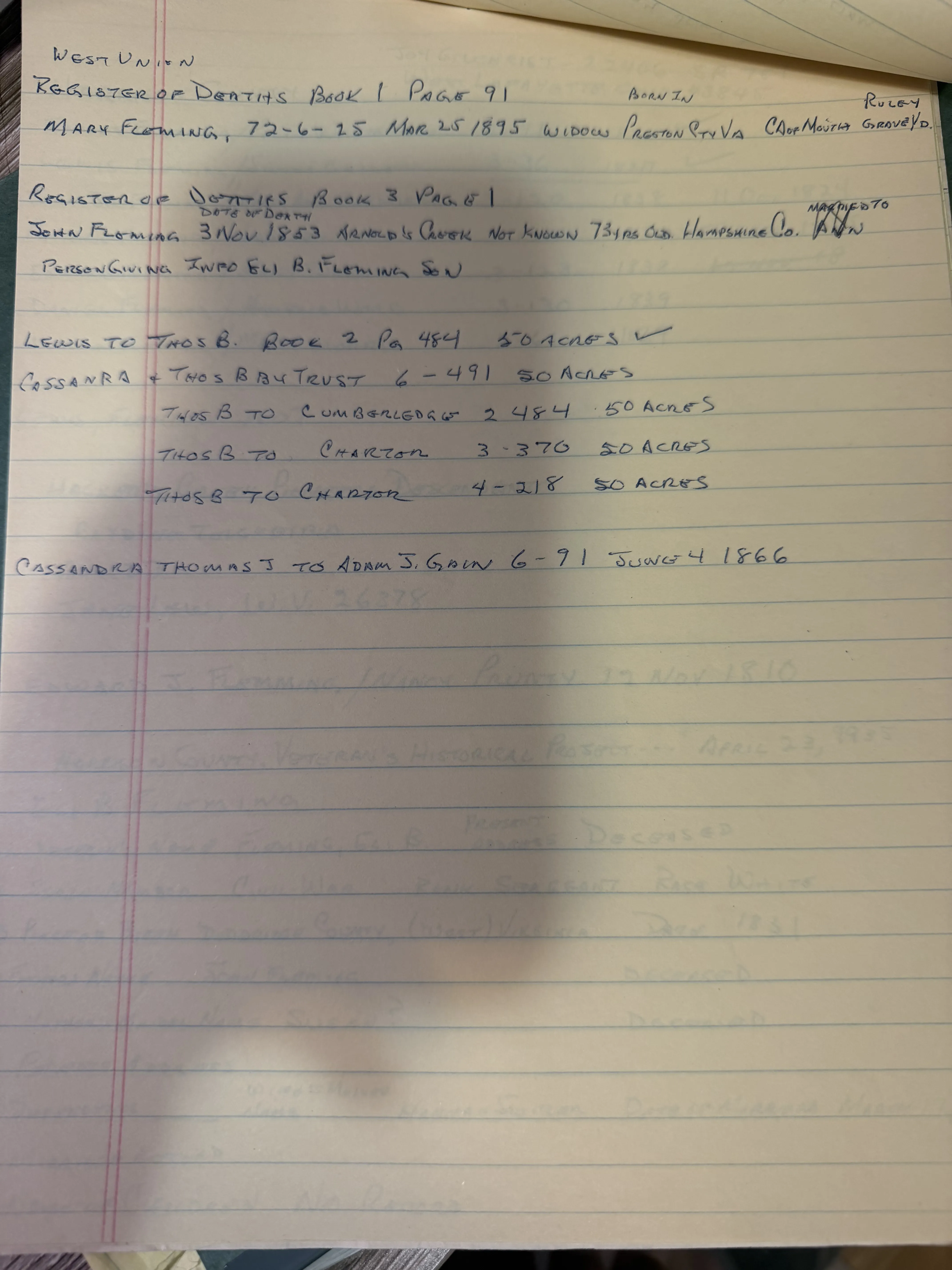
On 28 August 1851 he married Martha Turner at Parkersburg, in Wood County. The county register records the officiating minister as Francis Guthrie — Book 1, page 66. Martha was born in March 1832 in Wood County, daughter of a John Turner about whom nothing else is recorded. They were married at least forty-nine years; she outlived him, dying 11 June 1904.
Fifty acres on Burnt Cabin
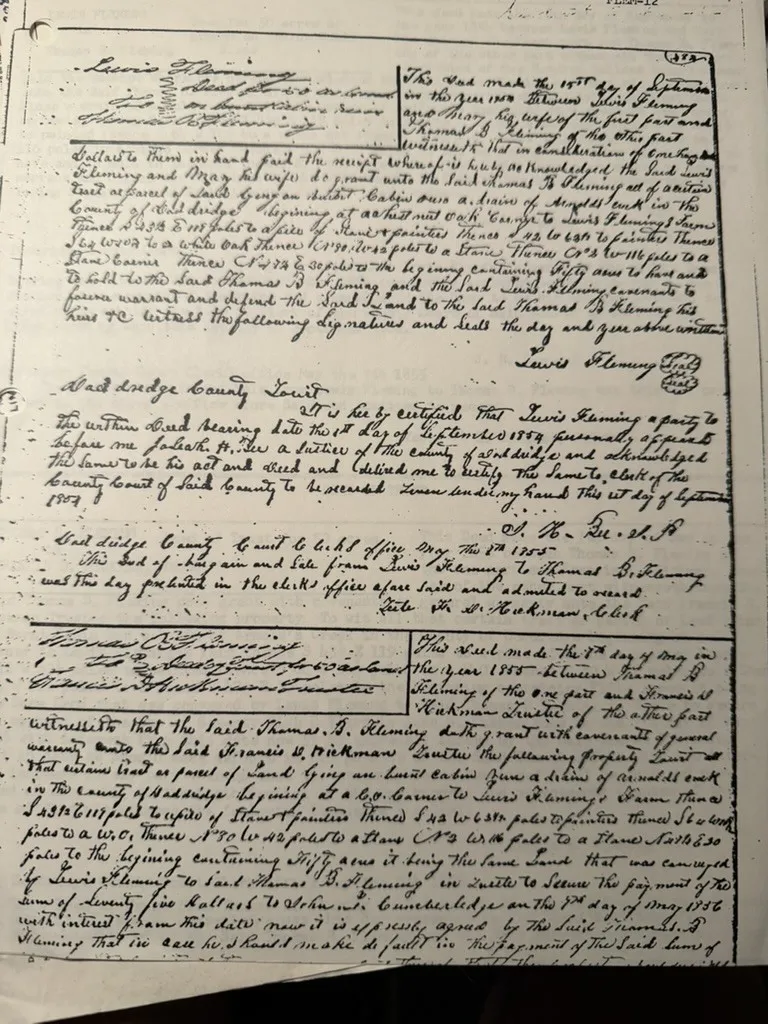
On 15 September 1854 Thomas bought a fifty-acre farm from his father for one hundred dollars. The deed survives, and its boundary call starts at a chestnut oak “corner to Lewis Fleming’s farm” — the son’s land cut straight off the father’s.
The place was Burnt Cabin Slope, a drain of Arnold’s Creek in Doddridge County, about ten miles west of West Union. The deed also names “Mary his wife” alongside Lewis in the dower release — Synthia had died around 1849, and Lewis had married the widow Mary Lake.
The deed sat unrecorded for nearly eight months. On 7 May 1855 it was entered in Deed Book 2, page 484 — and that same day Thomas put the same fifty acres into a deed of trust, conveying it to Francis D. Hickman as trustee to secure seventy-five dollars owed to John W. Cumberledge, repayable in one year, with the land to be sold on default under the Code of Virginia.
He was twenty-five, three years married, with children coming, and he had mortgaged three-quarters of the farm’s purchase price back out of it the day the purchase was recorded. It is the plainest surviving statement of what this family’s economics actually were.
Twelve children — Martha’s own count
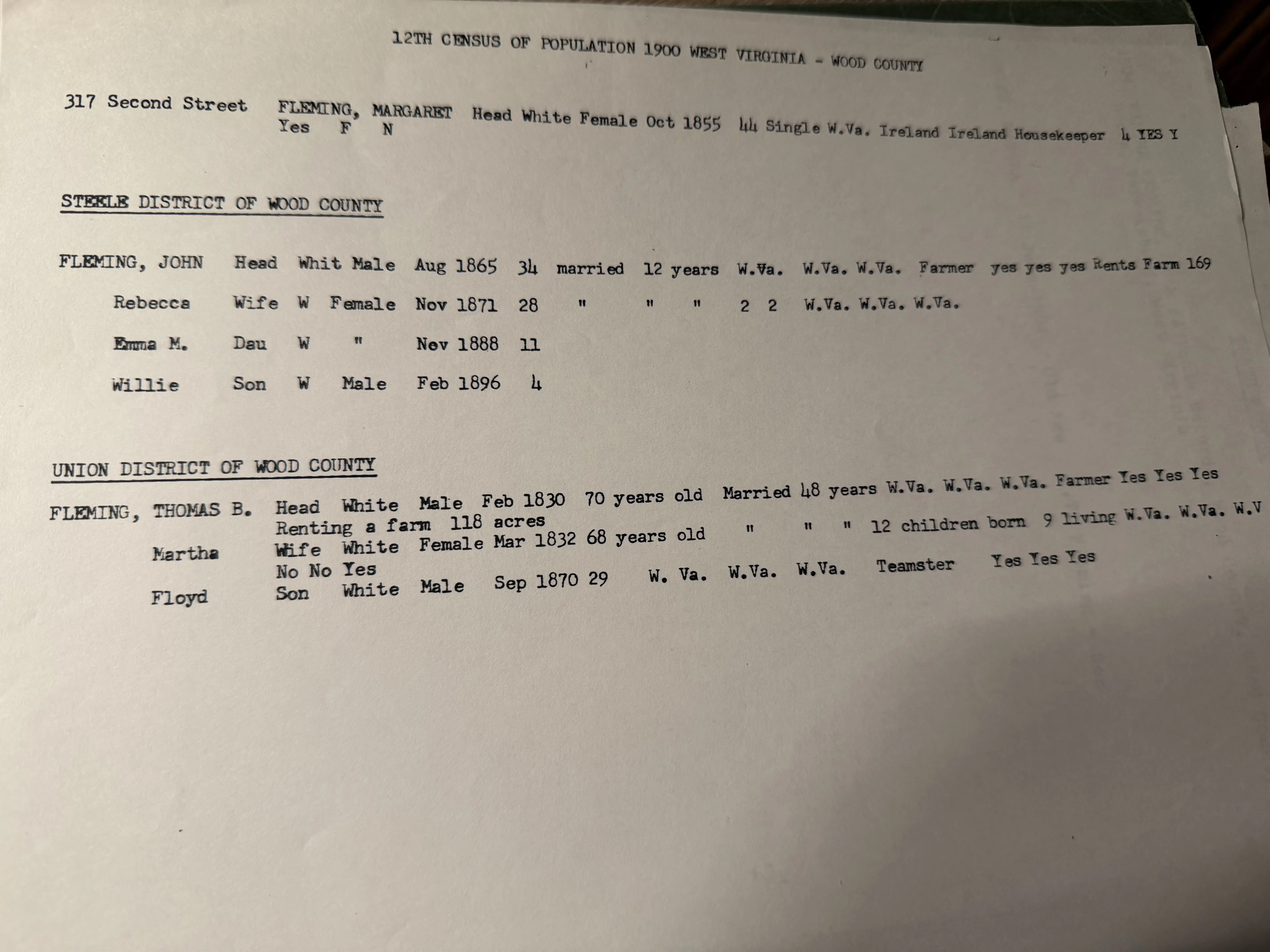
The 1900 census asked Martha, and she said twelve born, nine living. The abstract is here. That is the best figure available, because it is the mother’s own answer to an enumerator rather than a descendant’s reconstruction a century later.
Robert Earl’s sketch lists ten, and his reading of the 1880 census agrees with that count — but a family group sheet records the children who survived to be remembered. The two missing from his ten are most likely infants who died young, which is precisely what the census’s “children born / children living” pair exists to capture.
The ten he names:
| Child | Born | Married |
|---|---|---|
| Margaret V. | 15 Feb 1854 | John Glover |
| James W. | 20 Dec 1857 | Verona Belle Dunbar |
| Cynthia E. | 1858 | — |
| Lewis M. | 1863 | — |
| Ulysses Grant | 1864 | — |
| John E. | 1866 or 1868 | Bessie M.(?) |
| Levennia / Mary Lavina | 20 Oct 1868 | — |
| Floyd | 1 Oct 1870 | — |
| Charles M. | 5 Nov 1872 | — |
| Elizabeth | 1876 | — |
The family GEDCOM gives thirteen — all ten of these, plus Henrietta (Jun 1853), “B. Fleming” (1859), and George McClellan Fleming (5 Jul 1864). With Martha’s own answer of twelve, these deserve a second look rather than dismissal. Henrietta’s June 1853 birth is still eight months before Margaret’s, which full siblings cannot manage, and “B.” is an initial rather than a name — but a household with twelve births and nine survivors has room for children the sketch never knew about. George McClellan is more interesting — an 1864 brother to Ulysses Grant Fleming, the two of them named for the Union general and the man who ran against Lincoln that November. Twins, or a duplicate. Unresolved.
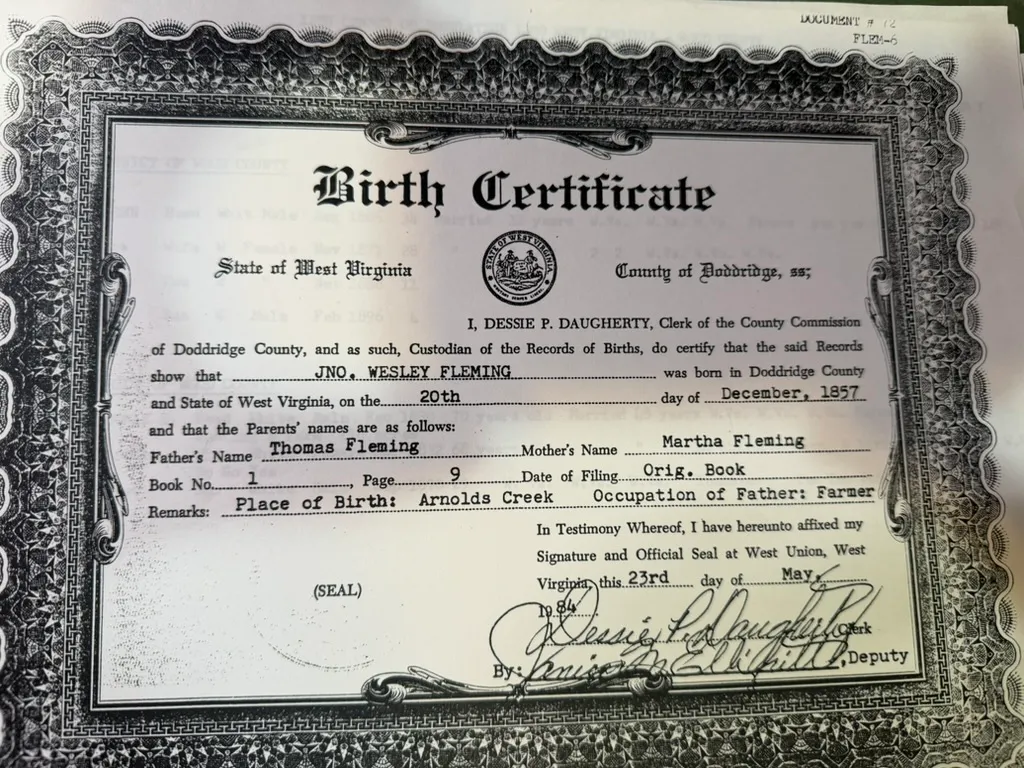
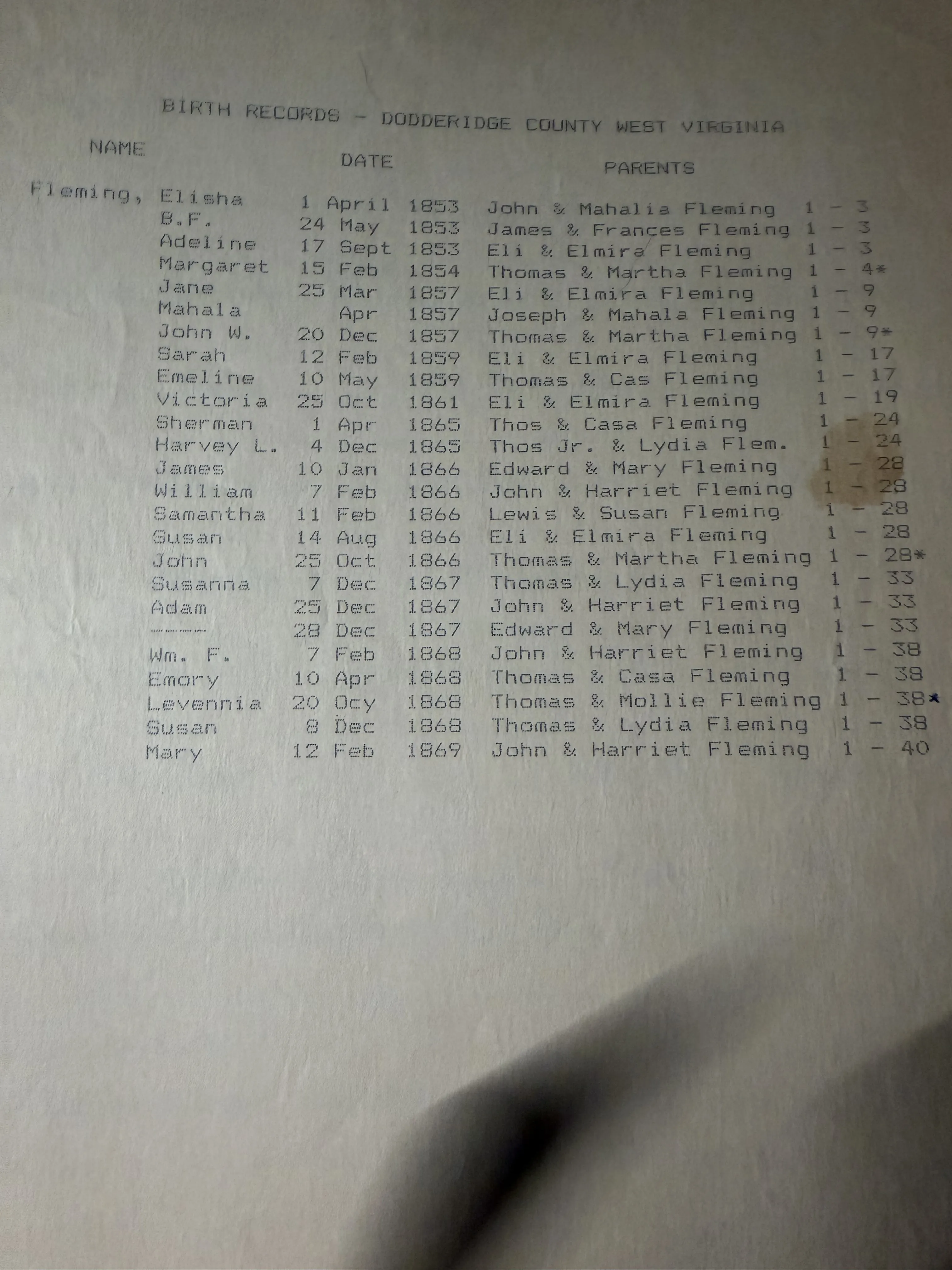
On James’s birth year — settled, and the sketch was right. The sketch says 20 December 1857, the GEDCOM 1855, and this archive followed the GEDCOM on the strength of an “age 84” at death. His certified birth register entry — Doddridge County Book 1, page 9 — gives 20 December 1857, names Thomas and Martha, and records the father’s occupation as Farmer. The 1855 is withdrawn.
Cynthia went to St. Louis
The one story the family kept about a daughter. Cynthia, the third child, had left home by the 1880 census, and Robert Earl set down what was remembered:
“Family tradition has it that Cynthia as a single girl had gone to St. Louis, Missouri where she became very wealthy.”
An unmarried woman leaving the Doddridge County hills alone for a Mississippi river city in the 1870s. Nothing else about her survives — not a marriage, not a death, not how the money was supposed to have been made.
Parkersburg, and then out of the record
By 1880 the household had moved off the Doddridge hill farm to the Parkersburg District of Wood County, just outside the city limits: Thomas, Martha, and eight of the ten children, with Margaret married away and Cynthia gone to St. Louis.
The 1900 census finds him at about seventy, still working — he, Martha, and their youngest son Floyd renting a farm of 118 acres. After that he disappears. Robert Earl searched and reported the result without dressing it up:
“No death record could be found for Thomas.”
A candidate, in his own papers
Elsewhere in the same research file, under “Death in Wood County”, he wrote down:
FLEMING, THOMAS J — 5 May 1910 — 75 yrs — Farmer
Wood County, a farmer, 1910 — where Thomas was last seen in 1900, renting a farm at seventy. It may well be him, and he seems not to have connected it.
Two things do not match, and neither is being smoothed over:
- The age. 75 in May 1910 means a birth about 1835; his was February 1830, which would make him 80.
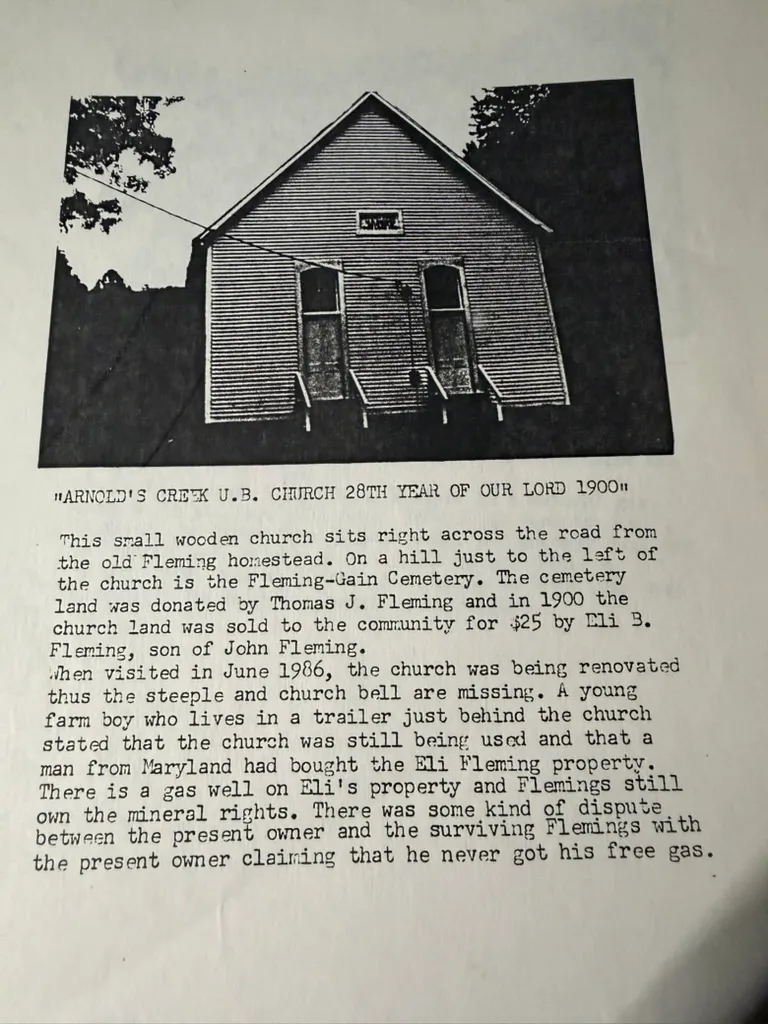
- The initial. Thomas J., where the county records call him Thomas B. — though a Thomas J. Fleming also gave the land for the Fleming-Gain Cemetery, so the name belonged to someone else too.
Against that: stated ages in this family’s death records are badly unreliable. The same archive holds an “age 84” for a man who was 82 and an “age 40” for a man of 72, and the informant on Martha’s own death record is entered as F. T. Fleming where the typescript calls him Floyd B. Five years and a middle initial are well within this family’s margin of error.
Ordering the full Wood County entry for 5 May 1910 is the obvious next step. If it names a wife or a father, it closes the one gap Robert Earl left open on his own great-great-grandfather.
Until then he remains one of the few direct ancestors here with a documented life and no documented end.
Sources: the Thomas Bailey Fleming biographical sketch and the 1851 marriage record and 1854 deed, both from Robert Earl Wildermuth’s research papers; Dale Eesley / FamilySearch GEDCOM (Thomas Bailey Fleming, 9ZHX-K9J); Wildermuth/Bain family book — Fleming section.
Appears in
Pictured in