"John Fleming Family Legacy" — the typescript that answers the question
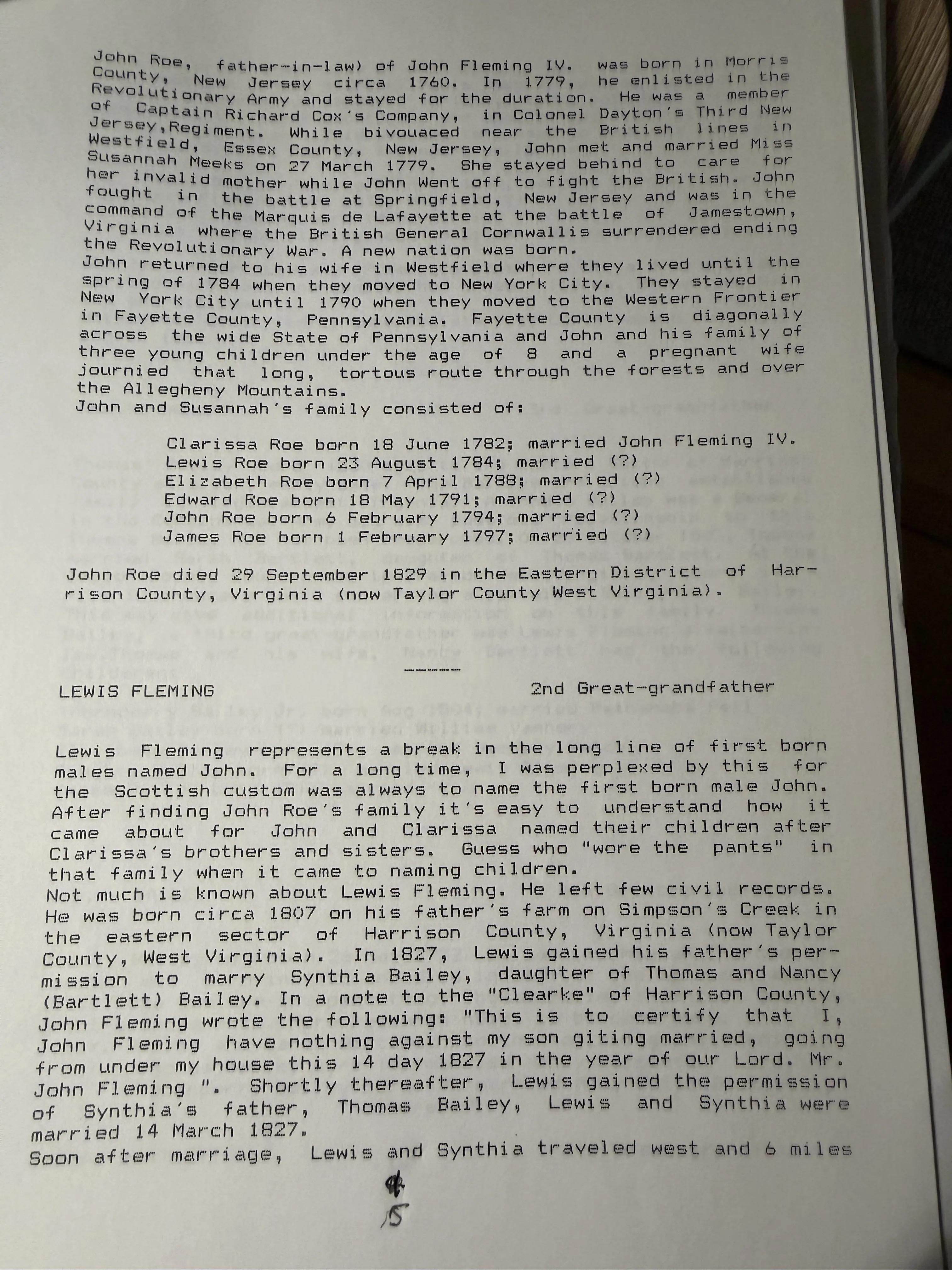
Not a chart. Thirteen pages of continuous prose, generation by generation, each headed with the person’s name and their exact relationship to him — 5th Great-grandfather, 2nd Great-grandmother, and finally just Mother and Father. It runs from an emigrant weaver in 1712 down to his own parents, and closes with four pages of “Fleming Fables” — the stories, not the dates.
It reads like the 1988 Little Histories grown up: sourced, argued, occasionally funny, and willing to say “I have some reservations” and “more research needs to be done here.” It is the companion text to the 1998 pedigree charts, and it is where he put the reasoning the charts only assert.
→ The complete transcription is here — all thirteen pages, verbatim.
⚠ He retracted the oldest generations later the same year
On 27 November 1998 he withdrew the four-Johns lineage that opens this typescript — “our oldest of Fleming ancestors were not 4 guys named John” — instructing that John Fleming Jr. and John Fleming III be removed and James Fleming inserted. The retraction is here.
Pages 1–3 should therefore be read as his March-1998 position. Everything from John Fleming IV forward — the 1827 consent, the Roes, the Baileys, the Bartletts, the Kelleys, the Fleming Fables — is unaffected.
Why he did it
Page 11 gives the reason, and it is the closest thing in the papers to a statement of purpose for the entire twenty-year search:
“James Wesley Fleming died in the Washington County Home for Men just outside Marietta, Ohio on 2 October 1940 at the grand old age of 83. At the time of his death, noone knew who his father and mother were, when or where he was born nor his age. I’ve always felt that this was wrong for everybody should have a heritage and people should know the contributions each of us make while on earth. This factor has been one of my driving forces to pursue this 20 year search for my ancestors. No man who walked this earth and helped build this great country should leave this world without his descendents knowing where he came from and when and what his contributions were.”
His own grandfather — James Wesley Fleming, the man in the vest and watch-chain portrait — died in the county home for men, and no one at the graveside could say who his parents were. Robert Earl was sixteen. Everything in this archive descends from that.
The paragraph goes straight on to the second motive: “to find out where my Great-grandfather Johann Christian Wildermuth came from. All that was known was that he came to Philadelphia (WRONG) from Germany.” The parenthesis is his — by 1998 he knew the Philadelphia arrival was a false trail, and he flagged his own earlier error in capitals as he typed.
The county home is new to this archive, which had recorded only that he died at Marietta. And note the age: he writes 83, consistent with his own 1857 birth year rather than the archive’s 1855.
It settles the parentage of Lewis Fleming
For years this archive named Lewis’s father Edward Fleming, of the Simpson Creek farm, on the authority of Joy Gilchrist’s The Squires Family — and cited an 1827 note in which “Edward” let his son “go out from under my house.”
Page 5 quotes that note in full, and it is not Edward’s.
“In 1827, Lewis gained his father’s permission to marry Synthia Bailey, daughter of Thomas and Nancy (Bartlett) Bailey. In a note to the ‘Clearke’ of Harrison County, John Fleming wrote the following:
‘This is to certify that I, John Fleming have nothing against my son giting married, going from under my house this 14 day 1827 in the year of our Lord. Mr. John Fleming’.
Shortly thereafter, Lewis gained the permission of Synthia’s father, Thomas Bailey, Lewis and Synthia were married 14 March 1827.“
The signature is there twice. Lewis Fleming’s father was John Fleming.
And the Edward is accounted for. Page 4 lists John Fleming IV’s thirteen children, and among them: Edward Fleming, born 2 July 1817, married Mary Turner — Lewis’s younger brother, ten years his junior. A real Edward Fleming on the same farm in the same county, one generation displaced. That is more than enough to produce the misattribution the archive inherited.
The Simpson Creek detail survives intact; only the name attached to it was wrong. Lewis was “born circa 1807 on his father’s farm on Simpson’s Creek in the eastern sector of Harrison County.”
The line, in his own words
John Fleming Sr. — 6th great-grandfather. Came to Cecil County, Maryland in 1712, “from either Scotland or Ireland but he was of Scottish origin.” Wife Jean, maiden name unknown. A weaver by trade — and he explains why that mattered:
“Scottish woven fabrics were much wanted throughout Europe and that is one reason for a large emigration of Scots. The King of England had placed an embargo on Scottish woolens that demanded that all woven materials be sent to London where a pitifully small price was paid.”
He found the man’s will. Family tradition said he died at “Derry, Pennsylvania”; Robert Earl spent a long time hunting a town called Derry before realising it was a township — Derry Township, then Lancaster County, now Dauphin County — where John Sr. appears on the tax rolls of 1754, 1755 and 1756. An archivist in Chester County found the will from the known death date. Probated 17 May 1777. Seven children named, with spouses. Of a supposed son Samuel he notes: “I have some reservations … because John Sr. never mentioned him in his Will.”
Note the qualification: “either Scotland or Ireland.” His own Chart 4 prints Ballyclare, Antrim County, Ireland as a flat fact. The prose is more honest than the form, and the prose should govern.
John Fleming Jr. — 5th great-grandfather. Born Cecil County 1714, lived his whole life in Frederick County, Maryland (now Montgomery). A prosperous tobacco grower with a large plantation and smaller farms near a trading post called Cabin John, on ground “near what is now Washington, D.C. but there was no Washington D.C. then.” Married Anne White. In 1778 he and his sons John III and James took Maryland’s Oath of Fidelity and Support — which, he notes with evident satisfaction, “made them all sworn patriots and is the basis for all female descendents to become members of the Daughters of the American Revolution.” Died Christmas Day 1796, aged 82; will probated 16 January 1797.
Robert White — 5th great-grandfather, “the other patriarch of our line.” A prosperous tobacco grower of Prince Georges County. Married Anne Burgess in Anne Arundel County, 22 September 1709. Five children. Will probated 11 April 1769. (The chart says he died April 1768; the probate date here implies 1769.)
John Fleming III — 4th great-grandfather. Born c. 1744, Frederick County. Married Nancy Ann Hopkins 20 November 1777. In 1781 he moved with his father-in-law and “several of the Wallaces and Whites” to Fallowfield Township, Washington County, Pennsylvania — “Quite a move for a one year old son.” He and John Hopkins served in the 5th Battalion, Washington County Militia, under Colonel Thomas Crooks, company commander Benjamin White. Died 7 July 1829, Pike Run Township; will probated 10 August 1829.
A note on this page. Most of it is a long, graphic account of frontier warfare on the Ohio — bounties paid for scalps, and one atrocity described at length. It is written in the language of the period he was describing rather than the period he was writing in, and it treats the Wyandotte only as perpetrators. This archive records that the passage exists and what militia service it documents, and does not reproduce it.
John Hopkins — 5th great-grandfather. Came from Scotland to Montgomery County, Maryland about 1775. Married Eleanor Wallace, daughter of James Wallace. Seven children, one of them “Richard Hopkins believed killed by the Indians.” Died circa 1796.
John Roe — 4th great-grandfather, and the best story in the seven pages. Born Morris County, New Jersey c. 1760. Enlisted in the Revolutionary Army in 1779 and stayed for the duration — Captain Richard Cox’s Company, Colonel Dayton’s Third New Jersey Regiment. And:
“While bivouaced near the British lines in Westfield, Essex County, New Jersey, John met and married Miss Susannah Meeks on 27 March 1779. She stayed behind to care for her invalid mother while John went off to fight the British.”
He fought at Springfield, New Jersey, and was under Lafayette at Jamestown, Virginia when Cornwallis surrendered. Then Westfield until 1784, New York City until 1790, and out to Fayette County, Pennsylvania — “three young children under the age of 8 and a pregnant wife journied that long, tortous route through the forests and over the Allegheny Mountains.” Died 29 September 1829 in the Eastern District of Harrison County.
John Fleming IV — 3rd great-grandfather. Born Montgomery County, Maryland, 11 October 1781; raised in Washington County, Pennsylvania; married Clarissa Roe 20 January 1803 in the Eastern District of Harrison County. He was an assistant surveyor for his cousin James Fleming, a Revolutionary officer — “This surveying experience enabled John IV to aquire many acres of land and in his latter days he was known as a land baron.”
About 1838 Clarissa died; he sold the eastern farm to sons John V. and Patrick and moved west to what became Doddridge County, where Lewis was already settled. In 1858 he married Susannah Prunty, kin to the founders of Pruntytown. Died at his farm on Arnold’s Creek, about six miles west of West Union, 3 November 1853.
Thirteen children, including Lewis (1807), the twins John and Patrick (both 23 Nov 1813), Edward (1817), and Thomas and Clarissa (both 4 Aug 1823).
Why the eldest son was not called John
He noticed the break himself, and worked out why:
“Lewis Fleming represents a break in the long line of first born males named John. For a long time, I was perplexed by this for the Scottish custom was always to name the first born male John. After finding John Roe’s family it’s easy to understand how it came about for John and Clarissa named their children after Clarissa’s brothers and sisters. Guess who ‘wore the pants’ in that family when it came to naming children.”
Clarissa’s brother was Lewis Roe, born 23 August 1784. Five generations of Johns, and the chain breaks because a woman from New Jersey named her children after her own family.
The Bailey and Bartlett pages
Thomas Bartlett married Sarah and had thirteen children, all named here with their spouses — including Nancy (m. Thomas Bailey) and Mary Polly (m. Thornberry Bailey), two Bartlett sisters marrying two Bailey brothers, and Charlotte and then Amelia both marrying John Maulsby, Amelia “after her sister Charlotte’s death.”
J.B.Y. Bailey born 26 May 1732, married Hannah Thornberry, “born in 1728 and died in 1831 at the advanced age of 103.” Stated outright, and followed by “More research needs to be done here.”
Two research leads he left:
- A chancery file at the Taylor County Court House in Grafton, box 2 — a lawsuit “Bailey vs. Bailey.”
- A book, “Bailey Genealogy,” in the History and Genealogical Library, Clarksburg, West Virginia.
The Kelley pages, and Verona’s mother
Pages 8–10 do the Kelley side, and they matter for one reason: they name Martha Kelley as Verona Belle’s mother, in prose, unambiguously — “Verona Belle was born out of wedlock to Martha Kelly … The father was Seth Dunbar.”
That is the same man who, on Chart No. 1 of his own 1998 pedigree set, printed Sarah J. Henry in the mother’s box. The prose and the form contradict each other in the same month. The prose is detailed, census-backed and repeated across three pages; the form is two lines. Verona’s page keeps Martha Kelley, and this settles the question of which of his sources to prefer.
He also tracks Martha herself, and loses her:
“Martha vanished after the 1870 census. … Martha may have married and thus her last name would have changed making it more difficult to find her.”
New here: the 1860 census shows Martha as a domestic in the Patrick Fleming household — and Patrick Fleming was Lewis Fleming’s brother. The Kelleys and the Flemings were already in the same house nine years before Verona was born, and twenty-five years before Verona married a Fleming. Nobody in this archive knew that.
Johnson Kelley gains a trade — “he later became a skilled shoe maker and elevated to a boot maker” — and a widowerhood: the 1850 Barbour County census lists him with ten children and no wife. His last two daughters were twins, California and Rebecca, born 1847. (The archive holds the daughter’s name as “Alta California.”)
Ebenezer Kelley and Rachel Johnson get their ten children with exact dates, including twins Isaac and John L. — and a lead: “a couple of sons distinguished themselves in the War of 1812. More research in 1812 war records would bring these two sons’ exploits to light.”
“Fleming Fables” — pages 12 and 13
Four pages of family stories, and the most human thing in the papers. Among them:
- A snake in a cap. Laverna’s mother sent her brother Walter to fetch the midwife and told him to bundle up; he picked up the cap from the woodpile by the fireplace and a snake came out of it.
- Baby Grace. Verona Belle, pregnant, fell down the spring-house steps at Churchtown; Grace was born premature and could keep down only boiled water and whey. Scarlet fever went through the house and she died.
- The typhoid. Verona and her small daughter May were watering tomatoes in the heat from a stream can; May drank from the can, took typhoid and died within days. The fever went through the whole family, and it left Laverna with a husky, raspy voice for the rest of her life.
- Cynthia Fleming in St. Louis — the archive already had the tradition that she “became very wealthy.” Here is the substance: she made her money in boarding houses, was said to own a whole city block, and left everything to the Catholic Church.
- Ulysses Grant Fleming, “indeed a rogue” — he refused to go to his mother’s burial, and while the funeral was underway he loaded the household furniture into a wagon and left for good. In 1987 his great-niece Susan Raison, cleaning up old cemeteries on a field trip to Atlanta, found a stone reading Ulyses Fleming. Robert Earl’s whole comment is a question mark in brackets.
- The message in the bottle. The Fleming girls — “including my mother” — put their names in bottles and threw them in the Ohio. A young man came up from Parkersburg, twenty-five miles downriver, courted Aunt Lenora, and married her.
- How he found Josephine. No marked stones at the Burnt Hill graveyard, so he went into the little church and copied names out of the visitors’ book. He wrote to a San Jose address; the reply came from Merritt Island, fifty miles from his house. She was 83, a lifelong schoolteacher, and he taped three hours with her. That interview is where the log-cabin recollections in this archive come from.
He ends on a genealogy seminar where a speaker who was both a genealogist and a physician was asked the leading cause of death among the pioneers. The answer was one word: “FILTH.”
Where it differs from the archive
| Typescript | Archive | |
|---|---|---|
| Lewis Fleming’s father | John Fleming, and the note proves it | was Edward — corrected |
| Martha Turner died | 11 June 1903, of old age | 11 June 1904 |
| Thomas Bailey Fleming born | Eastern Sector, Harrison Co. (now Taylor County) | now Doddridge County |
| John E. Fleming born | 26 October 1866 | “1866 or 1868” — now exact |
| Mary A. Fleming born | 1842 | c. 1844 |
| Lewis Simpson Fleming born | 1845 | 5 May 1844 |
| Mary Lake’s three children | named: Granville, Martha, William | unnamed |
| James Wesley Fleming died | in the Washington County Home for Men, aged 83 | “at Marietta,” aged 84 |
| Verona Belle born | 14 June 1869 | 11 June 1869 |
| Verona’s mother | Martha Kelley — contradicting his own chart’s Sarah J. Henry | Martha Kelley ✓ |
| Martha Kelley born | Harrison County | Barbour County |
| Sadye married Earl Adam | 31 December 1922 | 31 December 1920 |
The Martha Turner year is a straight conflict — 1903 here, 1904 on his own chart. Neither is sourced. Unresolved.
Sadye’s wedding date, settled from his own page
Robert Earl gives three different years across his own documents for the same wedding: 1920 (the archive’s figure), 1921 (two boxed charts and the 1998 Chart No. 1), and 1922 (here, on page 11).
His own child list on that same page decides it. He records Ruth Irene Wildermuth born 29 April 1922:
- Married 31 Dec 1920 → first child sixteen months later. Ordinary.
- Married 31 Dec 1921 → first child four months later.
- Married 31 Dec 1922 → first child eight months before the wedding. Impossible as a reading of his own text.
1920 stands, and 1922 is a typing slip. The 1921 on three charts remains the real alternative and would make Ruth a very early arrival — which is possible, and which no one in the family ever wrote down either way.
Two internal slips worth knowing about: the Thomas Bailey section opens “Thomas Bailey born 1830” (impossible — he married in 1803) and says he married “Sarah Bartlett” before naming his wife as Nancy Bartlett four lines later. The child lists elsewhere make it plain: Nancy married Thomas Bailey; Sarah married George Brown. Typing errors, not new facts.
Source: “John Fleming Family Legacy,” typed narrative in seven hand-numbered pages by Robert Earl Wildermuth, c. 1998 — contemporaneous with the 22 March 1998 pedigree charts; in his research papers, in Chuck’s keeping. Photographed 2026.
Catalogue
- Type
- Document
- Medium
- Typed narrative, thirteen pages, hand-numbered in pencil
- Date created
- c. 1998
- Place created
- Casselberry, Florida
- ID number
- FLEMING
- Provenance
- Robert Earl Wildermuth's genealogical research papers; in Chuck's keeping. Photographed 2026.
- Rights
- Family use; permission required for republication.