Lewis Fleming
also known as the Arnold's Creek Fleming; 'almost an enigma' (Robert Earl Wildermuth)
b. 1807, Simpson Creek farm, Eastern Harrison County, Virginia (now West Virginia)
d. 1862, Taylor County, (West) Virginia (unverified — reportedly during the Civil War)
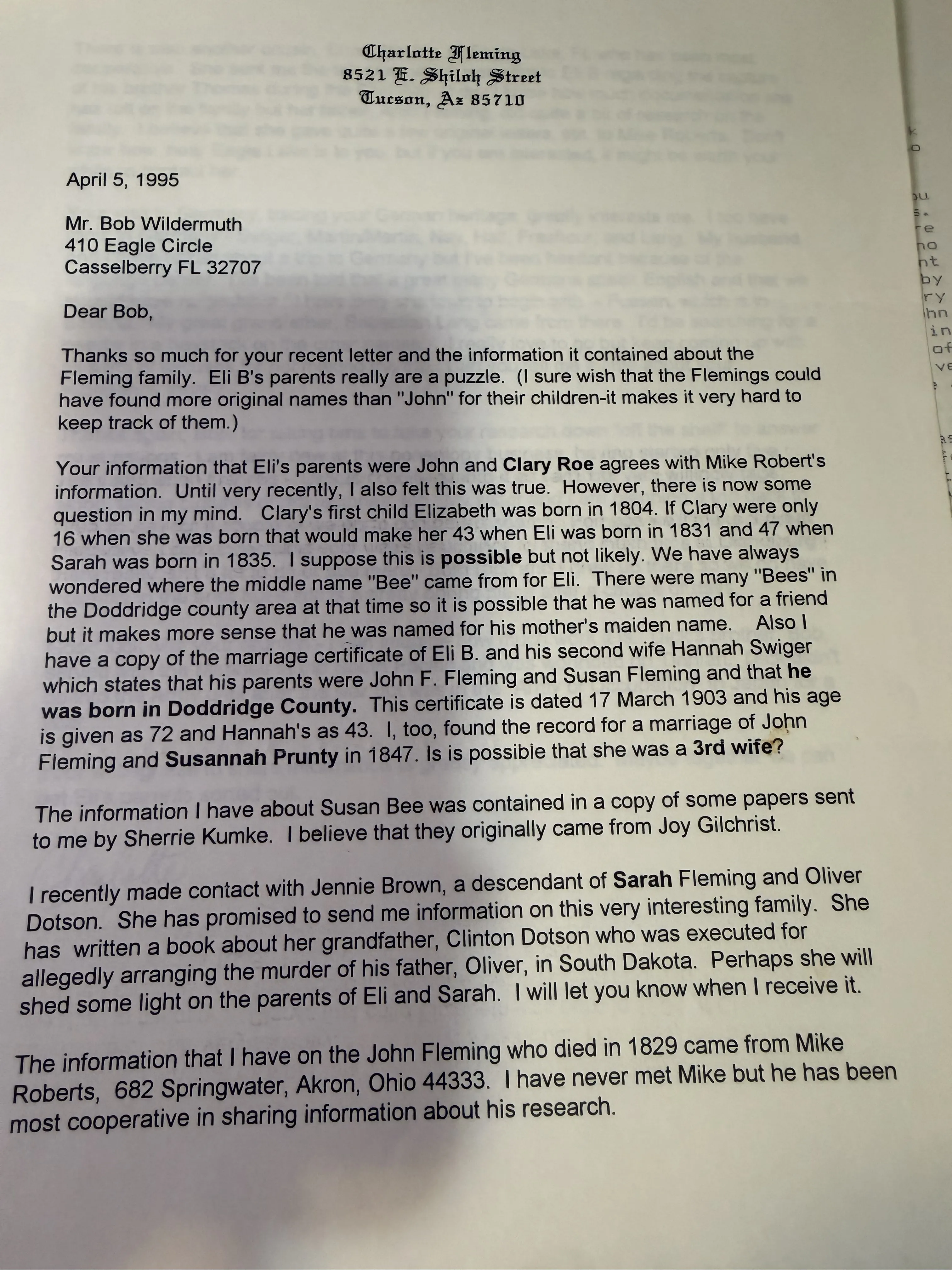
Lewis Fleming is the deepest Fleming ancestor Robert Earl Wildermuth pursued in his research, and the one who defeated him. In his comment preserved in the Wildermuth/Bain family book, Robert Earl wrote:
“Lewis Fleming remains almost an enigma to me. He left very few civil records and his is a very difficult trail to follow.”
He was born about 1807 — no birth record survives; the 1850 Doddridge County census fixes the year — on his father John Fleming IV’s Simpson Creek farm in eastern Harrison County, then part of Virginia.
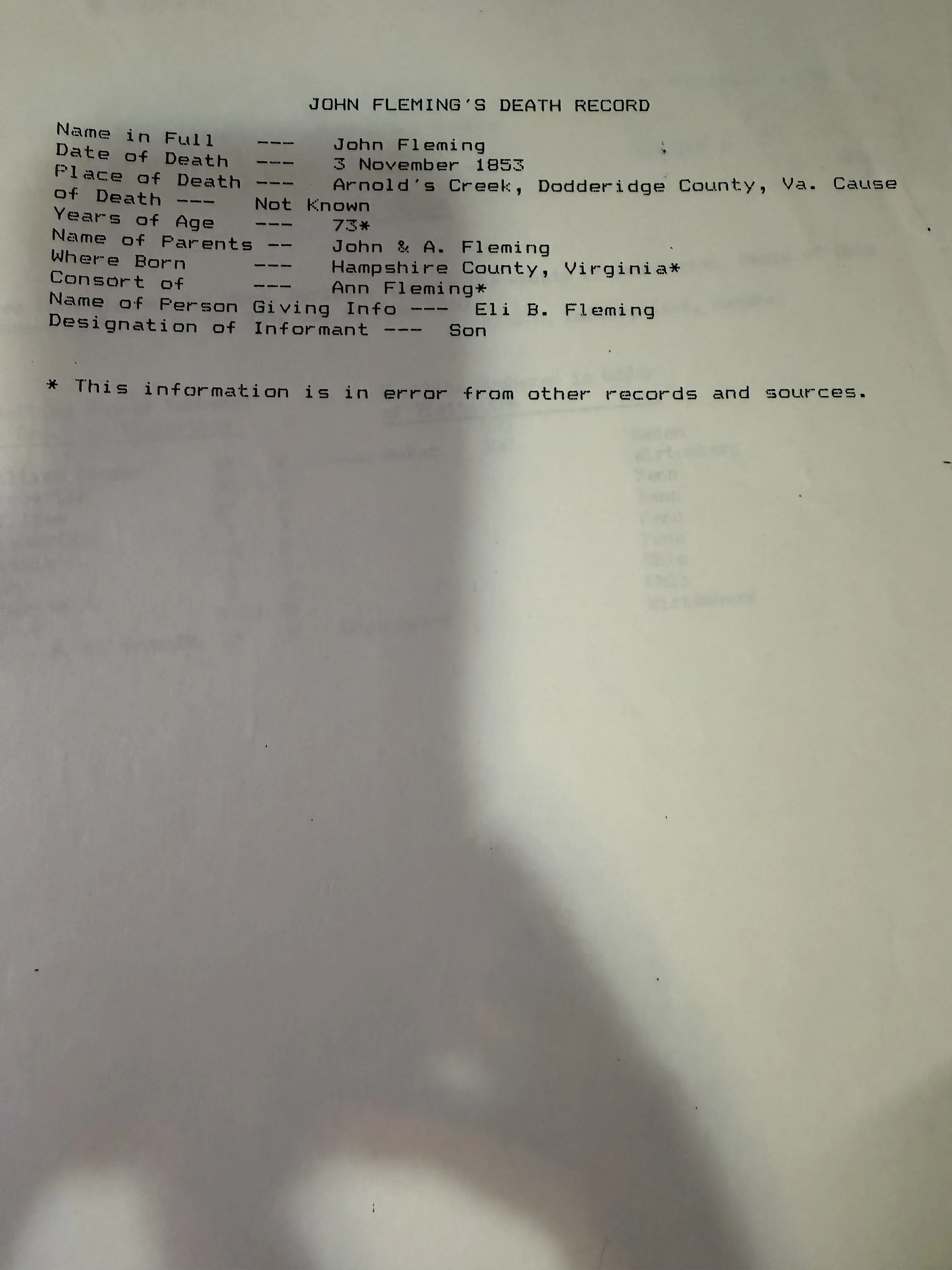
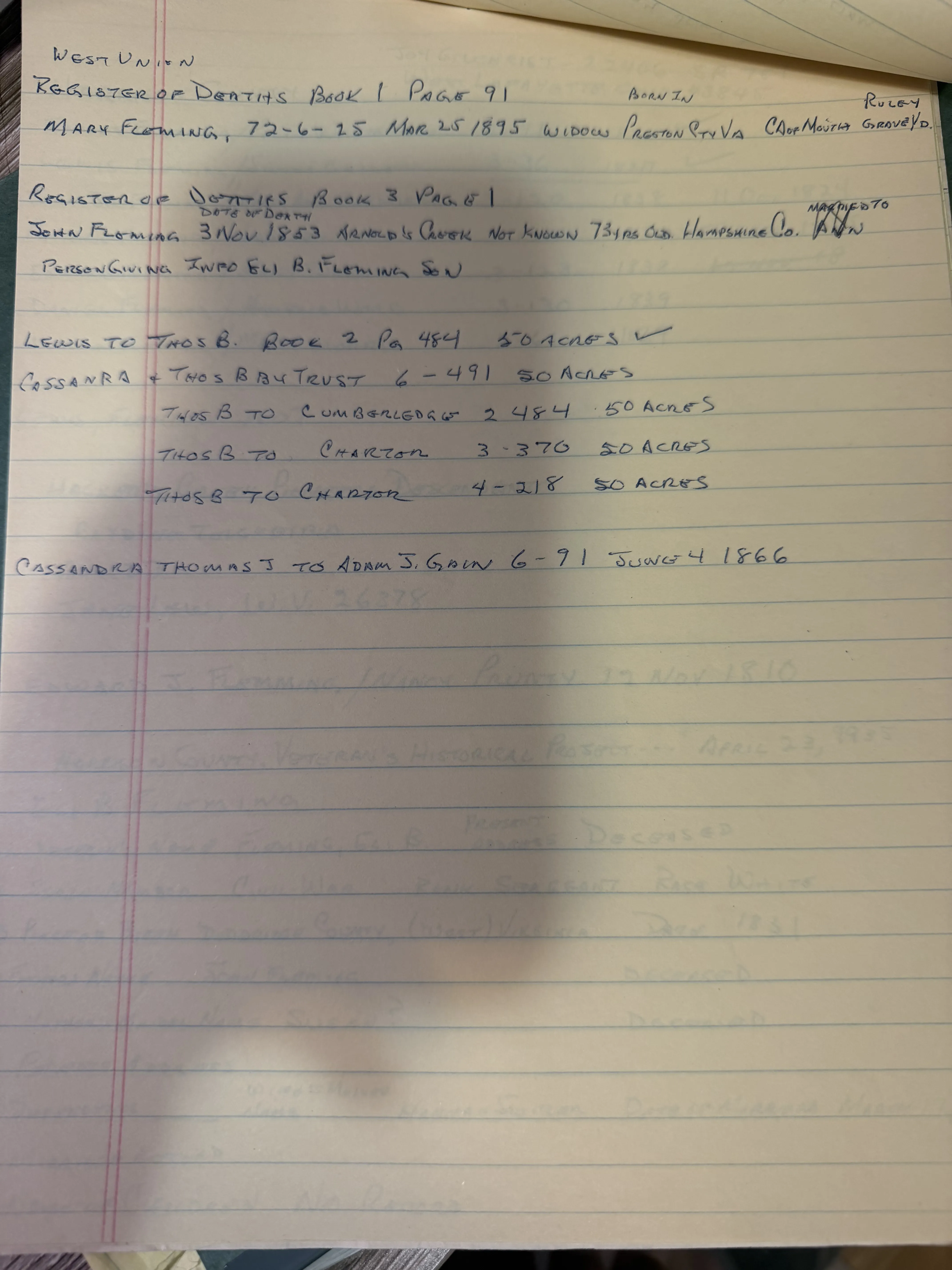
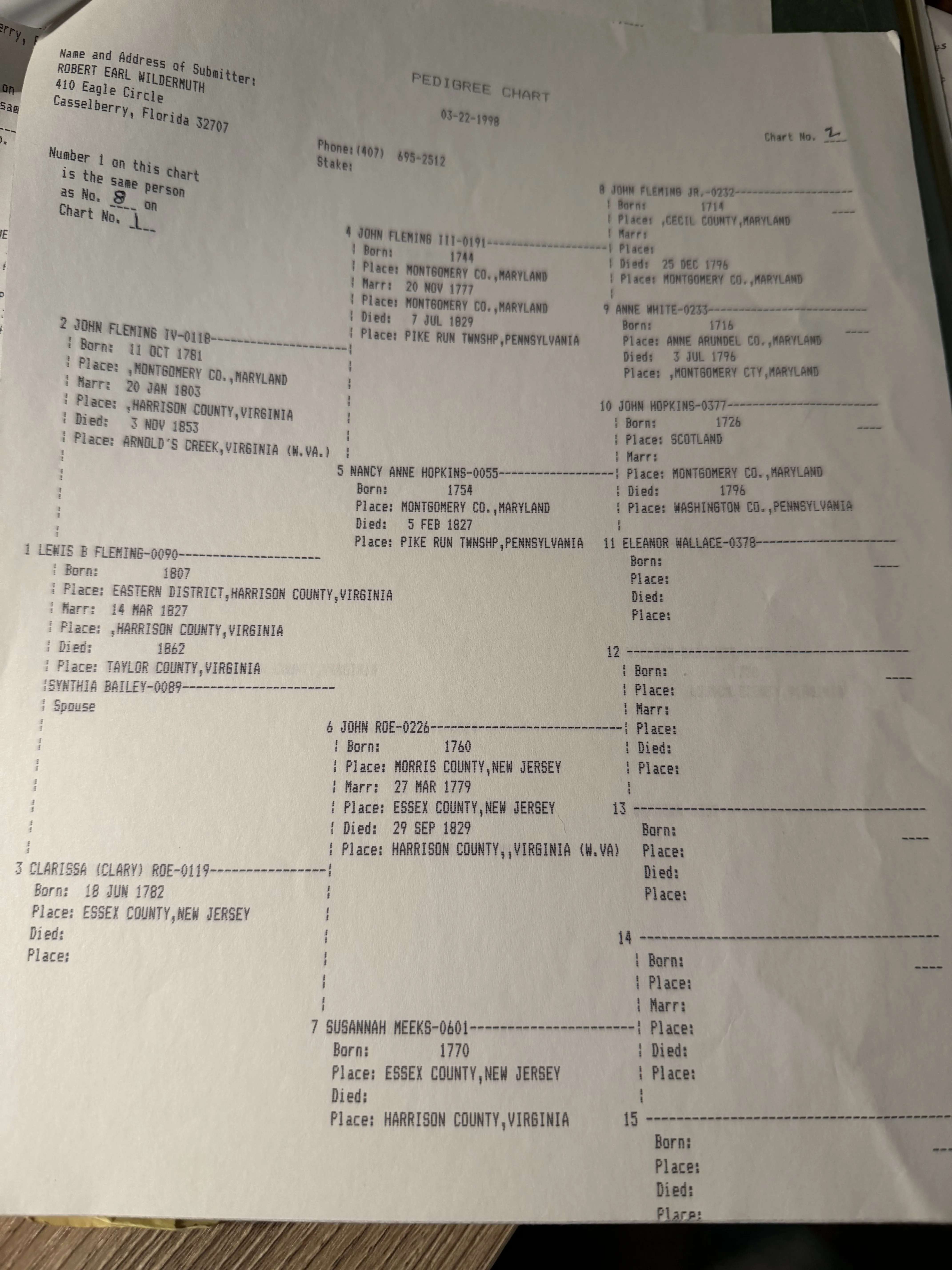
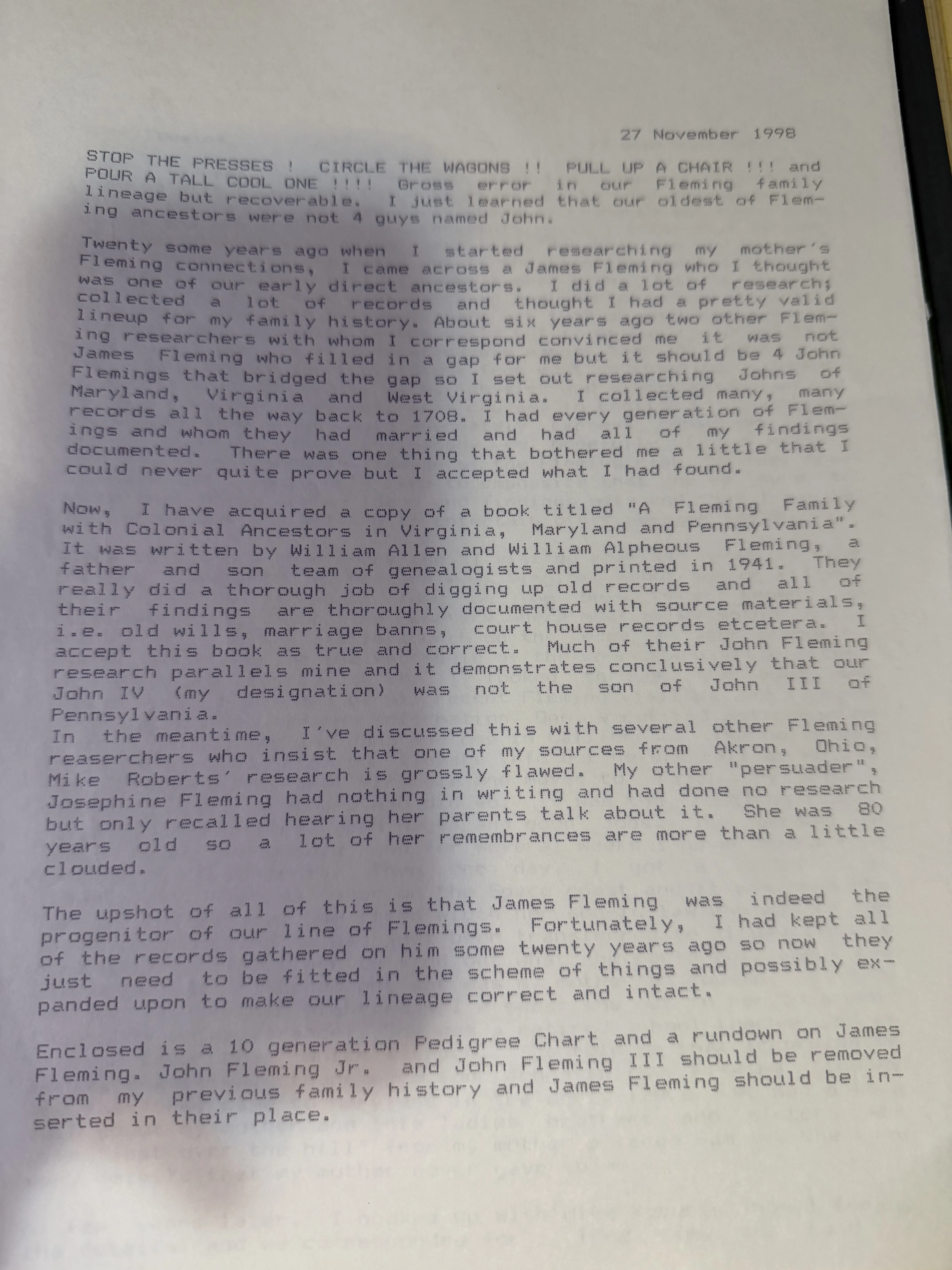
His father was John Fleming — not Edward, as this archive said until August 2026. The 1827 marriage consent, quoted in full in Robert Earl Wildermuth’s typescript, is signed John Fleming twice over. He was John Fleming IV, b. 11 October 1781 in Montgomery County, Maryland, d. 3 November 1853 at Arnold’s Creek. Edward Fleming was Lewis’s younger brother, born 2 July 1817. See below.
His father was John Fleming — a correction
This archive said Edward Fleming for years, following Joy Lea Gilchrist’s The Squires Family by way of the Wildermuth & Bain book, and cited an 1827 note in which “Edward” let his son “go out from under my house.”
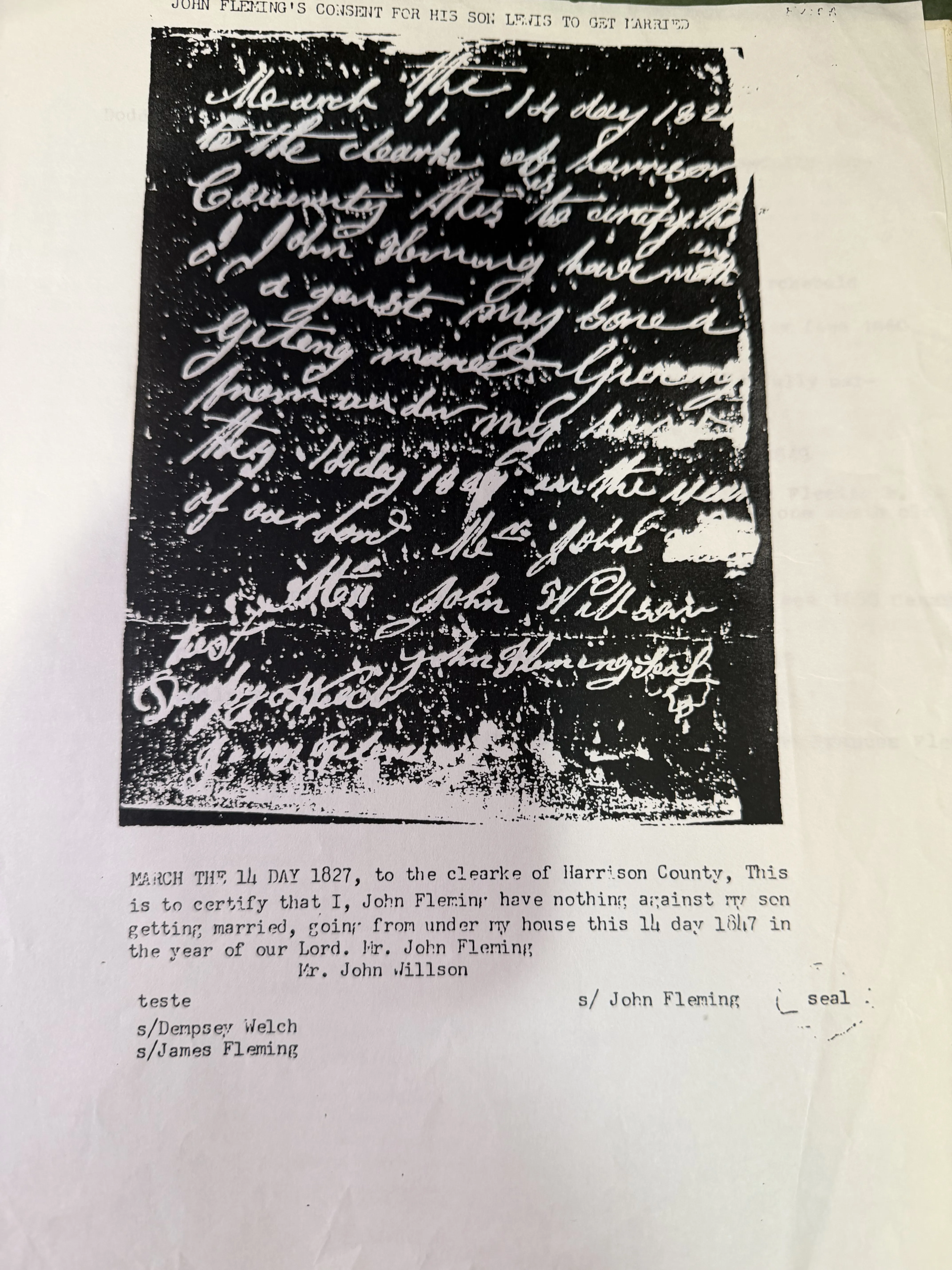
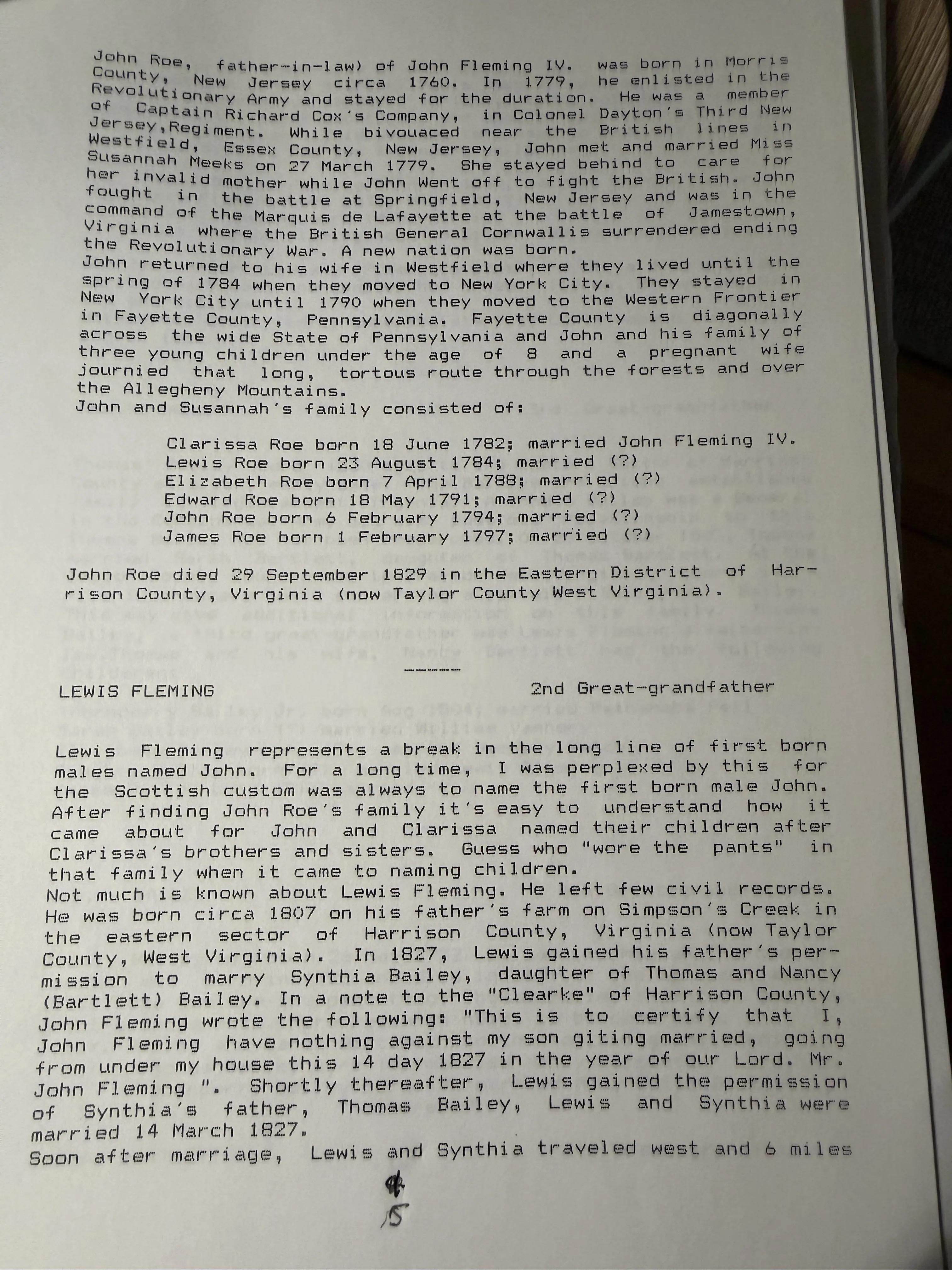
The note is quoted in full in Robert Earl Wildermuth’s own typescript, and it is signed John Fleming:
“This is to certify that I, John Fleming have nothing against my son giting married, going from under my house this 14 day 1827 in the year of our Lord. Mr. John Fleming.”
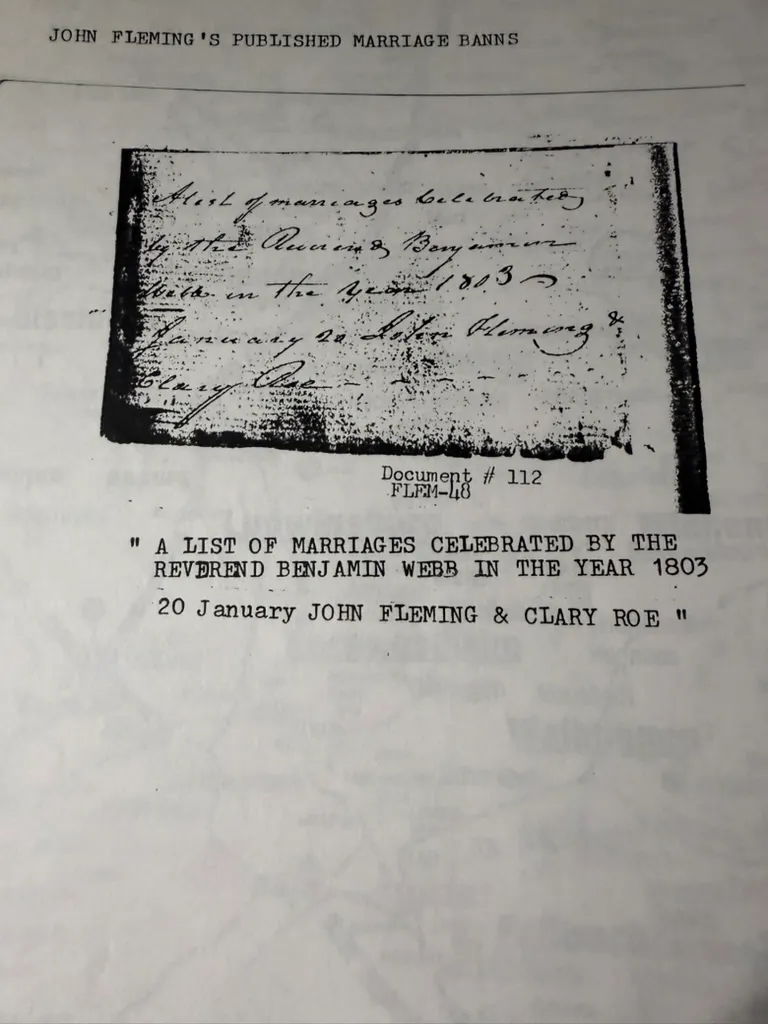
Twice in four lines. Lewis’s father was John Fleming IV — born 11 October 1781 in Montgomery County, Maryland, married Clarissa Roe on 20 January 1803 in Harrison County, and died 3 November 1853 at his farm on Arnold’s Creek, six miles west of West Union — in the settlement his son Lewis had opened.
And there really was an Edward. John Fleming IV’s thirteen children include Edward Fleming, born 2 July 1817, who married Mary Turner — Lewis’s younger brother by ten years, on the same land, in the same county. An Edward Fleming one generation out of place is more than enough to explain how the wrong name reached Gilchrist and then this archive.
What survives from the old account: the Simpson Creek farm is right — Robert Earl places Lewis’s birth “on his father’s farm on Simpson’s Creek in the eastern sector of Harrison County.” Only the name attached to it was wrong.
What does not survive: the Revolutionary soldier. A man born in 1781 cannot have fought in that war. The Revolutionary service in this line belongs to Lewis’s great-grandfather John Fleming III, who served in the 5th Battalion, Washington County Militia, and to his maternal grandfather John Roe, who enlisted in 1779 and was at Yorktown under Lafayette.
He found it in the courthouse, filed where it belonged. In a letter to Fleming cousins he says so directly:
“Found this note filed with my grandfather Lewis’ marriage banns in the Harrison County Court House.”
— and attributes it to “our John (b. 1781).” So the note was not a family keepsake or a secondhand report: it was in the county’s own 1827 marriage file, alongside Lewis’s banns, and Robert Earl had it copied.
And the document itself is now in the archive. A photograph of the manuscript — headed by him “John Fleming’s Consent For His Son Lewis To Get Married” — is here. It is signed with a seal, dated 14 March 1827 (the day of the wedding itself), and witnessed by Dempsey Welch and James Fleming. The transcription caveat this page carried is withdrawn.
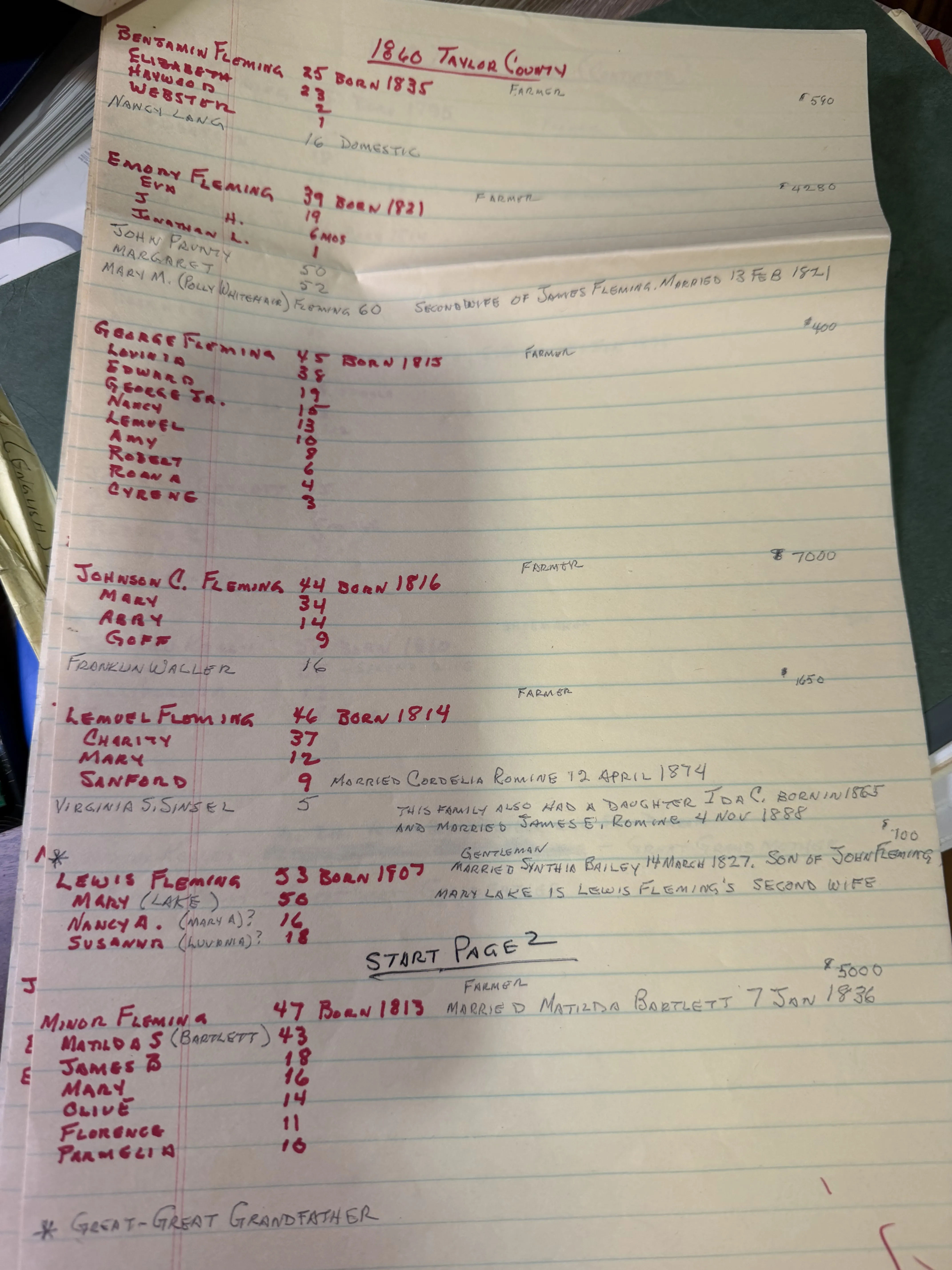
A second statement, in his own hand. On his working 1860 Taylor County census sheet he wrote beside this household: “Married Synthia Bailey 14 March 1827. Son of John Fleming.” — and starred it, with a key at the foot of the page reading “✱ great-great grandfather.”
The 1827 marriage and the move to Arnold’s Creek
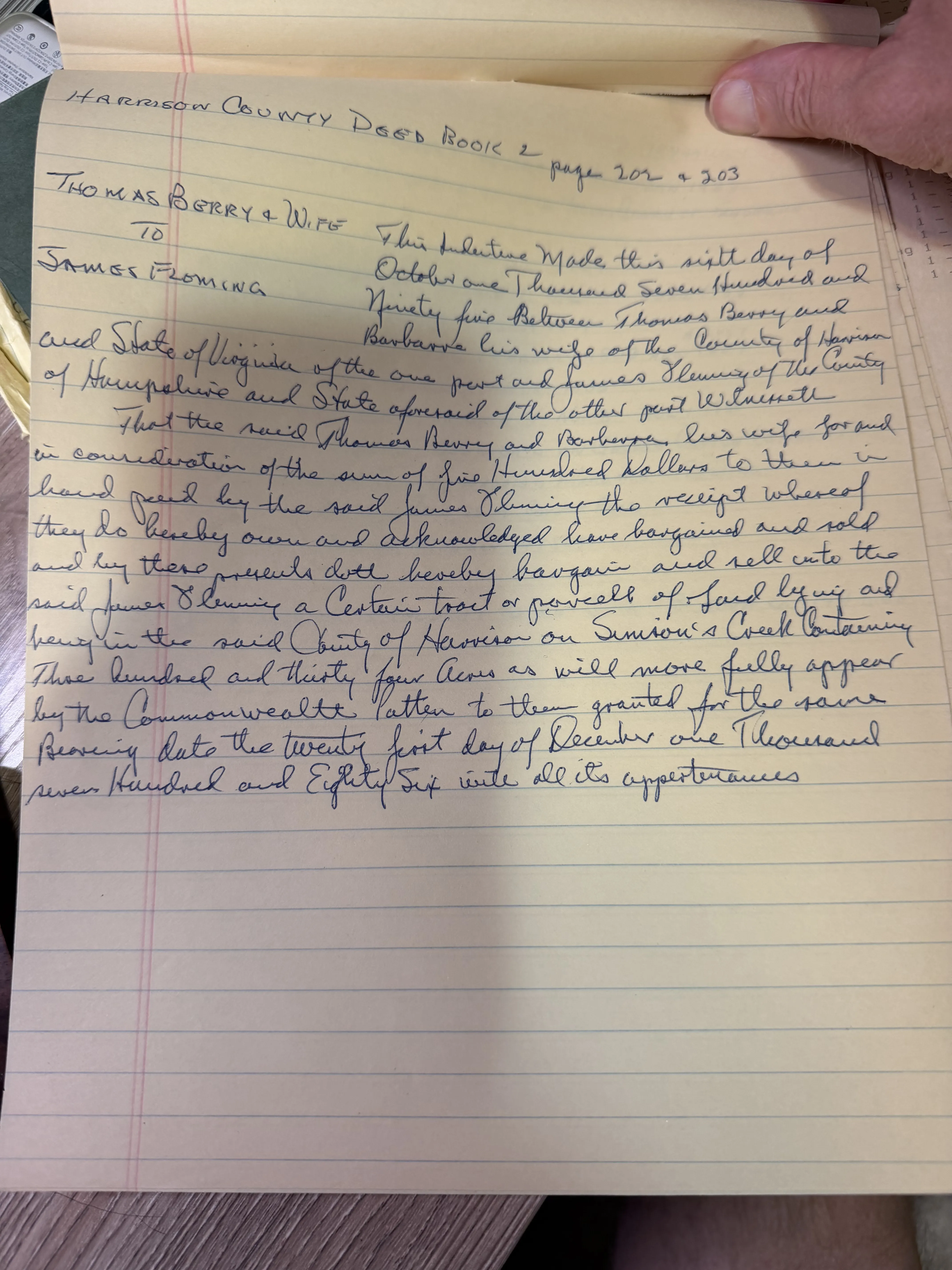
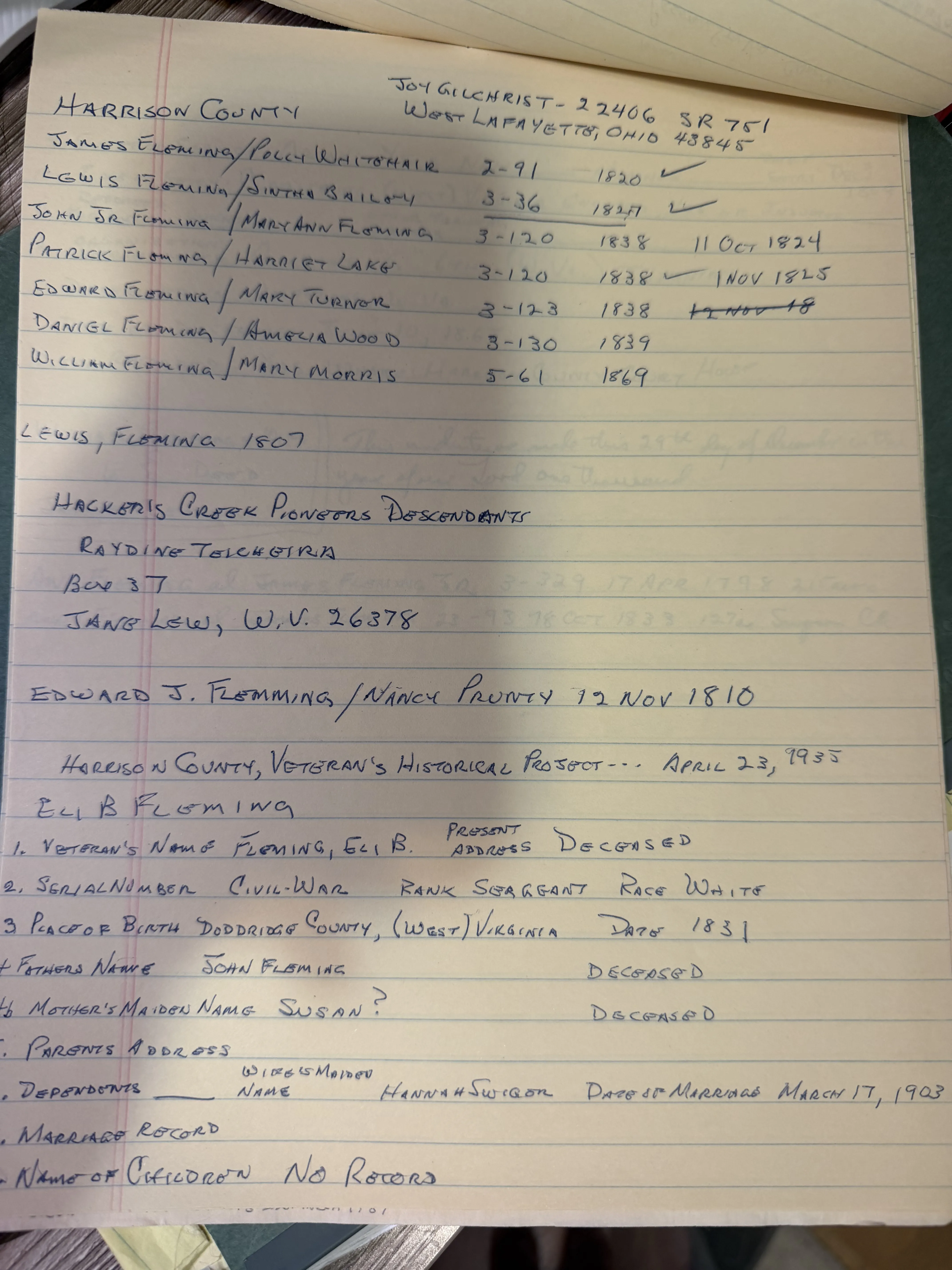
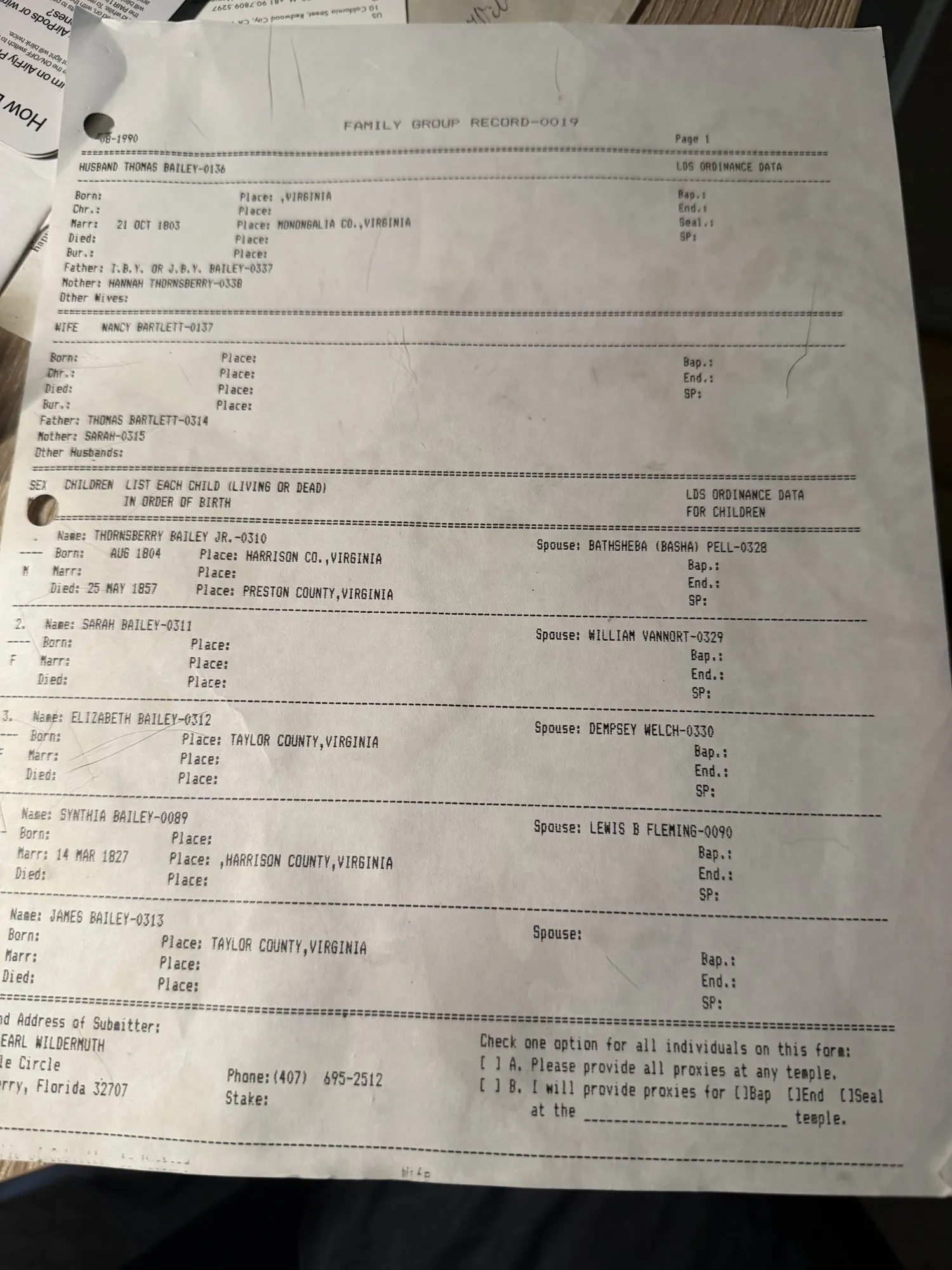
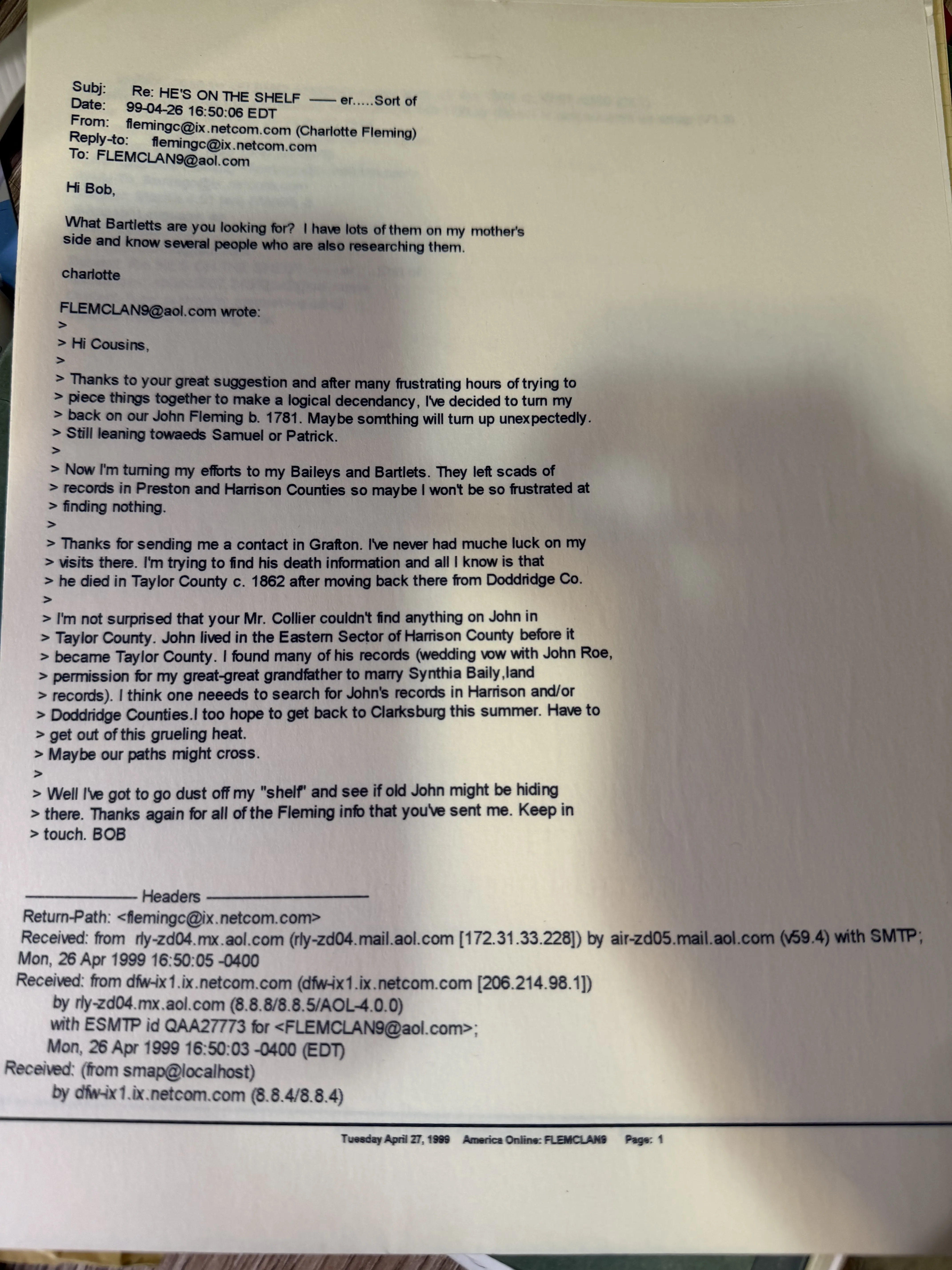
In 1827 Lewis gained his father’s written permission to marry — John Fleming sent a note to the “Clearke” of Harrison County allowing his son “going from under my house” — and on 14 March 1827, with the further consent of her parents, he married Cynthia (Synthia) Bailey, daughter of Thomas Bailey and Nancy (Bartlett) Bailey, Cylis Hickerson officiating. The Baileys and Bartletts were old Virginia families — and the Bailey Family Group Record in Robert Earl’s own research papers now carries that side back two further generations, to J.B.Y. Bailey and Hannah Thornsberry, and to Thomas Bartlett and a wife recorded only as Sarah.
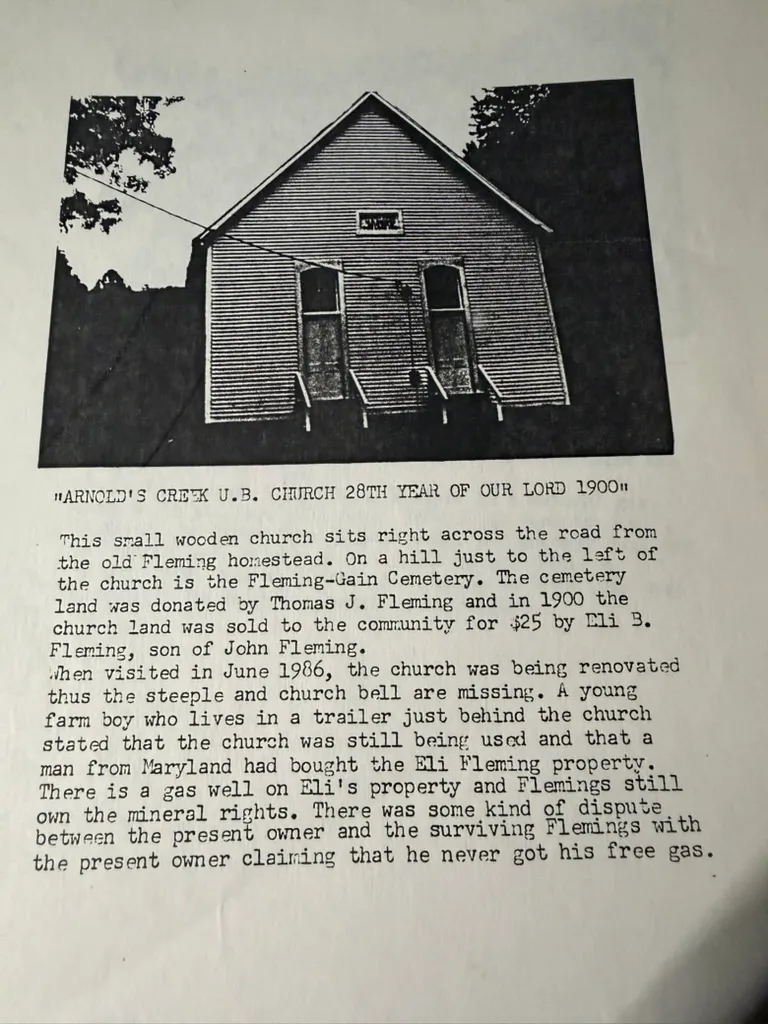
The settlement was photographed in 1986. Robert Earl found it and took pictures: a level bottom under high wooded hills, a small clapboard church across the narrow dirt road from the old Fleming homestead, and the Fleming-Gain Cemetery on the hill beside it. A gas well was still running on the ground in 1986, and the Flemings still held the mineral rights.
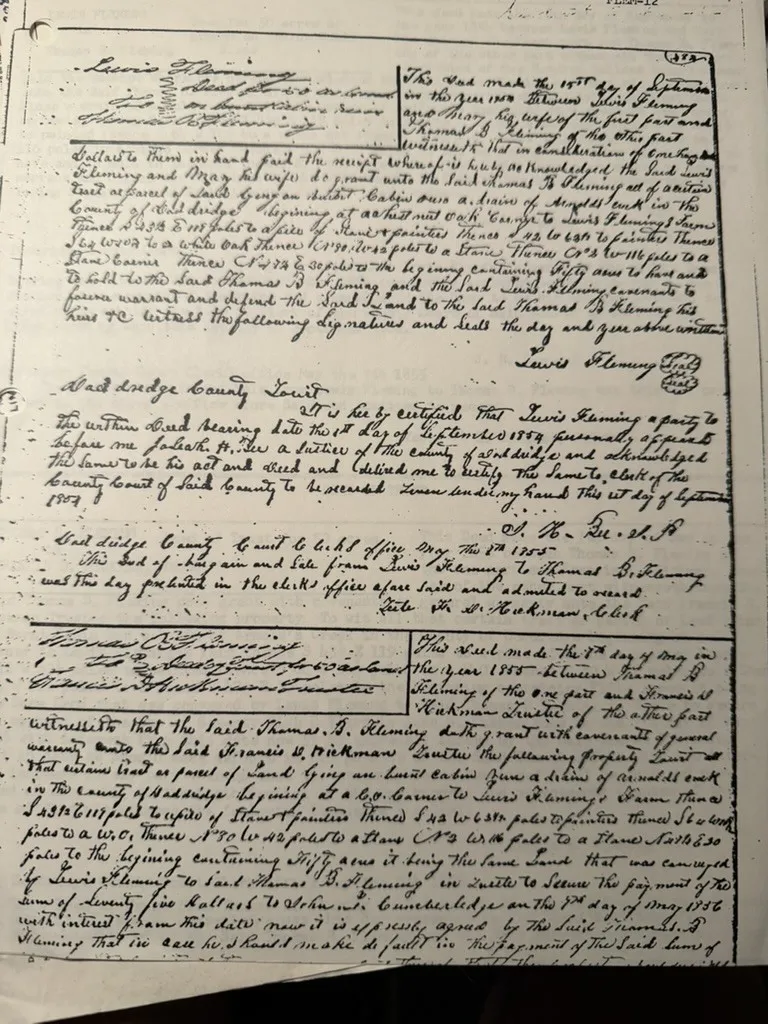
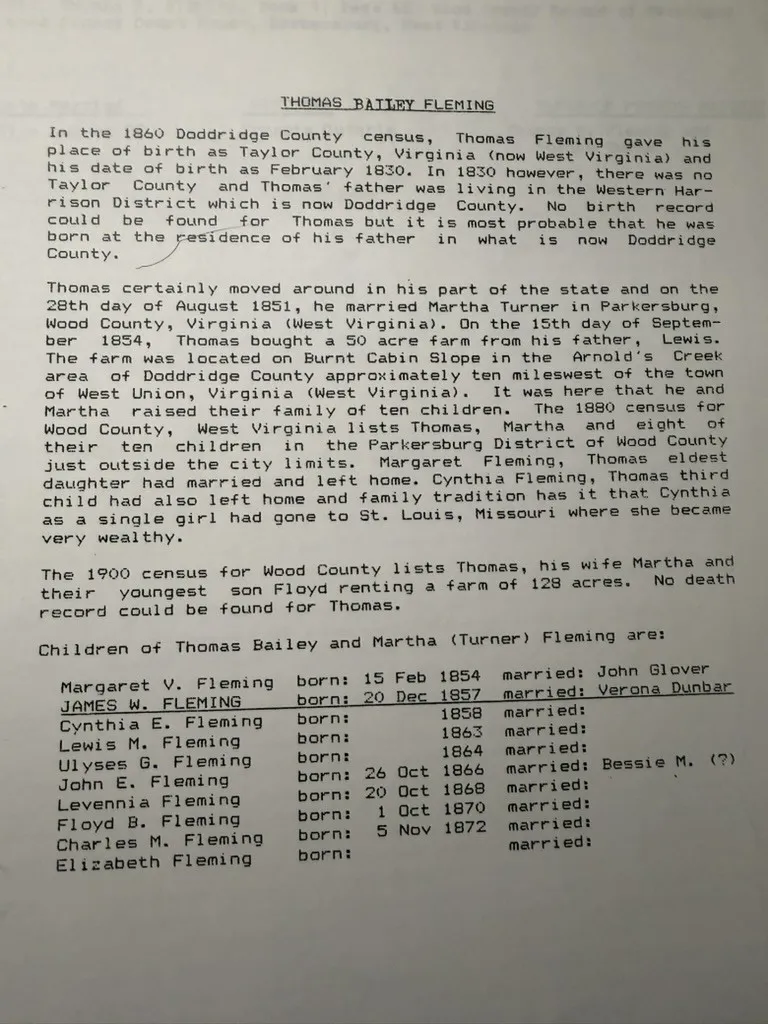
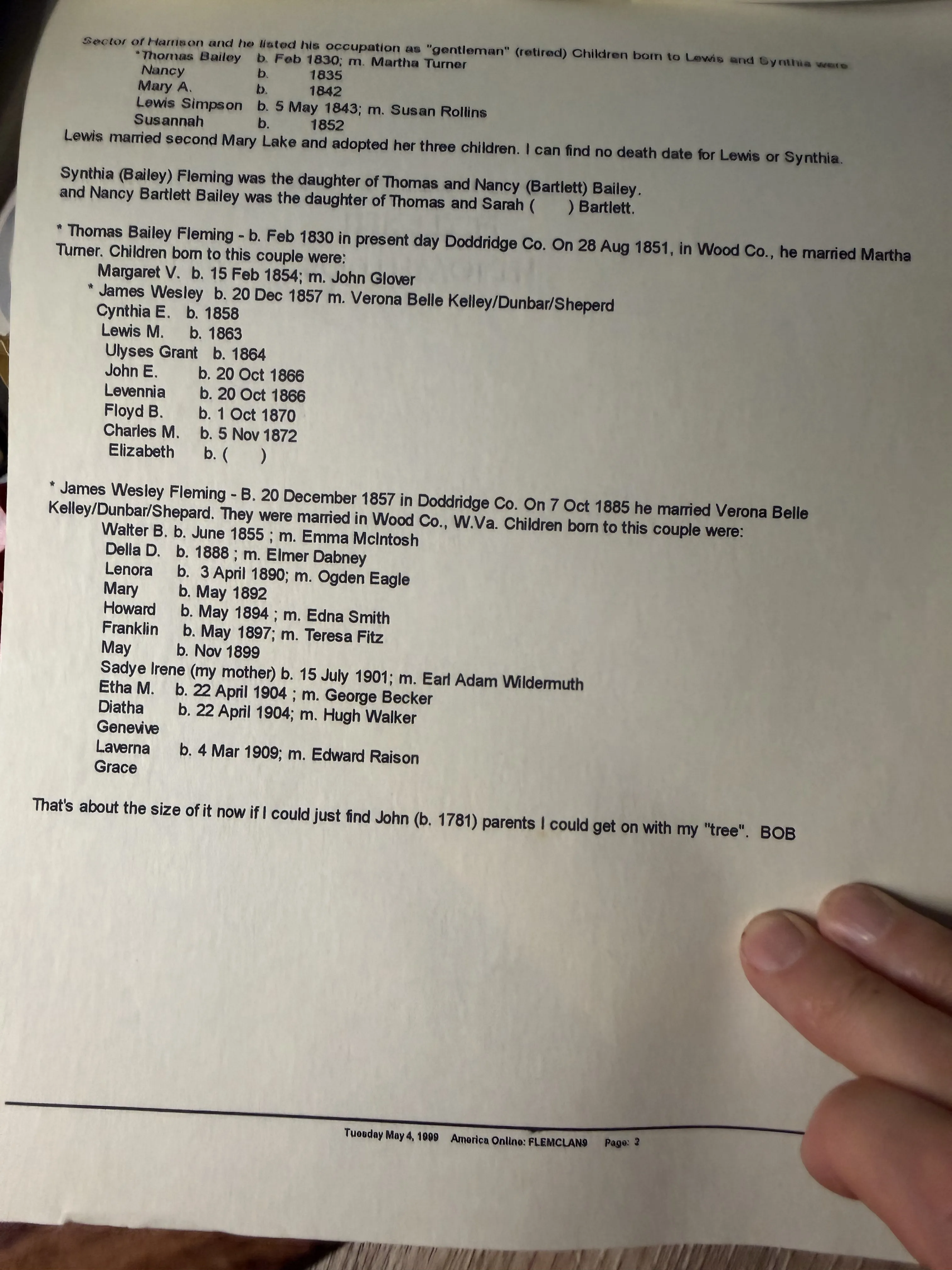
Soon after, Lewis and Cynthia moved west to the Arnold’s Creek area in the Western District of Harrison County — the district that in 1863 became Doddridge County. The 1830 census places him there. In 1852 he bought 222 acres from Joseph and Jacob Gratz. Two years later, on 15 September 1854, he and his second wife sold fifty of those acres to their son Thomas for one hundred dollars — the deed survives, and its boundary call opens at a chestnut oak “corner to Lewis Fleming’s farm.” The parcel lay on Burnt Cabin, a drain of Arnold’s Creek. The instrument names the grantors as “Lewis Fleming and Mary his wife” — a dower release, and the only legal document in the archive that names his second wife. Arnold’s Creek is the settlement where James Wesley Fleming — Sadye’s father — would be born in 1855. The GEDCOM confirms the descent Robert Earl could not trace: Lewis’s eldest son Thomas Bailey Fleming (b. 1830) was Wesley’s father — so Lewis is Wesley’s grandfather and a documented direct forebear of this line.
Not yet checked: the slave schedules
By 1852 he had 222 acres on Arnold’s Creek, and by 1860 he had sold up, moved back to Taylor County and was listed as a “gentleman” — a man of some property.
Whether he held anyone in slavery is unknown, and this archive has never looked. The federal slave schedules of 1850 and 1860 — taken alongside the population census, naming slaveholders and listing the age and sex of each person held — would answer it directly, for Doddridge County in 1850 and Taylor County in 1860.
Nothing here settles it, but one figure points. The western Virginia hill counties had very low slaveholding, this household sent one son into the Union Army and one into the Confederate — and the 1860 census returns him at one hundred dollars, the smallest of any Fleming household in Taylor County. A man of that return is not a slaveholding planter in 1860. That leaves 1850 open, when he still held the Arnold’s Creek land.
Recorded as an open item so that silence is not mistaken for an answer. The 1795 Maryland will in this archive, which disposes of two enslaved people, sits on the far side of the break in this line — above John Fleming IV, in the generations Robert Earl withdrew — and says nothing about Lewis.
Two wives, and a family split by the war
Cynthia died about 1849; Lewis then married Mary Lake, a widow with three children. His documented children were:
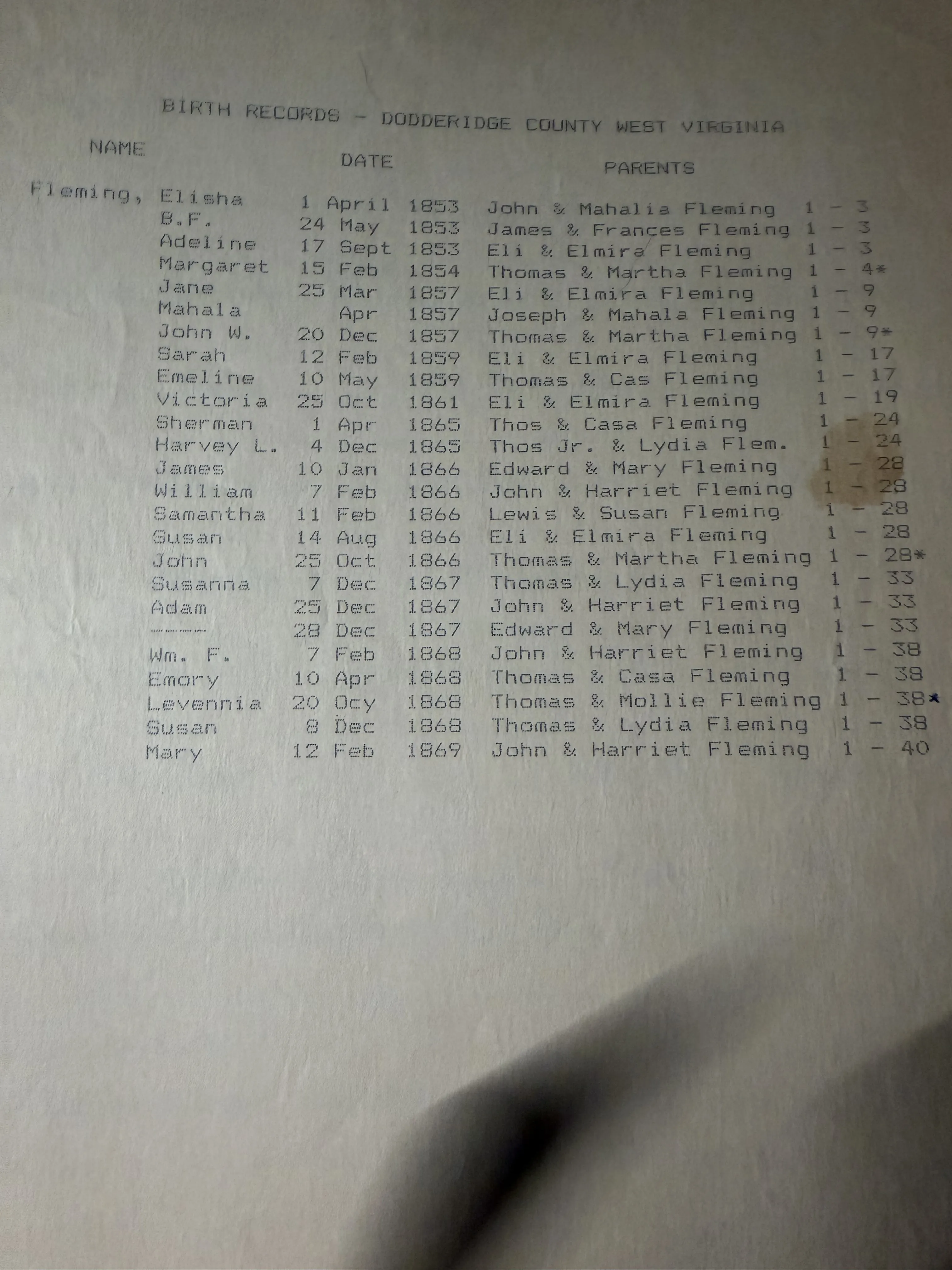
- With Cynthia Bailey: Thomas Bailey Fleming (b. February 1830; m. Martha Turner 1851), Nancy (b. ~1835), Mary Ann (b. ~1844; m. Henry Middleton Jenkins 1863), and Lewis Simpson Fleming (b. 5 May 1844; m. Susan Jane Rollins 1865; d. 1918) — and, per Gilchrist, John, who served in the Union Army, and Patrick, a Confederate.
- With Mary Lake: Luvanah D. Fleming (b. ~1852; m. Henry H. Knight 1875).
That one son wore Union blue and another Confederate gray is the sharp local truth of the West Virginia hill country in 1861–65, where the new state itself was born of the split.
Late in life Lewis and Mary moved back east to Taylor County, leaving son Lewis Jr. with Lewis’s brother James; the 1860 Taylor County census lists him at 53, occupation “gentleman” — the period term for retired — with Mary (Lake), 56, and two daughters at home. His return that year is one hundred dollars. Set beside the other Fleming households on the same page — $7,000, $5,000, $4,280 — he is the poorest Fleming in the county, a man who had sold his land and was living on what was left of it. No death record has been found; unverified family sources place his death about 1862, in the war years.
He is Chuck’s maternal 4×-great-grandfather on the Fleming line: Lewis → Thomas Bailey Fleming → James Wesley Fleming → Sadye → Robert Earl → Terrie → Chuck. The enigma Robert Earl left open — his own descent from this “difficult trail” — the GEDCOM has since closed.
Source: Wildermuth/Bain family book — Fleming section, including Robert Earl Wildermuth’s own research comment and Joy Lea (Gregoire) Gilchrist, The Squires Family, p. 357. Transmitted by Chuck Eesley 2026.
Appears in
Pictured in