Arnold's Creek, June 1986 — the church, the cemetery, and the Fleming farm
He went and stood there. In June 1986 — three years before the memoir, twelve before the charts — Robert Earl Wildermuth drove into the Doddridge County hills, found the settlement his family came out of, and photographed it.
The church
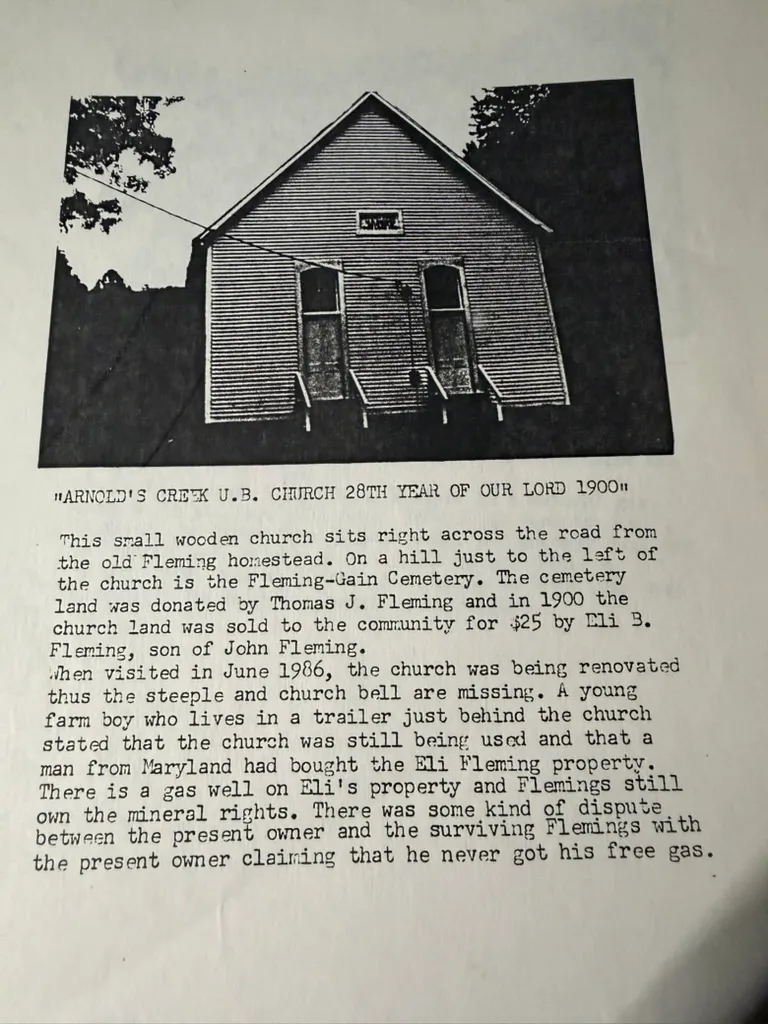
The caption on the photograph reads “ARNOLD’S CREEK U.B. CHURCH 28TH YEAR OF OUR LORD 1900” — a United Brethren congregation. His notes underneath:
“This small wooden church sits right across the road from the old Fleming homestead. On a hill just to the left of the church is the Fleming-Gain Cemetery. The cemetery land was donated by Thomas J. Fleming and in 1900 the church land was sold to the community for $25 by Eli B. Fleming, son of John Fleming.”
Three things there the archive did not have.
“Eli B. Fleming, son of John Fleming” — a local record, independent of any chart, making Eli the son of John Fleming IV. That was never the disputed part; the argument with Charlotte Fleming was about Eli’s mother. But it is corroboration from the ground.
The Fleming-Gain Cemetery, and the name is a marriage. The typescript records that John Fleming IV’s daughter Susannah Agnes married Adam J. Gain. The burying ground carries both surnames, which is what a hollow looks like after two families have been intermarrying in it for a century.
Thomas J. Fleming gave the cemetery land — another Fleming of the settlement, not yet placed in this archive.
When he arrived the church was under renovation, the steeple and bell removed, which is why the building in the photograph looks oddly bare.
The farm
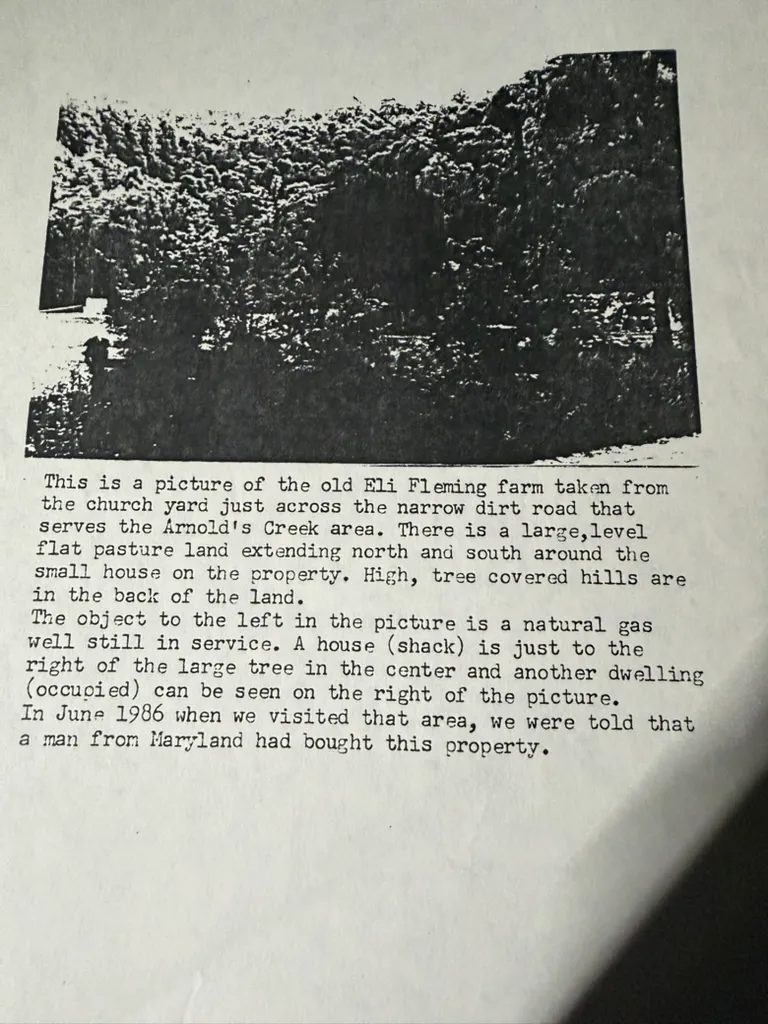
“This is a picture of the old Eli Fleming farm taken from the church yard just across the narrow dirt road that serves the Arnold’s Creek area. There is a large, level flat pasture land extending north and south around the small house on the property. High, tree covered hills are in the back of the land.”
This is the ground. The level bottom with the wooded hills behind it is where Lewis Fleming settled after his 1827 marriage, where he ran up to several hundred acres, where John Fleming IV died in 1853, and where Thomas Bailey Fleming bought his fifty acres on Burnt Cabin and mortgaged them straight back out. James Wesley Fleming was born on it in 1857 — “Place of Birth: Arnolds Creek.”
The dark object at the left of the frame is a natural gas well, still in service in 1986.
What the farm boy told him
The best part of the visit is not in either photograph. A young man living in a trailer behind the church came out and talked, and Robert Earl wrote down what he said:
- the church was still in use
- a man from Maryland had bought the Eli Fleming property
- there was a gas well on it and the Flemings still held the mineral rights
- and there was a dispute — the new owner “claiming that he never got his free gas”
A hundred and fifty years after the family came over the mountains from Maryland, a man from Maryland bought the farm — and fell out with the surviving Flemings over gas. Robert Earl set it down without comment.
(Free gas to the surface owner is a common term in Appalachian oil-and-gas leases. That the Flemings had kept the minerals while selling the land is why any of them still had standing to argue about it.)
Source: two photographs with typed captions from Robert Earl Wildermuth’s June 1986 research visit to Arnold’s Creek, Doddridge County, West Virginia; in his research papers, in Chuck’s keeping. Re-photographed 2026.
Catalogue
- Type
- Photograph
- Medium
- Photographs with typed captions, mounted on research sheets
- Date created
- June 1986
- Place created
- Arnold's Creek, Doddridge County, West Virginia
- ID number
- FLEMING
- Provenance
- Photographed by Robert Earl Wildermuth on a research visit, June 1986; in his research papers, in Chuck's keeping. Re-photographed 2026.
- Rights
- Family use; permission required for republication.