John Fleming IV
also known as "John Fleming IV" is Robert Earl Wildermuth's own designation, invented to keep five generations of Johns apart
b. 1781-10-11, Montgomery County, Maryland
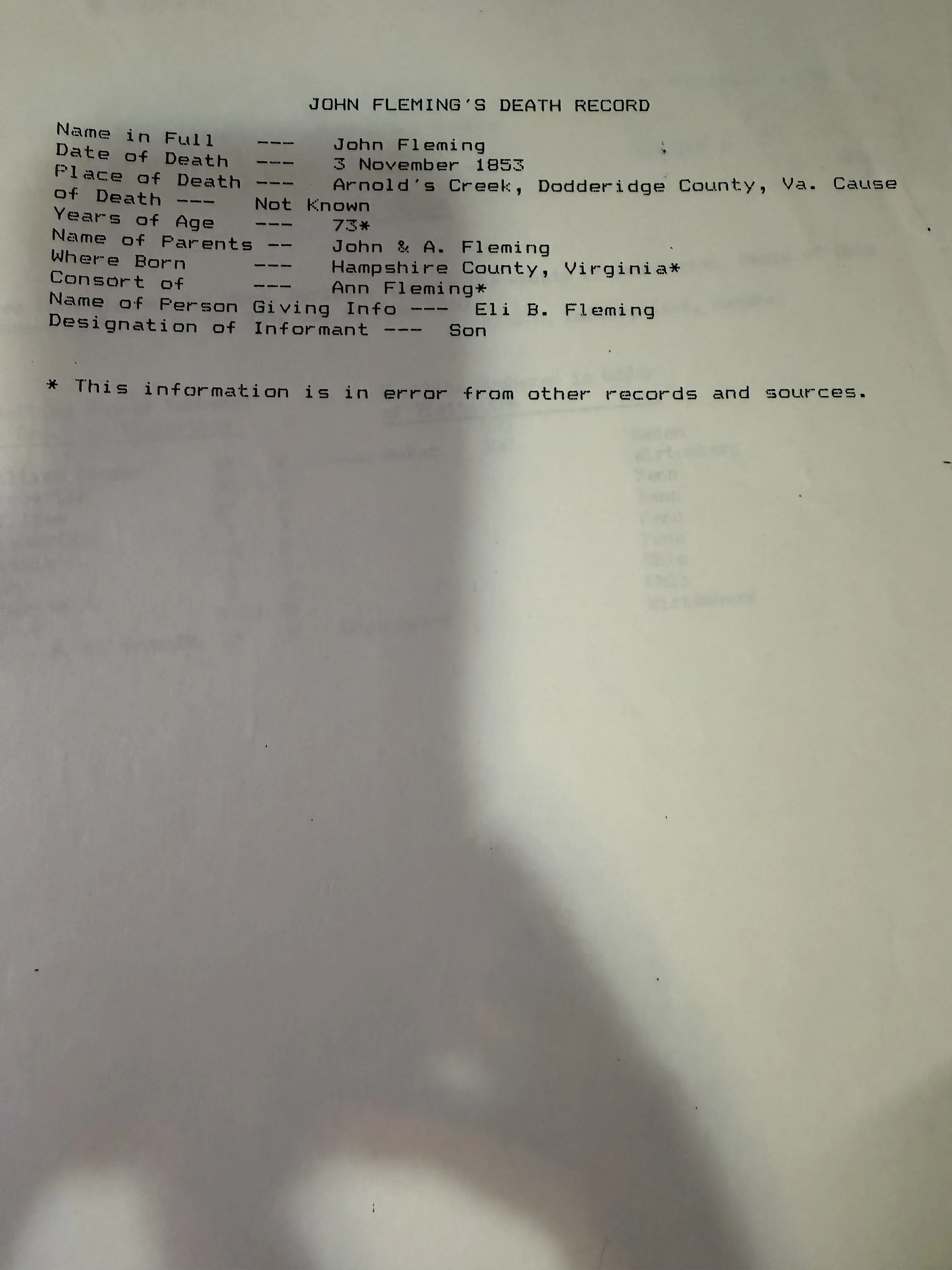
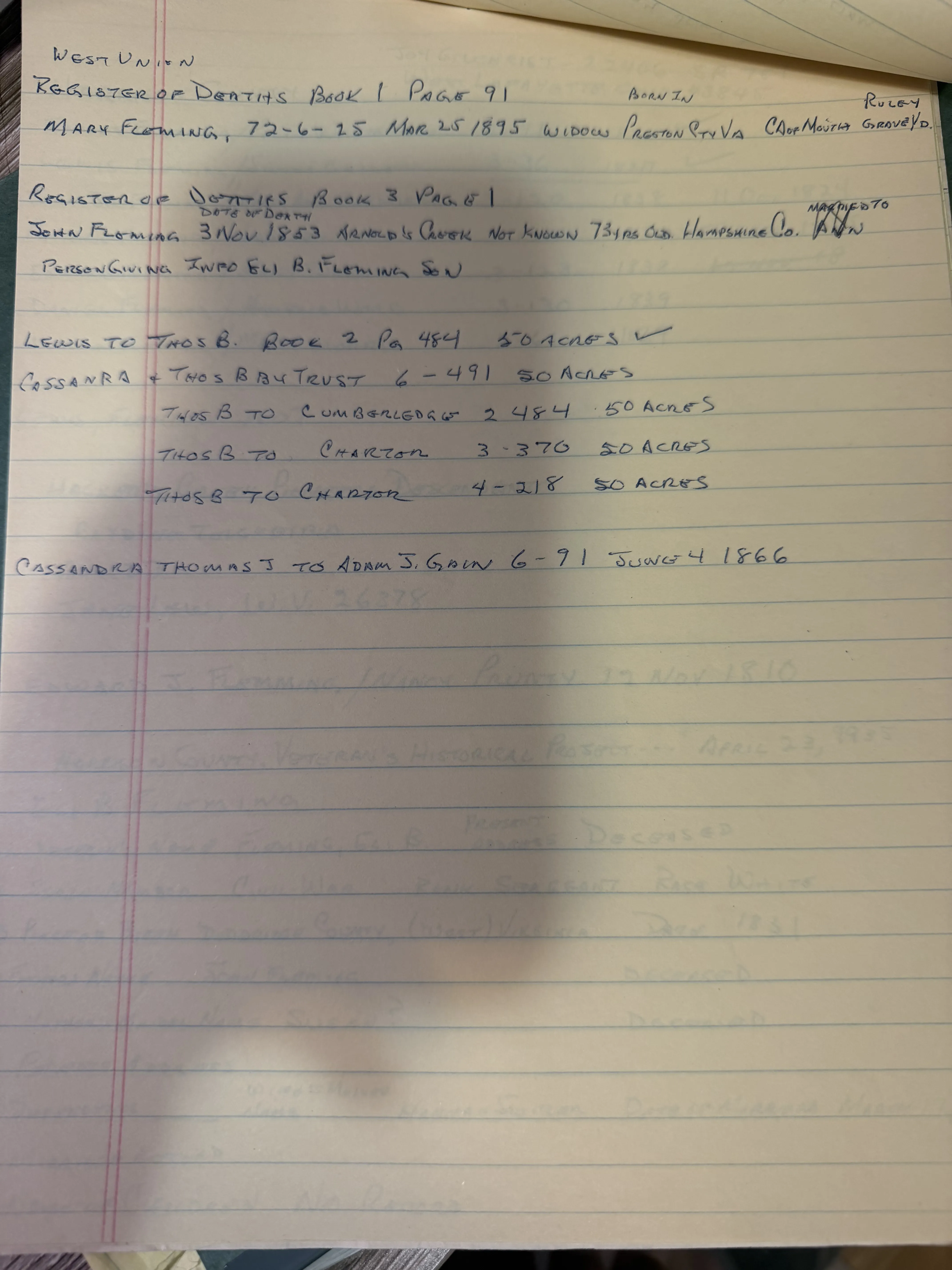
d. 1853-11-03, his farm on Arnold's Creek, about six miles west of West Union, Harrison County (now Doddridge County), Virginia
John Fleming IV is the man this archive called Edward until August 2026.
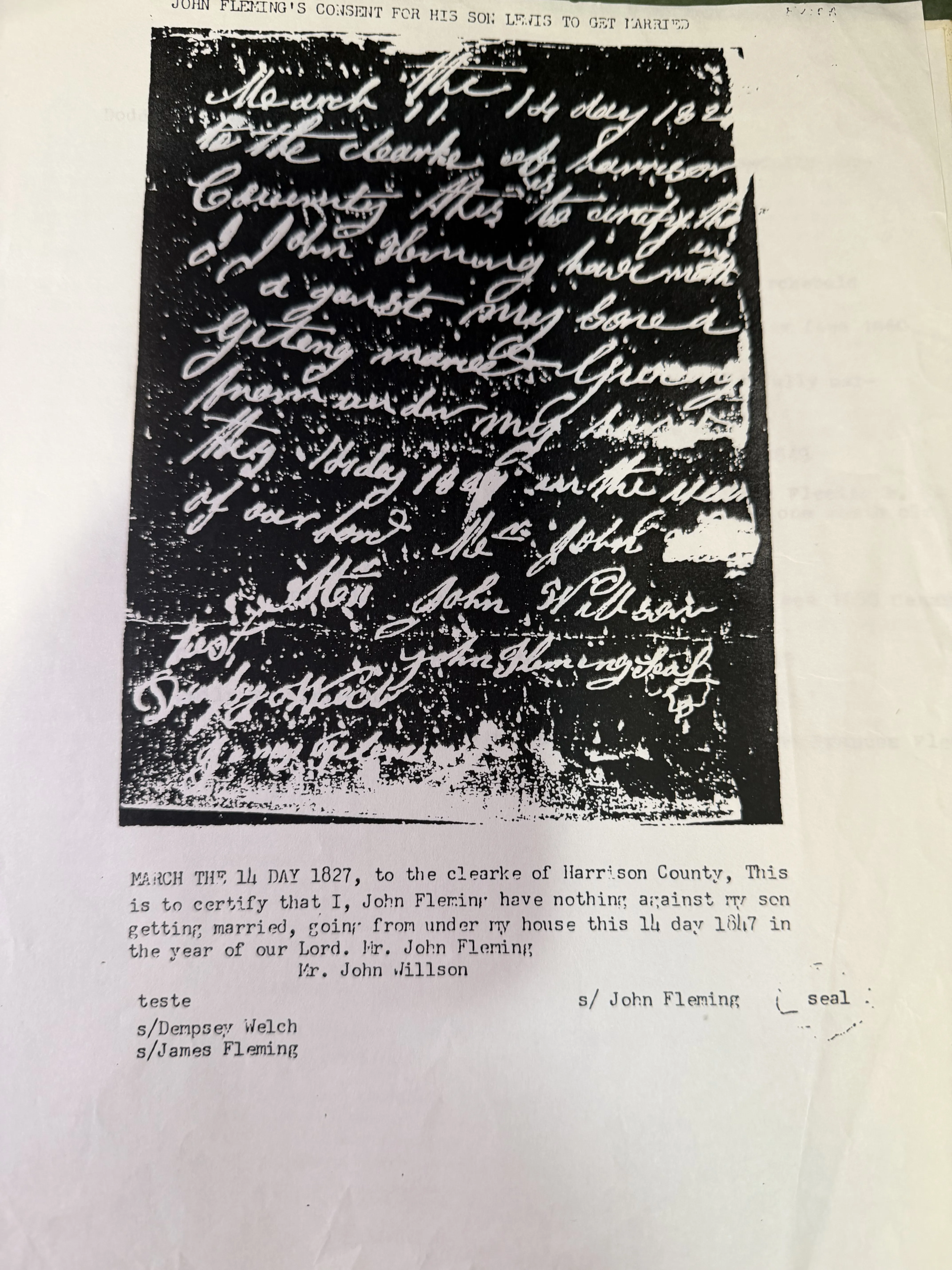
The correction comes from his own signature. In 1827 his son Lewis needed written permission to marry, and the note that went to the “Clearke” of Harrison County — quoted in full in Robert Earl Wildermuth’s typescript — reads:
“This is to certify that I, John Fleming have nothing against my son giting married, going from under my house this 14 day 1827 in the year of our Lord. Mr. John Fleming.”
(The Edward the archive had inherited was real, but a generation out of place: Edward Fleming, b. 2 July 1817, was Lewis’s younger brother. See below.)
The document is in the archive — a photograph of the manuscript, signed with a seal, dated 14 March 1827, the day of the wedding itself, and witnessed by Dempsey Welch and a James Fleming. (That witness is worth noting: the November 1998 retraction makes a James Fleming the family’s true progenitor, and here is one close enough to the household to witness a son’s marriage consent.)
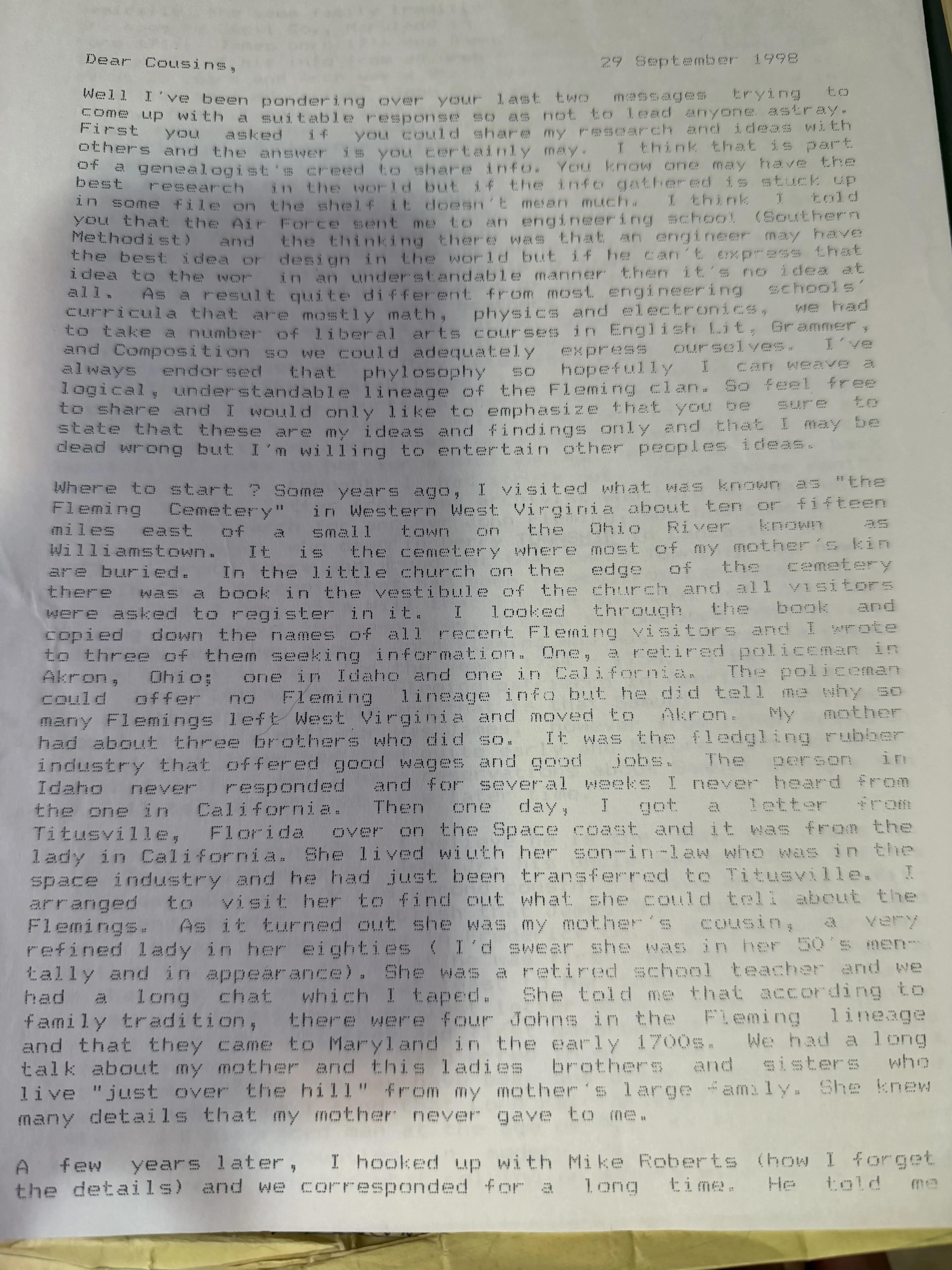
And he found it himself. Writing to cousins, he described where it came from:
“I’ve enclosed a sort of cute note that our John (b. 1781) scrawled to the ‘County Clarke’ giving permission … to ‘go out from under my house’ (I think he meant from under his roof) to get married. Found this note filed with my grandfather Lewis’ marriage banns in the Harrison County Court House.”
So this is not a family tradition or a chart entry. He handled the document, filed where it should be — with the 1827 marriage banns in the Harrison County courthouse — and he attributes it explicitly to “our John (b. 1781).” That is the strongest single piece of evidence on this page.
The numeral is not his. Robert Earl added it himself — “the junior part is of my choosing for the sake of keeping all of the Johns straight” — because this family produced five consecutive Johns and no contemporary distinguished them.
His own ancestry is unresolved — and his researcher said so
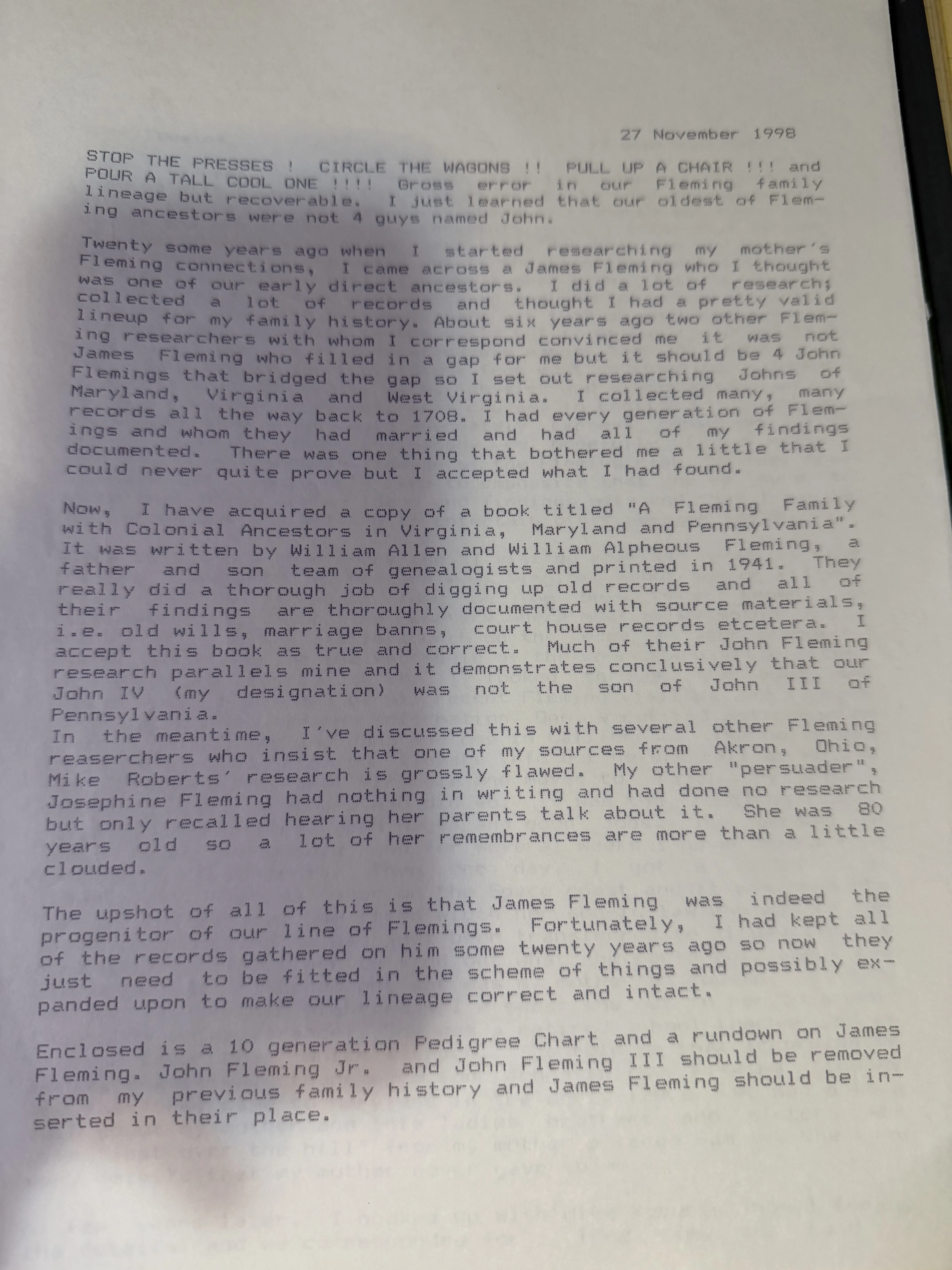
Retracted. This page originally traced him back through John Fleming III, John Fleming Jr. of Cabin John, and John Fleming Sr. of Ballyclare, County Antrim, on the authority of the March 1998 pedigree charts and the Family Legacy typescript.
Robert Earl Wildermuth withdrew that line on 27 November 1998, eight months after printing it — “Gross error in our Fleming family lineage but recoverable. I just learned that our oldest of Fleming ancestors were not 4 guys named John.” A well-sourced 1941 genealogy convinced him that “our John IV (my designation) was not the son of John III of Pennsylvania,” and he instructed that John Jr. and John III be removed and James Fleming inserted instead. The letter is here.
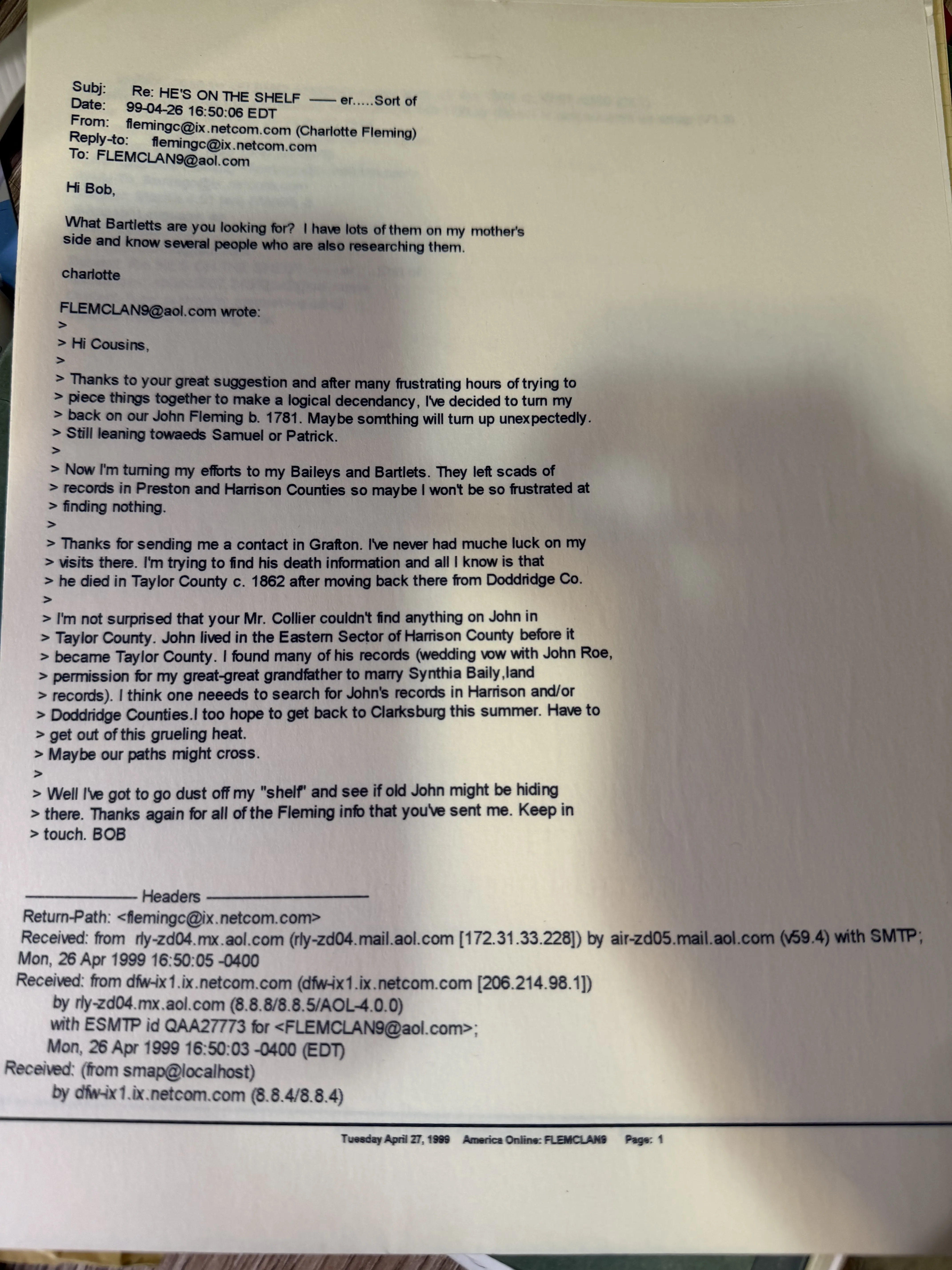
So his parents are not known in this archive — and he never settled them either. The 1853 death register records the family’s own answer, “John & A. Fleming”, which is the four-Johns tradition he tested and rejected. In November 1998 he named James Fleming instead. And by April 1999 he had moved again, shelving the whole question:
“I’ve decided to turn my back on our John Fleming b. 1781… Still leaning towards Samuel or Patrick.”
Four positions in thirteen months. The James Fleming land trail below is the strongest documentary thread anyone has, but it was not his conclusion — his last recorded view names Samuel or Patrick. A Patrick Fleming appears in the 1820 Virginia census in Hampshire County, which is the county this man’s death register gives as his birthplace.
Pennsylvania frontier, Virginia farm
His birthplace should probably read Hampshire County, Virginia. The 1853 death register says Hampshire County — and Robert Earl starred it as erroneous, substituting Montgomery County, Maryland from the pedigree he withdrew five years later. So the archive is carrying a civil record’s answer as a mistake, on the authority of a lineage its own author repudiated.
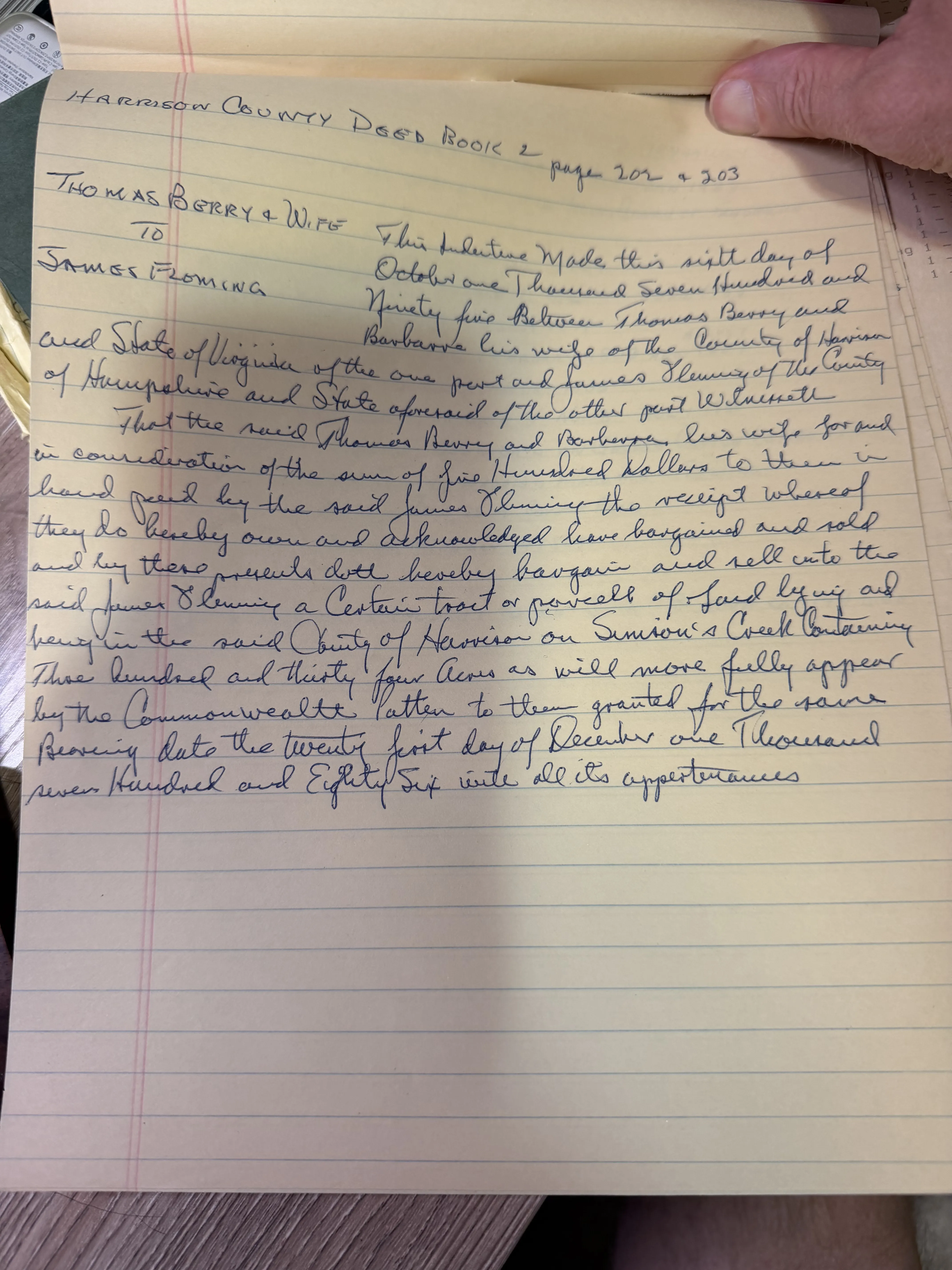
And a 1795 deed in his papers puts a James Fleming “of the County of Hampshire” buying 334 acres on Simpson’s Creek — the creek where John’s son Lewis was born on his father’s farm. Hampshire County → Simpson’s Creek is a coherent single-family move; Montgomery County, Maryland is not. The Montgomery County birth is kept in the frontmatter for now only because nothing yet replaces it with a citation, but it should be treated as the weaker reading.
He was born 11 October 1781, per every chart, in Montgomery County, Maryland — or, more likely, Hampshire County, Virginia (see above). He was raised to adulthood in Washington County, Pennsylvania — the family moved to the western frontier in the year of his birth, which drew Robert Earl’s dry aside: “Quite a move for a one year old son.”
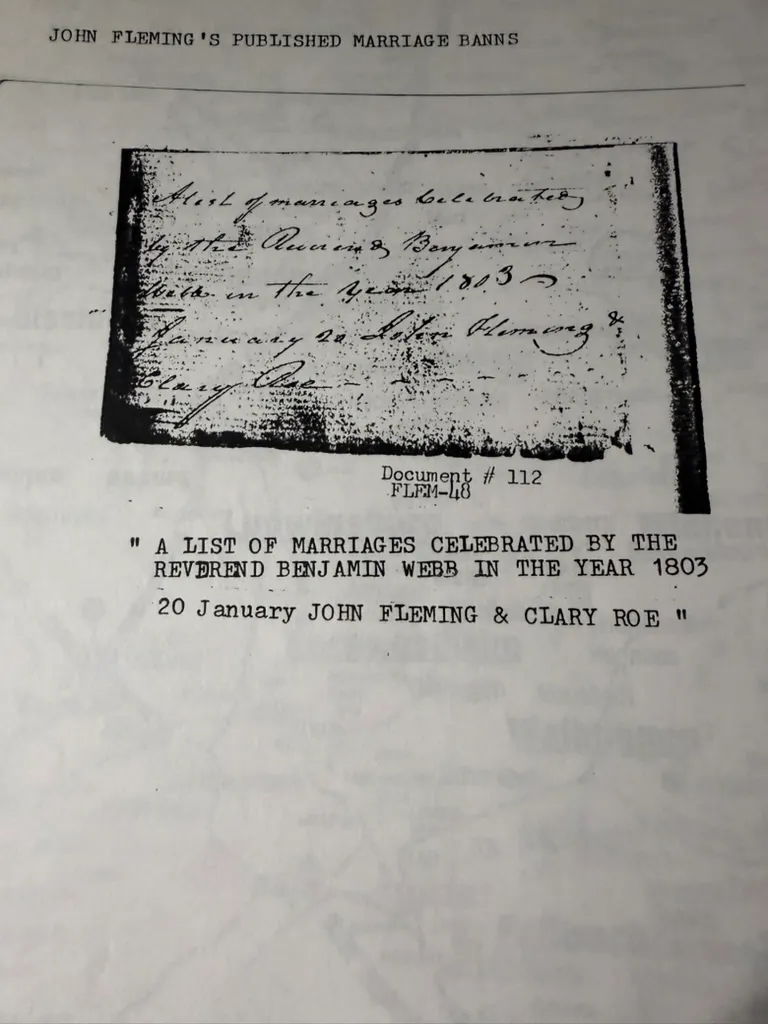
Then south again: on 20 January 1803 he married Clarissa Roe in the Eastern District of Harrison County, Virginia — now Taylor County, West Virginia. The minister’s own return survives, photographed among the papers: “A list of marriages celebrated by the Reverend Benjamin Webb in the Year 1803 — January 20 John Fleming & Clary Roe.” The document is here. It is contemporary, and it is the firmest date on this page.
(The 1781 birth and the Washington County upbringing come from the same retracted charts, but they describe John IV himself rather than his ancestry, and the death record’s independent “age 73” is close enough to corroborate the birth year. Held, with that caveat.)
The surveyor who became a land baron
“John Fleming was an assistant surveyor for his cousin James Fleming who was an officer in the Revolutionary War. This surveying experience enabled John IV to aquire many acres of land and in his latter days he was known as a land baron.”
Surveying was the great advantage on the early frontier: the man who measured the land saw first which parcels were worth taking. It is the clearest statement in the papers of how this family got its footing — and it explains how his son Lewis came to be buying 222 acres and selling fifty of them to his son.
Thirteen children, and where the Edward came from
By Clarissa, thirteen — including twins, and two children sharing a birthday eleven years apart:
| Child | Born | Married |
|---|---|---|
| Elizabeth | 1 Jan 1804 | Zachariah Constable |
| Nancy Ann | 1805 | Samuel Smith |
| Lewis B. | 1807 | Synthia Bailey |
| James | 1810 | Francis Dotson |
| John | 23 Nov 1813 | Mary A. Fleming |
| Patrick | 23 Nov 1813 | Harriet Lake |
| Edward | 2 Jul 1817 | Mary Turner |
| Susannah Agnes | 10 Sep 1820 | Adam J. Gain |
| Thomas | 4 Aug 1823 | Cassandra Tucker |
| Clarissa | 4 Aug 1823 | Levi Harper |
| Eli B. | 28 Feb 1831 | Elmira Anna Kinney |
| Sarah | 10 Jun 1834 | Capt. Oliver Dotson |
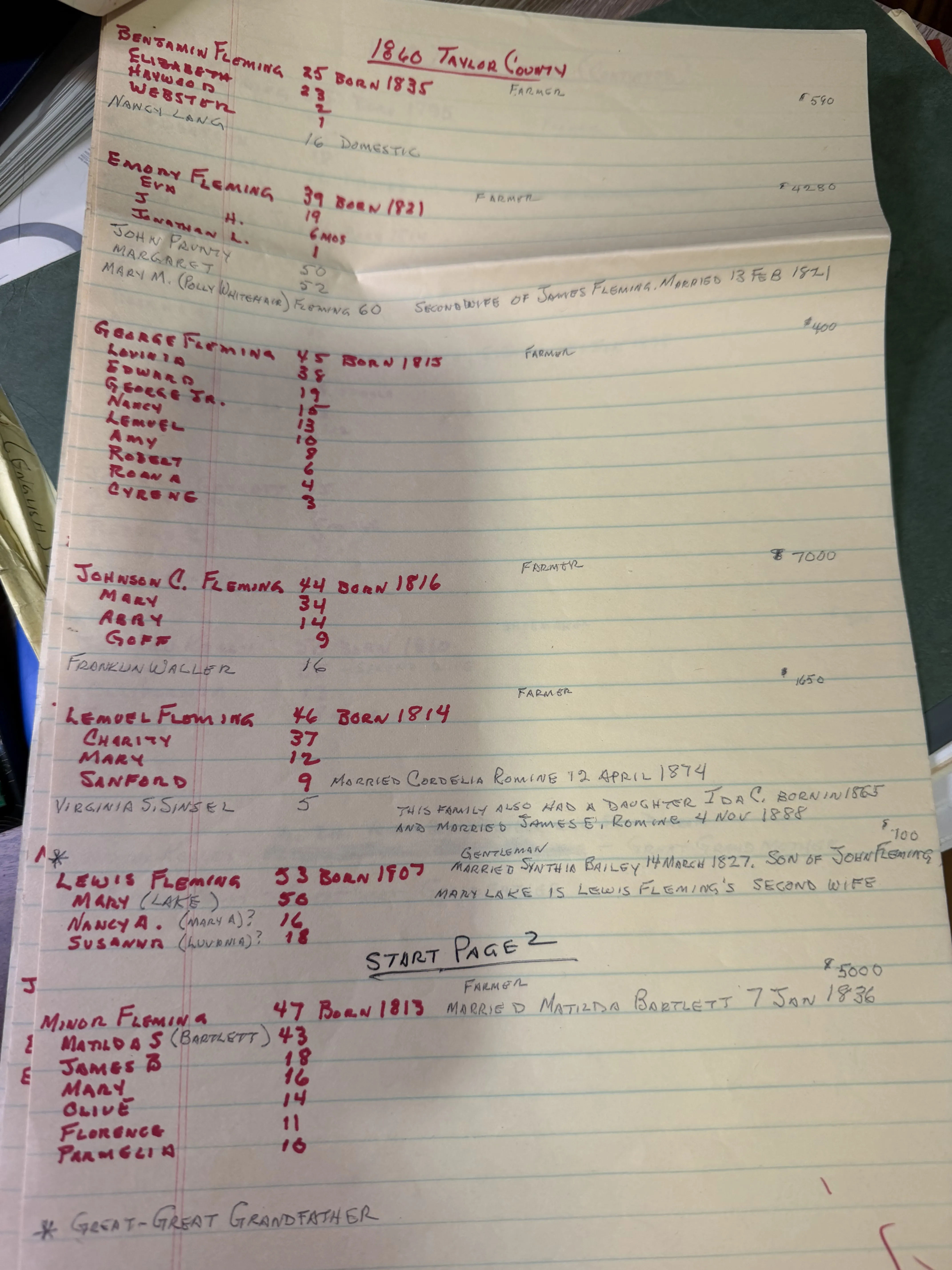
There is the Edward. Lewis’s brother, ten years younger, on the same farm in the same county — and he married a Turner, as Lewis’s own son Thomas Bailey Fleming later would. An Edward Fleming of Simpson Creek existed; he was simply not anybody’s father here.
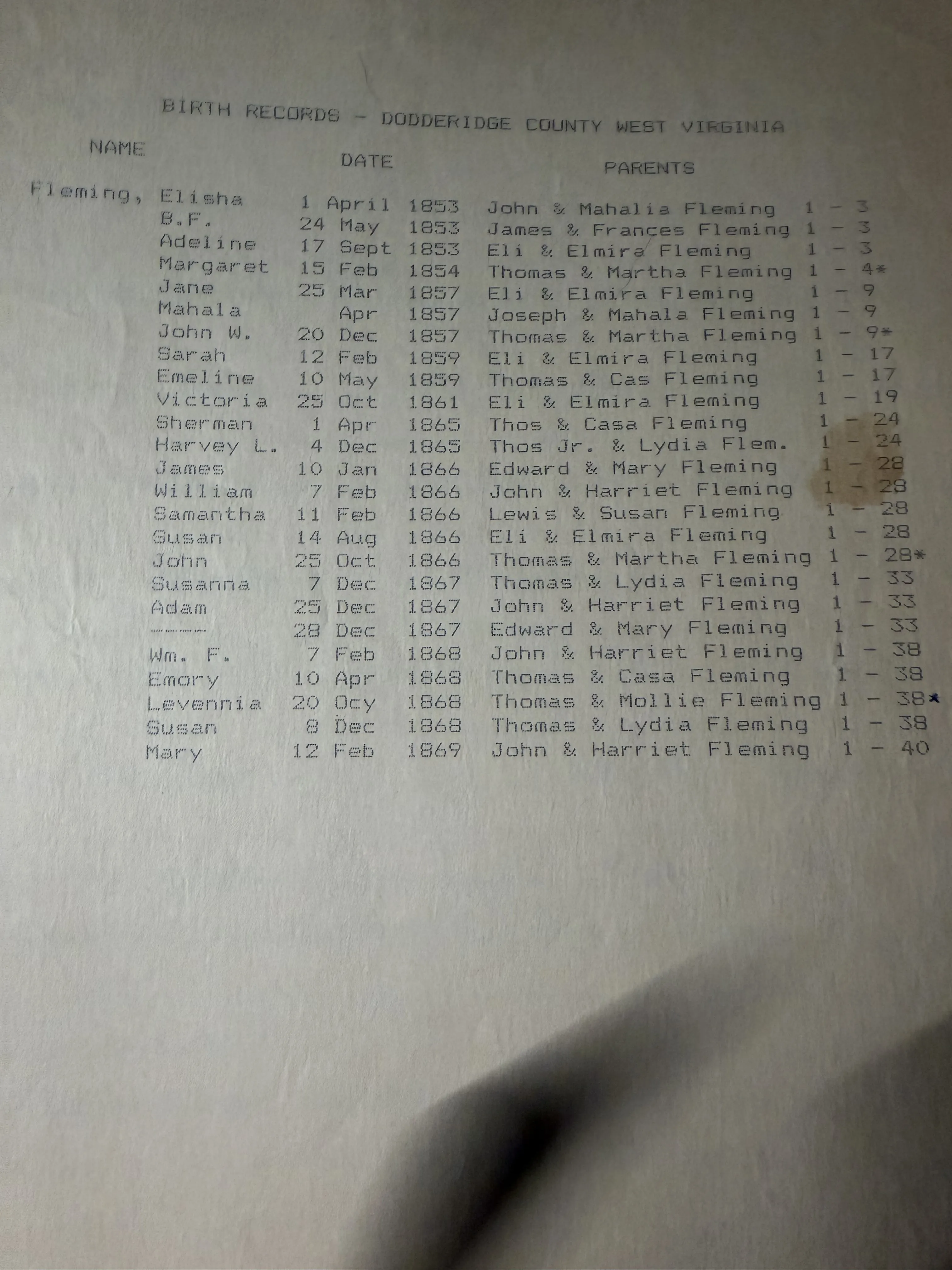
Two of the thirteen are marked with an asterisk on the typescript, and one entry — John, b. 1813, “married Mary A. Fleming” — has him marrying a woman of his own surname. Both unexplained.
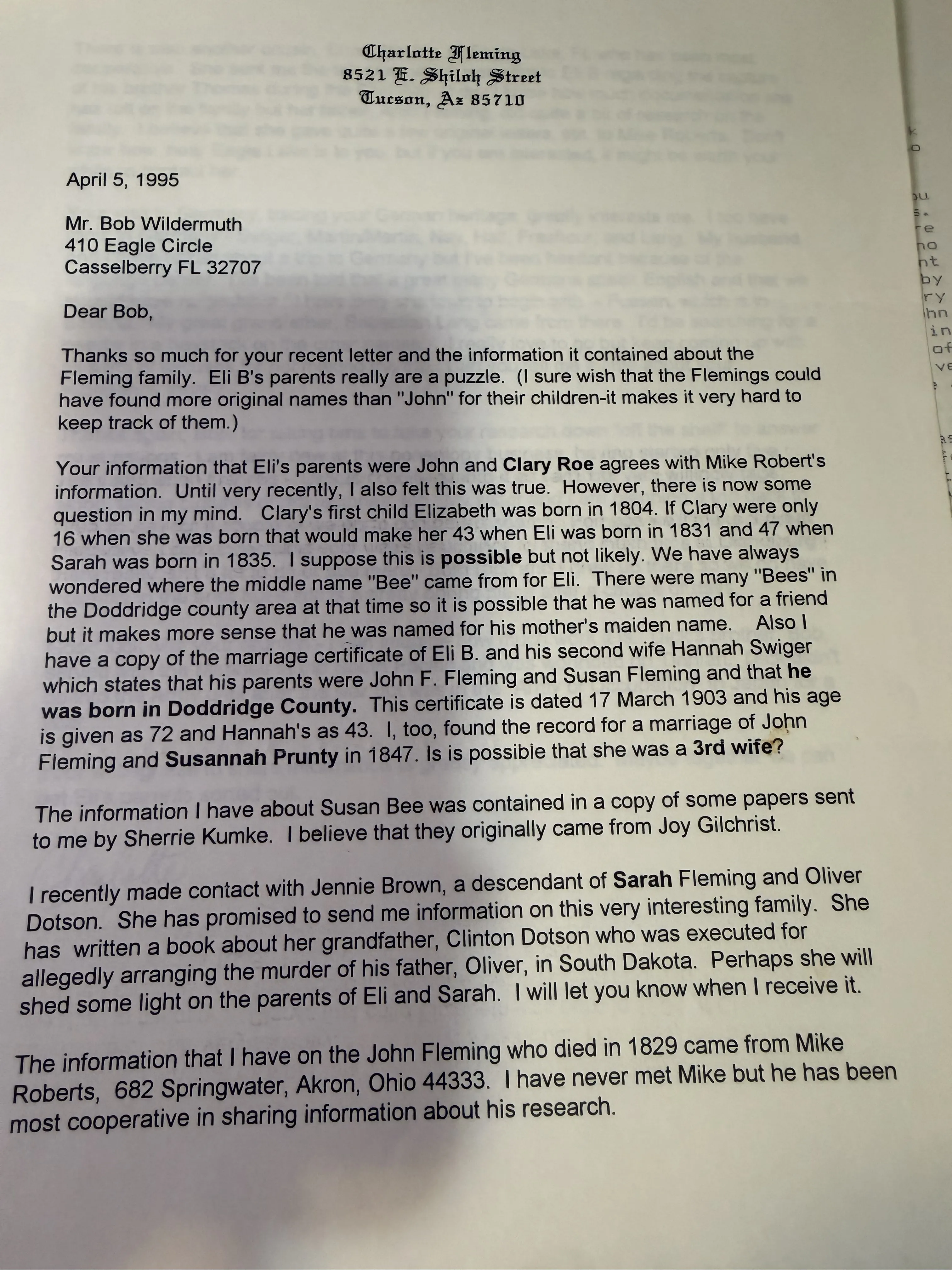
Were all thirteen Clarissa’s? He argued it out with a cousin and concluded yes
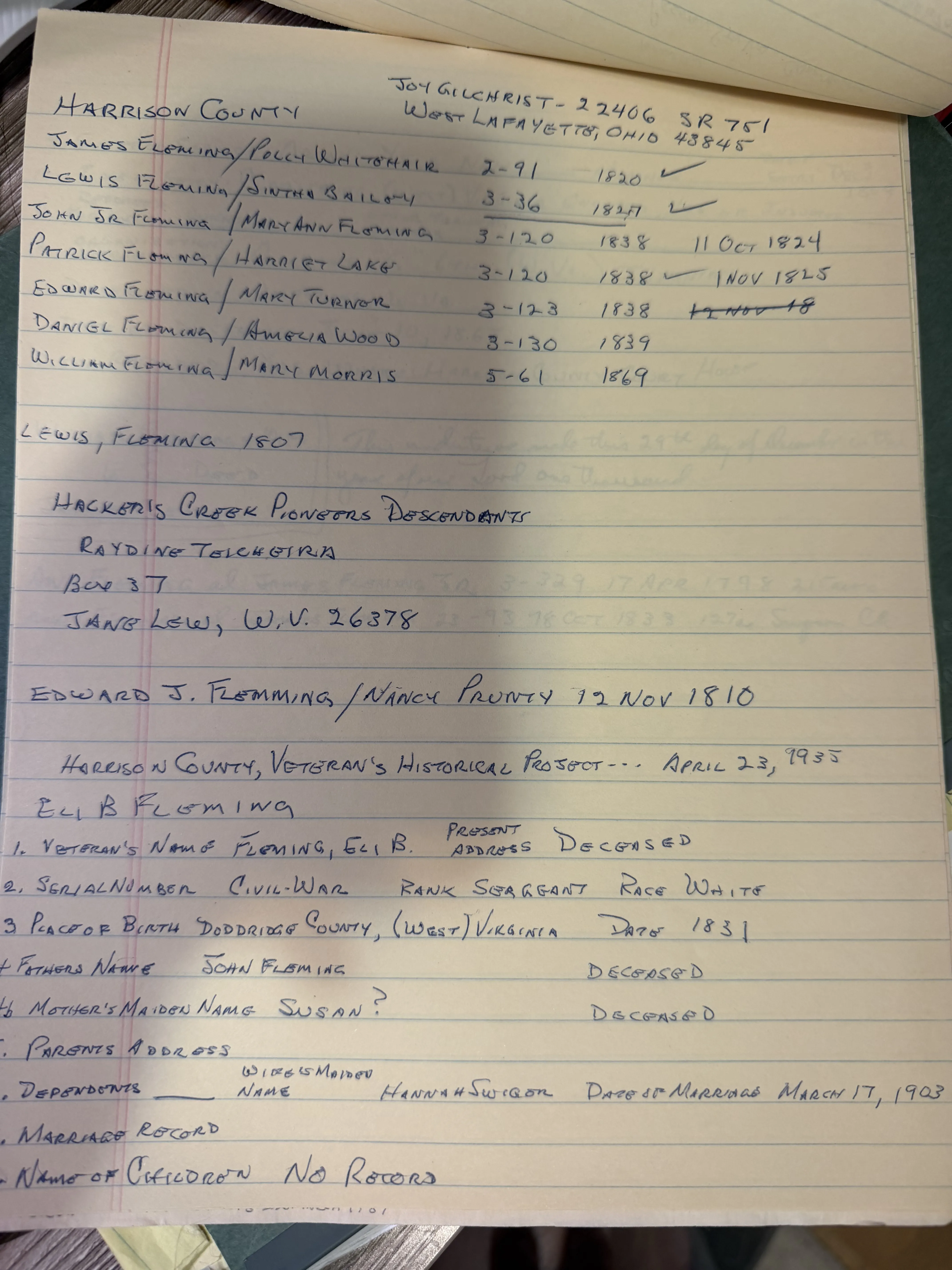
His cousin Charlotte Fleming proposed in April 1995 that Clarissa was not the mother of the youngest two, Eli B. (1831) and Sarah (1834). Her evidence was good: Eli B. Fleming’s marriage certificate of 17 March 1903, when he remarried at seventy-two, names his parents as John F. Fleming and Susan Fleming — and the middle name Bee looks like a mother’s maiden name, the custom that produced Thomas Bailey Fleming.
Robert Earl agreed at first — “Old John (1781) must have married three times and perhaps wife number two was indeed a Susannah Bee” — and then went and checked, and reversed himself.
“I’ve searched and searched for proof of a John Fleming (1781) Susanna Bee marriage. I even found a ‘crusty’ old marriage book in the Doddridge County, W.Va. Courthouse. I cannot support a John Fleming/Susanna Bee marriage.”
His grounds, and they are documentary:
- The ages don’t work. He married Susanna Prunty in 1847, aged about 66. “According to the 1850 census Susanna Bee was about 22.”
- Marriage Book I disposes of her. It shows “John Fleming married Susanna Prunty in 1847 and Susanna Bee married David Jacobs that same year” — and he followed Bee and Jacobs through about three censuses, still husband and wife.
- Eli was not born in Doddridge County. John held the farm in the Eastern Sector of Harrison County until 1838 — “I have the land sales record” — so an 1831 birth belongs there, not in Doddridge.
And then his own reconstruction, which is the most human sentence in the correspondence:
“I think Clary Roe was Eli Sr’s mother and she probably died in childbirth when her last daughter, Sarah, was born in 1835 thus prompting John to sell his farm and move to Doddridge County where he had a son, Lewis, my second great grandfather.”
This archive follows him. All thirteen were Clarissa’s; she likely died in childbirth with Sarah in 1835; and the 1838 land sale to Patrick and John was a widower breaking up the home place. Two wives, not three — Clarissa, then Susannah Prunty in 1847 (not the typescript’s 1858, which falls after his own death).
He left the door open, as he always did: “Please let me know the source of your John/Susanna Bee info. I could be wrong.”
And the door should stay open wider than this page first allowed. The name Susan appears in two records, not one: Eli’s 1903 marriage certificate, and the 1955 veteran’s questionnaire, which gives his mother’s maiden name as “Susan?” — question mark included.
The distinction that matters: Robert Earl disproved a Susanna Bee. He showed that particular woman married David Jacobs in 1847 and stayed married to him. He did not disprove a Susan. A middle wife of that name, surname unknown, remains possible, and Clarissa should not be treated as settled for the youngest two children.
(The two “Susan” records are probably not independent — a 1955 compiler could have worked from the 1903 certificate — so this is one claim attested twice, not two witnesses.)
What he was certain of was his own descent, and it is worth having in his words:
“Glad I don’t have to ponder over that one for my line parted with the birth of my great, great grandfather, Lewis B. who was the son of John and Clary. Born a couple of years after their marriage.”
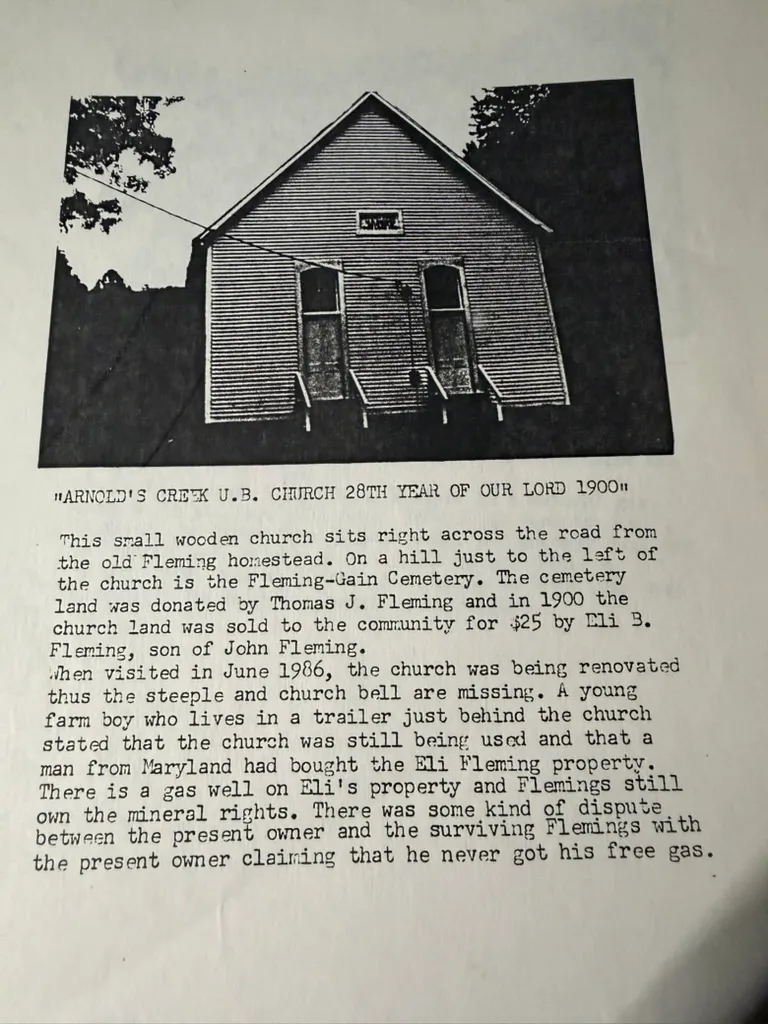
Arnold’s Creek
About 1838 Clarissa died. He sold the eastern Harrison County farm to his sons John V. and Patrick and moved west into what became Doddridge County — where Lewis had already settled. A father following his son, not the other way round.
In 1858 — five years after the date given for his death, an unexplained inconsistency in the typescript — he is said to have taken a second wife, Susannah Prunty, kin to the founders of Pruntytown in Taylor County.
He died 3 November 1853 at his farm on Arnold’s Creek, about six miles west of West Union. His death was registered by his son Eli B. Fleming, then twenty-two.
The ground is still there. Robert Earl drove into Arnold’s Creek in June 1986 and photographed it — a level pasture under wooded hills, with the old United Brethren church across the dirt road and the Fleming-Gain Cemetery on the rise beside it. The church’s own history records that in 1900 the land was sold to the community for twenty-five dollars by “Eli B. Fleming, son of John Fleming” — a local record, independent of any chart, putting Eli in this family.
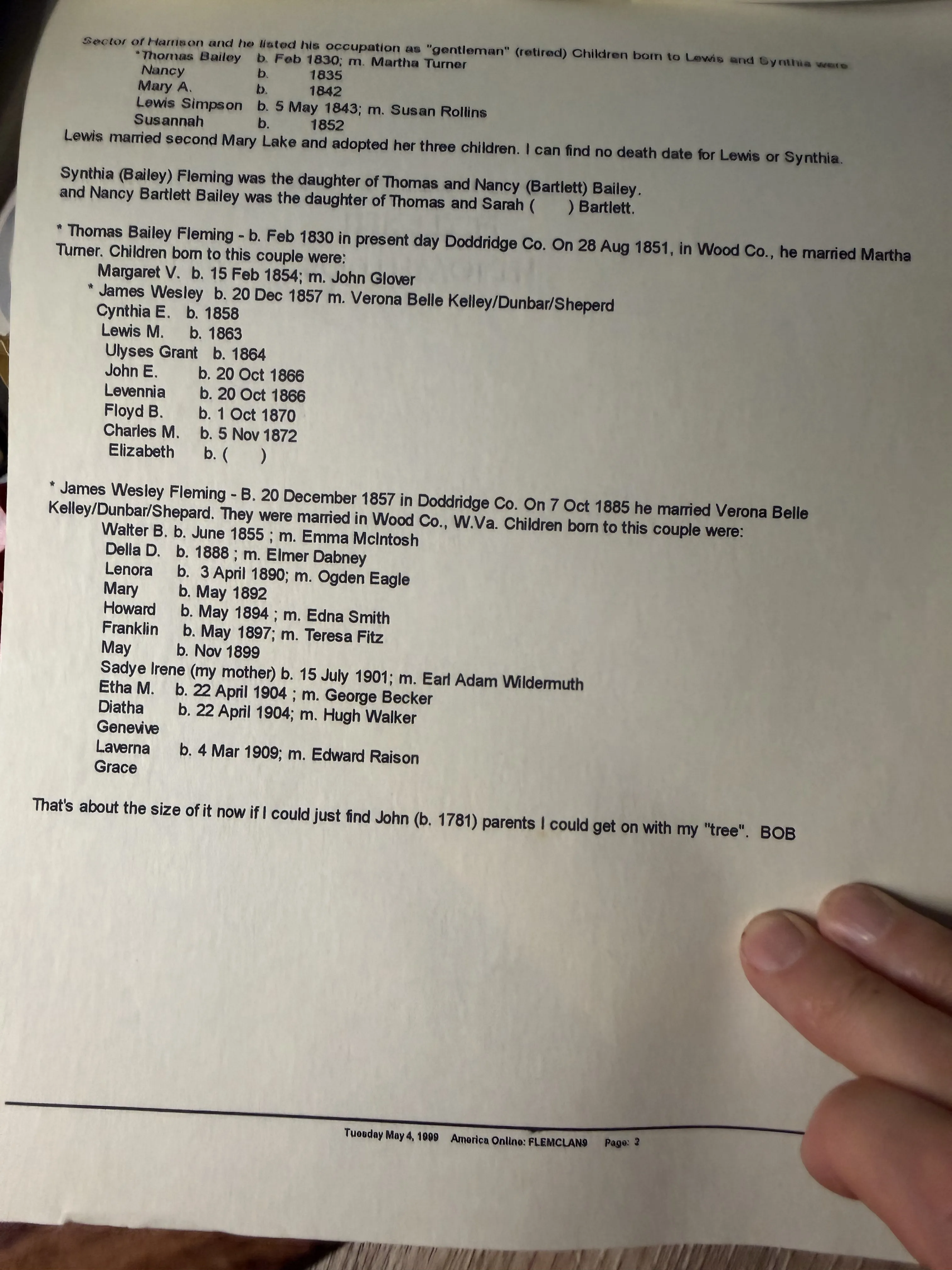
He is Chuck’s maternal 5×-great-grandfather: John IV → Lewis → Thomas Bailey Fleming → James Wesley → Sadye → Robert Earl → Terrie → Chuck.
A second civil record names him and Clarissa
The Taylor County Death Book records Patrick Fleming (d. 31 March 1865, scarlet fever) as “son of John and Clara Fleming.” Robert Earl copied it onto his census abstract.
Patrick is on this page’s child list — “born 23 Nov 1813, married Harriet Lake” — and the death book gives his wife as Harriett Lake and his age at death as 51 years, 4 months, 8 days, which works back to a birth on about 23 November 1813. The typescript’s date and a county register agree to the day.
So beyond the consent note, there is an independent civil record naming John and Clara Fleming as parents of one of the thirteen. Two documents from two courthouses, and they hold.
A farm bought for one dollar
Writing to a Bartlett researcher in May 1998, Robert Earl described how John came by his land:
“…married Clarissa Roe, who bought a 168½ acre farm from James Fleming for a dollar. An old custom … where to make the deal legal something of value had to change hands. In 1838, he sold this farm for $2,000 to his two sons, John and Patrick.”
One dollar for 168½ acres is not a sale, it is a gift — made in the form of a deed so it would hold. And the man making it is a James Fleming, around the time of the 1803 marriage.
Where those acres came from is now documented. In 1795 a James Fleming “of the County of Hampshire” bought 334 acres on Simpson’s Creek for five hundred dollars — the deed is transcribed in Robert Earl’s own hand. A 168½-acre farm handed to John for a dollar a few years later is half of that tract, and it sits on the creek where John’s son Lewis was then born.
That is one of seven places a James Fleming touches this household — the 1795 purchase, the 1798 and 1833 Simpson’s Creek deeds, the dollar farm, the 1827 consent he witnessed, his 1820 marriage to Polly Whitehair, and his daughter’s 1824 marriage to a Samuel Bartlett.
What that does and does not show. It is the densest documentary connection between a named Fleming and this household, and it is very likely what lay behind the November 1998 retraction. It is not a demonstrated parentage, and it was not his final view — five months later he was leaning towards Samuel or Patrick and had put the question aside.
The record that would prove it: the c. 1803 Harrison County deed for the 168½ acres. A one-dollar conveyance normally states the relationship between the parties outright.
Not yet checked: the slave schedules
He was a landholder in western Virginia through the 1830s, 40s and early 50s, described by his own descendant as “known as a land baron” — a man who used surveying work to accumulate acreage in Harrison and Doddridge Counties.
Whether he held anyone in slavery is unknown, and this archive has never looked. The record that would answer it is the federal slave schedule — the separate enumeration taken alongside the 1850 and 1860 censuses, listing slaveholders by name with the age and sex of each person held. He died in November 1853, so the 1850 schedule for Harrison or Doddridge County is the one that covers him.
Two things pull in opposite directions and neither settles it. The western Virginia hill counties had very low rates of slaveholding — mostly subsistence farms worked by the family — and his grandsons split Union and Confederate in the war. But “land baron” is exactly the profile where the question is worth asking rather than assuming.
Recorded here as an open item so that silence is not mistaken for an answer. The 1795 Maryland will in this archive, which disposes of two enslaved people, belongs to a household on the far side of the break in this line and says nothing about him.
What else is not proved
Everything else on this page comes from one researcher’s unsourced narrative and his matching chart. The 1827 note is a transcription, not the document. No deed, will, survey or census has been examined here.
What would settle it: Harrison County marriage records for 20 January 1803; the county’s 1827 marriage bonds and consents, where the original note should sit; Harrison County deeds for the sale to John V. and Patrick around 1838; and any Doddridge County estate record after November 1853.
Source: “John Fleming Family Legacy”, Robert Earl Wildermuth’s seven-page typescript, c. 1998, pp. 4–5; and Chart No. 2 of his 22 March 1998 pedigree charts.
Appears in
Pictured in