Charlotte Fleming of Tucson — the 1995 correspondence, and the puzzle of Eli's mother
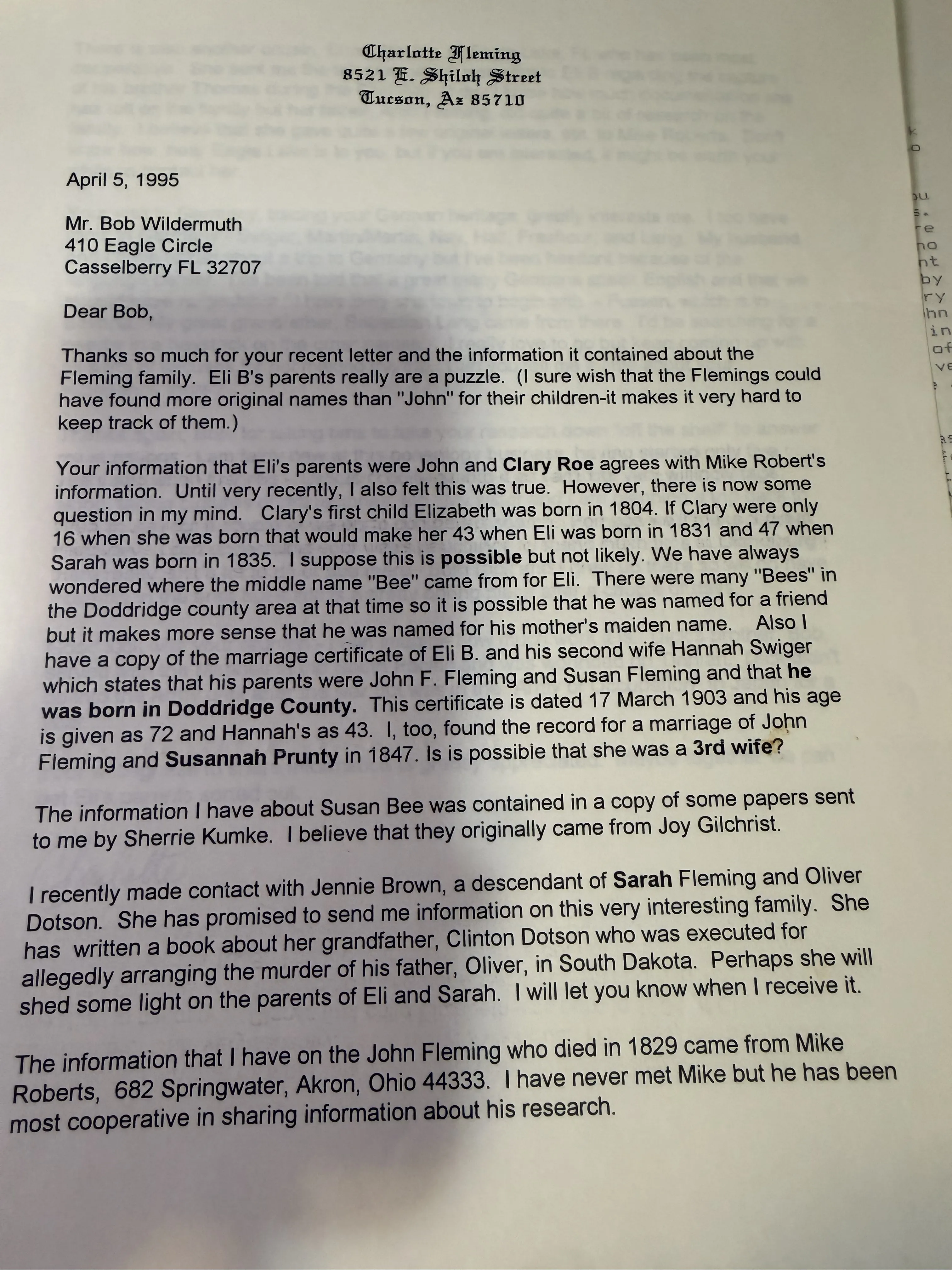
Four letters exchanged in a month between Robert Earl Wildermuth in Casselberry, Florida and Charlotte Fleming of Tucson, Arizona — a distant cousin, retired five years and newly serious about genealogy, whose husband Dick “very willingly tags along, taking pictures of gravestones.” Both Dick and Charlotte had grown up in Clarksburg.
It is the best surviving example of how this research actually moved: two people in different states, neither near the records, trading photocopies and cheques for postage, each holding a piece the other needed.
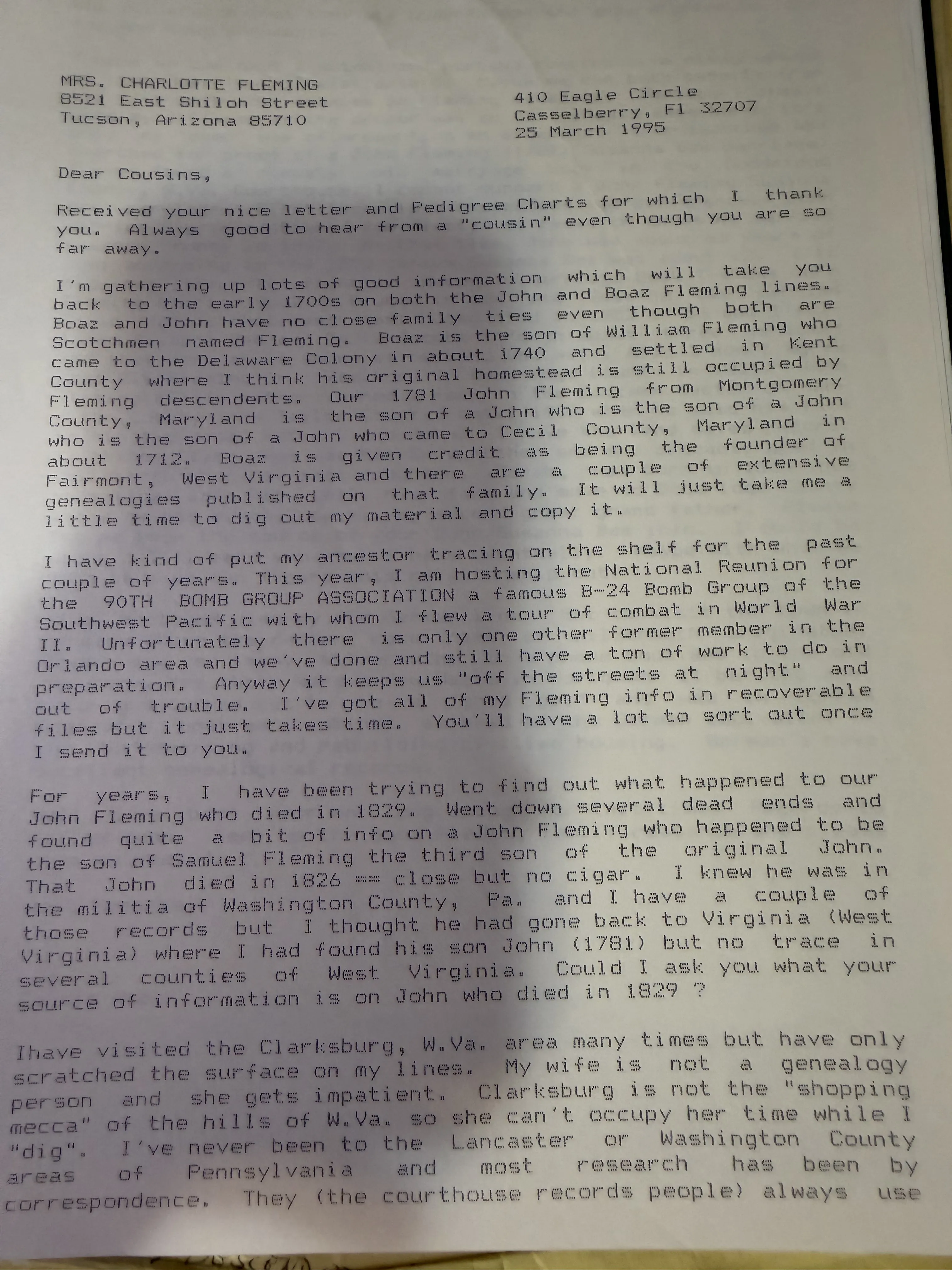
His opening letter of 25 March 1995 — “Dear Cousins” — sets out the two separate Fleming families, explains that his ancestor-tracing has been “on the shelf for the past couple of years” while he hosts the bomb-group reunion, and asks her a direct question he had been stuck on for years:
“For years, I have been trying to find out what happened to our John Fleming who died in 1829. Went down several dead ends and found quite a bit of info on a John Fleming who happened to be the son of Samuel Fleming the third son of the original John. That John died in 1826 — close but no cigar … Could I ask you what your source of information is on John who died in 1829?”
The question they were both working on
Who was the mother of Eli B. Fleming?
The archive’s answer, from the 1998 typescript, is Clarissa Roe — she is given all thirteen of John Fleming IV’s children. Charlotte doubted it, and set out her reasoning on 5 April 1995:
“Clary’s first child Elizabeth was born in 1804. If Clary were only 16 when she was born that would make her 43 when Eli was born in 1831 and 47 when Sarah was born in 1835. I suppose this is possible but not likely.”
(In fact Clarissa was born in 1782, so she was 22 at Elizabeth’s birth and would have been 49 and 53 — which makes Charlotte’s objection stronger, not weaker.)
Then the evidence, and it is a primary record:
“I have a copy of the marriage certificate of Eli B. and his second wife Hannah Swiger which states that his parents were John F. Fleming and Susan Fleming and that he was born in Doddridge County. This certificate is dated 17 March 1903 and his age is given as 72 and Hannah’s as 43.”
Eli B. Fleming, marrying at seventy-two, named his mother as Susan. Not Clarissa.
And the middle name had always bothered them:
“We have always wondered where the middle name ‘Bee’ came from for Eli. There were many ‘Bees’ in the Doddridge county area at that time so it is possible that he was named for a friend but it makes more sense that he was named for his mother’s maiden name.”
So: a Susan Bee, and Eli B. Fleming carrying her surname as a middle name — exactly the pattern this family uses elsewhere, in Thomas Bailey Fleming and Thornsberry Bailey. Her information on Susan Bee came from Sherrie Kumke, and originally from Joy Gilchrist — the same researcher whose Squires Family gave this archive the mistaken Edward.
She also found a date the typescript gets wrong:
“I, too, found the record for a marriage of John Fleming and Susannah Prunty in 1847. Is is possible that she was a 3rd wife?”
1847, not 1858. The typescript’s 1858 would place the marriage five years after John’s own death.
Robert Earl accepted the argument at first. Writing back on 22 April:
“I certainly agree with your rationale that Clary (Roe) Fleming was most likely not the mother of Eli B. and/or Sarah. Old John (1781) must have married three times and perhaps wife number two was indeed a Susannah Bee.”
The 22 April letter, in three pages
His reply is the longest item in the exchange, and it opens somewhere other than genealogy. He was seventy:
“Well your letters caught me very much under the weather. This past month has sure been a bummer for me. Started out in March with an urinary tract infection that led up to the full nine yards of prostate searching and six biopsies (all benign); then of all things, I got the hiccups — fourteen days and nights before they got those under control, and then pleurisy. … Somewhere along the line these ‘Golden Years’ have gotten tarnished.”
Then: “Sure glad to receive your two letters. Anything having to do with genealogy always gives me a lift.”
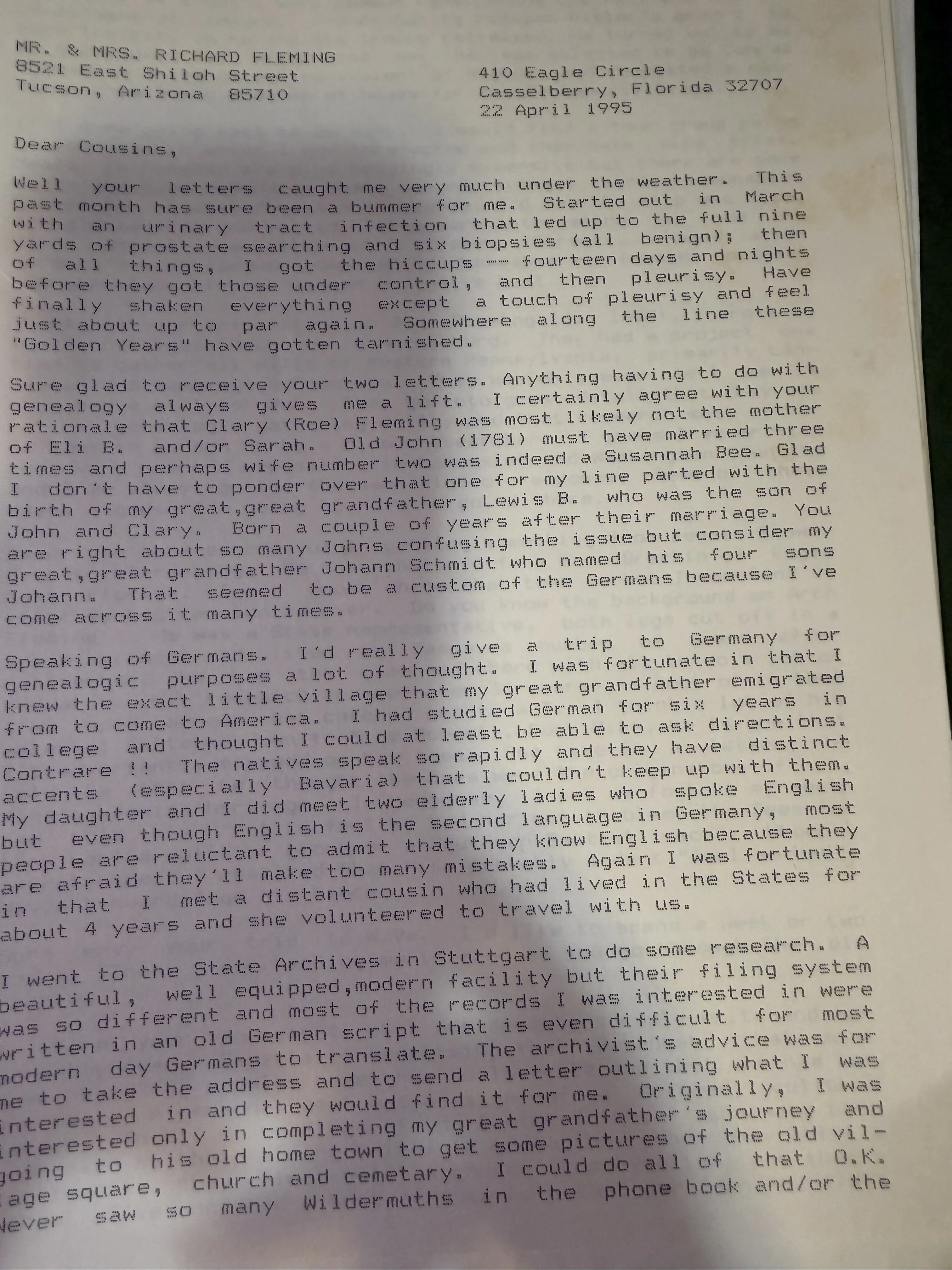
Why the Eli question did not threaten his own line. “Glad I don’t have to ponder over that one for my line parted with the birth of my great,great grandfather, Lewis B. who was the son of John and Clary. Born a couple of years after their marriage.” Lewis is early in the marriage; Eli is late in it. That is the whole shape of Charlotte’s objection, and the reason it left him unbothered.
(He calls Lewis his great-great-grandfather here and, on page 3, his 3rd great grandfather. The starred key on his own 1860 census sheet says great-great. A slip of the typewriter, two pages apart.)
And a German parallel to the four Johns, which is the sort of thing only he would have reached for: “consider my great,great grandfather Johann Schmidt who named his four sons Johann. That seemed to be a custom of the Germans because I’ve come across it many times.” — John Jacob Schmidt, on the other side of his own tree, running the same trap as the Flemings.
Germany, 1992 — the trip and the archive
The middle of the letter is the fullest account in the papers of his genealogical trip to Germany, and it is candid about what it cost and what it produced:
“I had studied German for six years in college and thought I could at least be able to ask directions. Contrare !! The natives speak so rapidly and they have distinct accents (especially Bavaria) that I couldn’t keep up with them.”
He went to the State Archives in Stuttgart — “beautiful, well equipped, modern facility” — and hit the wall every foreign researcher hits: the filing system was unfamiliar and the records were in old German script “that is even difficult for most modern day Germans to translate.” The archivist’s advice was to take the address and write. He had gone for photographs of the village square, church and cemetery, and got those; the records he wanted needed a letter he would have to send from home.
His verdict on the whole excursion: “genealocically it was an expensive bust.” (This is the trip the 1992 Schlossplatz photograph comes from — and the reason the closing line about Stuttgart and Clarksburg below is a comparison he had actually earned.)
Two Wildermuths he found there instead of ancestors. A street in a walled town — “the main street was Wildermuth Strasse… named after Germany’s most famous (compared to Shakespeare) female poetess” — and, in a cemetery, “one Nazi who was the commandant of LaHavre, France but he refused Hitler’s orders to burn the city as he and his troops retreated. He turned out to be a good guy for after the war he was selected to be Conrad Adenaur’s chief of our equivalent of H.U.D. and completed a massive re-building program of homes for the German civilians.”
Both are real people, and not relatives so far as anything here shows: the writer Ottilie Wildermuth (1817–1877), whose name is on streets across Württemberg, and Eberhard Wildermuth (1890–1952), the colonel who commanded the Le Havre garrison in 1944 and served as Federal Minister for Housing in Adenauer’s first cabinet. A retired American bomber navigator, in Germany looking for his own name, found it on a street sign and on the grave of the officer who had held Le Havre.
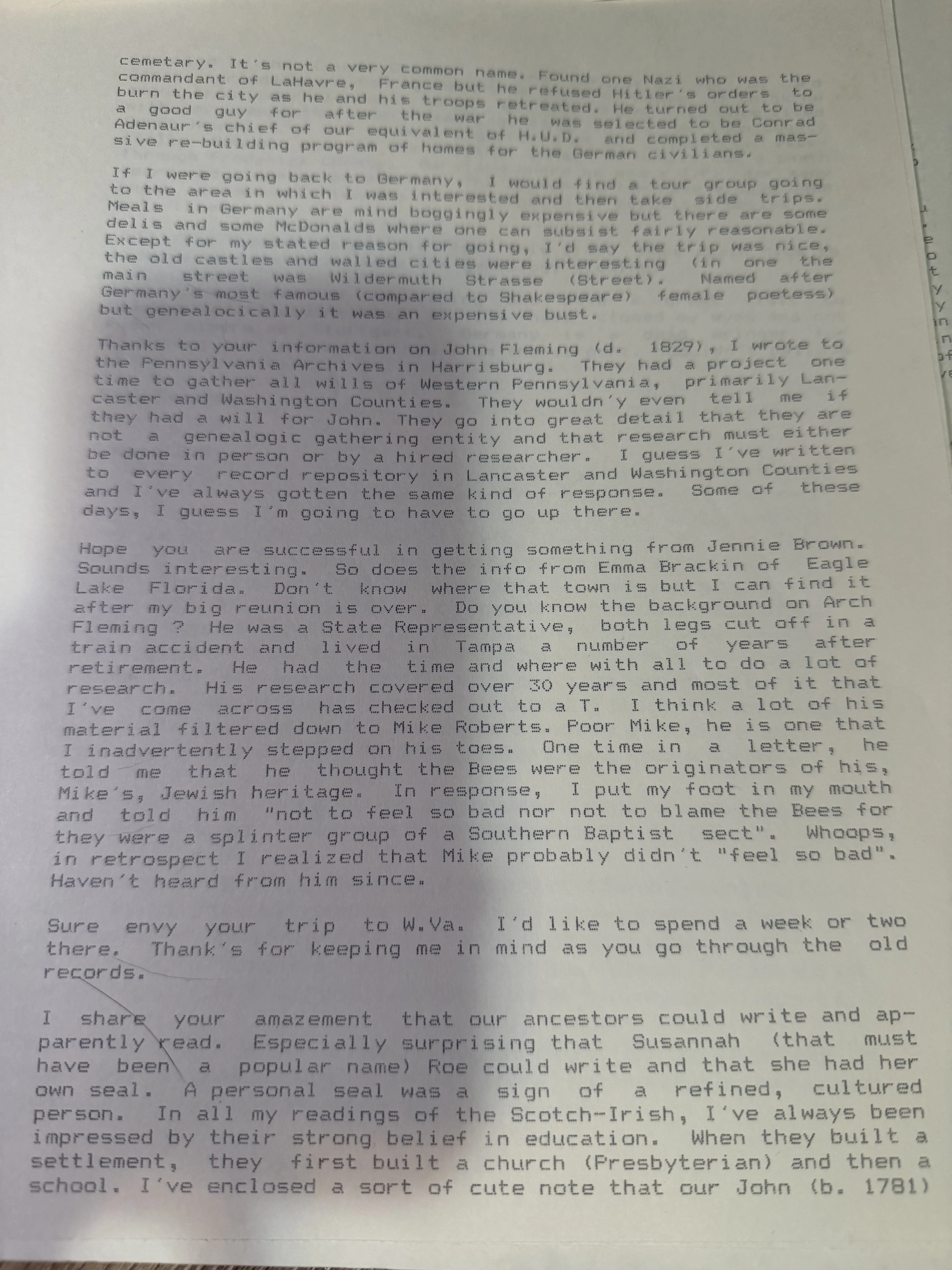
His answer to Charlotte on the literacy. She had noticed that both Roes could write; he took it further:
“I share your amazement that our ancestors could write and apparently read. Especially surprising that Susannah … Roe could write and that she had her own seal. A personal seal was a sign of a refined, cultured person. In all my readings of the Scotch-Irish, I’ve always been impressed by their strong belief in education. When they built a settlement, they first built a church (Presbyterian) and then a school.”
And the provenance of the consent note
The last page settles something the archive has never had in his own words — where the 1827 note came from:
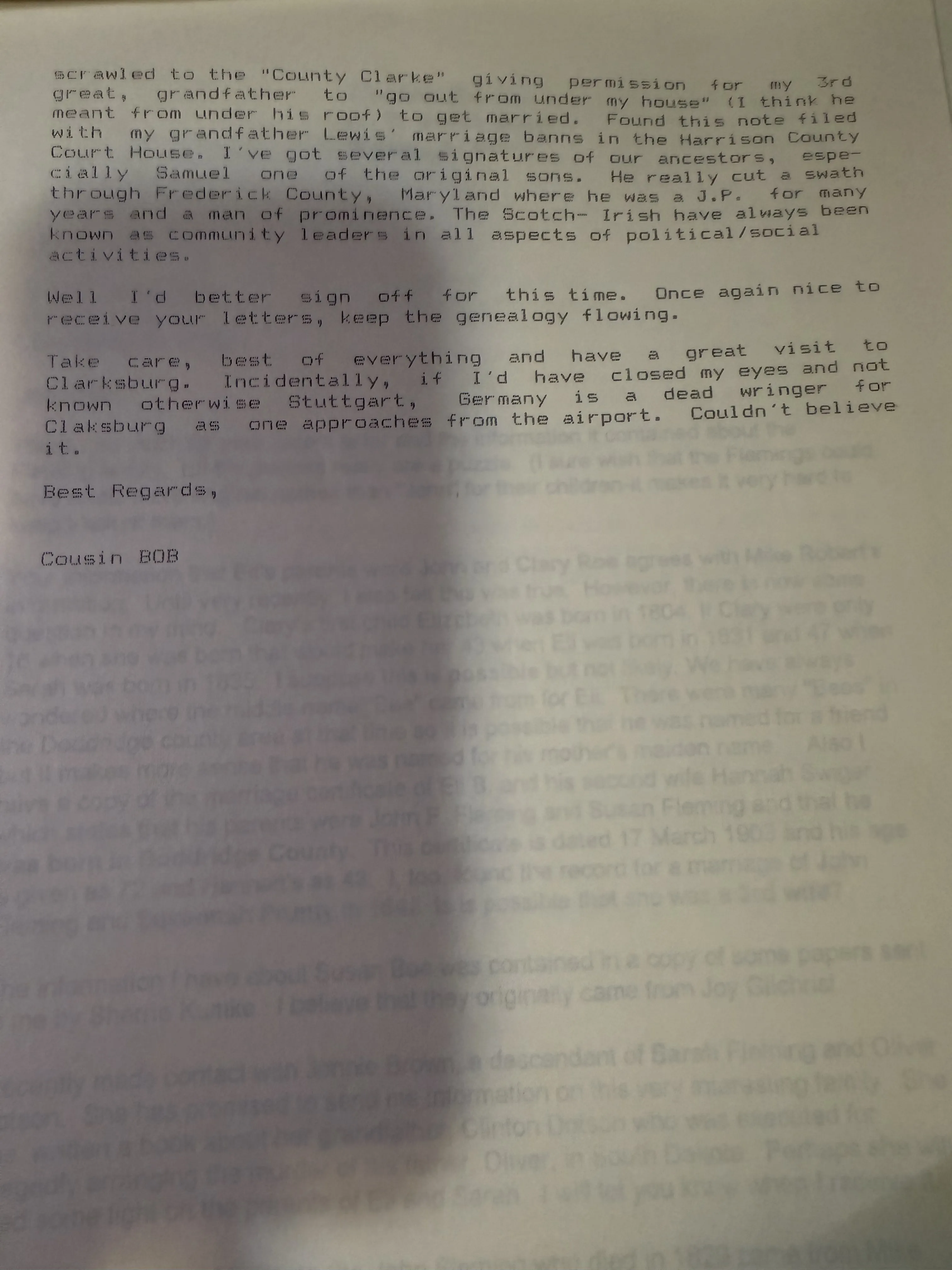
“I’ve enclosed a sort of cute note that our John (b. 1781) scrawled to the ‘County Clarke’ giving permission for my 3rd great grandfather to ‘go out from under my house’ (I think he meant from under his roof) to get married. Found this note filed with my grandfather Lewis’ marriage banns in the Harrison County Court House.”
So the consent note was filed with the marriage banns, in the courthouse, and he found the two together — which is why the archive holds both. He adds that he has “several signatures of our ancestors, especially Samuel one of the original sons. He really cut a swath through Frederick County, Maryland where he was a J.P. for many years” — the same Samuel he would still be “leaning towards” four years later, at the end.
And then he checked, and disagreed
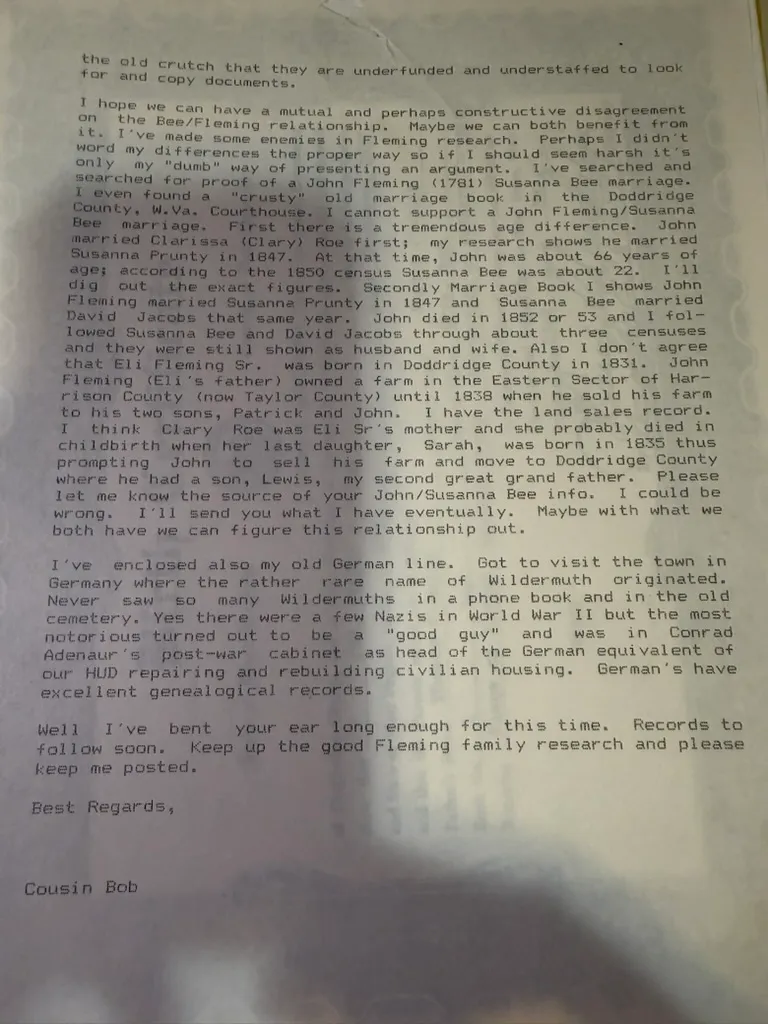
A later letter in the same exchange reverses it — and this is the sequence worth having, because it is a researcher taking a plausible theory to the courthouse and coming back with records against it. He opens by managing the disagreement carefully:
“I hope we can have a mutual and perhaps constructive disagreement on the Bee/Fleming relationship. Maybe we can both benefit from it. I’ve made some enemies in Fleming research. Perhaps I didn’t word my differences the proper way so if I should seem harsh it’s only my ‘dumb’ way of presenting an argument.”
Then the evidence:
“I’ve searched and searched for proof of a John Fleming (1781) Susanna Bee marriage. I even found a ‘crusty’ old marriage book in the Doddridge County, W.Va. Courthouse. I cannot support a John Fleming/Susanna Bee marriage.”
Three grounds:
- Age. John married Susanna Prunty in 1847 at about sixty-six; “according to the 1850 census Susanna Bee was about 22.”
- Marriage Book I accounts for her. “John Fleming married Susanna Prunty in 1847 and Susanna Bee married David Jacobs that same year” — and he tracked Bee and Jacobs “through about three censuses and they were still shown as husband and wife.”
- Eli was not born in Doddridge County. John held the Eastern Sector farm until 1838 — “I have the land sales record” — so Eli’s 1831 birth belongs in Harrison County.
His replacement account:
“I think Clary Roe was Eli Sr’s mother and she probably died in childbirth when her last daughter, Sarah, was born in 1835 thus prompting John to sell his farm and move to Doddridge County where he had a son, Lewis, my second great grandfather.”
This archive follows the reversal. Two wives, not three; all thirteen children Clarissa’s; her death placed at Sarah’s birth in 1835, which explains the 1838 land sale as a widower breaking up the home place. He also puts his own death of John at “1852 or 53” — the death register says 3 November 1853.
And he leaves it open, as always: “Please let me know the source of your John/Susanna Bee info. I could be wrong.” The “Susan” on Eli’s 1903 certificate is still unexplained — though Eli was then seventy-two, naming a mother who would have died before he was four.
The deed
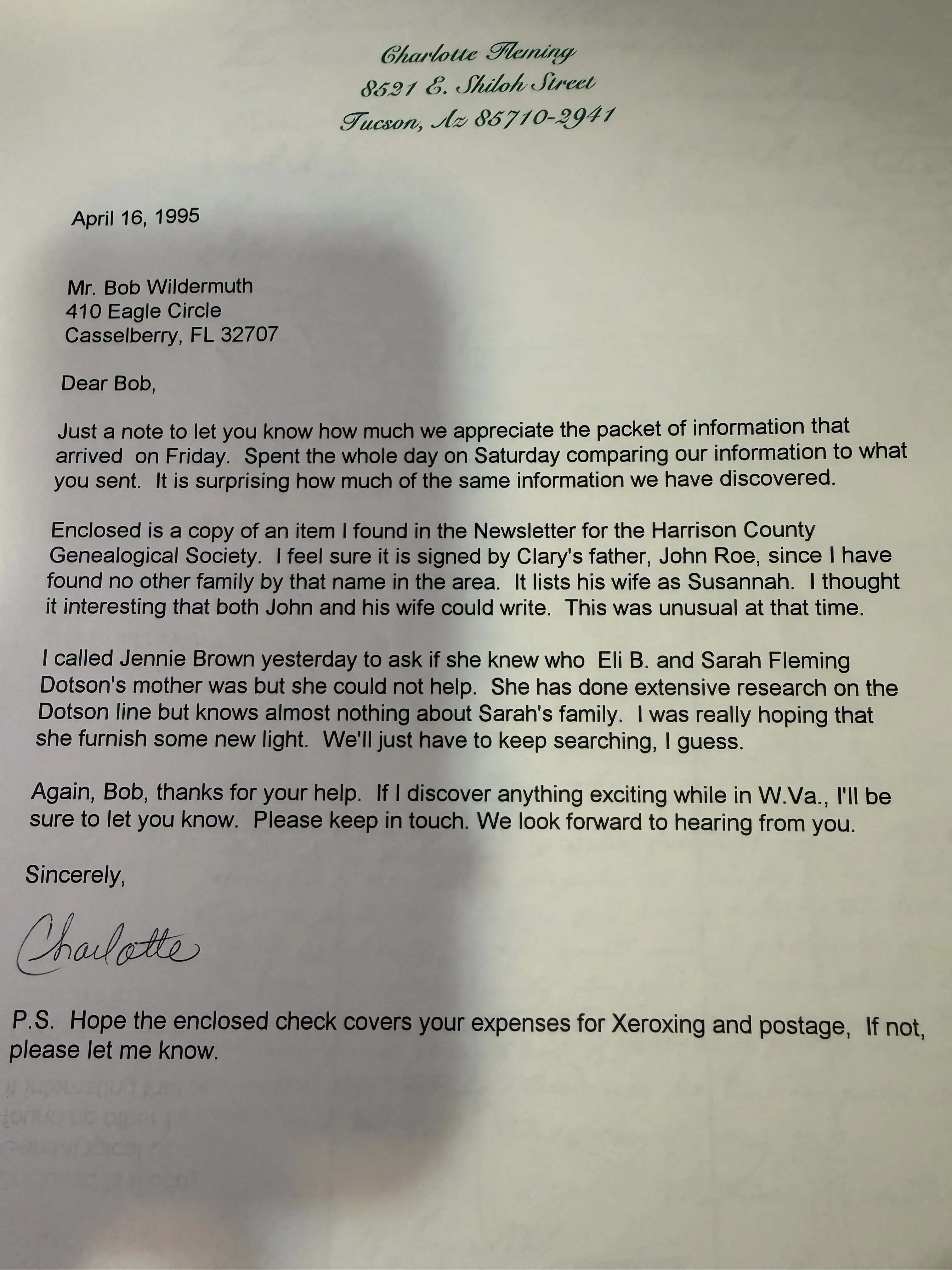
On 16 April Charlotte sent the find that produced the 1820 Rosier & Roe deed, spotted in the Harrison County Genealogical Society newsletter — with the observation that both John Roe and his wife could write, “unusual at that time.”
Her reasoning for the identification is worth having in her own words, because it rests on absence:
“I feel sure it is signed by Clary’s father, John Roe, since I have found no other family by that name in the area. It lists his wife as Susannah. I thought it interesting that both John and his wife could write. This was unusual at that time.”
She was right, and the archive has the proof she did not. The wife is Susannah Meeks, and the 1820 deed shows both Roes signing their own names with seals where their co-grantor Andrew Rosier could manage only a mark. Charlotte inferred the literacy from a newsletter item in Tucson; the deed in these same papers demonstrates it.
The same letter reports the dead end with Jennie Brown on Eli’s mother, and closes with the postscript that fixes the economics of the whole exchange: “Hope the enclosed check covers your expenses for Xeroxing and postage.”
The other researchers in the network
The letters name the whole informal circle these two were working inside, which is worth recording because most of it is now unreachable:
- Mike Roberts, Akron, Ohio — the source for the four-Johns lineage, “most cooperative.” Robert Earl later reported that others called his work “grossly flawed,” and separately that he had accidentally offended him and never heard from him again.
- Arch Fleming — the origin of much of it. A State Representative who lost both legs in a train accident and retired to Tampa, with “the time and where with all to do a lot of research.” Robert Earl’s verdict: “most of it that I’ve come across has checked out to a T.” (He gives the span as “over 30 years” here and “about 25 years” in his September 1998 letter — and notes that Arch’s being a state representative meant “he must have had some education.”)
- Erma Brackin of Eagle Lake, Florida — Arch Fleming’s daughter. (He types her as Emma in the 22 April letter and Erma elsewhere; one of the two is a slip.) She held a telegram sent to Eli B. Fleming about the capture of his brother Thomas during the Civil War. That telegram is not in this archive and is worth chasing.
- Jennie Brown — descendant of Sarah Fleming and Oliver Dotson, and author of a book about her grandfather Clinton Dotson, executed for allegedly arranging the murder of his own father Oliver in South Dakota. Charlotte telephoned her about Eli’s mother; she could not help.
- Joy Gilchrist and Sherrie Kumke — the route by which the Susan Bee information reached them.
Two useful cautions
A different Fleming line. Robert Earl warned Charlotte off a family they might easily have absorbed:
“Boaz and John have no close family ties even though both are Scotchmen named Fleming. Boaz is the son of William Fleming who came to the Delaware Colony in about 1740 and settled in Kent County … Boaz is given credit as being the founder of Fairmont, West Virginia.”
The archives that would not help. He had written to the Pennsylvania Archives in Harrisburg about the will of the John Fleming who died in 1829:
“They wouldn’y even tell me if they had a will for John. They go into great detail that they are not a genealogic gathering entity and that research must either be done in person or by a hired researcher. I guess I’ve written to every record repository in Lancaster and Washington Counties and I’ve always gotten the same kind of response. Some of these days, I guess I’m going to have to go up there.”
And the human parts
Charlotte, closing on 5 April 1995: “Your willingness to share information is greatly appreciated. Maybe together we can get Eli’s parents sorted out.” And, eleven days later, a postscript hoping the enclosed cheque covered his photocopying.
Robert Earl, on the difficulty of doing genealogy with a spouse in tow: “My wife is not a genealogy person and she gets impatient. Clarksburg is not the ‘shopping mecca’ of the hills of W.Va.” Charlotte, who grew up there, agreed: “there really isn’t a lot to do or see there … it still is a pretty boring place after a couple of days.”
He was writing in the middle of hosting the national reunion of the 90th Bomb Group Association — “a famous B-24 Bomb Group of the Southwest Pacific with whom I flew a tour of combat in World War II” — and apologising that his Fleming files would take time to dig out. And he signs off, having just come back from Germany:
“Incidentally, if I’d have closed my eyes and not known otherwise Stuttgart, Germany is a dead wringer for Claksburg as one approaches from the airport. Couldn’t believe it.”
Source: four letters, 25 March – 22 April 1995, between Robert Earl Wildermuth (Casselberry, Florida) and Charlotte Fleming (Tucson, Arizona); in his research papers, in Chuck’s keeping. Photographed 2026.
Catalogue
- Type
- Correspondence
- Medium
- Typed letters, four items, on personal letterhead
- Date created
- 25 March – 22 April 1995
- Place created
- Tucson, Arizona and Casselberry, Florida
- ID number
- FLEMING
- Provenance
- Robert Earl Wildermuth's genealogical research papers; in Chuck's keeping. Photographed 2026.
- Rights
- Family use; permission required for republication.