Robert Earl Wildermuth — Stanford University Registration / Transcript Card
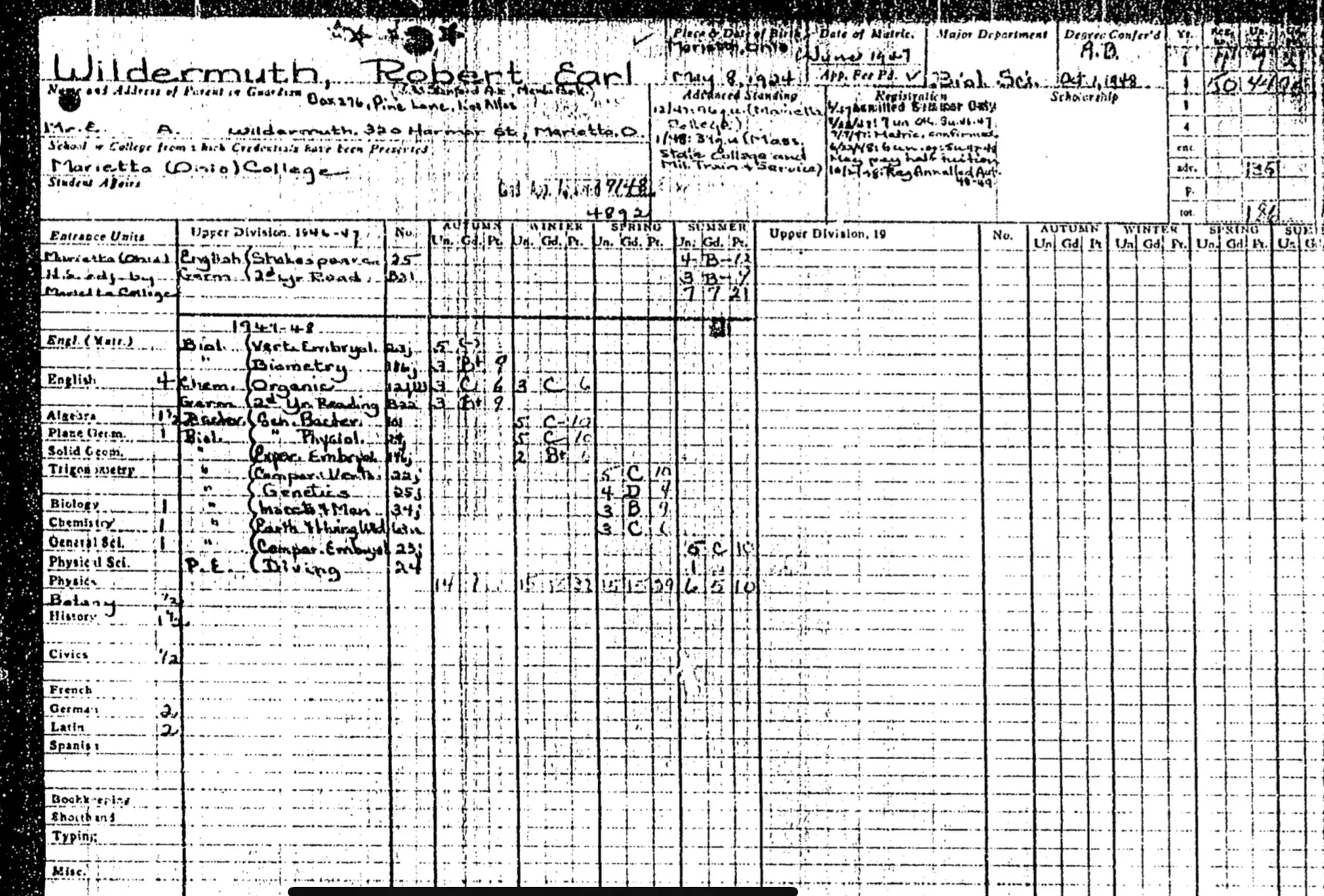
Robert Earl Wildermuth’s Stanford University registrar’s card — the official academic record of his 1946–1948 GI Bill undergraduate years at Stanford, the period he transitioned from B-24 navigator to civilian and earned the BA in Biological Sciences conferred 1 October 1948.
Three addresses at the top
The card carries WILDERMUTH, Robert Earl in block capitals, and beneath it — in the “Name and Address of Parent or Guardian” band — three addresses, in two different hands. They are the first Bay Area addresses this archive has ever held for the family.
| Box 276, Pine Lane, Los Altos | His own local address, written in the primary hand |
| [number] S. Stanford Av., Menlo Park | Interlineated above in fainter pencil — an update, or a first address later replaced |
| Mr. E. A. Wildermuth, 320 Harmar St., Marietta, O. | The parent/guardian line — his father Earl A. Wildermuth |
The Menlo Park house number is not recoverable from this scan. The pencil is faint and overwritten by the typed rule above it; the leading digit reads plausibly as a 7 and the rest does not resolve. The street and town are legible.
Candidate: 735 Stanford Avenue. Chuck proposed it from the memoir’s line that they “rented a house on the Stanford golf course.” Stanford Avenue in Menlo Park is a real street whose numbers run from roughly 103 to 1850, so 735 is a valid address and it fits the one digit that can be read. It is a candidate, not a reading — the card cannot be made to say it.
One wrinkle to check before adopting it: whether the 700 block of Stanford Avenue is anywhere near the golf course, which sits at the western edge of campus between Junipero Serra Boulevard and Sand Hill Road. If that block is on the eastern side of Menlo Park, then either the memoir line is loose — “on the golf course” standing in for “out by the campus” forty years after the fact — or the golf-course house is a third address that never reached this card.
How to settle it: the Stanford student directories for 1946–47 and 1947–48 list enrolled students with their local addresses. The Alumni Center that produced the yearbook is the likeliest place to hold them, and one line in the right volume would give the number exactly.
Box 276, Pine Lane, Los Altos is the more evocative of the two. A box number rather than a street number fits what Los Altos was in 1946–48: unincorporated orchard country — it would not become a city until 1952. A married veteran on the GI Bill renting in the apricot orchards, driving up to campus.
And the 1948 Quad confirms the arrangement in one word: his yearbook entry reads “Off campus.” He had married Dorothy Davis in April 1946, months before arriving; married veterans were not housed in the dormitories.
Note on the Marietta address: the card gives his father at 320 Harmar Street. Robert Earl’s memoir describes the family’s Marietta “dream house” at 413 Harmar Street. Two numbers on the same street — either a move, or one of the two is misremembered. He also attended Harmar Elementary; the family’s centre of gravity was that street.
What else the card records
“School or College from which Credentials have been Preserved:” — Marietta (Ohio) College. The transfer the archive knew from his memoir, in the registrar’s own hand: he had begun pre-med at Marietta College before the war took him, and Stanford held those credentials on file.
The Stanford registrar’s office filed the rest through the standard transcript-card format of the era: ruled rows for each course title, columns for unit count, grade, and semester.
Visible course entries include English, Mathematics (Algebra), Chemistry, Spanish (or another language), and other lower-division work consistent with a pre-medical track of the late 1940s. The handwritten ink in some cells records grades and quarter-credit annotations; the column headers point to Stanford’s then-distinctive quarter-based curriculum.
The card is the structured academic counterpart to the Stanford BA diploma already in this archive — together the two documents anchor Robert Earl’s Stanford years in primary-source form. The diploma celebrates the conferral; this card records the work that earned it.
In the memoir’s frame
Robert Earl’s 1989 memoir records that he came to Stanford on the GI Bill in 1946 after his Pacific tour and his marriage to Dorothy Davis. “Stanford University turned out to be a dream,” he wrote. “Academically Stanford was rated number three in the United States when I attended and it is known as the ‘Harvard of the West.’ Millionaire’s sons and daughters go there and movie star’s children strived for admission and here I was a young guy from rural Ohio and from the wrong side of town at that.” He applied to medical school during his Stanford senior year and was denied; took the BA anyway and went to work in industry. The course grades on this card are the record of the work he did in that period of denied-medical-school disappointment.
Why it matters
The Stanford transcript is the earliest piece of structured American higher-education documentation in this archive’s Wildermuth-side records. It documents the academic Robert Earl — the disciplined post-war GI-Bill student whose grades determined whether he could go on to medical school. The denial of that medical-school admission is what redirected his life into industry, Korea, the Pentagon, the radar observer schools, and ultimately the Air Force career he made instead. The grades on this card are the precise moment the life turned.
The second page
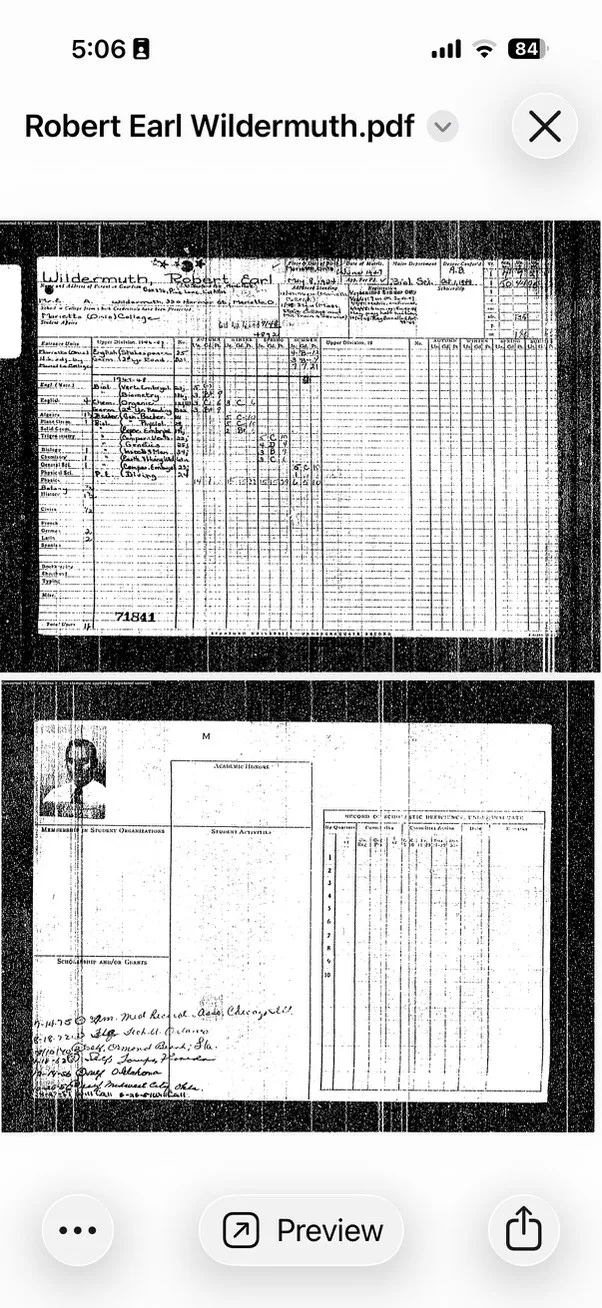
The card’s reverse carries the printed sections for Academic Honors, Student Activities and Scholarships — all three left blank — beside a Record of Scholastic Deficiency grid. Below them, in a much later hand, runs a column of dated entries with places: Am. Med. Record Assn., Chicago Ill. · Orlando · Ormond Beach, Fla. · Tampa, Florida · Oklahoma · Midwest City, Okla. Those are transcript-request destinations — the registrar noting each time, over decades, that a copy was sent somewhere Robert Earl needed it. The blank honors sections and the long list of requests tell the same story from both ends: an unremarkable undergraduate record that he needed to produce again and again for the rest of his working life.
Source: Wildermuth family archive, transmitted by Chuck Eesley 2026. Stanford registrar’s record card, and a 2026 phone photograph of the two-page PDF.
Catalogue
- Type
- Document
- Medium
- Stanford University registrar's transcript card, typewritten and handwritten
- Date created
- circa 1946–1948 (Robert Earl's Stanford years)
- Place created
- Stanford University, Palo Alto, California
- ID number
- WILDERMUTH-STANFORD-TRANSCRIPT
- Provenance
- Wildermuth family archive.
- Rights
- Family use; permission required for republication.