← Part of Letters from Vietnam
letter
Letter to Terrie, 21 September 1970 — 'Guess what! Here I am in the hospital suffering from Malaria'
Charlie's two-page letter to Terrie dated 21 September 1970, written on American National Red Cross stationery from a Vietnam hospital where he had just been admitted with malaria. The opening of the medical thread that runs across this letter and the 28 September Cam Ranh Bay convalescence letter. He is depressed and the future looks bleak, but counts his blessings: unaccustomed comfort, flush toilets, a real bed instead of a cot on the ground, decent food. Someone has a tape of Woodstock playing, which he finds interesting. He closes telling her to keep writing, and that he loves her.
What the letter is
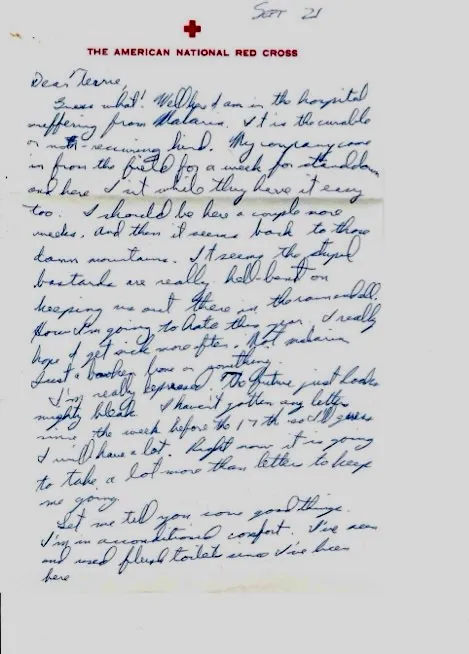
21 September 1970. Charlie writes Terrie from a Vietnam rear-area hospital on American National Red Cross stationery — the Red Cross cross logo and the printed line “THE AMERICAN NATIONAL RED CROSS” across the top of the cream sheet. He has just been admitted with malaria. He is writing rather than waiting in silence because he hasn’t had a letter from her since the week before the 17th and he wants to break the gap. The two pages turn from depression to counted blessings — flush toilets, a real bed, decent food, and someone’s tape of Woodstock playing nearby.
The Red Cross provided stationery, postage, and writing-assistance services to hospitalized servicemembers in Vietnam through its field offices at base hospitals across the country. A soldier in a hospital bed with no personal stationery could get a pad of Red Cross paper, a pen, and an envelope to write home. The letterhead on this letter is the direct material trace of that service.
Transcription
Sept 21
Dear Terrie,
Guess what! Well, here I am in the hospital suffering from Malaria. It is the curable or “nice” receiving kind. My company came in from the field for a week for stand-down and here I sit while they have it easy too. I should be here a couple more weeks. And then I seems back to those damn mountains. It seems the stupid bastards are really hell-bent on keeping me out there in the rain and all. How am I going to take this year? I really hope I get sick more often. Not malaria, just a broken bone or something.
I’m really depressed. The future just looks mighty bleak. I haven’t gotten any letter since the week before the 17th so I guess I will have a lot. Right now it is going to take a lot more than letter to keep me going.
Let me tell you some good things. I’m in unaccustomed comfort. I’ve seen and used flush toilets and I’ve been here
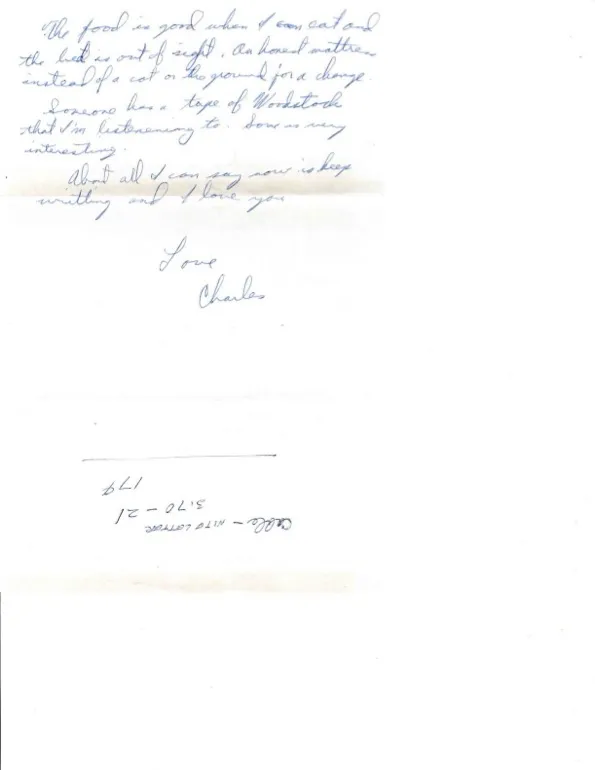
[page 2:] the food is good when I can eat and the bed is out of sight. An honest mattress instead of a cot on the ground for a change.
Someone has a tape of Woodstock that I’m listening to. Some is very interesting.
About all I can say now is keep writing and I love you.
Love Charles
What the letter records
The “curable or ‘nice’ receiving kind” of malaria. Vietnam malaria came in two main forms relevant to American troops: Plasmodium vivax (treatable, lower mortality, recurring episodes possible) and Plasmodium falciparum (more severe, higher mortality, chloroquine-resistant strains common in Vietnam by the late 1960s). The “curable or nice receiving kind” Charlie names is almost certainly P. vivax — the form that responded to standard chloroquine and primaquine treatment without the life-threatening complications of falciparum. The 101st Airborne operating in the wet mountains of I Corps was a high-risk environment for both, but vivax was the more common diagnosis.
The standdown irony. Charlie’s company had pulled in from the field for the week’s stand-down he himself would otherwise have enjoyed; instead he is in the hospital, watching them have an easier week from a bed. The juxtaposition is the central irony of the letter.
“I really hope I get sick more often.” The line is the unguarded version of the same wish that runs through the corpus: anything to keep him out of the field. Not malaria again, he qualifies, but a broken bone or something less violent than the field. The hospital was the kind of safety the war kept making impossible to find any other way.
The mail gap. “I haven’t gotten any letter since the week before the 17th.” A four-or-five-day mail gap from Maryland to a Vietnam APO was normal; what Charlie is describing is roughly that, complicated by the move from the field to the hospital. The letter is his bridge across the silence rather than a reply to anything.
The inventory of small luxuries. Flush toilets, an honest mattress, food he can eat — the second page counts exactly what a cot on the ground and C-rations don’t provide. It is the same instinct for concrete detail that runs through every letter, turned here toward comfort instead of danger.
Someone’s tape of Woodstock. A cassette of the festival (or its soundtrack) circulating through a Vietnam hospital ward in September 1970 is a small, sharp collision of the era’s two defining experiences for young American men — the war and the counterculture moment happening without them at home. Charlie’s flat “some is very interesting” is characteristically underplayed.
The 28 September letter from Cam Ranh Bay continues the arc.
Scans