← Part of Letters from Vietnam
letter
Letter to Terrie, 15 October 1970 — VIPs by helicopter, and 'the first enemy killed in over 3 months' in the brigade
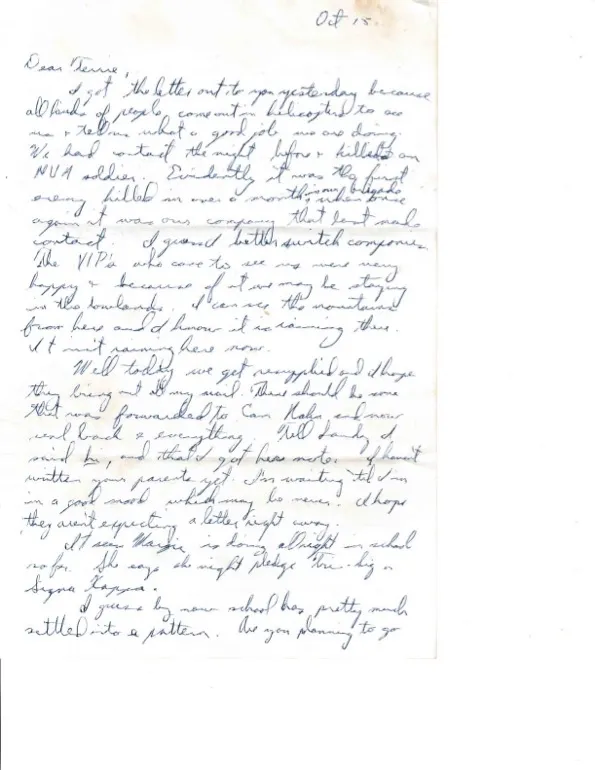
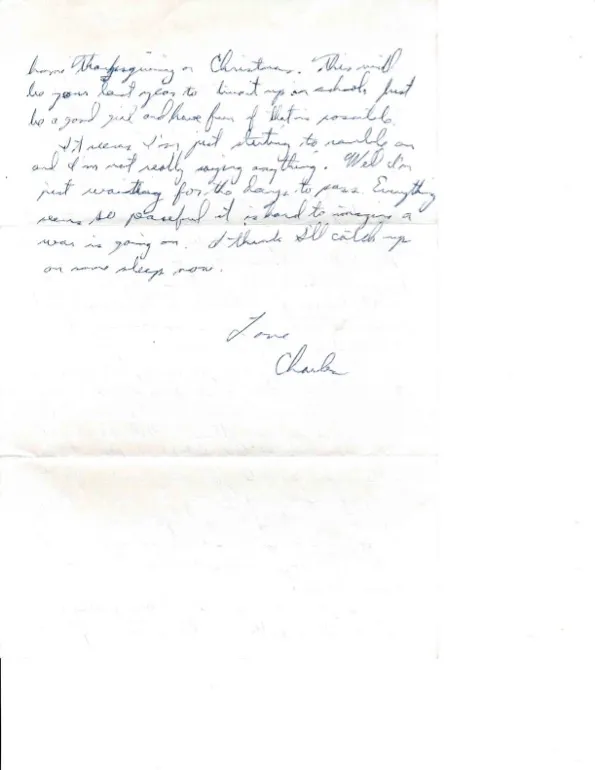
Charlie's two-page letter to Terrie dated 15 October 1970, reassembled from its scans (dad279 page 1, dad280 page 2). He got a letter out the day before because VIPs flew in by helicopter to congratulate the company — they'd made contact the previous night and killed an NVA soldier, reportedly the first enemy killed in the brigade in over three months, and once again it was his company that made contact. He jokes he should switch companies. The VIP visit has him hoping the attention means they'll stay in the lowlands rather than return to the rainy mountains he can see from where he's standing. Today is resupply day, and he hopes for mail forwarded from Cam Ranh Bay. He still hasn't written Terrie's parents, waiting for a good mood that may never come. His sister Marjie is doing all right in school and considering rushing a sorority. He asks whether Terrie plans to come home for Thanksgiving or Christmas — this being her last year in school — tells her to just be a good girl and have fun if possible, admits the letter is turning into a ramble, and closes on how strange it is that everything feels so peaceful it's hard to believe a war is happening, before deciding to catch up on sleep.
What the letter is
15 October 1970, two pages written the day after a rare and, by Charlie’s telling, significant event: contact with the enemy resulting in the first confirmed kill in the entire brigade in over three months. VIPs flew in by helicopter to congratulate the unit, and Charlie’s mood lifts with the possibility that the attention might keep his company in the safer lowlands. The letter then settles into its usual domestic rhythm — mail, his sister’s sorority prospects, a still-unwritten letter to Terrie’s parents — before closing on an observation about how strange the calm can feel.
Transcription
Oct 15
Dear Terrie,
I got the letter out to you yesterday because all kinds of people came in [by] helicopter to see us & tell me what a good job we are doing. We had contact the night before & killed an NVA soldier. Evidently it was the first enemy killed in over 3 months in [our] brigade, when once again it was our company that had made contact. I guess [I’d] better switch companies. The VIPs who came to see us were very happy, and because of it we may be staying in the lowlands. I can see the mountains from here and I know it is raining there. It isn’t raining here now.
Well, today we get resupplied and I hope they bring out my mail. There should be some that was forwarded to Cam Ranh and now back & everything. Well, Sandy — I said hi, and that’s got here more [than I expected]. I haven’t written your parents yet. I’m waiting til I’m in a good mood, which may be never. I hope they aren’t expecting a letter right away.
It seems Marjie is doing all right in school so far. She says she might pledge [Tri Delt] or Sigma Kappa.
I guess by now school has pretty much settled into a pattern. Are you planning to go
[page 2:] home Thanksgiving or Christmas. This will be your last year to [be at] school — just be a good girl and have fun if that is possible.
It seems I’m just starting to ramble on and I’m not really saying anything. Well, I’m just waiting for the days to pass. Everything seems so peaceful, it is hard to imagine a war is going on. I think I’ll catch up on some sleep now.
Love Charles
What the letter records
“The first enemy killed in over 3 months… in our brigade.” Whether or not the figure was precisely accurate, Charlie reports it as brigade-wide common knowledge, and it fits the broader pattern this corpus documents from the field: sharply reduced direct contact as Vietnamization advanced through 1970, punctuated by isolated, notable events rather than sustained engagement. His company, notably, is twice named as the one making contact when it does happen — see also the 14 September first-contact letter, which broke a 50-day streak the same way.
VIPs by helicopter. A vivid, specific detail — senior officers or visiting dignitaries flown in to congratulate a unit after a kill — that Charlie treats with plain self-interest rather than pride: what matters to him is whether the attention keeps the company in the lowlands rather than back in the rain.
A letter to her parents, still unwritten. “I’m waiting til I’m in a good mood, which may be never.” A small, honest admission of procrastination and mild dread about a formal in-law obligation, characteristic of how frankly he reports his own avoidance throughout the correspondence.
“Everything seems so peaceful, it is hard to imagine a war is going on.” The letter’s closing thought sits deliberately against its opening — a kill, VIPs, and brigade-wide news of combat, followed by a description of the same place as peaceful enough to nearly forget the war. The juxtaposition is the letter’s real subject, more than any single event in it.
Scans