← Part of Letters from Vietnam
letter
Letter to Terrie, c. February 1971 — NCO school or the early-out
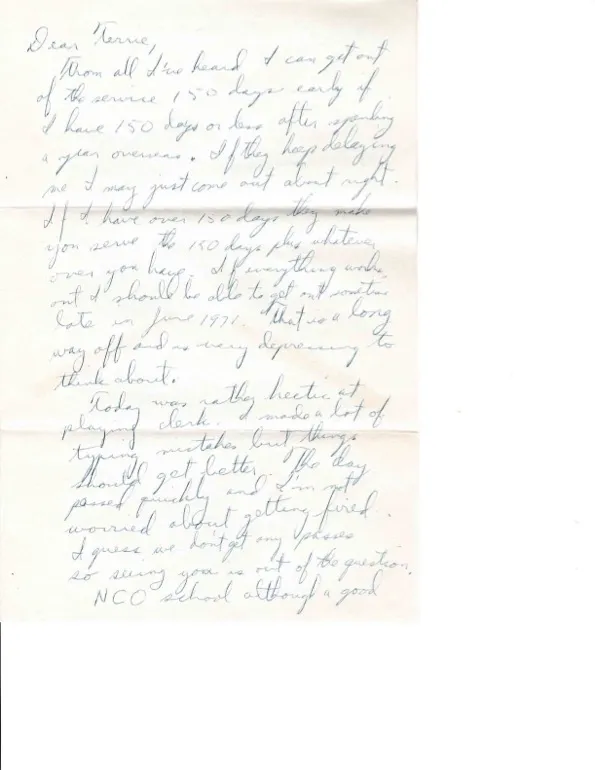
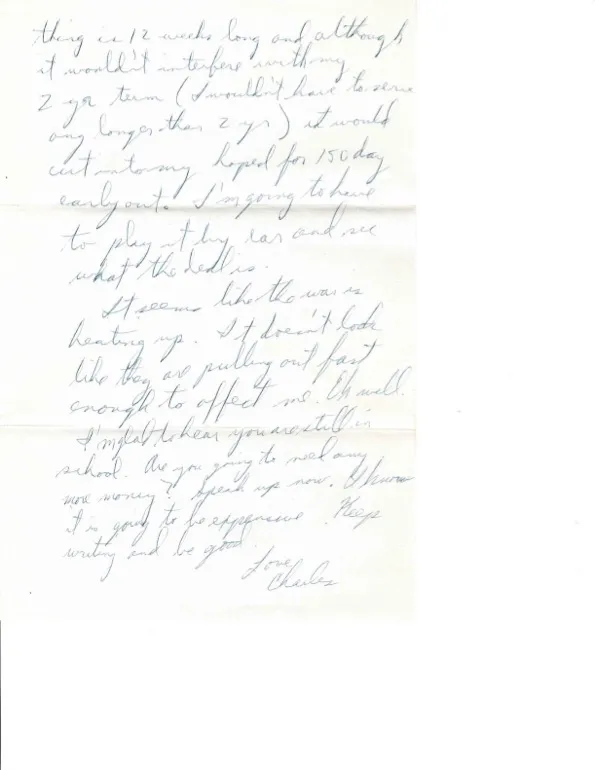
Charlie's two-page letter to Terrie from roughly February 1971 (undated; placed by the clerk job and the 'war heating up' reference), reassembled from its scans (dad234 page 1, dad235 page 2). He lays out the early-out math: he can leave the service 150 days early if he has 150 days or less left after a year overseas; if he has more, they make him serve down to 150 days plus the excess. If it works out he should be out sometime in late June 1971 — 'a long way off and very depressing to think about.' His clerk day was hectic and full of typing mistakes, but the day passes quickly and he's not worried about getting fired; there are no passes, so seeing Terrie is out of the question. He weighs a 12-week NCO school: a good thing that wouldn't extend his two-year term, but would cut into the hoped-for 150-day early-out, so he'll play it by ear. The war seems to be heating up and the drawdown isn't fast enough to get him home early. He asks whether she needs more money for school and tells her to keep writing and be good.
What the letter is
Around February 1971, from the clerk’s desk. The whole letter is Charlie running the arithmetic of getting out: the 150-day early-out rule, a late-June discharge that feels impossibly far off, and a 12-week NCO school dangled in front of him that he’d half like to take — except it would eat into the early-out he’s counting on. He decides to “play it by ear.” Around the calculation sits the ordinary clerk day (hectic, full of typos, no passes) and a glance at the war, which seems to be heating up faster than the Army is pulling out.
Transcription
Dear Terrie,
From all I’ve heard I can get out of the service 150 days early if I have 150 days or less after spending a year overseas. If they keep delaying me I may just come out about right. If I have over 150 days they make you serve to 150 days plus whatever over you have. If everything works out I should be able to get out sometime late in June 1971. That is a long way off and is very depressing to think about.
Today was rather hectic at playing clerk. I made a lot of typing mistakes but things should get better. The day passes quickly and I’m not worried about getting fired. I guess we don’t get any passes so seeing you is out of the question.
NCO school, although a good [page 2:] thing, is 12 weeks long and although it wouldn’t interfere with my 2 yr term (I wouldn’t have to serve any longer than 2 yrs) it would cut into my hoped-for 150 day early out. I’m going to have to play it by ear and see what the deal is.
It seems like the war is heating up. It doesn’t look like they are pulling out fast enough to affect me. Oh well.
I’m glad to hear you are still in school. Are you going to need any more money? Speak up now. I know it is going to be expensive. Keep writing and be good.
Love Charles
What the letter records
The whole tour as arithmetic. By February 1971 Charlie’s days are literally numbered, and every option — the school, the drop, the extension — is weighed only by what it does to the count. The 12-week NCO school is “a good thing” he turns down in his head because it would cost him 12 weeks of freedom.
“Playing clerk.” The self-deprecating name for the rear job that kept him out of the field — hectic, full of typos, but safe, and the day “passes quickly.” The contrast with the Thanksgiving field letter three months earlier is the whole arc of his tour.
“The war is heating up… not pulling out fast enough to affect me.” Charlie reads the Lam Son escalation purely through self-interest: not as a tragedy unfolding, but as bad news for his early-out. It’s the short-timer’s tunnel vision, honestly recorded.
Scans