ancestor-sketch
The 1937 Marietta Flood — Robert Earl Wildermuth's childhood at 413 Harmar Street
Robert Earl Wildermuth's childhood memory of the January–February 1937 Ohio River flood — the highest crest in the river's recorded history, which put four feet of water on the first floor of his family's house at 413 Harmar Street, Marietta. The mantle from the fireplace floated off its base and banged around the rooms breaking every window. The family moved furniture to the second floor and stayed with friends on higher ground for the two weeks the water was up. Twelve-or-thirteen-year-old Robert Earl took his father's boat across to the Marietta business district, picked up newspapers at the still-operating second-floor newspaper office, and sold them at floodwater premium prices door-to-door — 'I could sell more papers than the news company could provide me. Everybody wanted a paper to see what the predictions were for the rising river waters to start receding.'
The flood
The January–February 1937 Ohio River flood was the highest crest in the river’s recorded history — sixty-three feet at Cincinnati on 26 January 1937, well above the previous 1884 record. The river overflowed for nearly a thousand miles from Pittsburgh to Cairo, Illinois; nearly a million people were displaced; over 350 deaths; property damage in the hundreds of millions of 1937 dollars. Marietta, Ohio sits at the confluence of the Muskingum and Ohio rivers and was directly in the flood’s path — the city’s lower-lying neighborhoods went under, and the 1937 high-water marks are still visible on Marietta buildings today.
The Wildermuth family’s house at 413 Harmar Street — three blocks back from the Muskingum, on a brick foundation four feet high — flooded to the first-floor ceiling line. Robert Earl was twelve, going on thirteen.
In Robert Earl’s own words
The flood is the most vivid disaster scene in Robert Earl’s 1989 memoir:
“As the rivers slowly rose, all people living in houses that were threatened with flooding, moved their furniture to the second floor of their houses and then found friends or relatives on higher ground with whom they could live while the high waters were up. This was usually about two weeks. Of course flood time was a big occasion for us young boys and we paddled around in our father’s boats and ‘rescued’ stranded people or took them to inspect their flooded homes. All for a fee of course.”
The signature image of the family’s flood — the wooden fireplace mantle floating off its base, banging around inside the house breaking every window — is the kind of specific physical detail that survives across the half-century into the memoir:
“The water was just deep enough to float a wooden mantle over our fireplace off its foundation and the large mantle was floating around in the house breaking all of the windows.”
The paperboy’s flood
The flood was also Robert Earl’s first commercial enterprise. He had a paper route already; during the flood, he reconfigured it as a boat route:
“I had a paper route so I would take our family’s boat over to the Marietta City district and get my papers from the local newspaper office that remained in operation on their second floor and my paper selling business was extremely large. I could sell more papers than the news company could provide me. Everybody wanted a paper to see what the predictions were for the rising river waters to start receding.”
The image — twelve-year-old Robert Earl rowing his father’s boat across the Muskingum into a flooded downtown Marietta to pick up the day’s newspapers from a second-floor newsroom, then rowing back through the West Side and selling them at floodwater-premium prices door-to-door — is the founding scene of his later business sense. The same instinct (find a service nobody else can deliver; do it; charge fairly) would show up forty years later in his post-Air Force second career as a Blue Cross of Florida medical-records auditor.
What survived in the family memory
Beyond his own family’s flood, Robert Earl notes the broader Marietta pattern:
“Actually the flood waters were only in our house once while we lived there but almost every year, the flood waters would get up to our street. The old buildings in the Marietta business district, most of them built in the 1800’s, have survived many, many floods with water up as high as ten to fifteen feet inside them and at this date many of them are still in use.”
The annual rise of the rivers — flood-water-on-our-street as routine — is the Marietta-river-town life detail his Wildermuth-side childhood was built on. The 1937 flood was the one event when the water came inside the house; the rest were near-misses Robert Earl took for granted.
The flood photographs
Two period photographs of the 1937 flood are held in this archive alongside the memoir transcription:
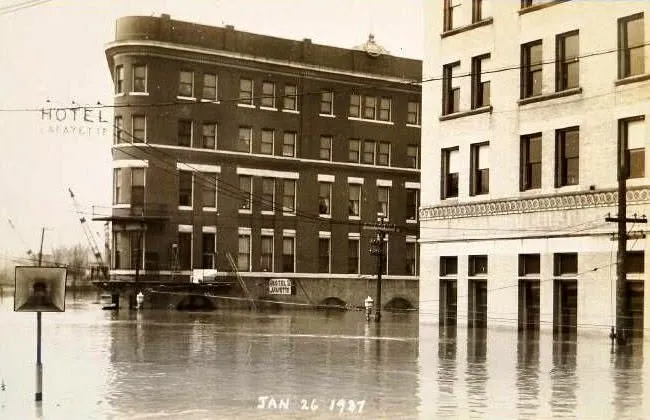
- The Hotel Lafayette in Marietta on 26 January 1937 — the iconic Marietta flood photograph, captured at the peak crest. The four-story Hotel Lafayette stands surrounded by floodwater up to its first-floor windows, with a smaller three-story building beside it equally flooded. The handwritten date “Jan 26 1937” is inscribed in the lower margin. The Hotel Lafayette was Marietta’s premier hotel at the time, in the business district that Robert Earl rowed his boat across to reach the newspaper office.
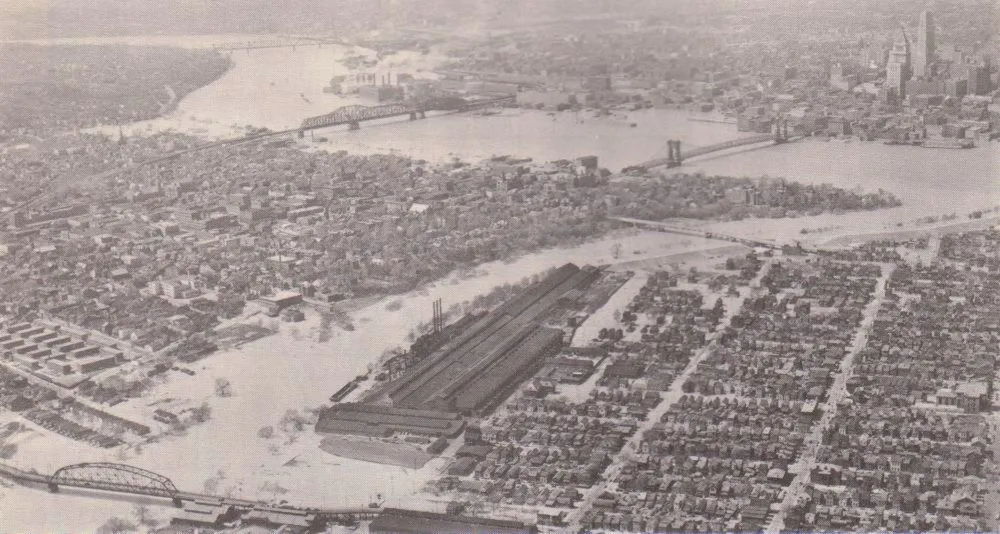
- An aerial view of the 1937 Cincinnati flood — the broader-scale shot showing how the Ohio River had spread far beyond its banks across the Cincinnati / Northern Kentucky basin at the peak of the disaster. The Roebling Suspension Bridge (the great 1866 bridge that John Roebling built before the Brooklyn Bridge) is visible spanning the swollen Ohio. Industrial buildings, residential blocks, and neighborhoods on both sides of the river sit under water as far as the camera reaches.
The two photographs together — local Marietta scale and the river-wide Cincinnati scale — frame the disaster context of Robert Earl’s family memory.
Further reading
- The 1937 Ohio River flood on Wikipedia — the river-wide scale of the disaster.
- Marietta, Ohio’s flood history — the broader pattern of Ohio-Muskingum confluence flooding at the city.
- The 413 Harmar Street place page — the house where Robert Earl rode out the flood.
- Robert Earl’s full 1989 memoir — the original source.
Source: Robert Earl Wildermuth’s 1989 memoir — the 1937 flood passages, in his own words.
Scans