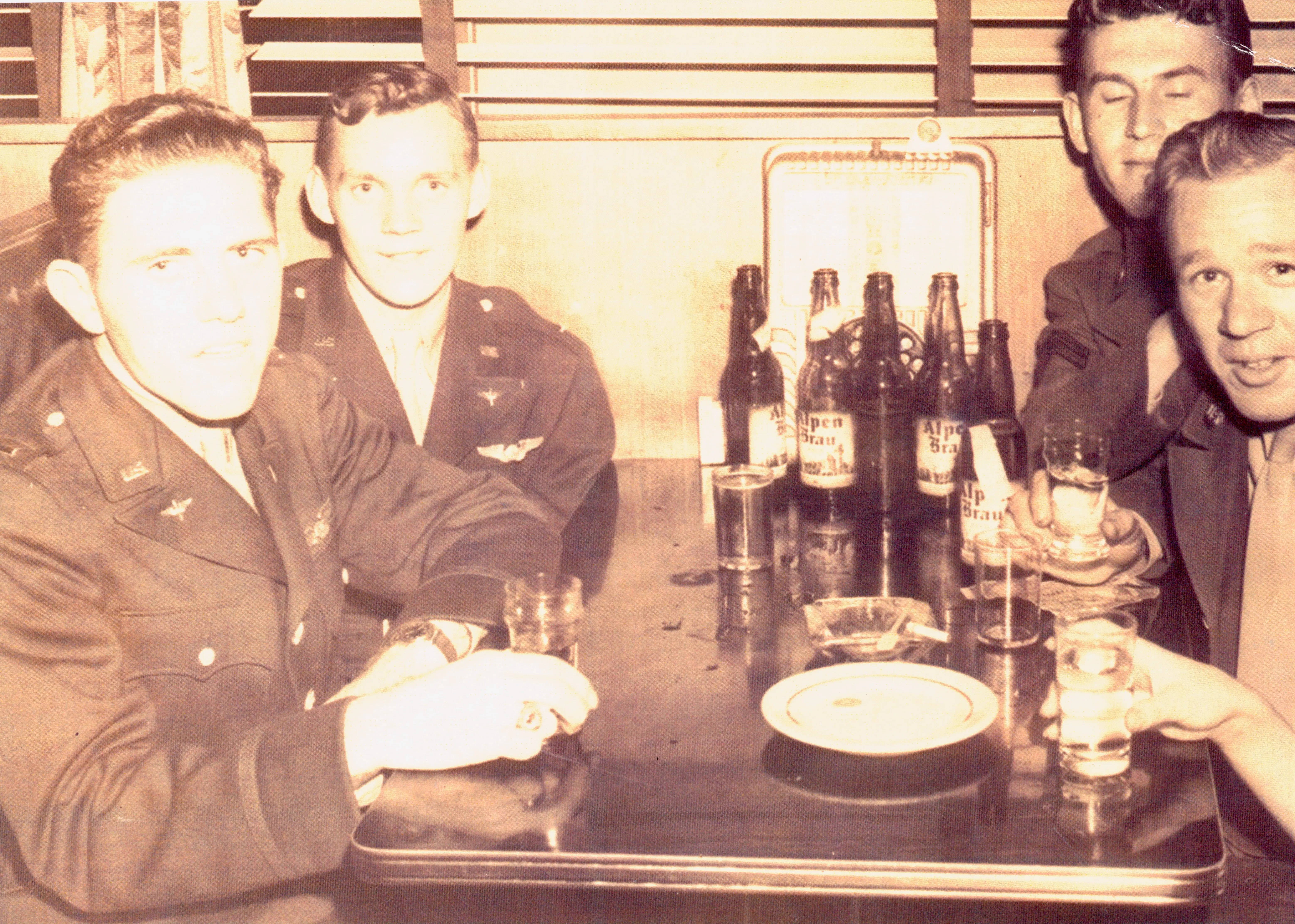
S.Sgt. Milton Emkow
also known as Milt
He was the ball turret gunner — the man who rode the glass-bubble turret lowered through the floor of the B-24 Liberator to hang beneath the airplane in flight — on Robert Earl Wildermuth’s ten-man crew. He was also the crew’s assistant engineer and armament supervisor.
From Columbus, Wisconsin. Like his crewmate Fuzzy Kuszmaul, he had originally enlisted for pilot training but was “eliminated from pilot training during the big phase down when pilot trainees became surplus.”
His armament role on the crew was the most operationally weighty position outside the pilots’ seats. Robert Earl’s memoir lays it out:
“Milton was also the armament supervisor and as such he had to insure that all .50 caliber ammunition was in its place for each of the guns; that the right type of bombs were hung in the bomb bay for a specific mission; that the bombs were fused properly, and that the bomb release system functioned properly. A lot of responsibilities and he was absolutely trustworthy.”
The ball turret itself was the position that required “guts” on every flight. The turret rotated in all azimuths, hung beneath the airplane “just a big glass bubble with guns,” and the gunner had to “buckle in and be cast off” to scan the under-quarter for enemy fighters. Milt “never hesitated.” The position has its own American literary memorial in Randall Jarrell’s 1945 poem “The Death of the Ball Turret Gunner” — the most-anthologized American war poem of the 20th century:
From my mother’s sleep I fell into the State, And I hunched in its belly till my wet fur froze. Six miles from earth, loosed from its dream of life, I woke to black flak and the nightmare fighters. When I died they washed me out of the turret with a hose.
Robert Earl’s one small character note on Milt: “Milton always seemed a little resentful of officers.” The friction was carried in the manuscript without elaboration. It was not enough to compromise his trustworthiness on the armament work the crew’s survival depended on. He survived the tour.
His postwar trajectory is open. The path forward sits at the Columbus, WI local press and the 90th Bomb Group veterans’ archive.
Sources: Robert Earl Wildermuth, The Big One: World War II (typewritten manuscript, c. 1989), Crew Members section.