Saigon · Republic of Vietnam (now Ho Chi Minh City, Vietnam) · Vietnam
Saigon, 1969–1971
The city Charles McMaster 'Charlie' Eesley wrote home from during his 1969–1971 U.S. Army tour. The letters that survived the trip back to Marietta, Ohio are the primary record of his two years there — a span he carried with him for the next four and a half decades and the subject of the [Letters from Vietnam](/docs/letters-from-vietnam/) collection in this archive.
Why this place matters
The Vietnam tour was the formative experience of Charlie's adult life. The eulogy describes him as 'broken by life and the legacy of his time in Vietnam' and yet, in Hemingway's phrase, 'strong in the broken places.' Most long conversations with his son returned, eventually, to what he had seen and done in Saigon. The city is named here as the place those letters were written from, the place those long conversations kept returning to, and the place he never wanted to revisit even when his son, decades later, was a stone's throw away.
Across generations
.](/_astro/Charles_M_Eesley.OZpz5l3q_Z1AeVoq.webp)
.](/_astro/00000003_00000000_00000001.BWWATEb5_18aYck.webp)
.](/_astro/00000000_00000016_00000017.DA3HWvxF_Z2kxEv0.webp)
Charlie's tour ran from 1969 through 1971 under the U.S. Army's 101st Airborne Division (Screaming Eagle patch visible on his right shoulder in the EM-club frame). Three photographs survive from this period: his Army induction PFC EESLEY portrait (c. 1969, before deployment); the EM-club photograph (c. 1970, with a Vietnamese woman in green áo dài at the corner of the frame); and the July 1970 hooch photograph (bearded, on duty, the documentary middle of the tour). The eulogy notes Saigon specifically and that 'he had absolutely no desire to visit again after leaving.' His letters home are the period record — see [Letters from Vietnam](/docs/letters-from-vietnam/).
Alignment: Three photographs of the tour now placed: PFC induction portrait, EM club c. 1970, and July 1970 hooch. The specific Vietnam locations of the latter two are not yet documented; he was operating in I Corps with the 101st Airborne, north-central South Vietnam, not in Saigon city itself. The 'Saigon' framing on this page is the geographic shorthand his eulogy used.
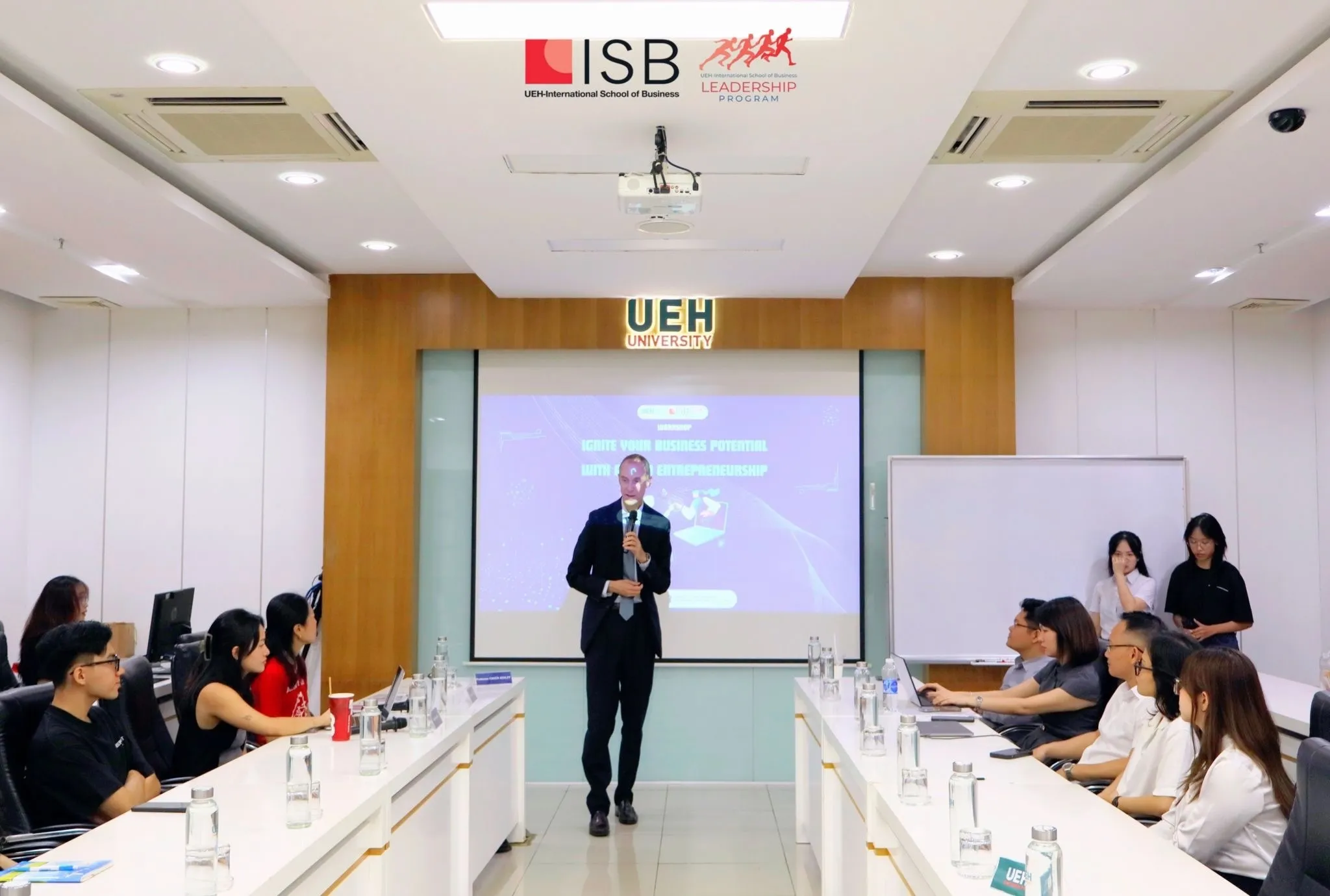
Chuck has returned to Ho Chi Minh City multiple times in the years since the June 2011 first visit, including teaching trips at local universities with the family foundation. The photograph shows Chuck giving a December 2024 presentation in a lecture hall at the **UEH-International School of Business (UEH-ISB), University of Economics Ho Chi Minh City** — the lectern in front of a projection screen reading 'Ignite Your Business Potential with Intrapreneurship,' the audience of Vietnamese students around three long conference tables. The two-generation geography of Charlie's 1969–71 tour and Chuck's 2024 teaching career in the same city produces an unusual parental-paternal symmetry: the city the father refused to revisit became one the son returned to repeatedly, in 2024 to teach entrepreneurship to its university students fifty-four years after his father had been an infantryman in the country.
Alignment: The December 2024 lecture-hall photograph and the June 2011 Cu Chi tunnel photographs together make this place's visit history the most layered in the archive — the same geographic point sitting under a soldier's tour (1969–71), a son's tourist visit (2011), a documentary letter sequence (the 1970–71 Vietnam letters), and a returning academic's classroom (2024).
, 2015, and Chuck's own account 2026.](/_astro/IMG_0276.DQ-BUStp_25Prso.webp)
, 2015, and Chuck's own account 2026.](/_astro/IMG_0279.Dn5FnJu7_ZluTRm.webp)
Chuck's first visit to Vietnam — Ho Chi Minh City, June 2011 — to see his childhood friend Mike Sieburg who was living there at the time. The two photographs are from the Cu Chi tunnels — the Viet Cong underground tunnel network 70 km northwest of HCMC, now a Vietnamese government tourist site. In the first, Chuck sits with four Vietnamese reenactors in NLF (Viet Cong) uniforms under the woven camouflage netting that hides the surface entry to a tunnel complex. In the second, Chuck sits on the turret of a destroyed American M48 Patton tank preserved at the site — captured or disabled during the war, left in place as memorial. The trip also included the War Remnants Museum (formerly the 'American War Museum,' the Vietnamese state museum documenting the war from the Vietnamese perspective). From Saigon Chuck called his father by Skype; Charlie told stories about being in that city, and when Chuck complained of the humidity, Charlie said he had 'missed the wonderful experience of the monsoons.' Source: Chuck's [eulogy for his father](/docs/eulogy-charles-mcmaster-eesley/), 2015, and Chuck's own account 2026.
Alignment: The Cu Chi tunnels and the War Remnants Museum are the two most-canonical sites for an American visitor with a father who served in country. That Chuck sat on the turret of an American tank that Vietnamese forces had defeated, while his father had been a U.S. infantryman in the same country four decades earlier, is the photograph's quiet historical layering.
Saigon — capital of the Republic of Vietnam until April 1975, renamed Ho Chi Minh City after the war — is the city Charles McMaster Eesley wrote home from during his U.S. Army tour. He arrived in 1969 and rotated out in 1971. The letters he wrote during those two years are the primary surviving record in his own voice; they form the Letters from Vietnam collection in this archive.
Charlie’s eulogy names Saigon specifically: it places him there with his “smart-ass comments that probably nearly got him court-marshaled,” it records that the stereo and record player he bought when he got home was the first thing he bought when he got home, and it includes the Skype call decades later when Chuck was visiting Saigon as a tourist and Charlie, on the other end of the line, declined to come.
A place across three generations
Saigon is one of only a few places in this archive that the family touched, walked through, and worked in across multiple generations and multiple registers. Charlie was an infantryman here in 1969–71, with the 101st Airborne in I Corps. Chuck came back as a tourist in June 2011 with his childhood friend Mike Sieburg living in the city; together they walked the Cu Chi tunnel system that the Viet Cong had used to bring the American war to a slow underground halt, and Chuck sat on the turret of a captured American M48 Patton tank preserved at the site — the small, quiet visual irony of the son sitting on the symbol of the father’s force. Chuck returned in December 2024 to lecture at UEH-International School of Business on entrepreneurship and intrapreneurship to a hall of Vietnamese university students, fifty-four years after his father had been an infantryman in the country.
Charlie himself never went back. The eulogy records the closing-parenthesis Skype call when Chuck was in Saigon and called him: Charlie told stories about being in that city, and when Chuck complained of the humidity, Charlie told him he had missed the “wonderful experience of the monsoons.” The black-deadpan humor of a tour that ended thirty-some years earlier and a man who had decided he was done with the place.
Further reading
- Letters from Vietnam — the curated collection of Charlie’s surviving letters home.
- Eulogy for Charles McMaster Eesley (Chuck Eesley, 2015) — the source for the Vietnam-after-Vietnam content woven through the family’s later life.
- The Vietnam War (Ken Burns & Lynn Novick, 2017) — the documentary series.
- Dispatches by Michael Herr — the war as it sounded.
- Matterhorn by Karl Marlantes — the war as it felt.
- Vietnam Veterans Memorial Fund — the searchable wall directory.
- Saigon (Wikipedia) — the city’s history and its renaming after the war.