Birthday note from Charlie to Chuck — late-period block-print, after the vision loss
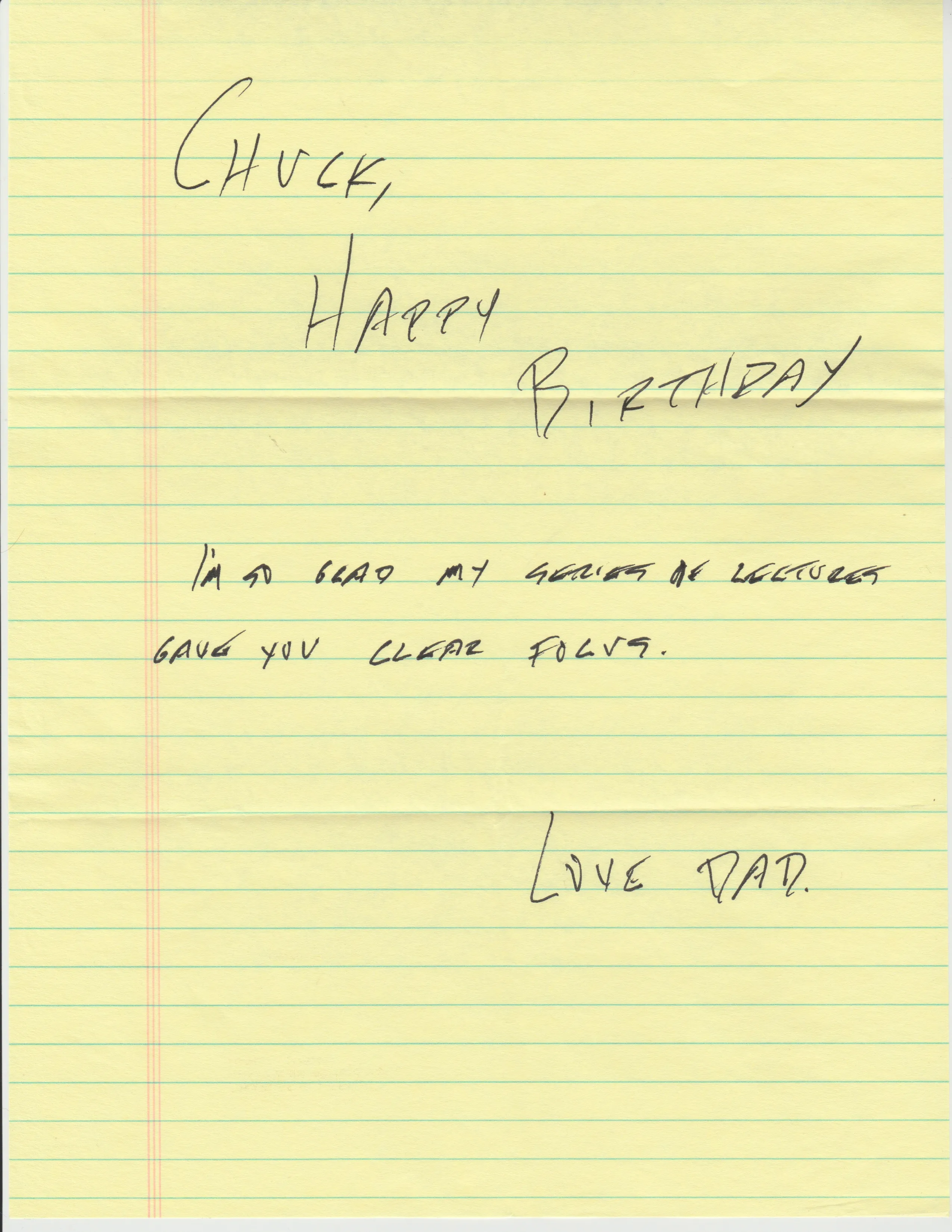
A short birthday note from Charlie Eesley to his son Chuck, written in large block-capital letters on yellow legal-pad paper. Confirmed by Chuck Eesley June 2026 as Charlie’s writing. The full text:
Chuck,
Happy Birthday
I’m so glad my series of lectures gave you clear focus.
Love Dad.
What the note records about Charlie’s handwriting
The most important thing this note documents is the changed shape of Charlie’s hand in late life. The earlier Charlie-writing in this archive — the 12th-grade autobiography of 1964–65, and the Vietnam letters of 1968–71 — is uniformly in smooth, fluid, mid-line cursive. The Charlie of this note writes in large block capitals, oversize letters, words spaced widely apart, with the pen pressure heavier than the cursive letters’ pressure had been.
The shift is consistent with the long-tail medical legacy of his Vietnam tour, now on his page under the Agent Orange / diabetes / vision-loss arc: diabetic retinopathy progressed slowly across his late life, eventually forcing him to retire early from his stockbroker career. Cursive writing requires close visual feedback to keep the line; large block-capitals can be drawn from muscle memory without precise sight. The note is the kind of letter a man whose vision is failing reaches for: bigger letters, fewer of them, separated more.
Why this small note matters
The Charlie-to-Chuck father-son thread elsewhere in this archive reads from Chuck’s side — the 2015 eulogy is Chuck’s piece, looking back. The Vietnam-era Charlie voice is the soldier in his early twenties writing his then-girlfriend. The autobiography Charlie is seventeen.
This note is the late Charlie voice writing to his son — the period of his life the rest of the archive otherwise carries only through Chuck’s adult memory of him. The handwriting is the bodily record of how Vietnam carried into late life: the disease the war seeded a quarter-century later, the loss of sight the disease produced, and the warmth of a father still writing his son a birthday note in whatever hand he had left.
The dry-teasing voice
The body text — “I’m so glad my series of lectures gave you clear focus” — is the same dry, teasing voice that runs through every Charlie piece in the archive. The autobiography at seventeen carries it (“It was Jeanne who made me feel like a dumbbell”). The Vietnam letters carry it (“I really hope I get sick more often. Not malaria, just a broken bone or something”). The eulogy quotes it in the late form (the dark joke about “losing weight in the form of his foot” after his Agent Orange / diabetes / amputation). And the birthday note carries it pointed at his son — a paternal “series of lectures” about life-direction now self-mocked, with the small piece of pride beneath the tease that the lectures had landed.
The same voice across the autobiography, the Vietnam letters, the eulogy quotations, and this birthday note is the throughline of the archive on Charlie’s side.
Source: Eesley family archive; filed with the Vietnam letters scanning batch but a much later piece. Cast / handwriting / text confirmation by Chuck Eesley June 2026.
Catalogue
- Type
- Letter
- Medium
- Handwritten in large block-capital letters, black marker or heavy ballpoint on yellow legal-pad paper
- Date created
- c. 2000s–2010s
- Place created
- presumed Marietta, Washington County, Ohio
- ID number
- CHARLIE-TO-CHUCK-BIRTHDAY-NOTE
- Provenance
- Eesley family archive. Originally filed with the Vietnam letters but actually a much later note — written after Charlie's diabetic retinopathy had progressed.
- Rights
- Family use; permission required for republication.