memoir
My Mother's Favorite Son — Charles Eesley's 12th-Grade Autobiography (c. 1964–1965)
Charles McMaster 'Charlie' Eesley's 12th-grade English autobiography, titled 'My Mother's Favorite Son' — typewritten on his sister Anne's typewriter, bound, dedicated 'to my parents who have made this autobiography a happy one,' in five chapters (Introduction / In the Beginning / Second Stage / Growing Up Too Fast / The Struggle Within) plus front matter (cover, dedication, table of contents, preface, acknowledgments) and a working outline. The teacher returned it with a B- and the comment 'Interesting reading, Charles! I wish to talk with you concerning punctuation and run-on sentences' — which Chuck later labeled, when scanning the bound copy for the digital archive, as the 'Stupid 12th Grade English teacher's inadequate and shortsighted comments' page. Seventeen pages of Charlie's voice five years before Vietnam, three years before the December 1968 letter to Terrie, fifty-one years before his son Chuck would eulogize him in late 2015. The earliest sustained piece of his writing in the archive.
What this document is
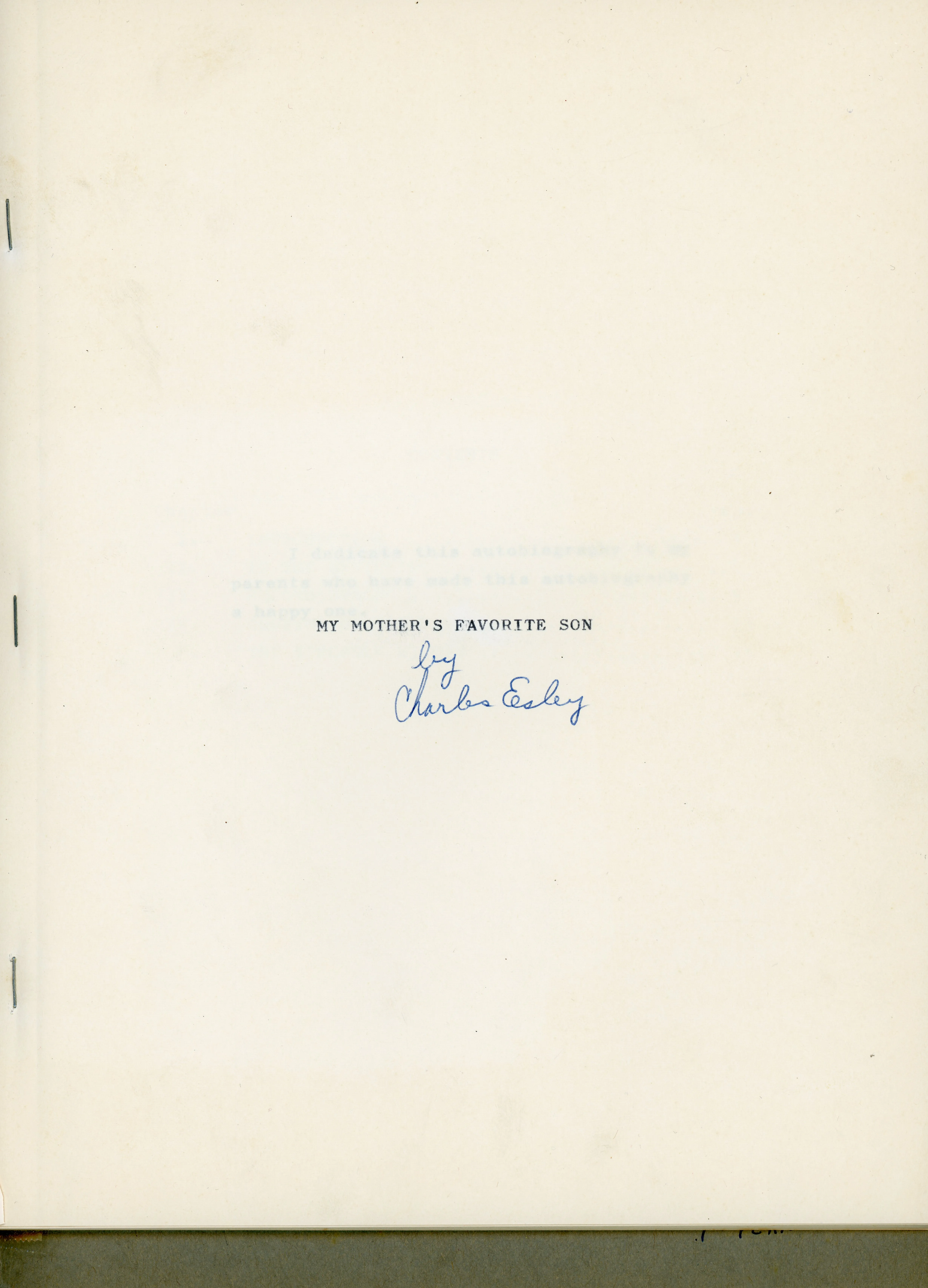
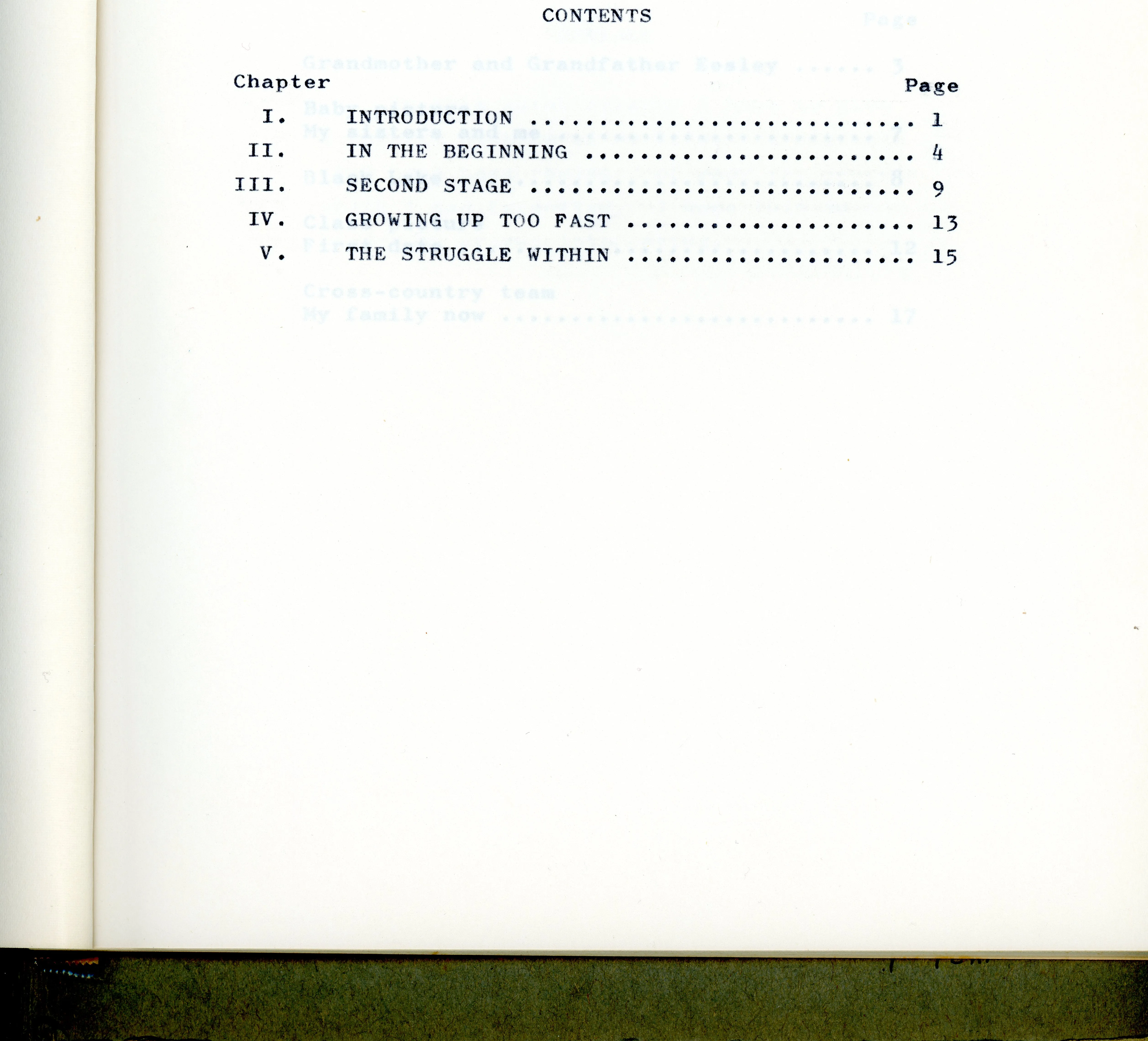
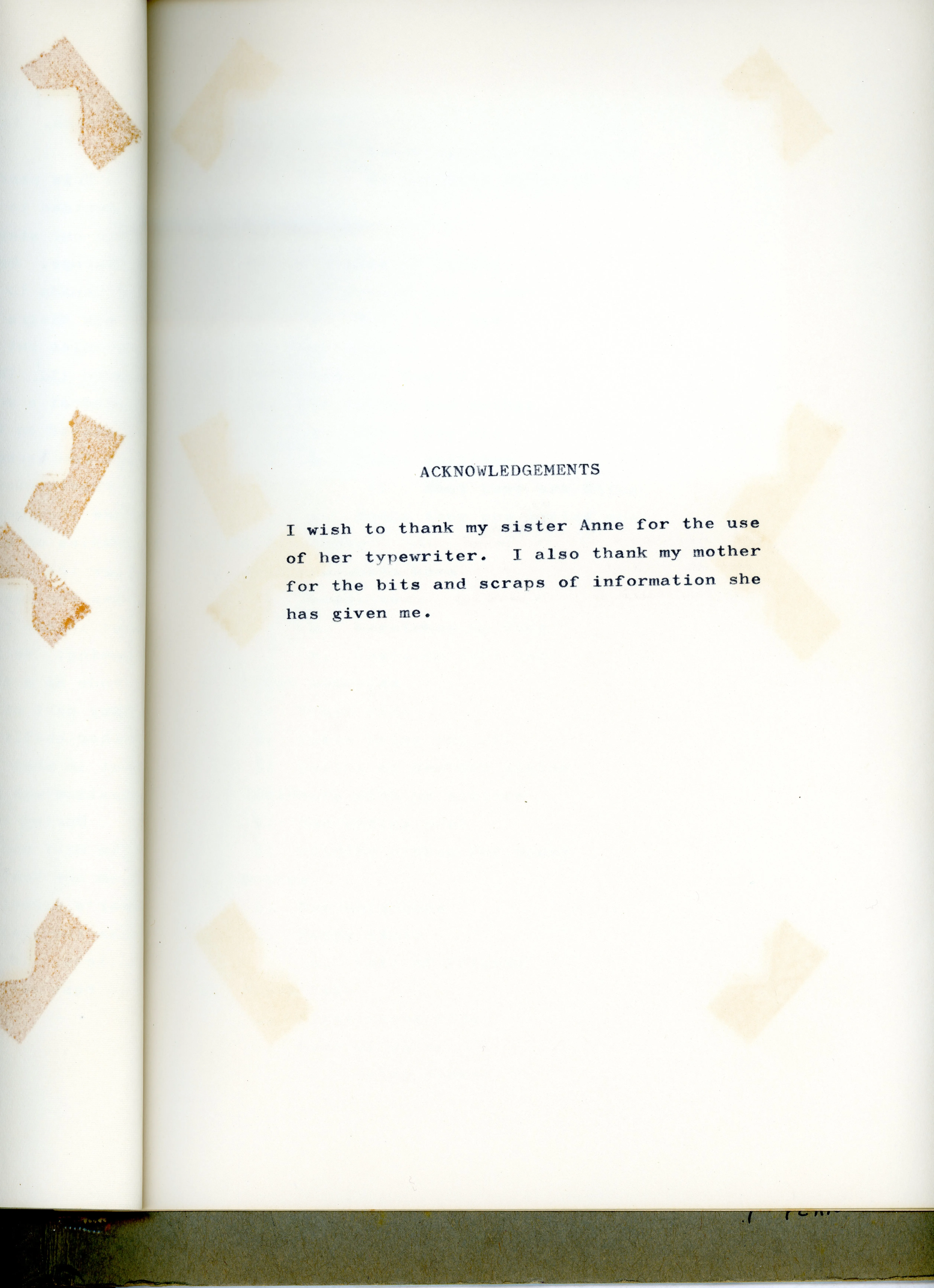
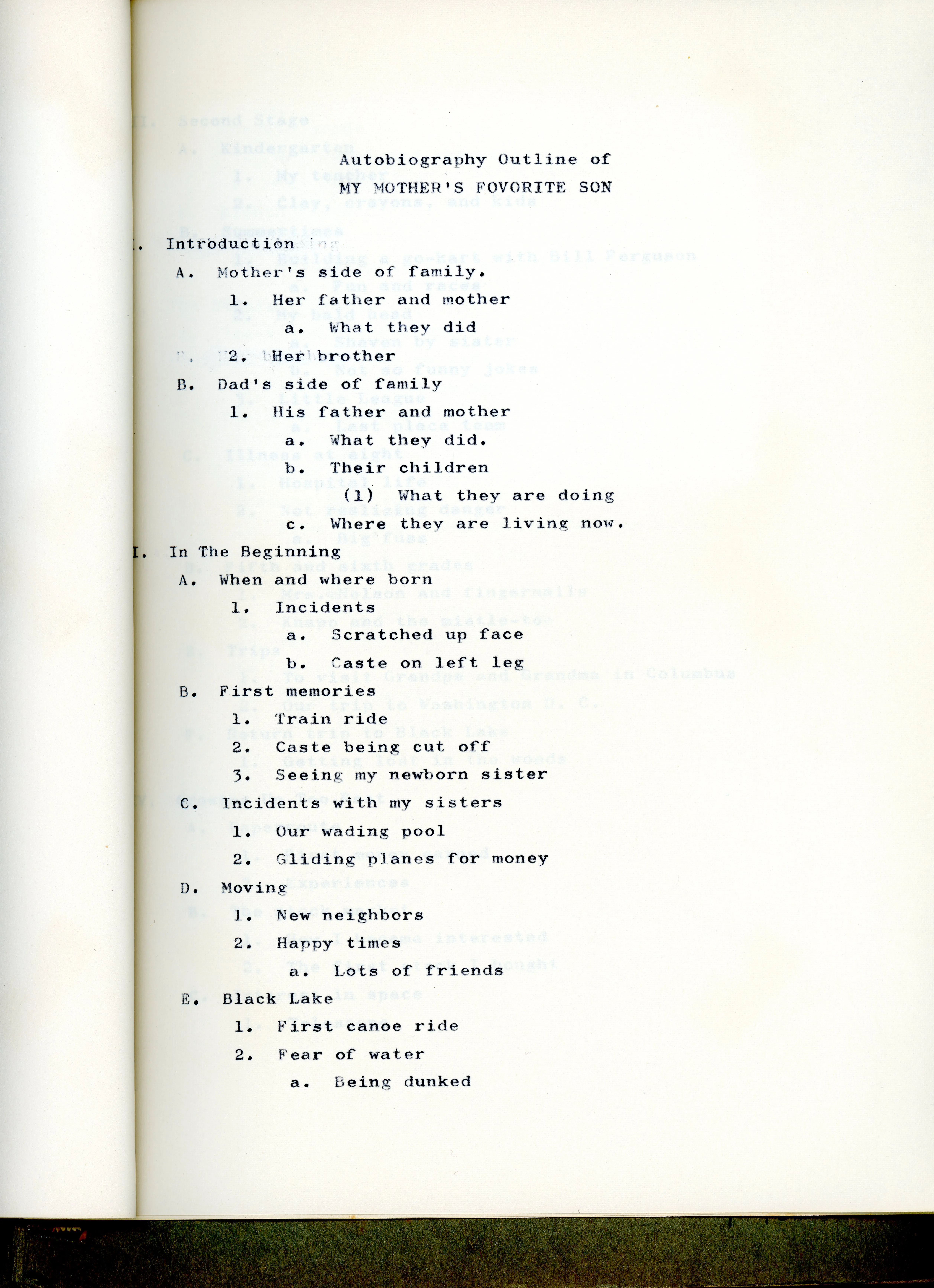
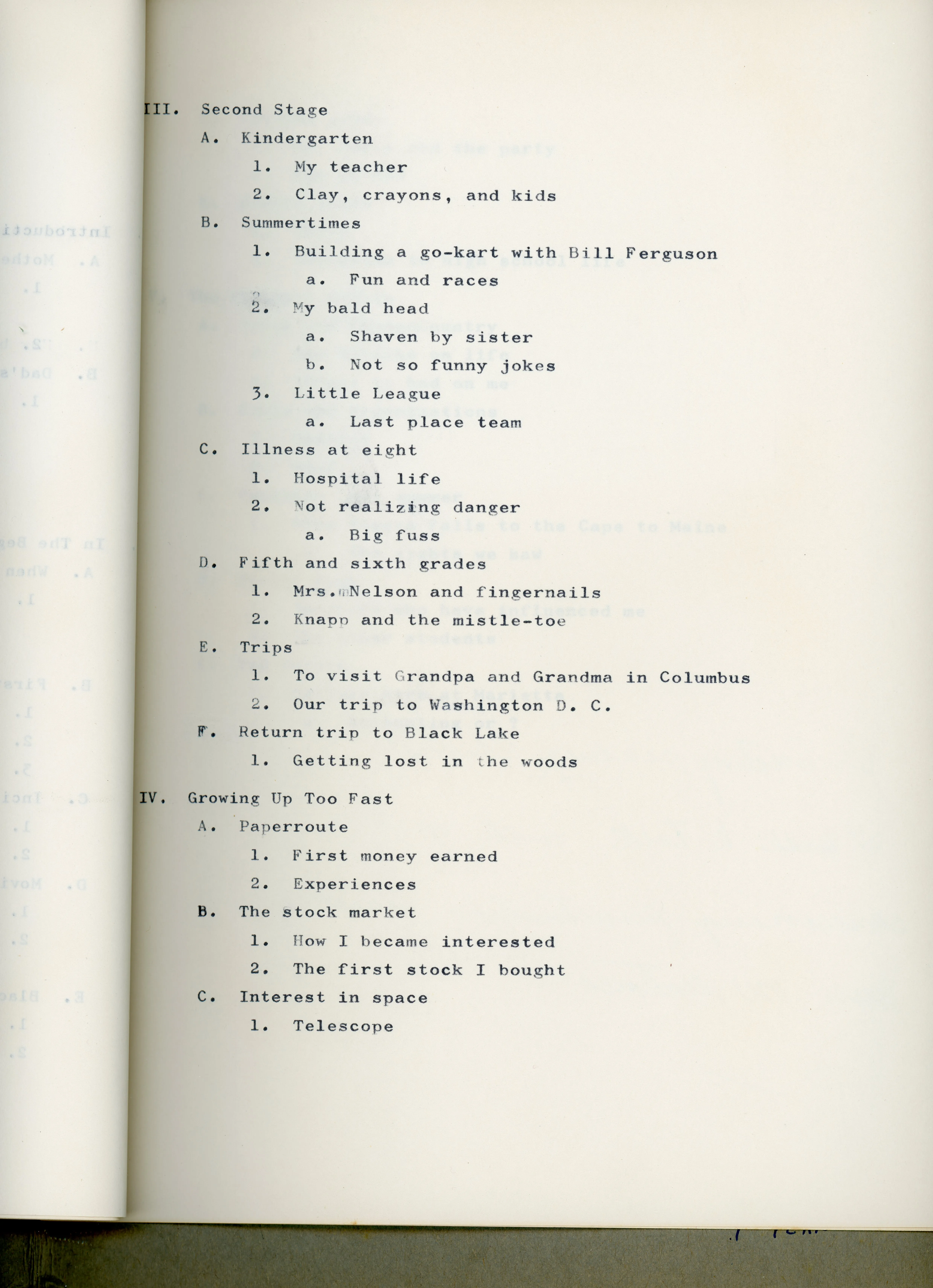
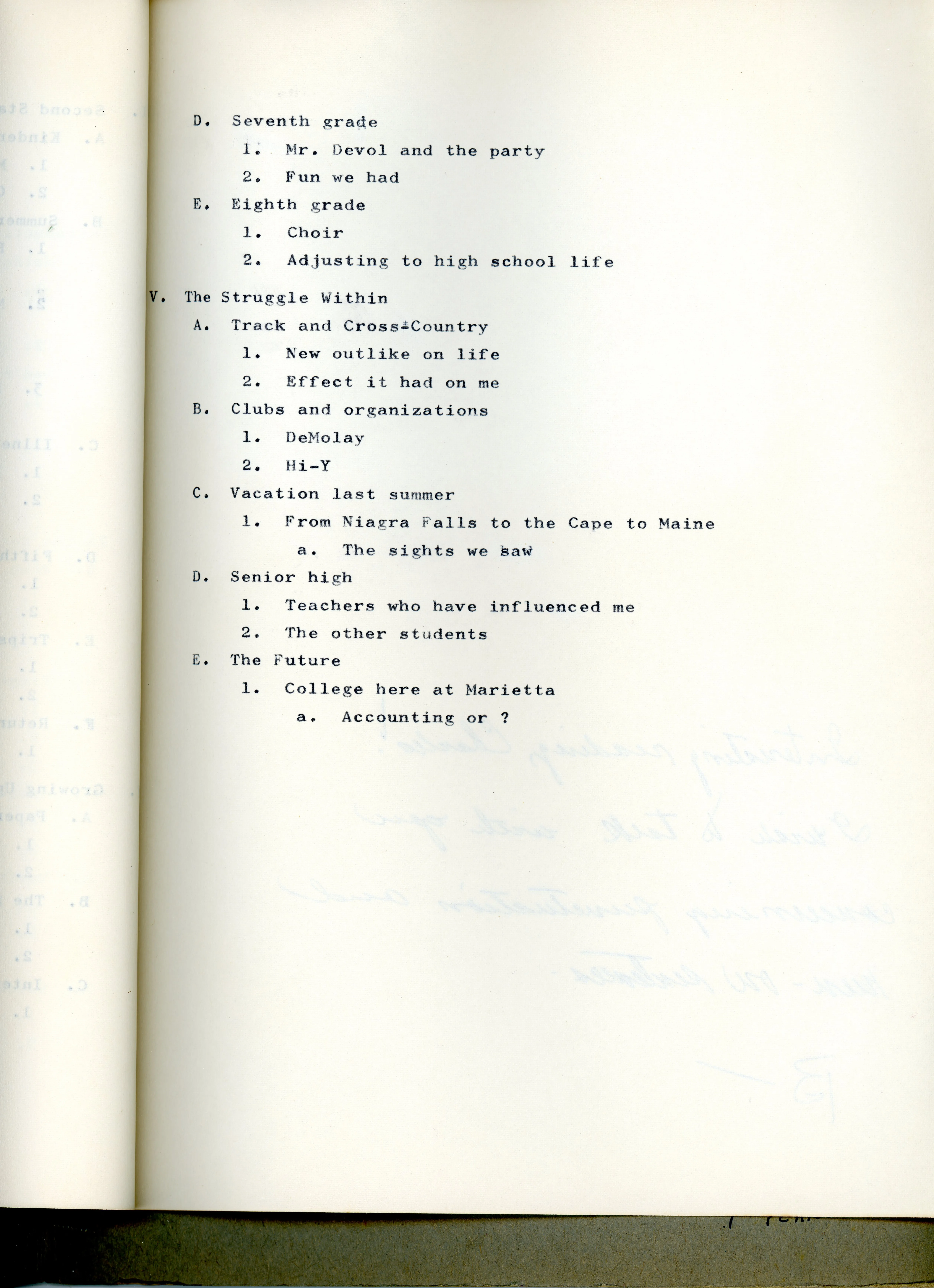
In the spring of his senior year at Marietta High School — sometime in 1964 or 1965 — Charlie Eesley typed up an autobiography for his 12th-grade English class. He typed it on his sister Anne’s typewriter. He typed a cover page (“MY MOTHER’S FAVORITE SON / by / Charles Eesley”) and signed it in blue ink. He typed a dedication page (“I dedicate this autobiography to my parents who have made this autobiography a happy one.”). A table of contents with five chapters. A four-sentence preface (“In this autobiography I hope to give a general picture of my life. In writing it I have been reminded of many incidents which I had forgotten. I hope this autobiography proves interesting.”). An acknowledgments page thanking Anne for the typewriter and his mother for “the bits and scraps of information she has given me.” A three-page working outline. Seventeen typewritten pages of body content. He bound it.
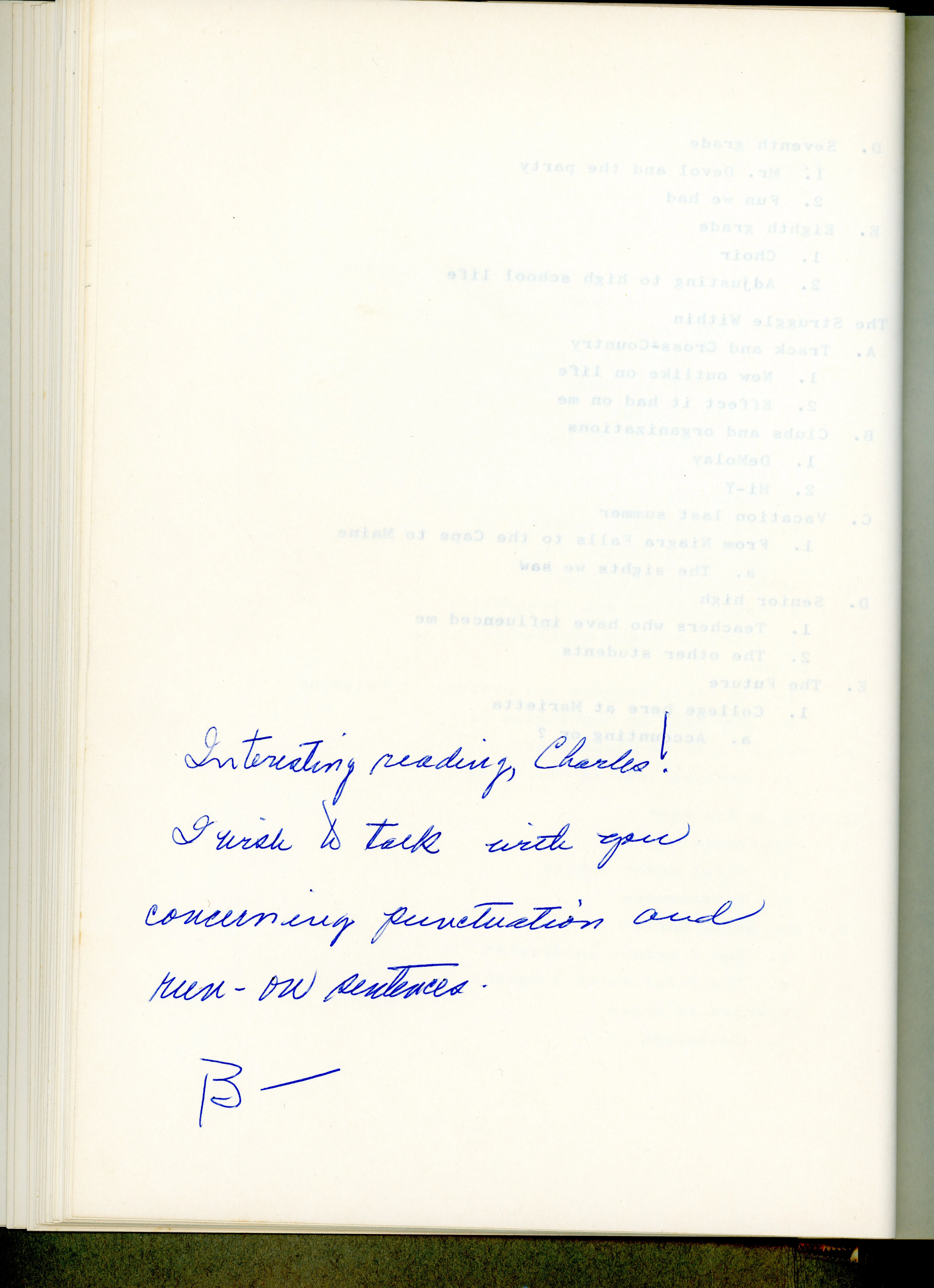
The teacher returned it with a B- and the comment, in blue ballpoint on the back cover:
Interesting reading, Charles! I wish to talk with you concerning punctuation and run-on sentences.
B-
When Chuck scanned the bound autobiography fifty years later — in December 2015, in the immediate wake of his father’s death — he labeled the teacher-comments scan file with what reads as the autobiography’s only retroactive editorial mark from the family: “Stupid 12th Grade English teacher’s inadequate and shortsighted comments.” That file label is the closest thing to a posthumous reply Charlie’s voice gets in this archive.
The five chapters
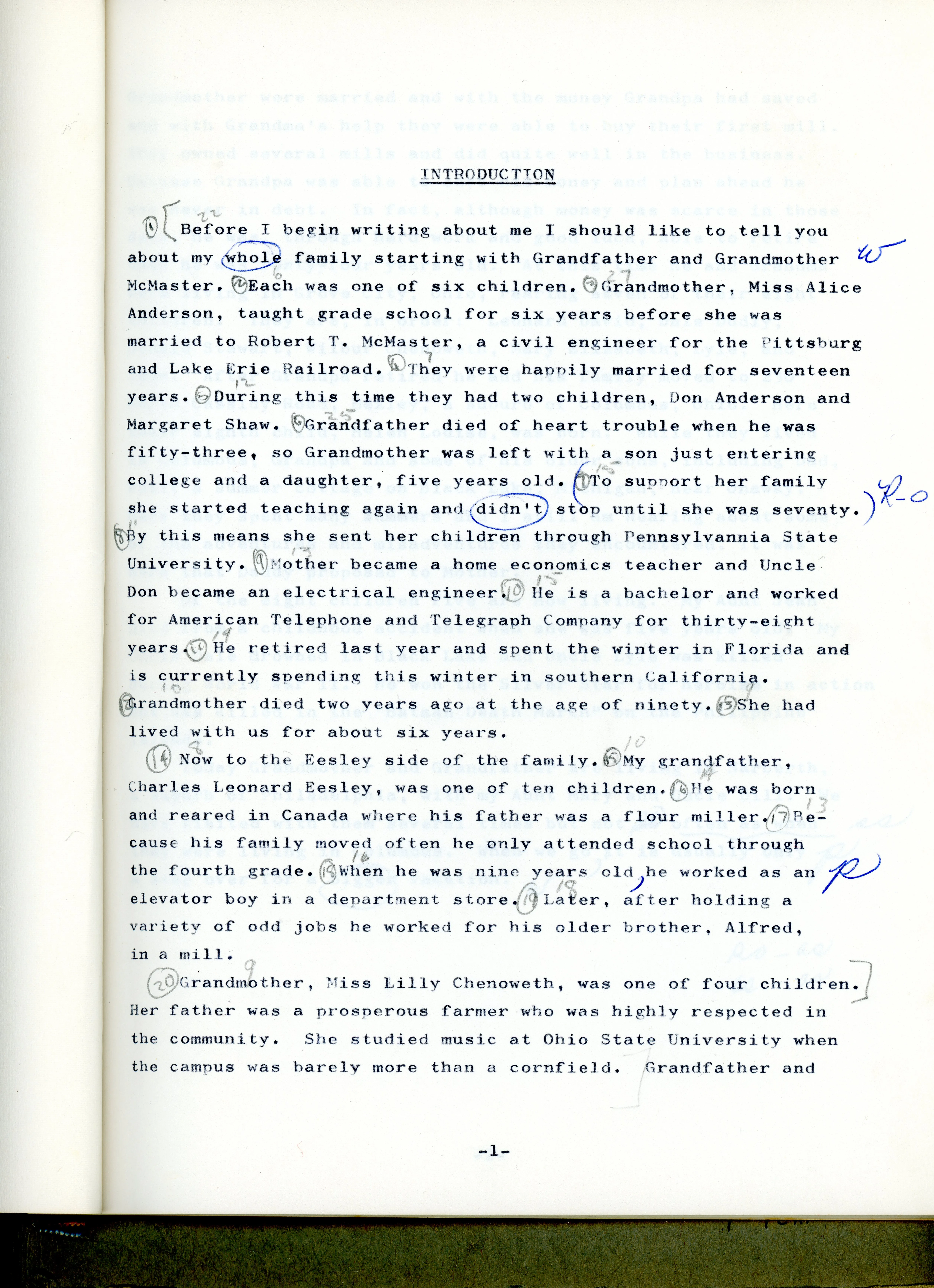
I. Introduction (pp. 1–3) — the McMaster and Eesley grandparents and their generation, in Charlie’s voice. Three pages of “Before I begin writing about me I should like to tell you about my whole family.”
II. In the Beginning (pp. 4–8) — birth at White Cross Hospital in Columbus on 17 February 1947, the club foot and hernia and scratched-up face that nearly killed him as an infant, the first vivid memory at three and a half (the club-foot cast coming off and the doctor’s knife being a bit too large), the move from Columbus to Marietta, neighborhood friends, Black Lake Michigan summer trips with the extended Eesley family.
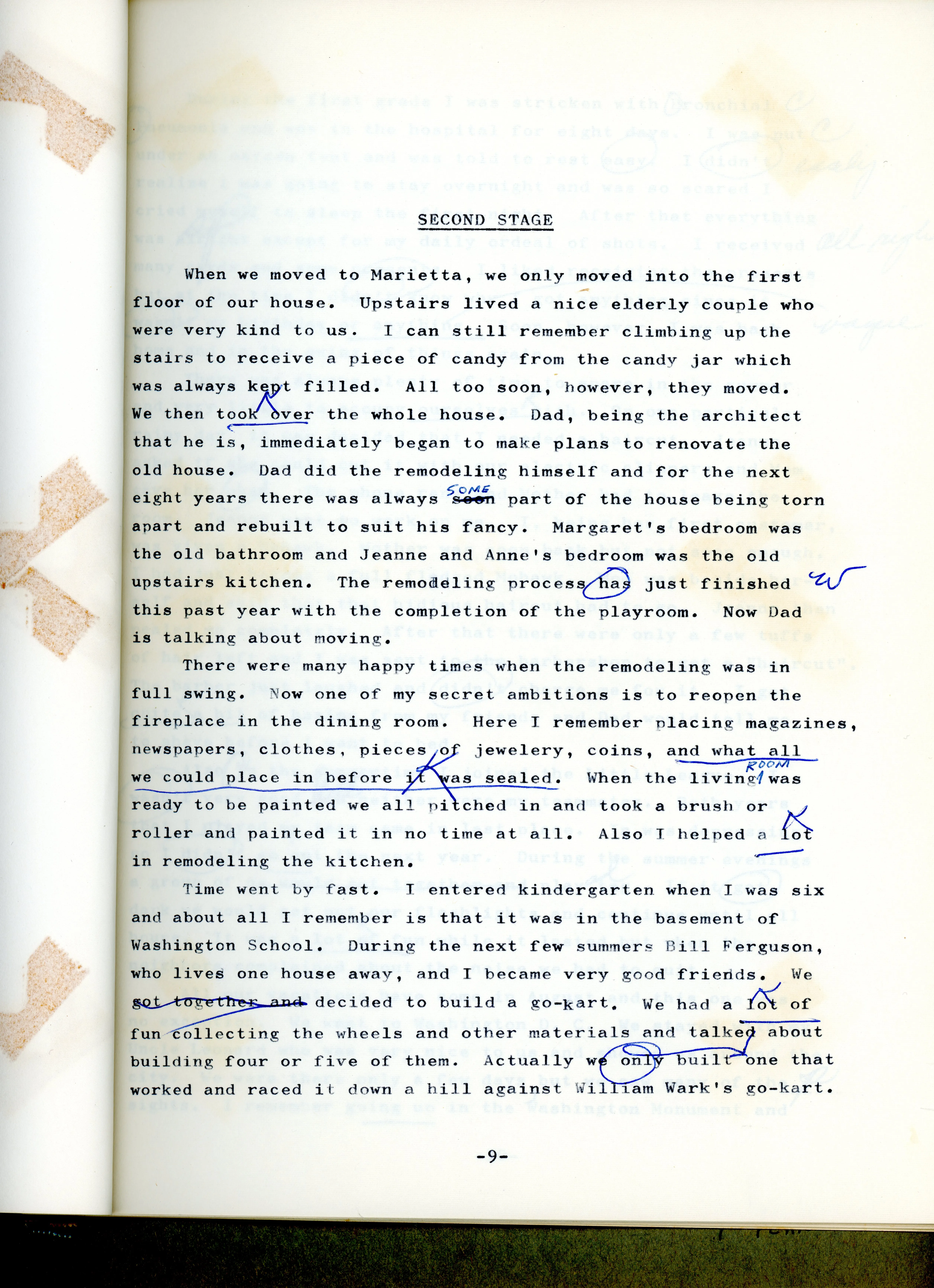
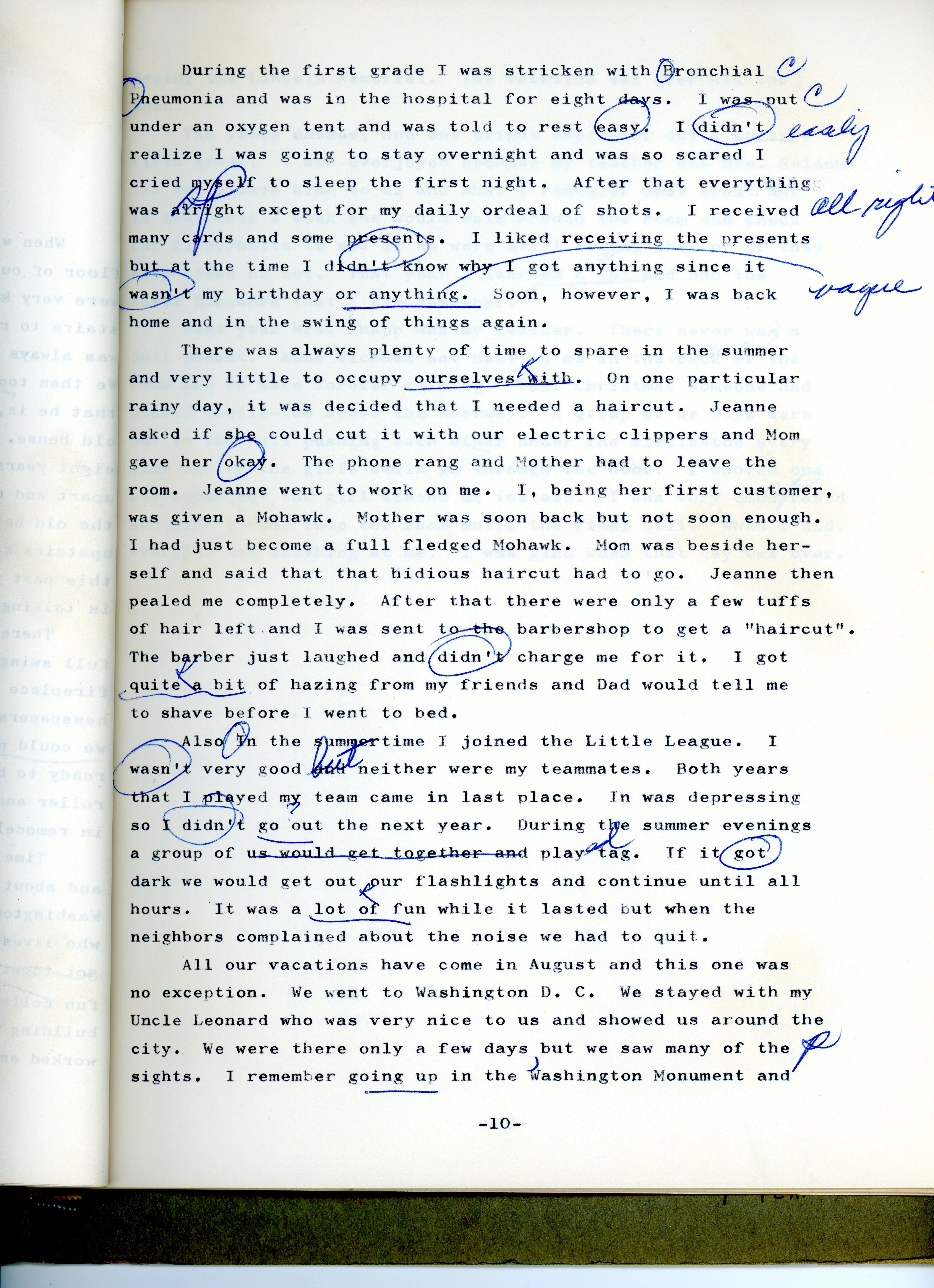
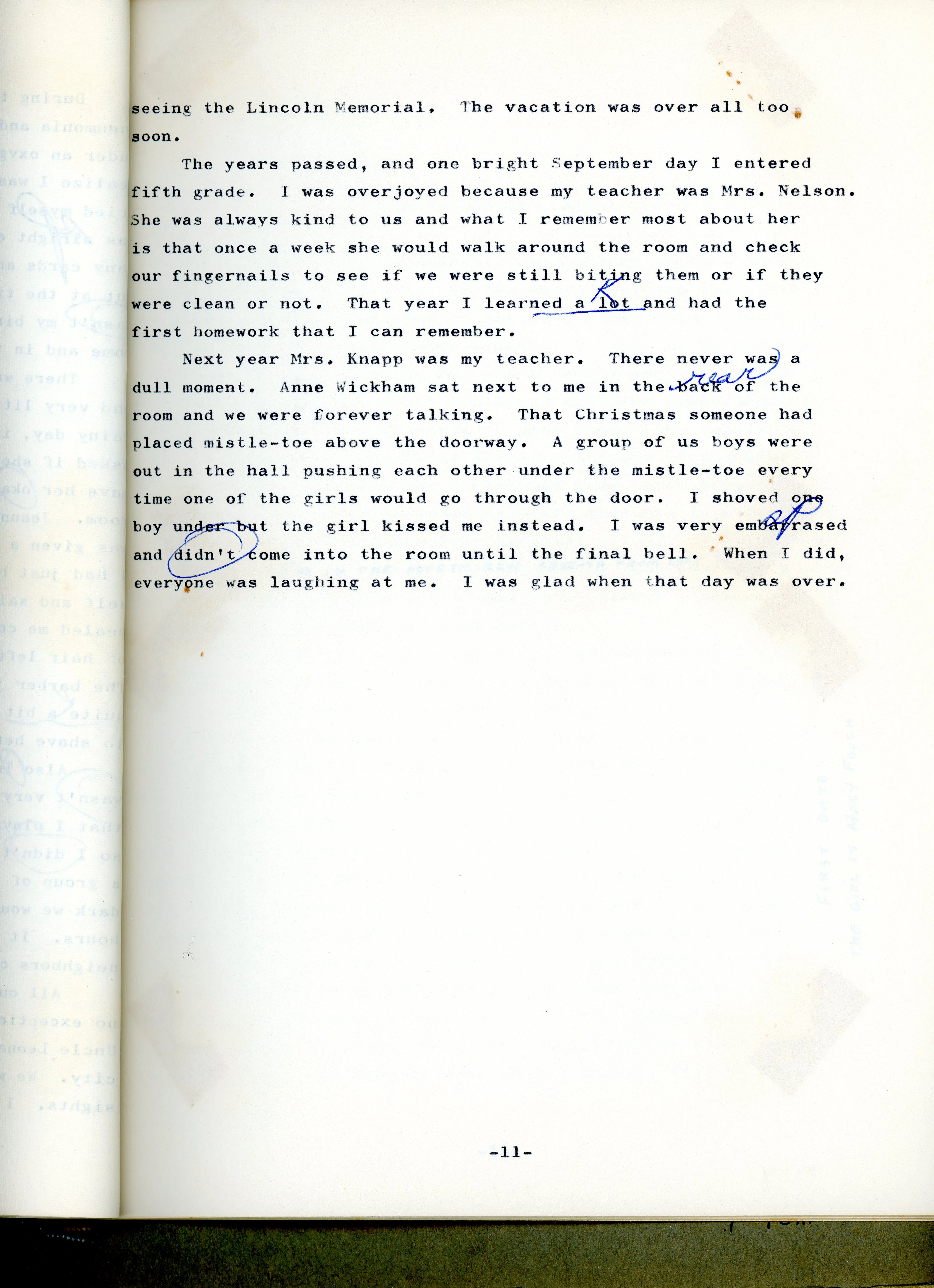
III. Second Stage (pp. 9–12) — the Marietta house at 651 Sixth Street (an old house Will Eesley the architect bought and spent eight years remodeling around the family), Washington School kindergarten, Bill Ferguson the next-door neighbor and the four-or-five go-karts they built and raced down the hill, Little League, the bald head Anne shaved him into, fifth-and-sixth-grade teachers, the time the girl kissed him under the mistletoe in front of everyone in the hallway and he was very embarrassed.
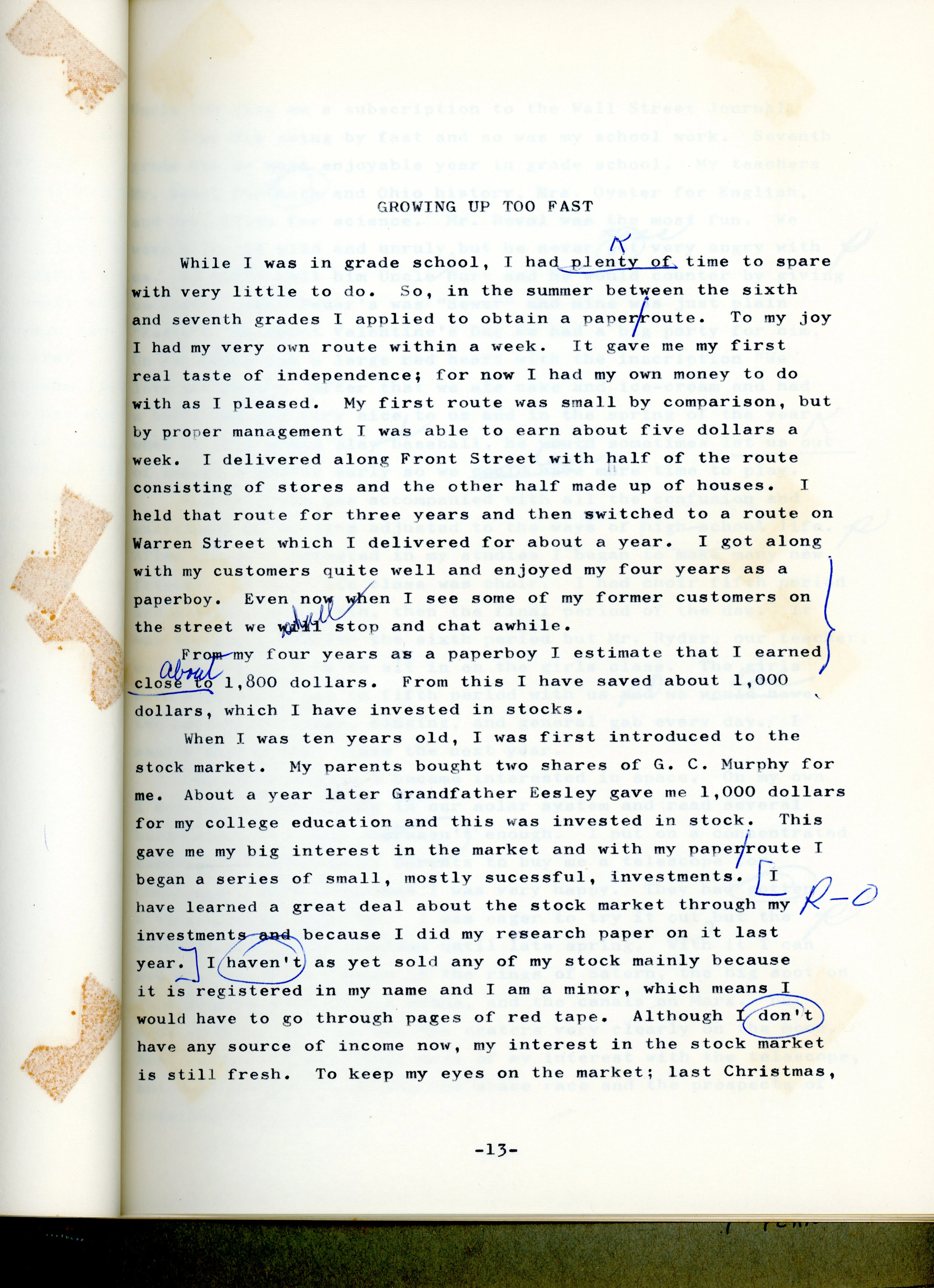
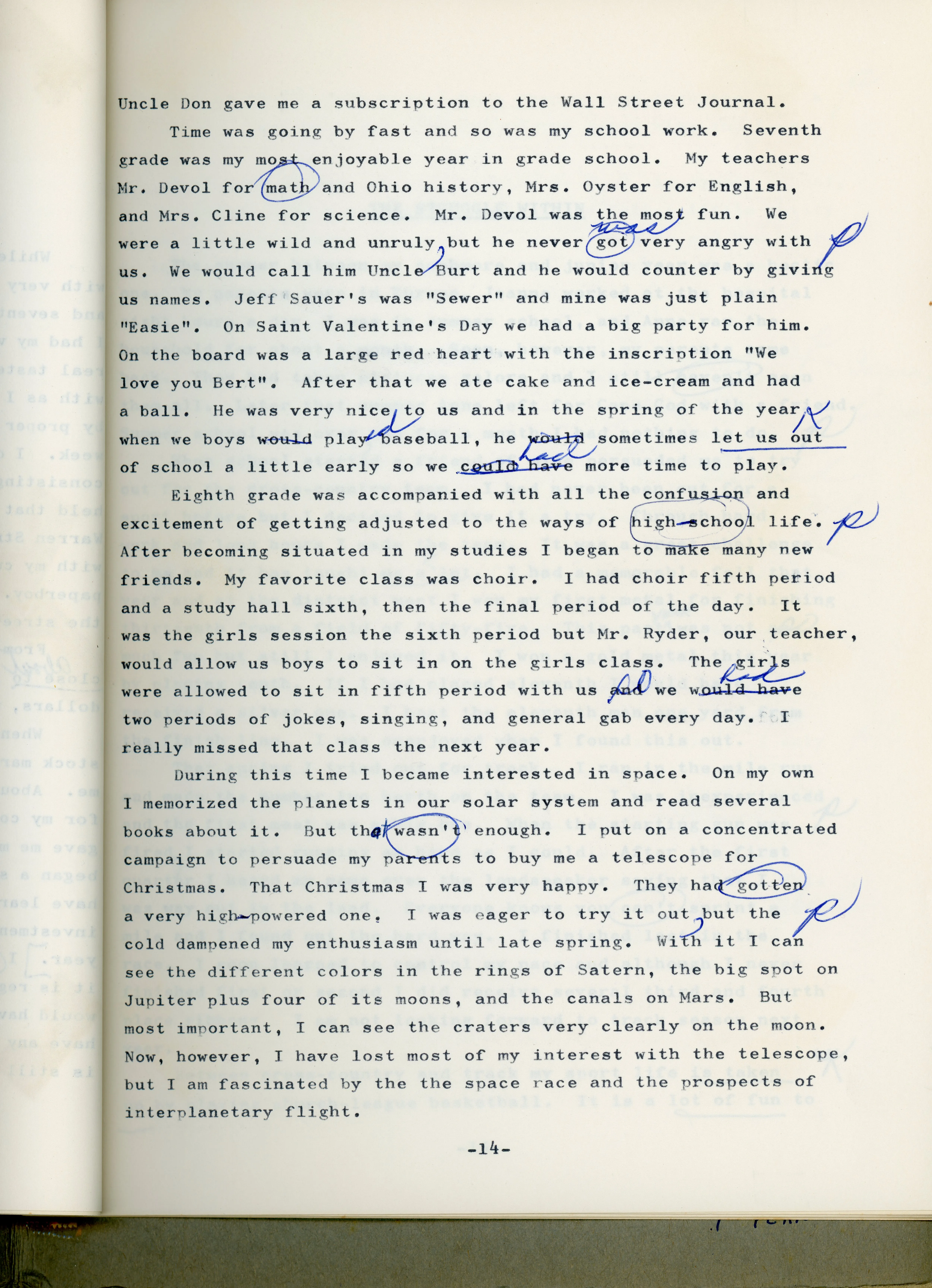
IV. Growing Up Too Fast (pp. 13–14) — the paper route Charlie ran for four years (Front Street, then Warren Street, about $1,800 earned), his early stock-market interest (Grandpa Eesley gave him $1,000 to invest; Uncle Don gave him a Wall Street Journal subscription), the telescope his parents bought him for Christmas, the rings of Saturn and the big spot on Jupiter and the canals on Mars.
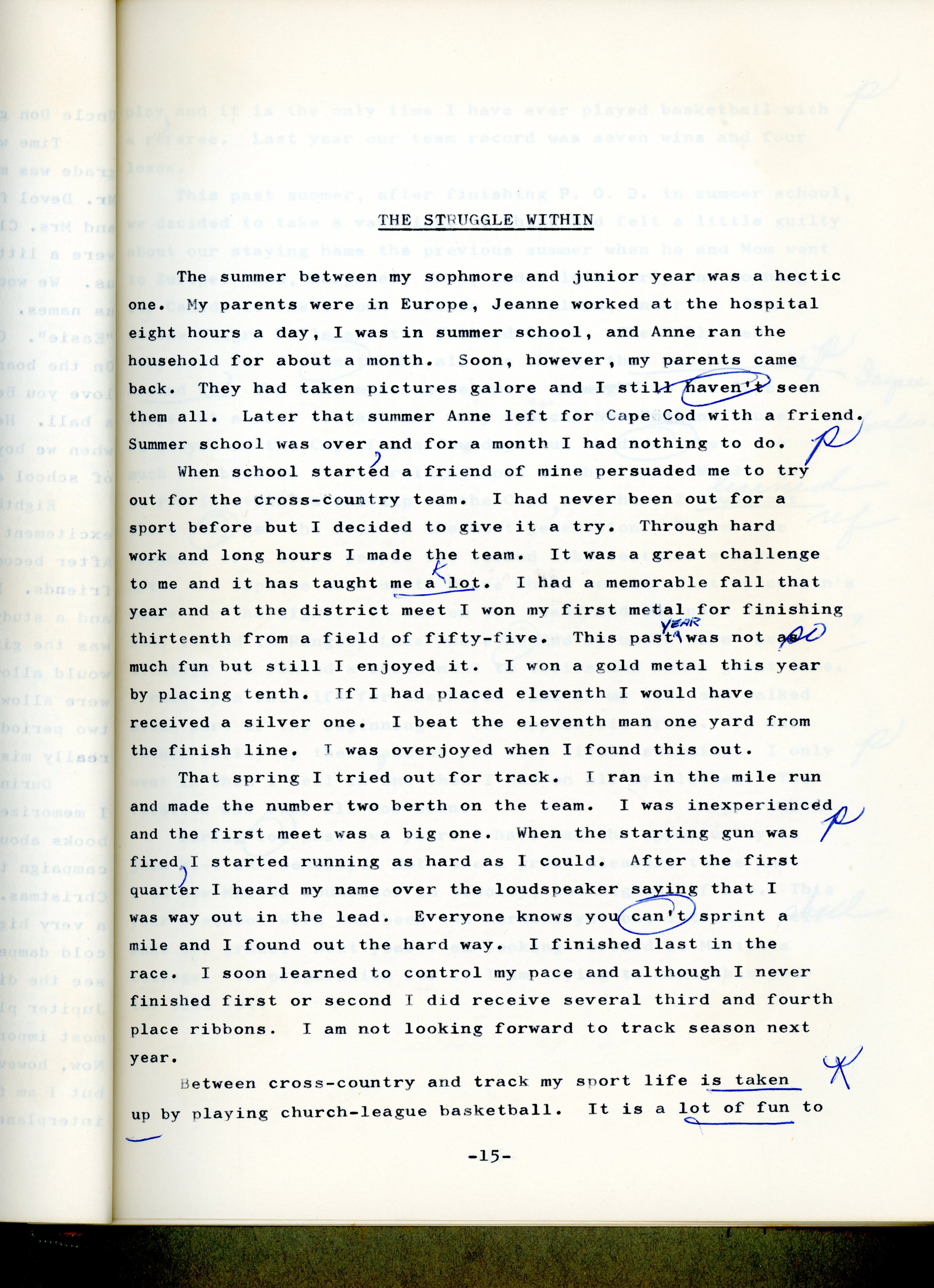
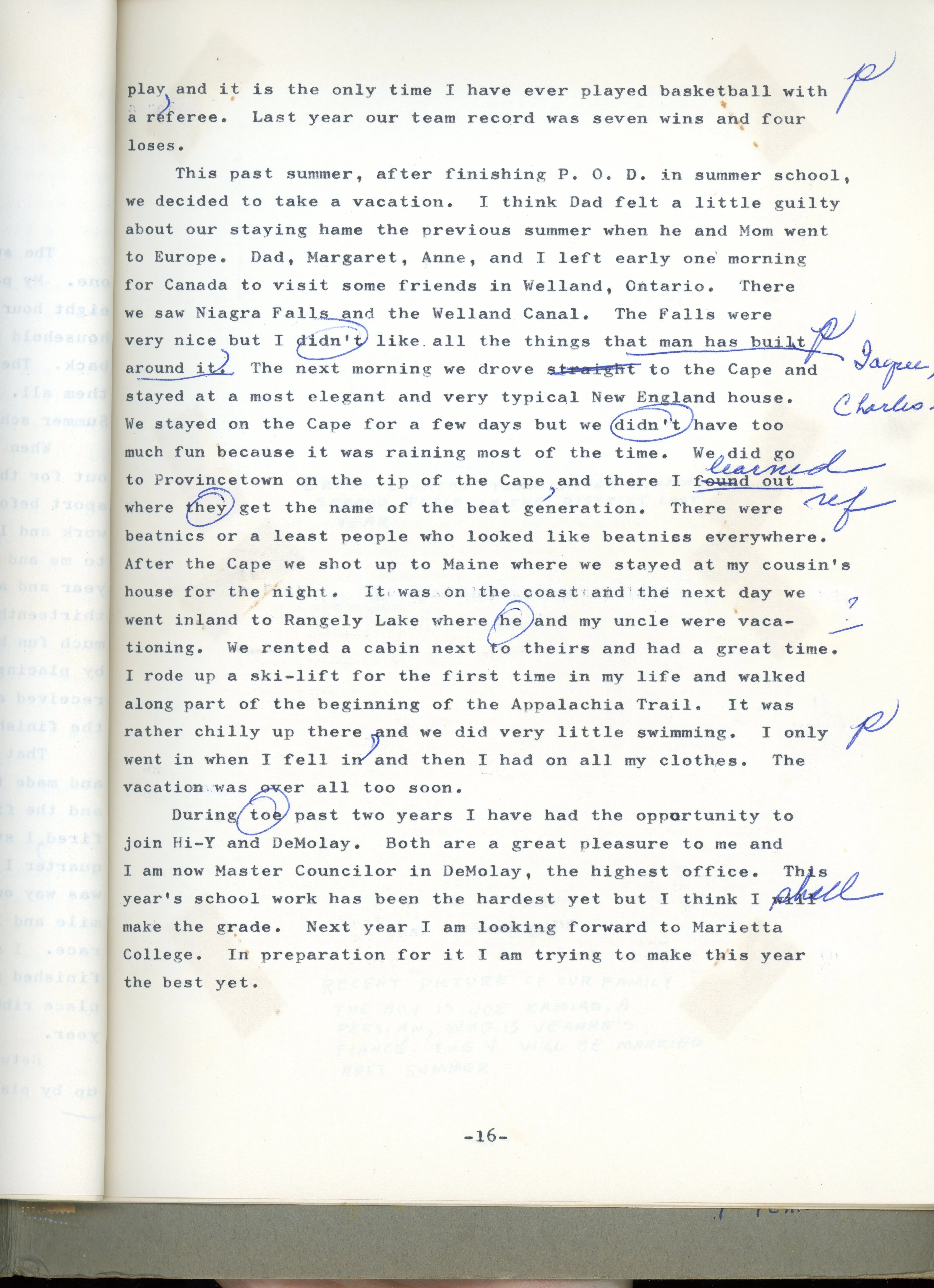
V. The Struggle Within (pp. 15–17) — running cross-country (district silver medal junior year; gold metal senior year for finishing thirteenth out of fifty-five), the mile run that he led for the first quarter and then crashed and burned because “everyone knows you can’t sprint a mile,” the church-league basketball games, the family driving trip the summer after his junior year through Niagara Falls and Welland, Ontario, and on to Cape Cod and Maine, DeMolay (he is “Master Councilor” — the highest office), Hi-Y, his looking forward to Marietta College for accounting.
Each chapter is short and direct — the prose of a smart, dry, slightly cocky seventeen-year-old who has read enough to know what an autobiography is supposed to do but who keeps the voice steady-and-personal rather than performative.
A note on DeMolay and Hi-Y — the two organizations Chapter V names
Two organizations Charlie names in Chapter V deserve a brief gloss for readers reading this in a later century, because both were ubiquitous in 1960s American high-school life and largely gone by the 2000s.
DeMolay — formally the Order of DeMolay (now DeMolay International) — is a Masonic-affiliated fraternal organization for boys ages 12 to 21, founded in Kansas City, Missouri, in 1919 by Frank S. Land. It is sponsored by local Masonic lodges and is named for Jacques DeMolay, the last Grand Master of the Knights Templar, who was burned at the stake by King Philip IV of France in 1314 for refusing under torture to betray his brothers. The order teaches seven cardinal virtues — filial love, reverence for sacred things, courtesy, comradeship, fidelity, cleanness, and patriotism — through ritual ceremonies, elected leadership offices, and community service. A chapter’s elected officers include the Master Councilor (the presiding officer, equivalent to chapter president), followed by Senior Councilor, Junior Councilor, and others. Charlie writing in 1964–65 that he is “Master Councilor — the highest office” means he was the top elected officer of his Marietta DeMolay chapter as a senior. Notable American DeMolays of his generation and those nearby include Walt Disney, Bill Clinton, John Wayne, and Pete Rose.
Hi-Y was the YMCA’s high-school youth program — the name stood for “High School YMCA.” Organized 1889 in New England; by the 1950s and 1960s, Hi-Y clubs were in nearly every American high school. The program emphasized character, leadership, public speaking, and community service through Christian-tradition framing, with state-level “Youth and Government” programs that ran model legislatures in state capitols across the country. Hi-Y declined sharply after the 1970s as the YMCA shifted away from high-school-club programming; by the early 2000s most Hi-Y chapters had folded.
Together, the two activities locate Charlie squarely in the classic 1964–65 small-town serious-good-student-leader cohort — the Marietta DeMolay chapter sponsored by the local Masonic lodge, and the Marietta Hi-Y club sponsored by the local YMCA. The Methodist household at 651 Sixth Street, the cross-country team, the paper route, the stock-market investing, DeMolay, and Hi-Y all sit in the same world: a serious, civically-engaged American teenager of the early 1960s heading to college.
The opening of the Introduction — the McMaster family in Charlie’s voice
“Before I begin writing about me I should like to tell you about my whole family starting with Grandfather and Grandmother McMaster. Each was one of six children. Grandmother, Miss Alice Anderson, taught grade school for six years before she was married to Robert T. McMaster, a civil engineer for the Pittsburgh and Lake Erie Railroad. They were happily married for seventeen years. During this time they had two children, Don Anderson and Margaret Shaw. Grandfather died of heart trouble when he was fifty-three, so Grandmother was left with a son just entering college and a daughter, five years old. To support her family she started teaching again and didn’t stop until she was seventy. By this means she sent her children through Pennsylvania State University. Mother became a home economics teacher and Uncle Don became an electrical engineer. He is a bachelor and worked for American Telephone and Telegraph Company for thirty-eight years. He retired last year and spent the winter in Florida and is currently spending this winter in southern California. Grandmother died two years ago at the age of ninety. She had lived with us for about six years.”
The new biographical detail this surfaces: Don McMaster worked for AT&T for 38 years; Alice McMaster lived with the Eesley family for six years at the end of her life; the “Margaret Shaw” middle-name reading of Peggy McMaster Eesley (instead of the “Margaret Jane” the family otherwise used).
The Eesley family in Charlie’s voice
“My grandfather, Charles Leonard Eesley, was one of ten children. He was born and reared in Canada where his father was a flour miller. Because his family moved often he only attended school through the fourth grade. When he was nine years old he worked as an elevator boy in a department store. Later, after holding a variety of odd jobs he worked for his older brother, Alfred, in a mill.
Grandmother, Miss Lilly Chenoweth, was one of four children. Her father was a prosperous farmer who was highly respected in the community. She studied music at Ohio State University when the campus was barely more than a cornfield…“
New biographical detail: Charles Leonard Eesley only had a 4th-grade education (the family moved too often); he worked as an elevator boy at age 9; he worked for his older brother Alfred “Alf” Eesley in a mill before going independent; Lilly Chenoweth studied music at Ohio State University when the campus was “barely more than a cornfield.”
Charles Leonard’s eight children — Charlie’s order
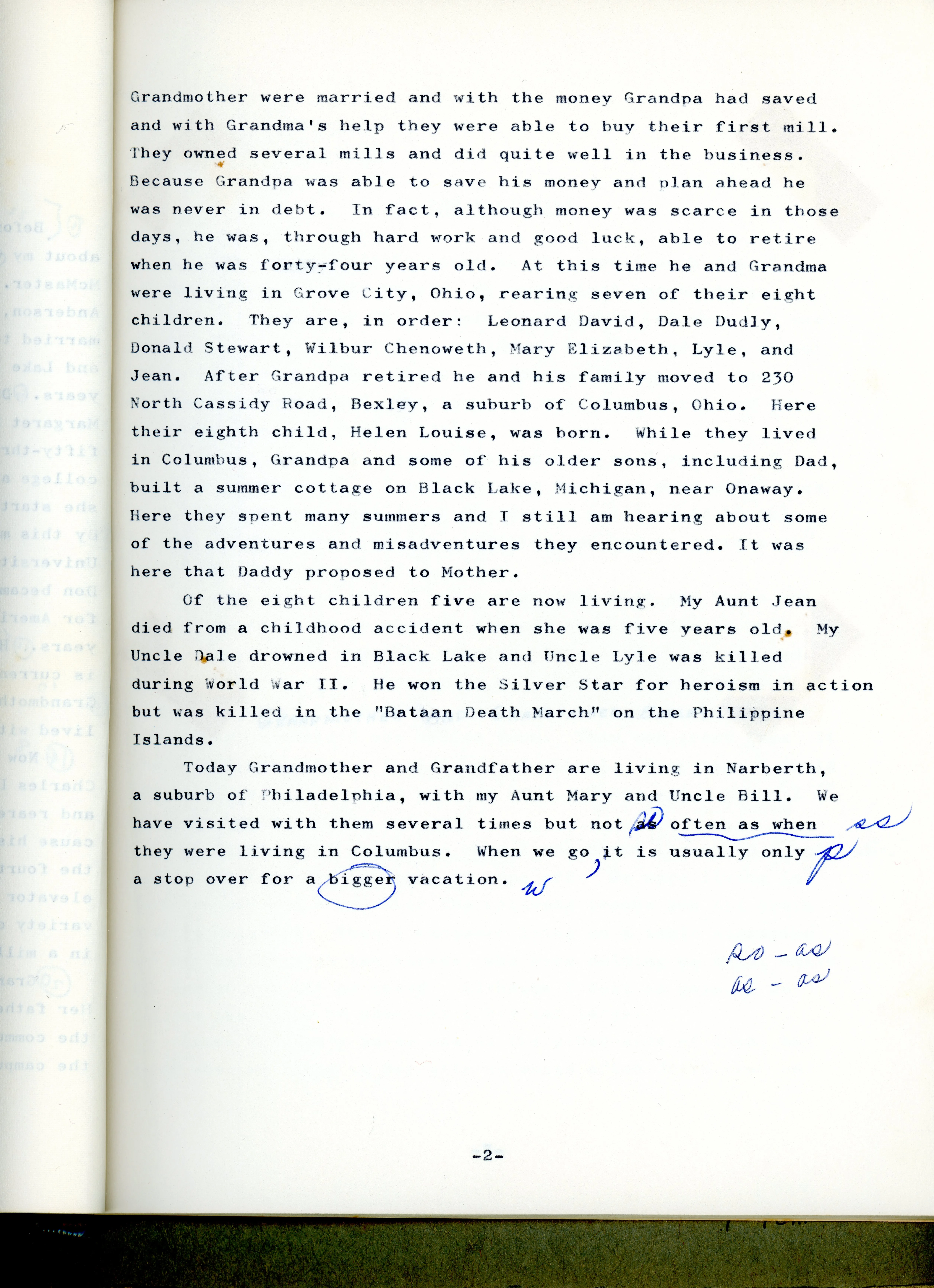
“At this time he and Grandma were living in Grove City, Ohio, rearing seven of their eight children. They are, in order: Leonard David, Dale Dudly, Donald Stewart, Wilbur Chenoweth, Mary Elizabeth, Lyle, and Jean. After Grandpa retired he and his family moved to 230 North Cassidy Road, Bexley, a suburb of Columbus, Ohio. Here their eighth child, Helen Louise, was born…”
Charlie’s birth-order list of the eight children: Leonard David, Dale Dudly (Charlie’s spelling), Donald Stewart, Wilbur Chenoweth (Will, Charlie’s father), Mary Elizabeth (Mary Bean), Lyle, Jean, and Helen Louise the youngest (born after the Bexley move). The Bexley address — 230 North Cassidy Road — is documented here for the first time in the archive.
And the deaths:
“My Aunt Jean died from a childhood accident when she was five years old, my Uncle Dale drowned in Black Lake and Uncle Lyle was killed during World War II. He won the Silver Star for heroism in action but was killed in the ‘Bataan Death March’ on the Philippine Islands.”
Charlie says Lyle was killed in the Bataan Death March specifically. This archive’s Lyle page has him in the Cabanatuan POW camp; the death-march framing may be the family memory of the broader campaign — both readings appear in mid-20th-century American Pacific-war memory. Worth a side-by-side note on Lyle’s page.
On the Marietta house — 651 Sixth Street
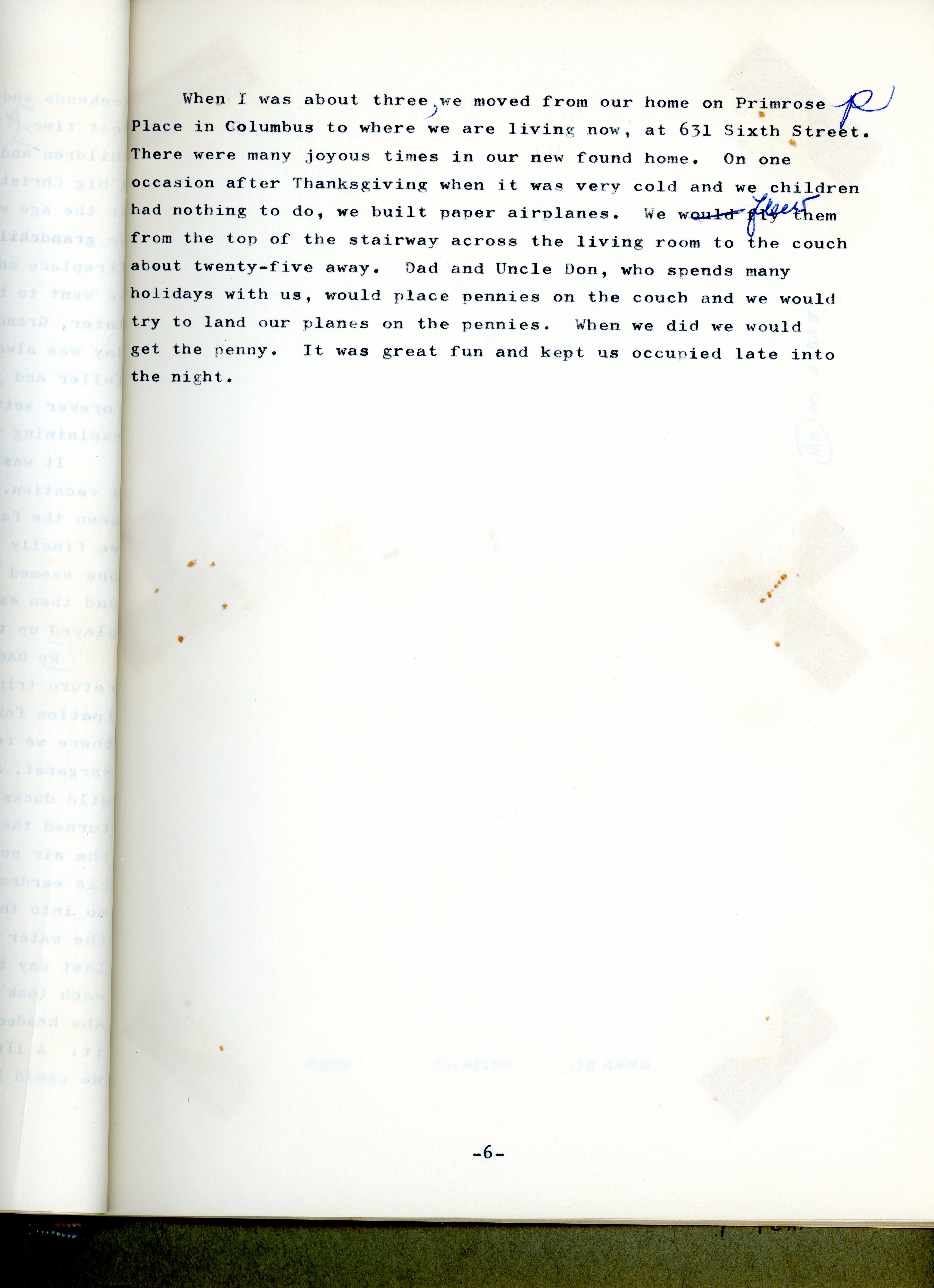
“When I was about three, we moved from our home on Primrose Place in Columbus to where we are living now, at 651 Sixth Street.”
The Marietta address: 651 Sixth Street — not the “Seventh Street house” the archive currently lists on Peggy’s page. Either the family moved between Sixth and Seventh at some point after Charlie graduated, or earlier archive sources mis-transcribed the street. Reconciliation queued.
Will Eesley the architect then spent eight years renovating the house around the family. Charlie’s dry observation: “The remodeling process has just finished this past year with the completion of the playroom. Now Dad is talking about moving.”
On being born
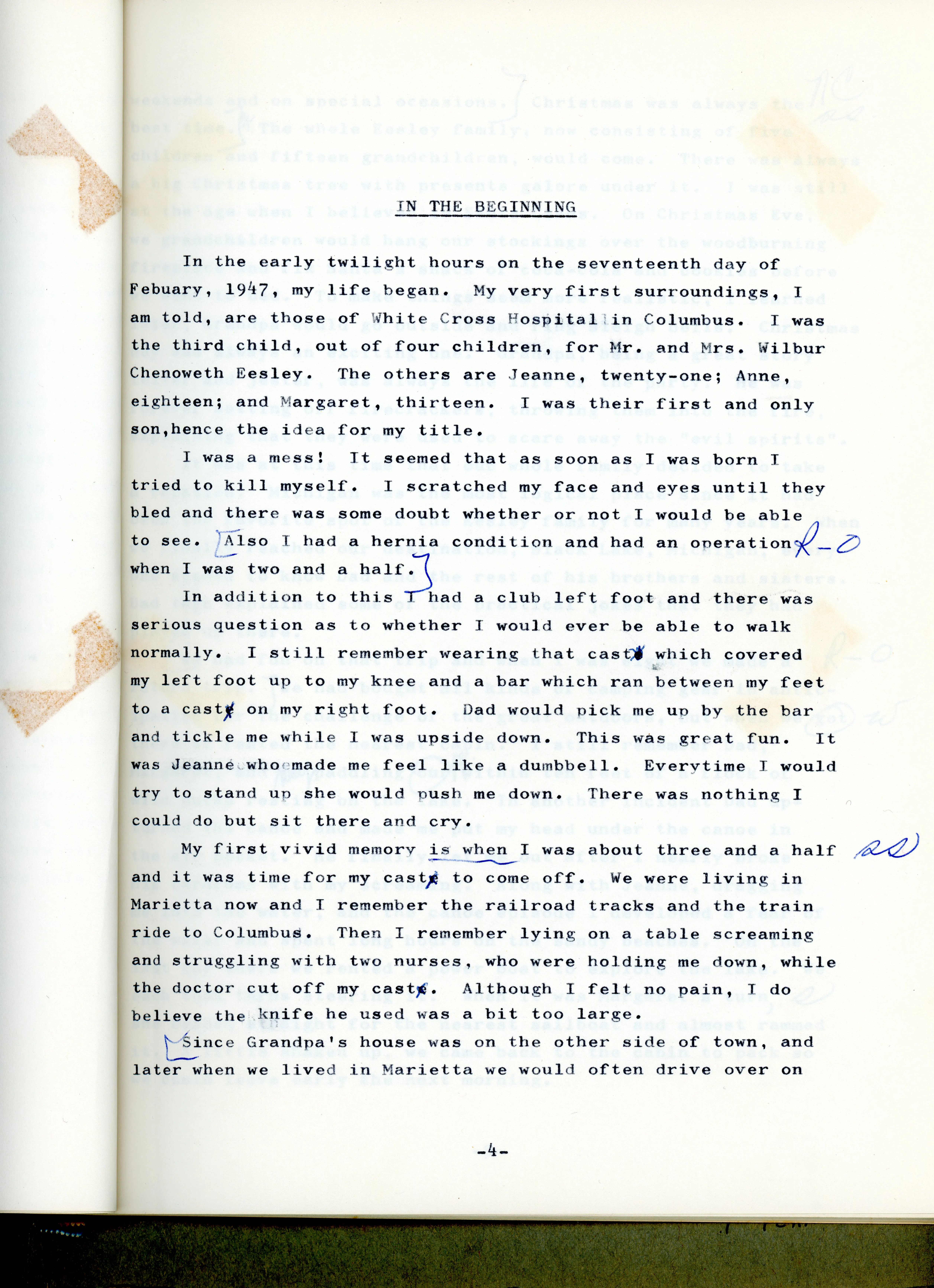
“In the early twilight hours on the seventeenth day of February, 1947, my life began. My very first surroundings, I am told, are those of White Cross Hospital in Columbus. I was the third child, out of four children, for Mr. and Mrs. Wilbur Chenoweth Eesley. The others are Jeanne, twenty-one; Anne, eighteen; and Margaret, thirteen. I was their first and only son, hence the idea for my title.
I was a mess! It seemed that as soon as I was born I tried to kill myself. I scratched my face and eyes until they bled and there was some doubt whether or not I would be able to see. Also I had a hernia condition and had an operation when I was two and a half.
In addition to this I had a club left foot and there was serious question as to whether I would ever be able to walk normally. I still remember wearing that cast which covered my left foot up to my knee and a bar which ran between my feet to a cast on my right foot. Dad would pick me up by the bar and tickle me while I was upside down. This was great fun. It was Jeanne who made me feel like a dumbbell.“
The 17 February 1947 birth at White Cross Hospital in Columbus, the club foot and hernia and scratched-up face, the bar between his feet Will Eesley would pick him up by — all surfacing for the first time in the archive. The line “It was Jeanne who made me feel like a dumbbell” is a small piece of the dry humor that will run through Charlie’s adult voice.
On Christmas at the Bexley grandparents’
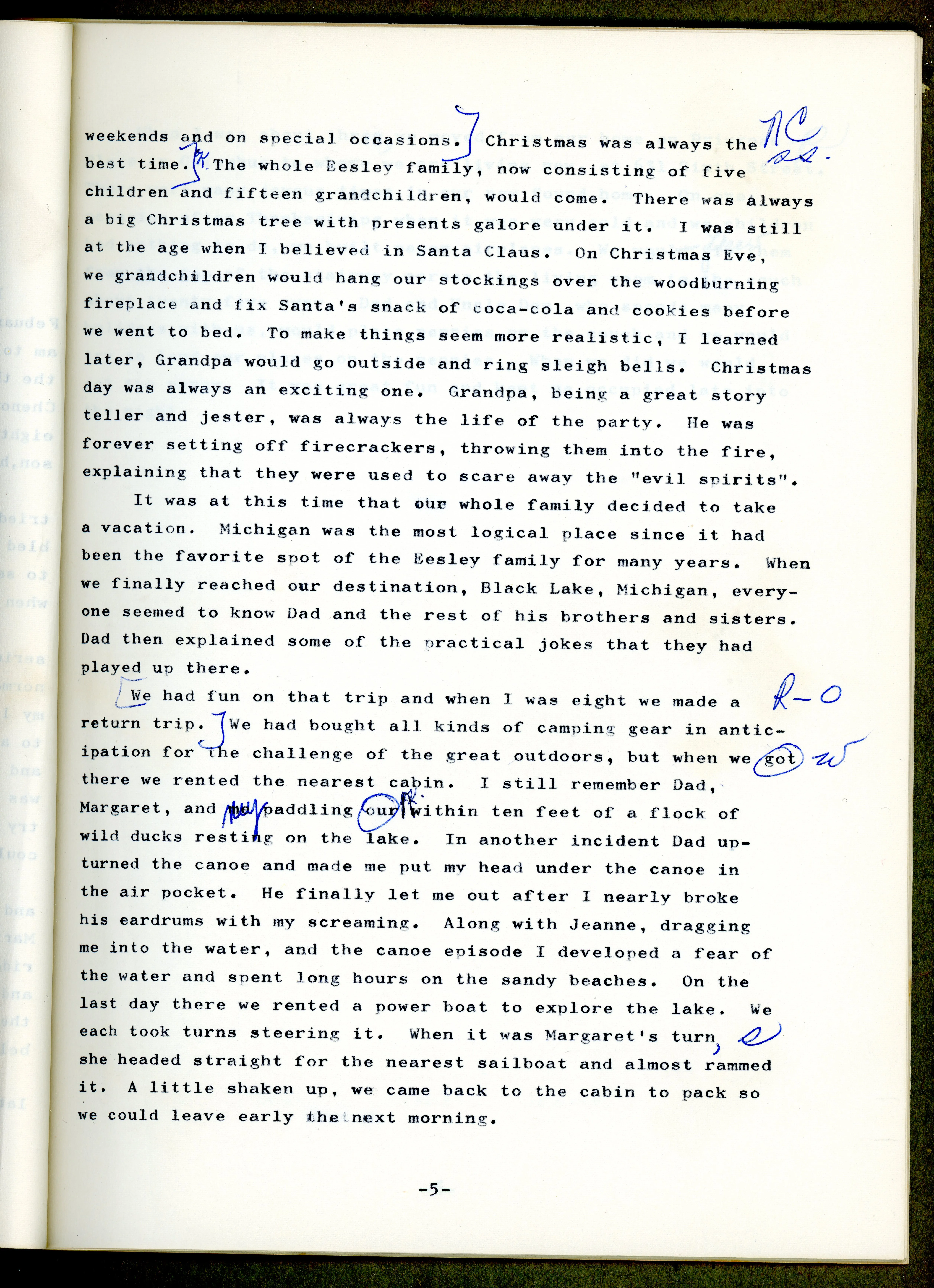
“Christmas was always the best time. The whole Eesley family, now consisting of five children and fifteen grandchildren, would come. There was always a big Christmas tree with presents galore under it. I was still at the age when I believed in Santa Claus. On Christmas Eve, we grandchildren would hang our stockings over the woodburning fireplace and fix Santa’s snack of coca-cola and cookies before we went to bed. To make things seem more realistic, I learned later, Grandpa would go outside and ring sleigh bells. Christmas day was always an exciting one. Grandpa, being a great story teller and jester, was always the life of the party. He was forever setting off firecrackers, throwing them into the fire, explaining that they were used to scare away the ‘evil spirits.’”
Charles Leonard ringing sleigh bells outside on Christmas Eve to keep his grandchildren believing in Santa, and throwing firecrackers into the fire to scare away “evil spirits.” Specific Eesley-grandfather childhood-Christmas detail that the archive didn’t have until this autobiography surfaced.
On the close calls at Black Lake
“I still remember Dad, Margaret, and my paddling out within ten feet of a flock of wild ducks resting on the lake. In another incident Dad upturned the canoe and made me put my head under the canoe in the air pocket. He finally let me out after I nearly broke his eardrums with my screaming. Along with Jeanne, dragging me into the water, and the canoe episode I developed a fear of the water and spent long hours on the sandy beaches. On the last day there we rented a power boat to explore the lake. We each took turns steering it. When it was Margaret’s turn she headed straight for the nearest sailboat and almost rammed it.”
Will Eesley demonstrating air-pocket survival under an overturned canoe with his eight-year-old son. Jeanne giving him a lifelong fear of water. Maggie at four nearly ramming a sailboat. The Black Lake summer cottage — the one Dale Eesley drowned at, the one Charles Leonard built with his older sons — as the venue of Charlie’s near-traumatic childhood Michigan vacations.
On meeting the world through paperboying and the stock market
“While I was in grade school, I had plenty of time to spare with very little to do. So, in the summer between the sixth and seventh grades I applied to obtain a paper route. To my joy I had my very own route within a week. It gave me my first real taste of independence, for now I had my own money to do with as I pleased. My first route was small by comparison, but by proper management I was able to earn about five dollars a week. I delivered along Front Street with half of the route consisting of stores and the other half made up of houses. I held that route for three years and then switched to a route on Warren Street which I delivered for about a year. I got along with my customers quite well and enjoyed my four years as a paperboy. Even now when I see some of my former customers on the street we will stop and chat awhile.
From my four years as a paperboy I estimate that I earned close to 1,800 dollars. From this I have saved about 1,000 dollars, which I have invested in stocks.
When I was ten years old, I was first introduced to the stock market. My parents bought two shares of G. C. Murphy for me. About a year later Grandfather Eesley gave me 1,000 dollars for my college education and this was invested in stock. This gave me my big interest in the market and with my paperroute I began a series of small, mostly successful, investments. I have learned a great deal about the stock market through my investments and because I did my research paper on it last year. I haven’t as yet sold any of my stock mainly because it is registered in my name and I am a minor, which means I would have to go through pages of red tape. Although I don’t have any source of income now, my interest in the stock market is still fresh. To keep my eyes on the market, last Christmas, Uncle Don gave me a subscription to the Wall Street Journal.“
The paperboy / stock-market thread is the one Charlie’s son Chuck would later eulogize in 2015: “his wisdom, far-sightedness and patience in investing… inspired him to become a stockbroker, funded my grandparents’ travel in retirement, and paid for a large part of my education.” The interest in the market — visible at seventeen and explicit at the line “my interest in the stock market is still fresh” — is the through-line from this autobiography to the stockbroker career he would have for the next four decades and the Marietta-dollars-compounding-into-a-Stanford-education Chuck would later name as his half of the arc.
On the page that ought to have been there — the family photographs (now found)
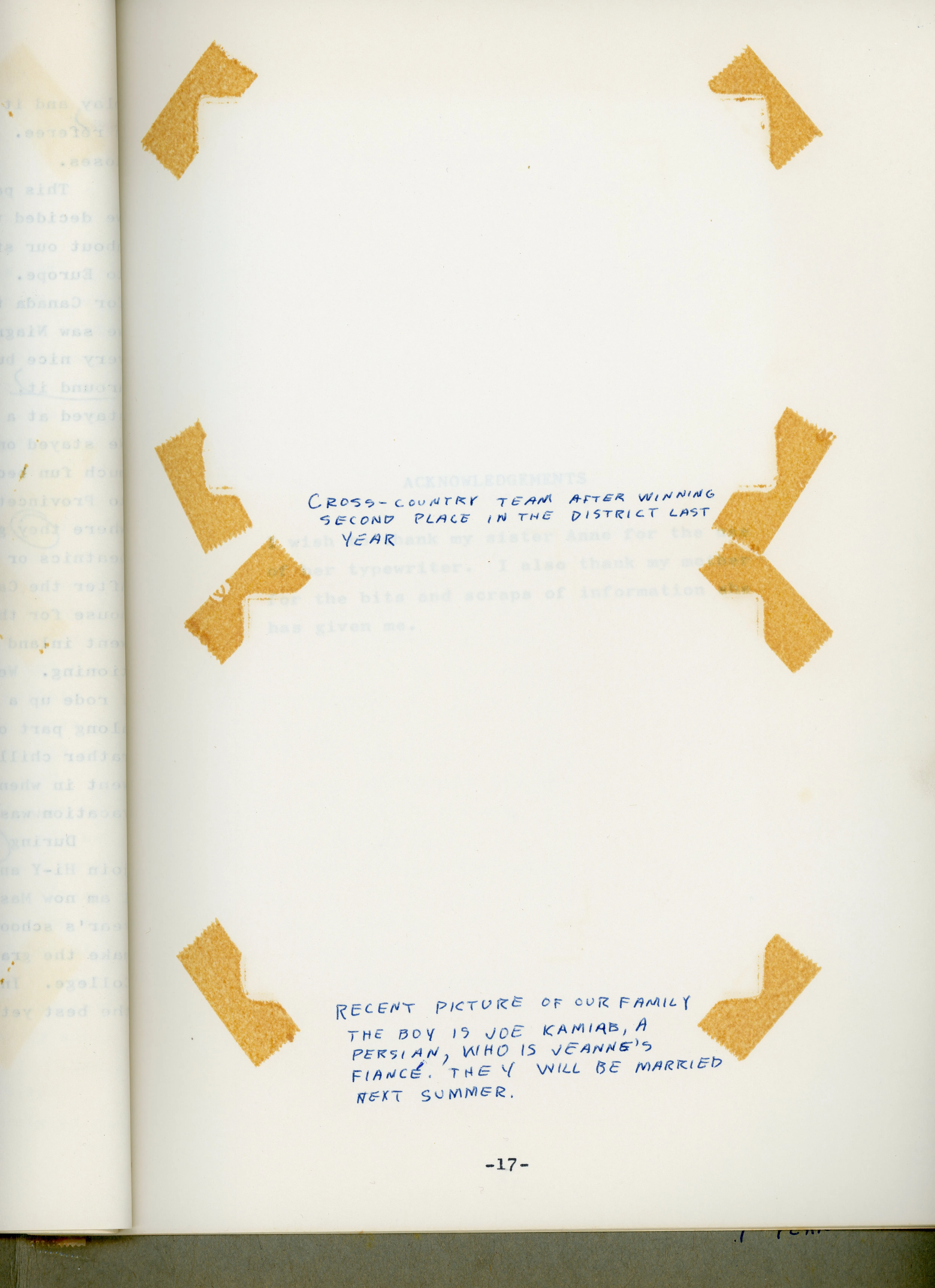
Page 17 — the last page of the body — is handwritten by Charlie, not typed. It carries two captions for photographs that were once attached to the bound autobiography but were not with the document when Chuck scanned it in December 2015:
“Cross-country team after winning second place in the district last year”
“Recent picture of our family. The boy is Joe Kamiab, a Persian, who is Jeanne’s fiancé. They will be married next summer.”
Both photographs have since been located in the family archive and added to this site in June 2026:
The cross-country team photograph
The Marietta High School cross country team, c. 1963–1965 — eight young men in matching long-sleeve quarter-zip pullovers on the school grounds, with Charlie third from left (blonde buzz cut, confirmed by Chuck June 2026). The two teammates at the center of the team (fourth and fifth from the left) hold a small plaque between them. Charlie’s handwritten caption “Cross-country team after winning second place in the district last year” matches Chapter V’s narrative of “district silver medal junior year”: this is the silver-medal-winning team photograph he attached to his own autobiography. The plaque held at the center is the district silver-medal plaque.
The family-with-Joe-Kamiab portrait
The Will and Peggy Eesley family with Joe Kamiab, c. 1965 — the formal indoor portrait of Will and Peggy (seated, front) with their four children and Jeanne’s fiancé Joe in the back row, in the order Charlie, Anne, Maggie, Jeanne, Joe (left to right). This is the “Recent picture of our family. The boy is Joe Kamiab, a Persian, who is Jeanne’s fiancé. They will be married next summer.” photograph that was once bound into Charlie’s autobiography. The ‘next summer’ is June 1965, which fits the apparent ages of all four children and places the portrait at or near Jeanne and Joe’s wedding.
What the rediscovery does
The two photographs — the team Charlie ran for and the family he was about to see his eldest sister marry out of — were chosen by the seventeen-year-old Charlie himself as the two images he wanted to attach to his self-portrait. That choice is itself biographical: the team and the family, the running and the home, were the two things he wanted his autobiography to be illustrated by. Fifty-plus years later both photographs are back with the document they were originally bound to.
The autobiography’s date narrows from the page-17 caption: it had to be written before the June 1965 Kamiab wedding (“they will be married next summer”). The most plausible writing window is fall 1964 or spring 1965 — Charlie’s senior fall or spring at Marietta High School.
On the teacher’s reply
“Interesting reading, Charles!
I wish to talk with you concerning punctuation and run-on sentences.“
B-
The teacher’s reading was technically correct — Charlie’s sentences run long and his commas miss. But the prose is sustained, observant, dry, and personally honest about a club foot and a hernia and a near-blinding and a near-drowning. The teacher’s B- and the file label Chuck applied fifty years later — “Stupid 12th Grade English teacher’s inadequate and shortsighted comments” — together form the autobiography’s editorial bookend. The teacher graded the punctuation; Charlie’s son, decades later, graded the teacher.
Why this document matters
The autobiography is the earliest sustained piece of Charlie’s writing in this archive by some margin. It’s three years earlier than the 13 December 1968 letter to Terrie (his earliest surviving letter to her, from his Marietta College senior year). It’s five years earlier than the Vietnam letters of 1969–71. It’s fifty years earlier than Chuck’s 2015 eulogy for him. Four layers of the same man: the seventeen-year-old high school senior; the twenty-one-year-old college senior writing to his girlfriend; the twenty-two-to-twenty-four-year-old infantryman in Vietnam; and the figure his son lifted up after his death in late 2015. They map onto each other.
The autobiography also establishes or corrects several archive-level facts:
- The Marietta house address: 651 Sixth Street (not Seventh, per Charlie’s 1965 description) — reconciliation needed.
- Charles Leonard Eesley’s life-trajectory: only a fourth-grade education, an elevator-boy job at nine, working for his brother Alfred in a mill, retiring at forty-four.
- Lilly Chenoweth Eesley studied music at Ohio State University when the campus was “barely more than a cornfield” — first time documented.
- The Bexley address: 230 North Cassidy Road — new to the archive.
- The two parental immigration / employment paths: Will the architect; Don the AT&T engineer (thirty-eight years).
- The family Christmas customs of the Charles Leonard Eesley household at Bexley (sleigh bells, firecrackers for the evil spirits).
- A new specific framing of Lyle’s WWII death — “killed in the Bataan Death March.” Reconciliation needed.
- Alice Anderson McMaster moved in with the Eesleys six years before her ~1963 death and lived with them through Charlie’s early adolescence.
Document held in the family archive. Scanned by Chuck Eesley December 2015. Pages 3, 7, 8, and 12 are not in the scan set — either lost from the bound original or not scanned. The handwritten captions on page 17 indicate two original photographs were attached to the autobiography that are no longer present.
Scans
People in this document
- Charles McMaster Eesley
- Wilbur 'Will' Eesley
- Margaret Jane 'Peggy' (McMaster) Eesley
- Jeanne Eesley Kamiab
- Anne Eesley
- Margaret "Maggie" Eesley
- Charles Leonard Eesley
- Lillie Dale (Chenoweth) Eesley
- Alice Gertrude (Anderson) McMaster
- Robert Thompson McMaster
- Donald Anderson 'Don' McMaster
- Lyle Eesley
- Dale Dudley Eesley
- Leonard David Eesley
- Donald Stuart Eesley
- Mary Elizabeth (Eesley) Bean
- Helen Louise (Eesley) Burnes