Margaret Jane 'Peggy' (McMaster) Eesley
also known as Peggy; Peggy Jane; Grandma Peggy
b. 1914-09-10, Coraopolis, Pennsylvania
d. 2007-05-21, Harmar Place, Marietta, Ohio
Coraopolis, Bethel, Penn State
Peggy was born September 10, 1914 in Coraopolis, Pennsylvania — the small borough on the Ohio River just northwest of Pittsburgh — to Robert Thompson McMaster (civil engineer) and Alice Anderson McMaster (schoolteacher). She graduated from Bethel High School (Bethel, Pennsylvania) in 1930 — finishing high school not quite sixteen — and from Pennsylvania State University in 1936, having gone up at seventeen and joined Phi Mu Sorority there. The line about the Penn State years that survived into the family memory: “I never lacked for a dance partner.” It is the only surviving sentence from before Will, and it sits in the record the way her dry humor later would — one phrase that says exactly the kind of person she had been.
The Home Ec classroom
She taught Home Economics in Butler, Pennsylvania in the years after Penn State, and again at Marietta High School in the early 1960s — her teaching career bracketed her years raising the four children, the way a generation of educated American women’s careers were often bracketed in mid-century. Home Economics was, in the secondary-school curriculum of the time, the practical-craft discipline that taught budgeting, cooking, household running, and the daily-life skills that schools then thought worth teaching to the generation about to set up its own households. (The continuity with the investing she is best remembered for in this archive is exact: a household economist on the home side, a portfolio strategist on the capital side — one practice, two scales.)
The three Marietta addresses, marriage, the children
Peggy McMaster Eesley married Will on June 20, 1942 and raised four children with him in Columbus and then Marietta, across three successive Marietta addresses spanning sixty-five years:
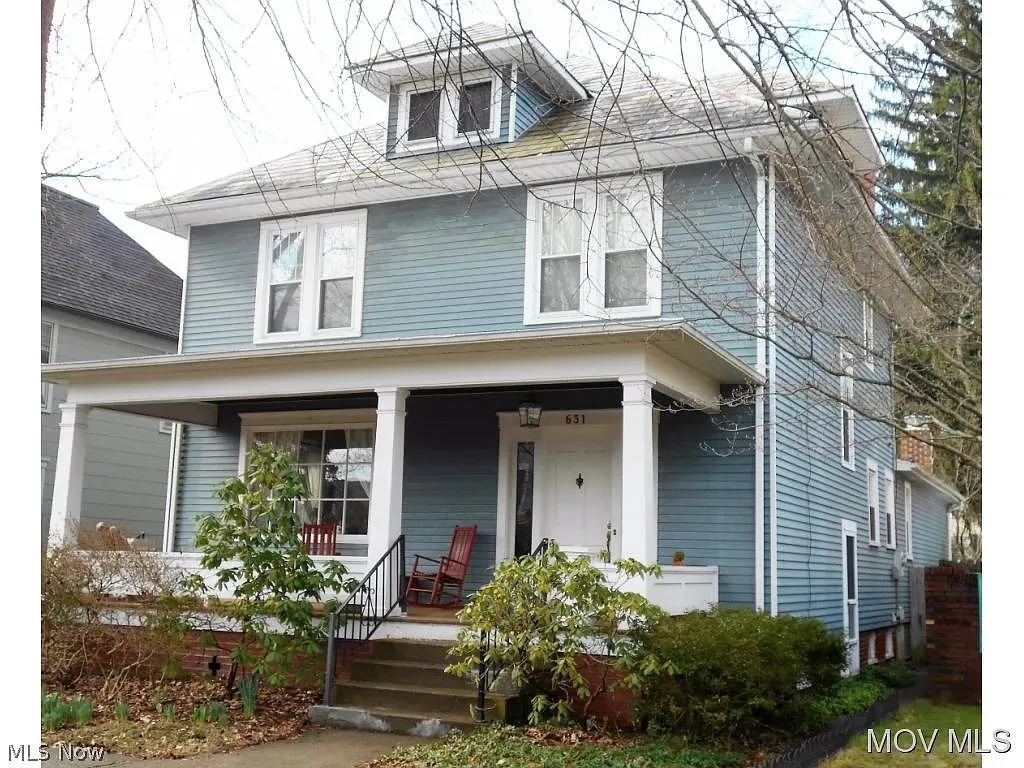
- 651 Sixth Street — the Marietta family house from about 1950 (when Charlie was three) through the 1960s. The old house Will the architect spent eight years remodeling around the family, with Maggie’s bedroom in the former bathroom and Jeanne and Anne’s in the former upstairs kitchen. The house Charlie grew up in and wrote his 1964–1965 12th-grade autobiography at — the autobiography that documents the address explicitly.
- Highland Ridge Road — the next house, designed and built by Will the architect himself, with the orchard he planted and the small red bridge he built over the pond out back. Will and Peggy moved here from Sixth Street; Charlie would later raise his own son Chuck in this same house.
- 424 N 7th Street — Peggy’s later-life house, where she lived as a widow after Will’s June 1986 death. This is the “Grandma Peggy’s house on 7th Street” of Chuck’s childhood memory — the house he went to every weekday afternoon after school through his elementary and high-school years, the house where Peggy played bridge and ran the household into her nineties. The Peggy 2007 obituary lists her as “formerly of 7th Street, Marietta” — her last address before Harmar Place. This is the house Chuck’s eulogy for his father names as one of “the places that should hold his name longest.”
The three-stage progression — 651 Sixth Street → Highland Ridge → 424 N 7th Street — runs the family across sixty years of Marietta life.
She is the figure who turns out to have done the most to shape the next two generations of Eesley life, not from any public role but through the sustained, patient practice of long-term investing. Chuck’s eulogy for his father puts it most simply:
“It was her wisdom, far-sightedness and patience in investing that inspired him to become a stockbroker, funded my grandparents’ travel in retirement, and paid for a large part of my education. Phone calls with dad always included an update of how the stock market was doing recently and a request that I use my education to make it go up again soon.”
Her dark, dry sense of humor went directly to her son Charlie, who passed a more diluted version to Chuck. “I failed to inherit the full dose of the wicked sense of humor my dad got from my grandmother,” Chuck said in the eulogy. “That’s why I had to become a professor where the bar for being funny is sufficiently low.”
The grandmother Chuck knew
The 424 N 7th Street house is also the house Chuck spent every weekday afternoon in through his childhood. He went there after school and stayed until his father got off work and the two of them drove home; one or two nights a week the three of them — Peggy, Charlie, Chuck — would stay for dinner there too. The “Grandma Peggy” of the next generation’s memory is the figure who set that table, week after week, year after year, across Chuck’s elementary through high-school years. By the 1980s Peggy had moved here from Highland Ridge, leaving the Highland Ridge house to Charlie and his family; the after-school routine ran between Charlie’s office and Grandma Peggy’s two-house Marietta circuit.
She played bridge in her later years, regularly and seriously — the after-Will, into-her-90s decades, when the McMaster patience-and-strategy side of her was running on cards instead of capital but on the same operating system.
Outside the bridge table she was an active member of the PEO (Philanthropic Educational Organization — UM chapter), the Betsey Mills Club, First Congregational United Church of Christ (where she served as director of Christian education and was a member of the Dana Philathia Class), and the Junior Reading Club that she and Will had both been part of. The obituary’s own closing characterization — “remembered for her optimistic outlook and ready smile” — is the line that runs underneath all of it.
The end
Toward the end she moved out of the 424 N 7th Street house and into Harmar Place, the retirement community in Marietta. Charlie went to see her there every day after work, sitting with her through dinner. The eulogy treats this as the quiet evidence of who they had been to each other — the daily routine of an only son and an aging mother, kept up across the last stretch.
She died May 21, 2007 at 11:30 p.m. at Harmar Place, age 92. She was preceded in death by her husband Wilbur “Will” Chenoweth Eesley (d. June 2, 1986; they had been married forty-four years) and by her brother Don McMaster. She was survived by her four children — Jeanne Eesley Kamiab and Joe of Cleveland, Anne Eesley of Spring Lakes, Michigan, Charles Eesley and Diana of Lowell, and Margaret “Maggie” Eesley of Forrest, Virginia — her four grandchildren (Stephanie Kamiab Mullin, Chuck Eesley, Amina Rubin, and Nooreen Rubin), and a great-grandson, Cameron Mullin.
A memorial service was held at First Congregational Church in Marietta on the Friday after her death, with the Rev. Linda Steelman officiating — the same church where she had taught Christian education for years, and where Charlie would later be eulogized by his own son in late 2015.
She did not live to see Chuck finish the MIT PhD (2009) or take the Stanford appointment in the years after. But the four-generation chain her investing had set running — Marietta dollars compounding for half a century into a Stanford education and onto a Stanford faculty appointment — was already in motion. She had done her half of the arc by the time she went.
The McMaster and Anderson lines on Peggy’s side are now seeded in the archive: Robert Thompson McMaster the civil engineer, Alice Anderson McMaster the Clifton-School teacher, Gilbert Clement and Margaret Thompson McMaster (Margaret photographed in 1866 holding the twin sons Erasmus Darwin and Robert T.), Rev. Abraham Ramsey Anderson the Presbyterian minister and Nancy Jane Shaw, plus Peggy’s brother Donald Anderson McMaster, who ran the northeastern U.S. communications power grid in WWII. The deepest documented McMaster ancestor here is Gilbert Clement (b. 1833); on the Chenoweth side it reaches one generation further to John K. Timmons (1806–1899). All eleven new entries draw on Aunt Maggie Eesley’s Four Generations archive.
Photographs in the archive
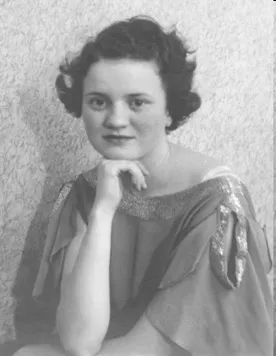
- The portrait at the head of this page — the formal studio frame from around the time of her June 1942 marriage to Will. Sequined off-shoulder dress, the classic late-1930s / early-1940s American studio style; her gaze directly at the camera, the chin resting on her hand. The closest the archive holds to her young-adult face.
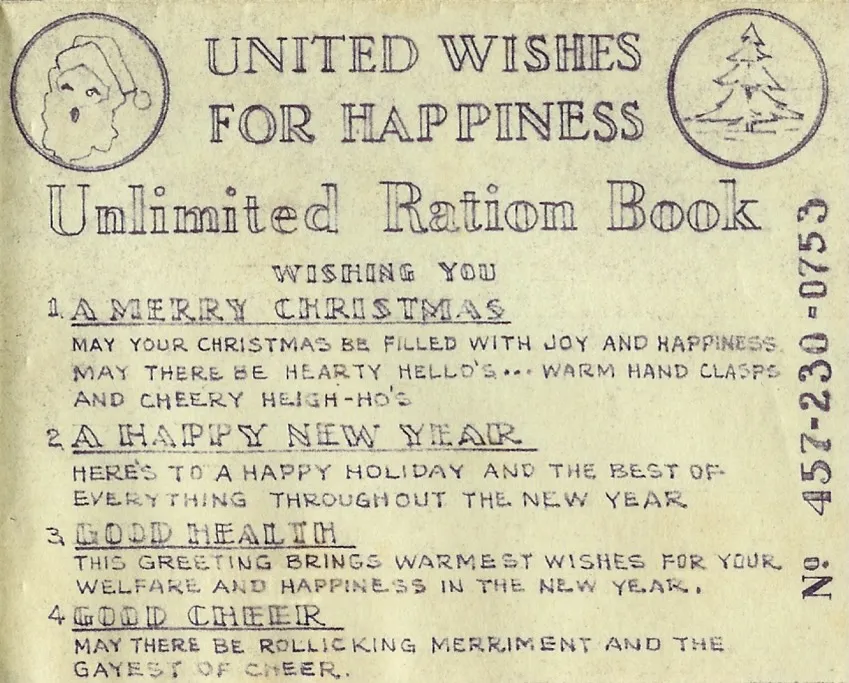
- The 1942 ration-book Christmas card she co-signed with Will (“Peggy and Will Eesley, 457 Eastmoor Blvd, 25 December 1942”) — the second Christmas of the war, their first as a married couple.
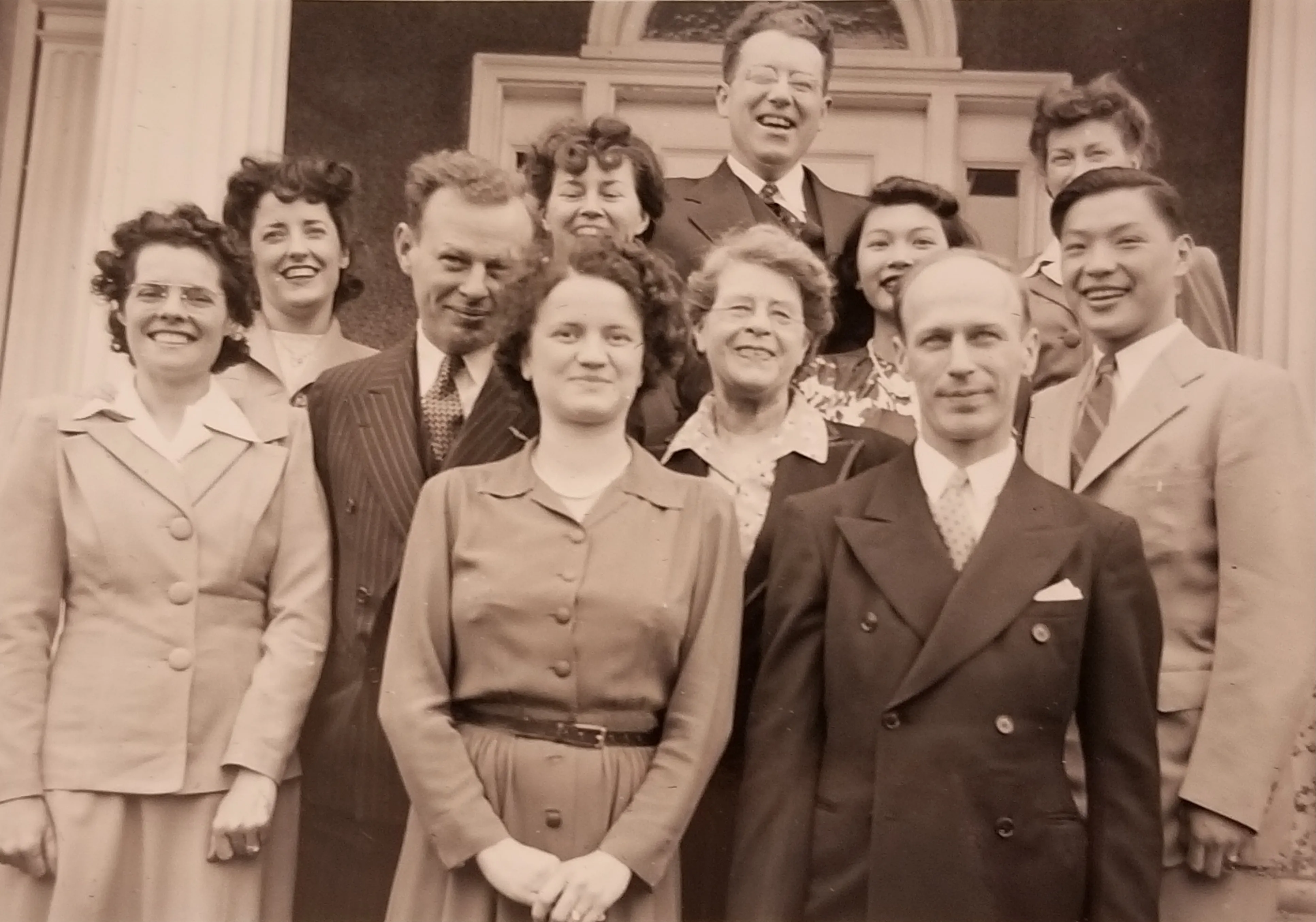
- The late-1940s Eesley family group portrait at Charles and Lillie Dale’s home in Bexley — Peggy in the front row beside Will, with Mary Bean behind her.
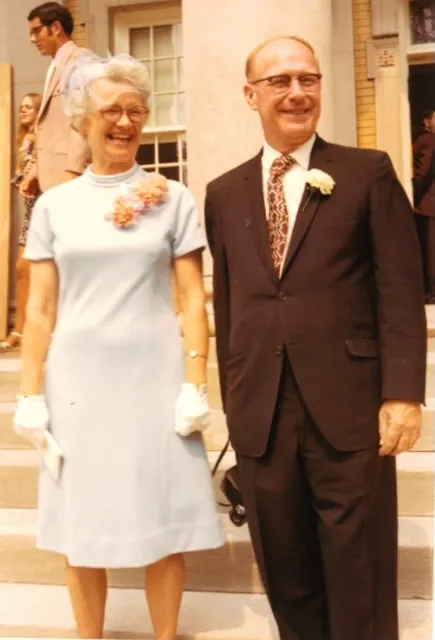
- The Charlie and Terrie wedding photograph (early 1970s) — Peggy in a pale-blue dress with a pink-and-yellow corsage, Will in a brown suit with a white boutonnière; both mid-laugh, parents of the groom.
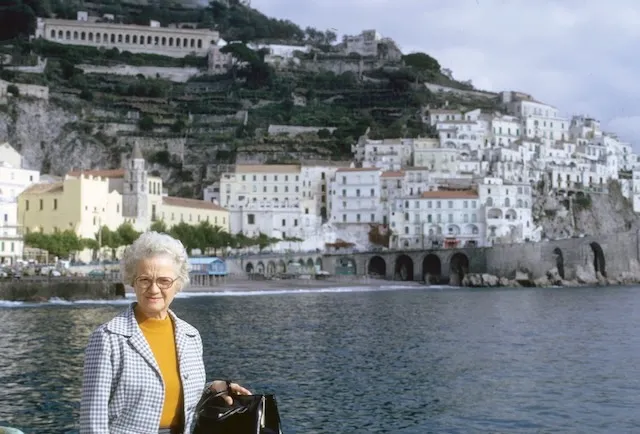
- The “Peggy on the Continent” retirement-travel pair — Paris and the Amalfi Coast in the same album, the visible end of the line of investing the eulogy named.
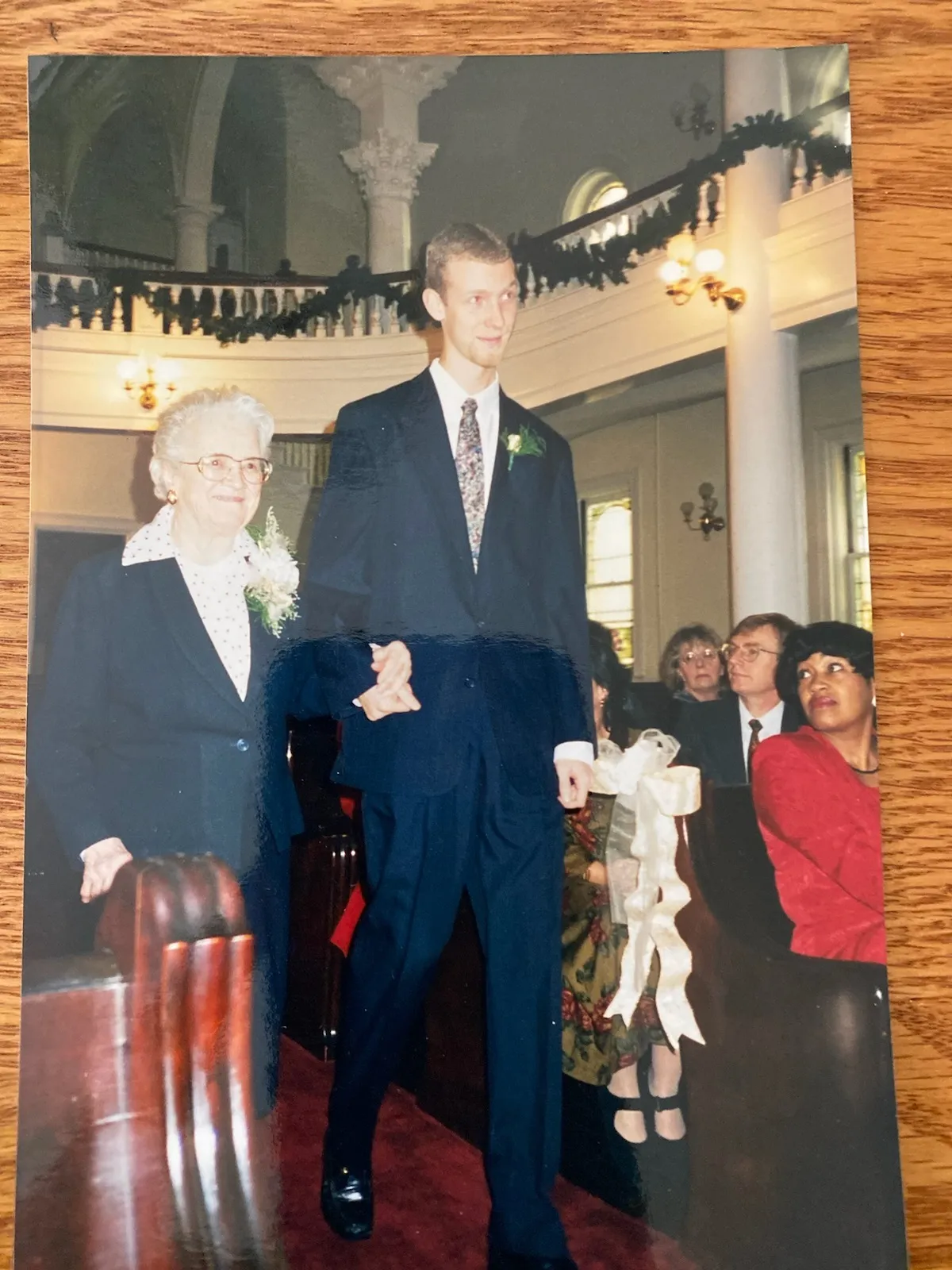
One of the last photographs of Peggy in the archive: on the arm of her grandson Chuck, walking down the aisle at her son Charlie’s wedding to Diana in the early 2000s — a few years before her 2007 death.
See also — family threads
Peggy is an anchor for five of the ten threads in the Family threads synthesis essay:
- Thread #1 — Education as inheritance — Penn State at seventeen (1936); Home Economics teacher at Marietta High School; her investing “paid for a large part of my education.”
- Thread #2 — Patience and the long view — the canonical investing instance; the eulogy frames her as the figurehead.
- Thread #5 — Service, stewardship, and giving — director of Christian education at First Congregational UCC; PEO; Betsey Mills Club; Junior Reading Club.
- Thread #6 — Humor as transmitted inheritance — “the dark, dry sense of humor went directly to her son Charlie, who passed a more diluted version” to Chuck.
- Thread #7 — Showing up in small, daily, unglamorous ways — Chuck’s daily after-school presence at the 7th Street house through his entire childhood.
See also — the three Peggys
Peggy McMaster Eesley is the first — longest-running and most central — of the three Peggys who circulated through this family across one generation. The other two were her sister-in-law Margaret Adelyne “Peggy” Youman (Don Eesley’s wife) and Peggy Arnold (the Highland Ridge neighbor). A short companion essay reads the trio.
Sources: Margaret “Peggy” Jane Eesley obituary, Marietta Times, May 23, 2007 (scrapbook page, p. 105); digitized in “Ohio, United States records,” images, FamilySearch (image 122 of 148), Washington County Public Library, Marietta, Ohio (Image Group Number 101430006). Chuck’s eulogy for his father (2015) on the investing thread. Family memory (Chuck) on the dance-partner line, the bridge years, and the daily after-school presence at the 424 N 7th Street house.
Appears in
- My Mother's Favorite Son — Charles Eesley's 12th-Grade Autobiography (c. 1964–1965) — memoir
- Letters from Vietnam — letter-collection
- Letter to Dorothy Hauser, 26 June 1970 — 'keep working for peace,' the mountains, and a company hit hard — letter
- Letter to Terrie, mid-1970 — 'I'm carrying the machine gun now. It weighs 25 lbs. I haven't used it and hope I never do.' — letter
- Letter to Terrie, October 1970 — 'I will vote for the immediate pull-out candidates' — letter
- Letter to Dorothy Hauser, 1 January 1971 — 'Say hi to the Mothers for Peace for me' — letter
- Letter to Terrie, 9 January 1971 — a birthday letter from the general's beach house — letter
- Letter to Terrie, 24 January 1971 — sunburn, finals, and planning a March reunion in Hawaii or the U.S. — letter
- Letter from Peggy Eesley to Terrie, 10 February 1971 — the Camp Eagle extension and the Congressional letter — letter
- Letter to Terrie, 22 March 1971 — R&R orders for Hawaii — letter
- Letter to Terrie, 31 March 1971 — Hawaii R&R planning, two months out — letter
- Letter to Terrie, 5 April 1971 — 'Mom suggested that we get married in Hawaii and save everyone all the bother' — letter
- Letter from Peggy Eesley to Charles & Terrie — the wedding aftermath, c. September 1971 — letter
- Letter from Peggy McMaster Eesley to Terrie, c. mid-1970s — Anne's Wisconsin hospitalization, and the mother-in-law line — letter
- Eulogy for Charles McMaster Eesley — eulogy
- Obituary of Anne Eesley (1946–2019) — obituary
- Family threads — the values and practices that run across the generations — essay
- The three Charleses — Charles Leonard, Charles McMaster, Charles Eric — essay
- The three Peggys — Peggy McMaster, Peggy Yeoman, Peggy Arnold — essay
Pictured in