← Part of Letters from Vietnam
letter
Letter to Terrie, 22 March 1971 — R&R orders for Hawaii
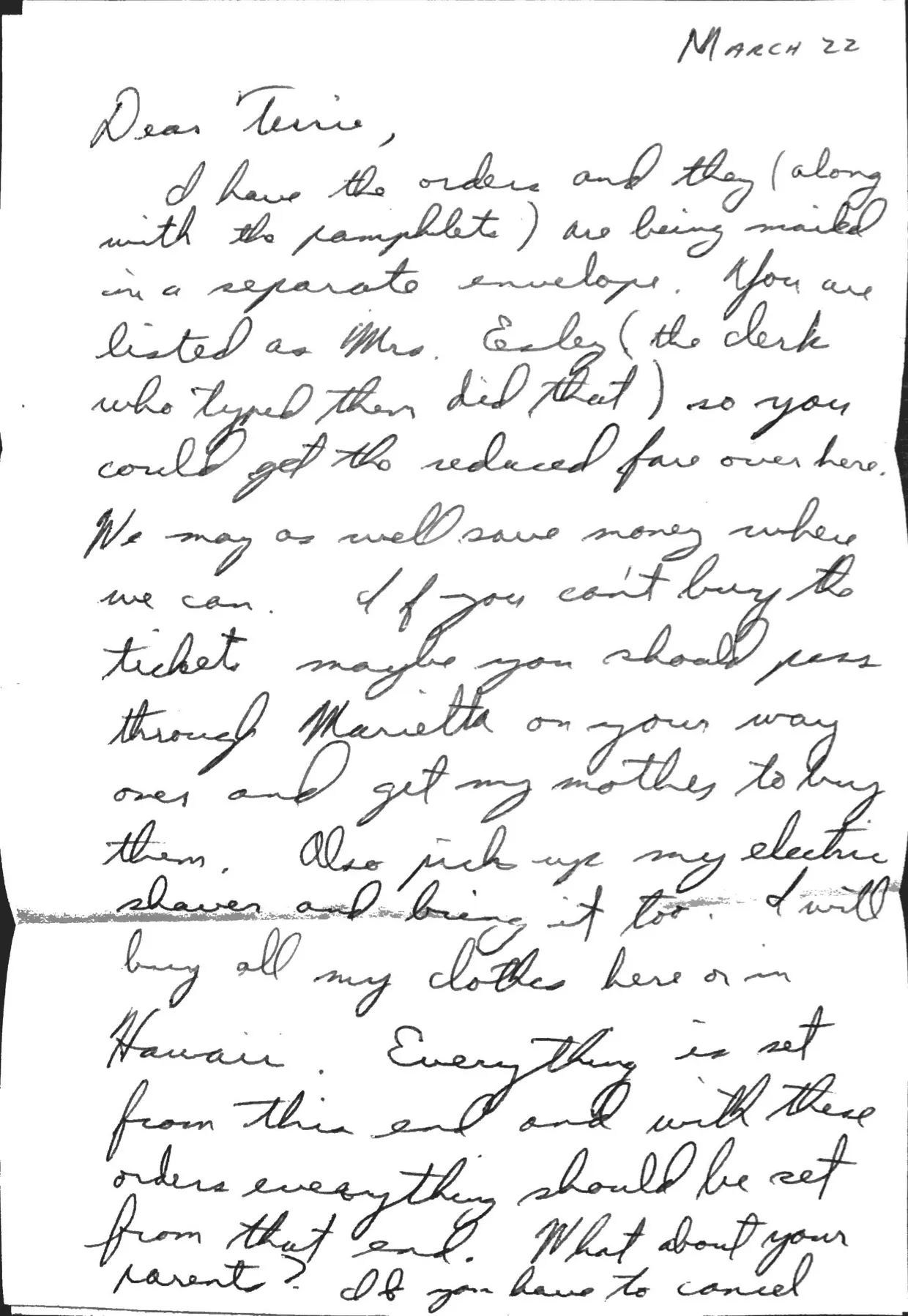
Charlie's letter to Terrie dated 22 March 1971 — the operational coordination letter for their R&R rendezvous in Hawaii. The Army has issued his orders; the clerk who typed them listed Terrie as 'Mrs. Eesley' so she could fly at the reduced military-dependent fare; Charlie is routing her through Marietta to get his mother to buy the tickets and to pick up his electric shaver. The center of the courtship year is in this letter: the plan for the week in Hawaii that was the only time the two of them would see each other between October 1969 and his return.
What the letter is
22 March 1971. Charlie is somewhere in I Corps with the 101st Airborne. He has just received his R&R orders — the one week of authorized rest-and-recuperation leave a soldier on a Vietnam tour was granted — and he is writing Terrie to coordinate the trip. They have chosen Hawaii, the most common American R&R destination because spouses and girlfriends could fly out from the mainland to meet servicemembers there. The letter is the operational plan: how she’ll get the tickets, how she’ll get there, what he’ll pack, what money he’ll send. Beneath the logistics, it is the central reunion of the courtship year — the one face-to-face week between his shipping out in late 1969 and his return to Marietta in 1971.
The Hawaii R&R program processed roughly 200,000 servicemembers per year at its 1969–70 peak through Fort DeRussy in Waikiki — the Army’s R&R center on the beach. A week of hotel, a per-diem allowance, civilian clothes, a girlfriend or wife flown out from the mainland. For a soldier whose calendar was otherwise the rotation of missions, mail call, and the days-left-in-country count, that week was the year’s emotional weight-bearing structure.
The “Mrs. Eesley” detail
The most quietly poignant fact in the letter: Terrie is listed as “Mrs. Eesley” on the R&R paperwork. The Army permitted military-dependent travel at reduced fare; the clerk who typed the orders, either to help or by error, wrote her down as Charlie’s wife. She wasn’t his wife yet — that wouldn’t happen until after the war — but she was, on the form, for the airline counter. He notes it directly:
“You are listed as Mrs. Eesley (the clerk who typed them did that) so you could get the reduced fare over here. We may as well save money where we can.”
The form gets ahead of the marriage; the marriage catches up.
Transcription (operational paragraphs)
March 22
Dear Terrie,
I have the orders and they (along with the pamphlet) are being mailed in a separate envelope. You are listed as Mrs. Eesley (the clerk who typed them did that) so you could get the reduced fare over here. We may as well save money where we can.
If you can’t buy the tickets maybe you should pass through Marietta on your way over and get my mother to buy them. Also pick up my electric shaver and bring it too. I will buy all my clothes here or in Hawaii.
Everything is set from this end and with these orders everything should be set from that end. What about your parents? If you have to cancel […] for Hawaii, I won’t be able to send you any more than $100 for your trip, but after you get to Hawaii I could give you all the flight fare.
[…]
The remaining paragraphs of the letter are intimate enough that the family has chosen to keep them in the private archive only. They are not in this transcription.
Three things this letter records
-
The Hawaii rendezvous logistics. Tickets, fare, shaver, $100 toward her flight, the rest covered once she arrives. The plan is detailed because it has to be — they have one week and the Pacific in between, and nothing about it is going to be improvised.
-
Marietta as the hand-off. Terrie is to route through Marietta, Ohio on her way over from Maryland so Charlie’s mother Peggy can buy the tickets and hand over Charlie’s electric shaver. Peggy is the proxy at home — the Marietta house at 113 Fourth Street is the operational hub of the trip even though no one in the Marietta house is the one going.
-
“What about your parents?” Terrie’s parents are Robert Earl and Dorothy Wildermuth — the B-24 navigator father whose attitude toward the soldier-boyfriend Charlie was already a strain by the time of the 22 June 1970 letter three months later. That Charlie has to ask “what about your parents?” in coordinating his R&R trip with Terrie tells the same story from earlier in the year: the parental approval was not yet fully there, and Hawaii was a decision Terrie was going to have to clear at home before she made it.
Privacy note: this letter is published in part. The full original is held in the family archive.
Scans