Dale Dudley Eesley
also known as Dale Dudley George Eesley (Bean's 1985 register variant — 'George' middle name not in the GEDCOM)
b. 1906-08-05, Pleasant Township, Franklin, Ohio
d. 1939-07-14, Franklin County, Ohio (buried Grove City, Franklin, Ohio)
Dale Dudley Eesley was born 5 August 1906 in Pleasant Township, Franklin County, Ohio. He died 14 July 1939, age 32, and is buried at Grove City, Franklin County, Ohio. He was married to Thelma G. Haughn for the last eleven and a half years of his life; she outlived him by some decades and remained part of the family circle until her death in the 1970s.
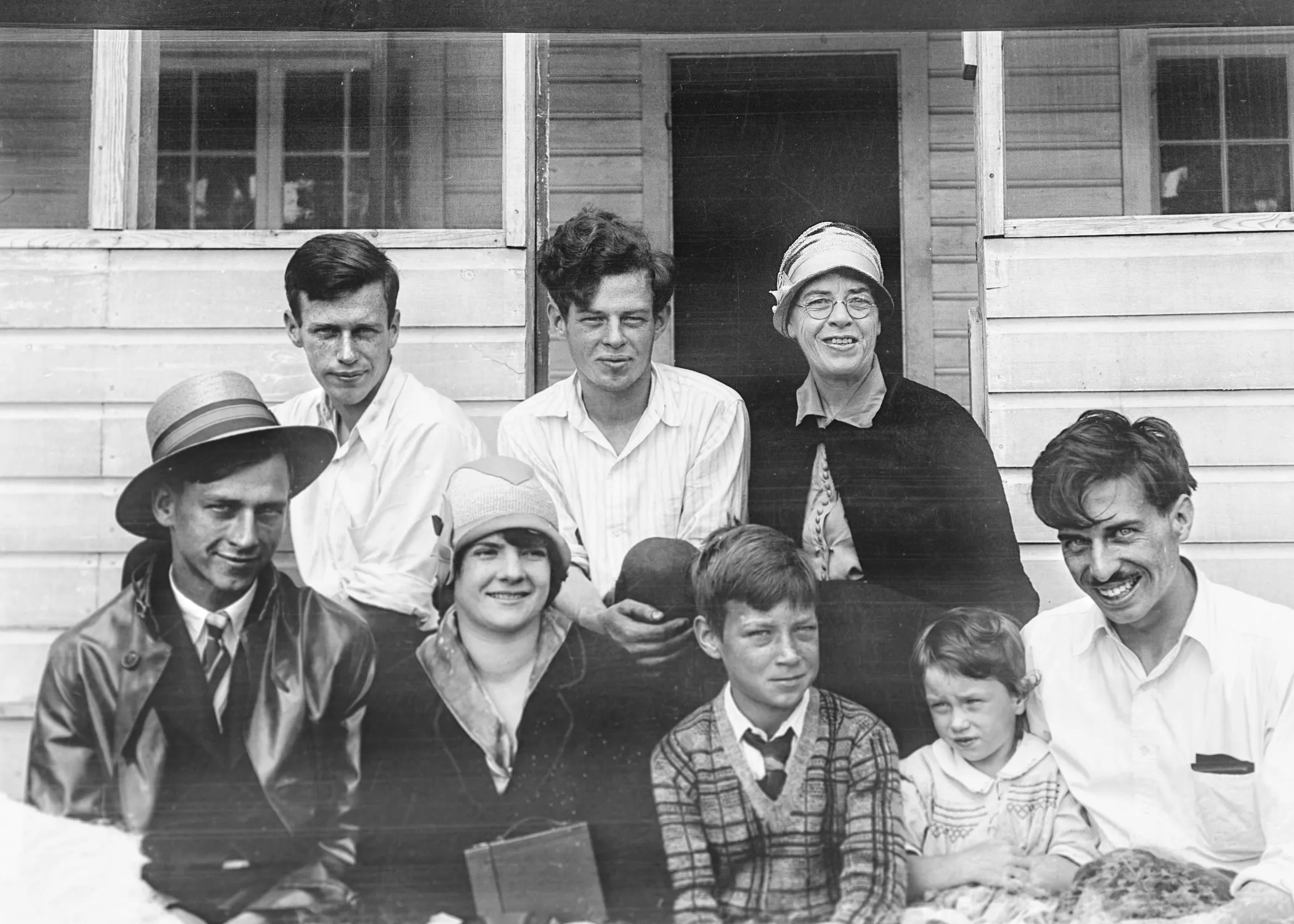
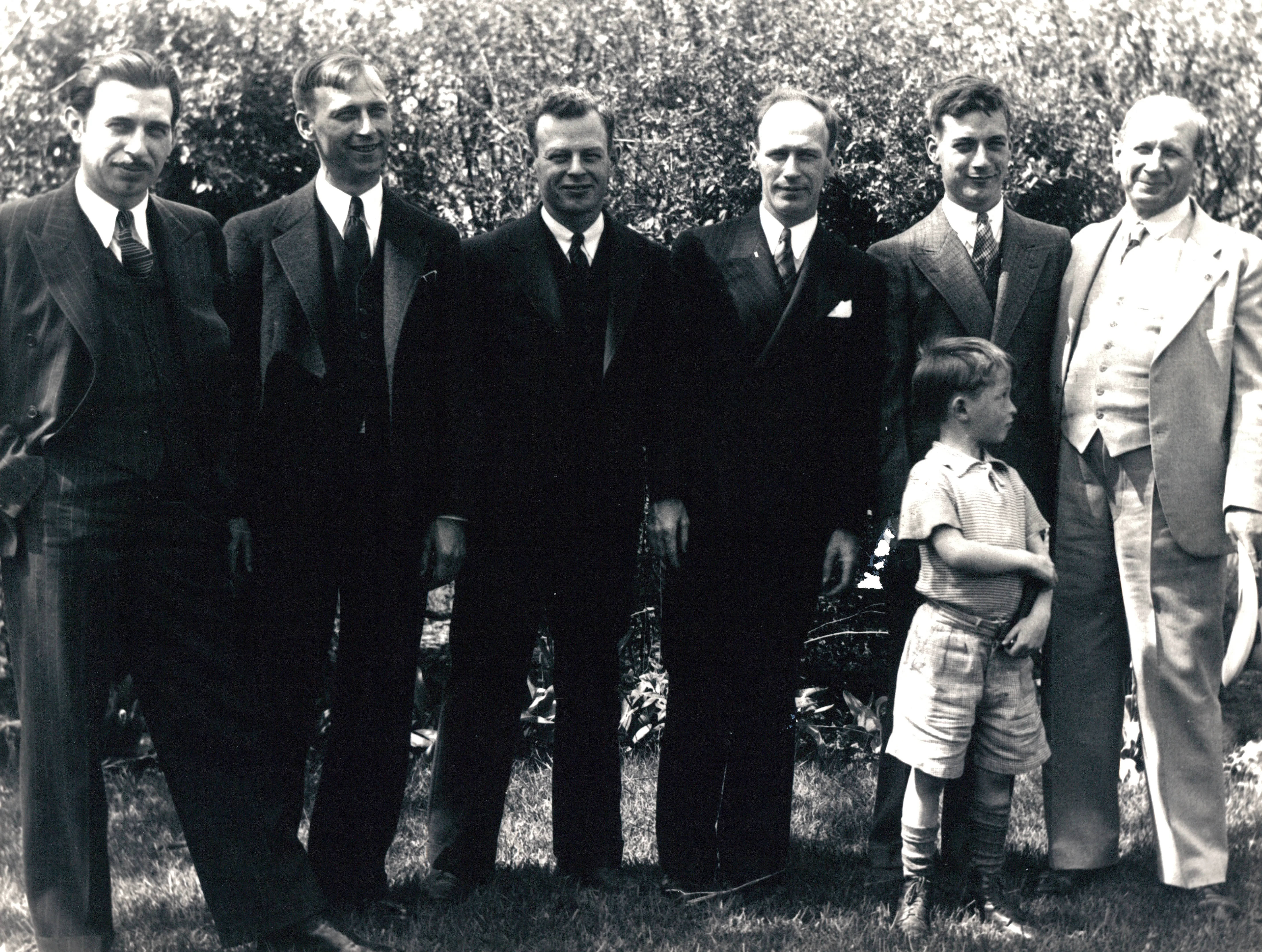
His birth date is sometimes recorded in family memory as 1916, but the GEDCOM and FamilySearch record MCZ8-WYX give 1906, which is consistent with his position as one of Charles Leonard and Lillie Dale’s older children and with his age in the group portrait. Bean’s 1985 register also gives his middle name as “George,” but the GEDCOM has just “Dale Dudley”; the third name may be a Bean expansion or a family-memory variant.
He appears in the c. 1937–1939 group portrait of Charles Leonard with five of his adult sons and grandson Tommy, as the figure on the right end of the brothers’ line — the only definitive photograph of him in this archive’s keeping, taken in the last window before his death at thirty-two.
Marriage to Thelma G. Haughn
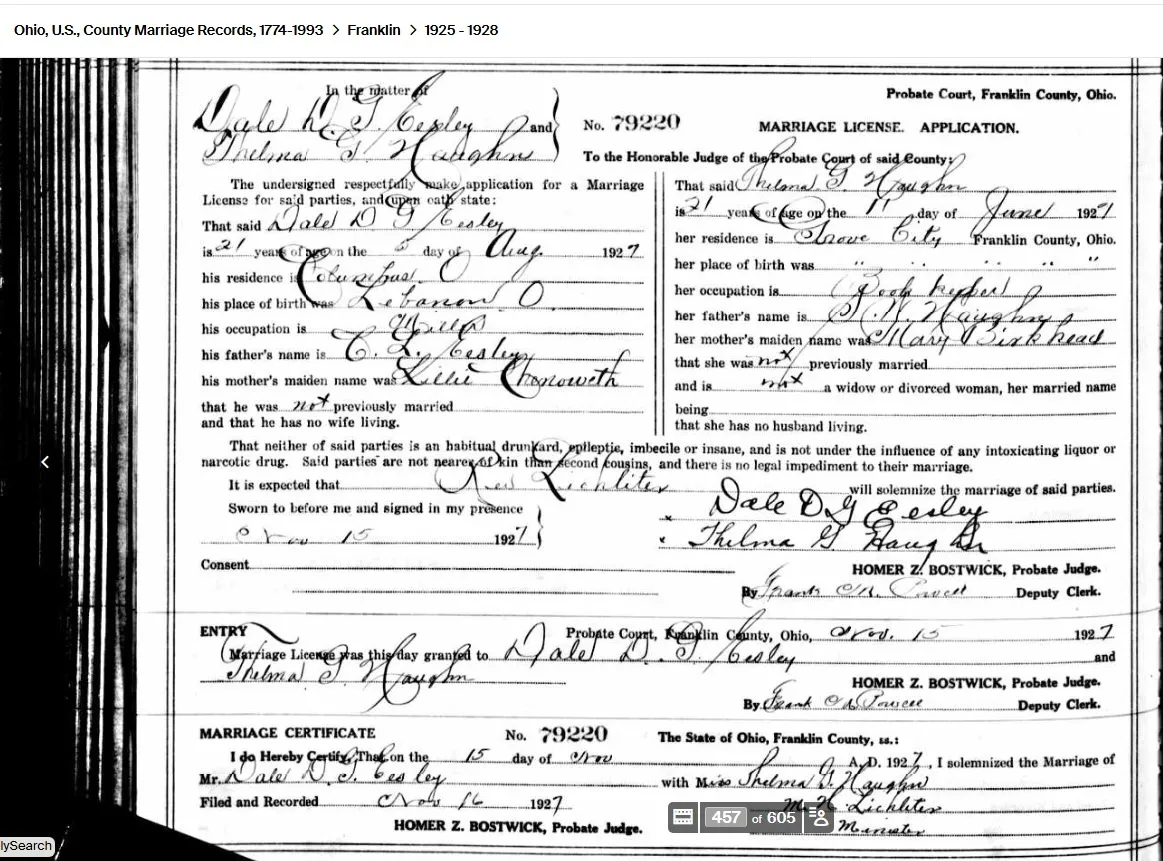
Dale married Thelma G. Haughn on 15 November 1927 in Franklin County, Ohio, at age 21 each. The marriage lasted eleven and a half years, until Dale’s drowning at Black Lake on 14 July 1939.
Marriage License Application #79220, Probate Court, Franklin County, Ohio. Dale D. Eesley (age 21, of Pleasant Township, Ohio) and Thelma G. Haughn (age 21, of Grove City, Ohio, occupation bookkeeper). License issued 9 August 1927 and granted 15 October 1927. Marriage solemnized 15 November 1927 by N.V. Lechler. Filed and recorded 16 November 1927. The marriage certificate names the bride as “Thelma G. Haughn,” confirming both the middle initial G and the Haughn maiden name (an earlier “Thelma Z. Haughn” reading was a misreading of the G). Franklin County Marriage Record, FamilySearch ark:/61903/3:1:9392-S59M-MH, image 699 of 861.
How he died — and what Helen carried for the rest of her life
On 14 July 1939 Dale took the boat across Black Lake, Michigan to run an errand to the general store on the far shore. He never returned. The boat was later found; he had drowned in the lake. Black Lake was the family’s summer gathering place — Charles Leonard and Lillie Dale owned a cottage there, and every Eesley summer for years ran on the lake’s rhythm. Dale was thirty-two. His body was returned home and is buried at Grove City, Franklin County, Ohio.
The errand was for chocolate, at his fifteen-year-old sister Helen’s request:
Mom carried deep pain and guilt over Dale’s death. She always blamed herself because she asked him to go across the lake to buy her some chocolate at the general store.
Dale’s youngest sister Helen was fifteen in July 1939, eighteen years his junior. He drowned on the run across the lake. Her self-blame outlasted Dale by sixty-one years — until her own death in 2000.
The household Dale left behind — his wife Thelma’s, his parents’ Charles Leonard and Lillie Dale’s — was processing a grown son’s drowning. Helen’s household was processing the same drowning, plus a teenage daughter convinced that she had caused it.
What likely happened — informed speculation
What follows is speculation, not record. The archive holds only the outline: a fit thirty-two-year-old crossing a familiar lake alone in a small boat in mid-July, the boat found afterward, his body recovered. No cause-of-death or eyewitness account has reached this page. But the few facts point in a direction.
The most telling detail is that the boat was found. A storm that swamped or sank the boat would have taken the boat down with him; an intact, empty boat instead suggests Dale went into the water while the boat stayed afloat — the ordinary pattern of a small-boat drowning. That makes a simple fall overboard the likeliest explanation. In a rowboat or a small outboard, the dangerous moment is almost always a shift of weight — standing, leaning, reaching, restarting a balky motor — that tips the hull just enough. A man suddenly in deep water in his clothes and shoes, alone, with no one to pull him back, can be in serious trouble within moments, especially if he struck his head going in.
A second possibility is a sudden medical event — a faint, a cardiac arrhythmia, a seizure — uncommon at thirty-two but not unheard of, and effectively a drowning if it dropped him over deep water with no one aboard to help. Weather is a third, but the surviving boat argues against a squall as the primary cause.
What does not belong in the explanation is the errand itself. Helen carried the guilt of having asked Dale to make the chocolate run, but the errand only put him on the water that afternoon; whatever actually took him — a lean, a wave, his own heart — would have been just as possible on any other crossing.
Two records could move this from guess to fact: Dale’s 1939 Michigan death certificate (the state recorded the death where it occurred, and the certificate would name a cause and often a circumstance), and the local Cheboygan-area newspaper, which in 1939 would almost certainly have reported a summer drowning on Black Lake. Both are research leads still open.
Helen and Thelma in Columbus
Thelma stayed in Columbus and remained part of the family’s life. Helen’s eldest daughter Barb knew Thelma was their aunt; her younger sisters Roberta and Katie grew up knowing her only as “a friend of the family.” See Thelma’s page.
The household Dale left was Thelma’s. By September 1939 — less than two months after Dale’s drowning — Thelma was packing up the home she had shared with Dale and moving in with a Mrs. Hudson. Lyle, Dale’s younger brother who would himself die at Cabanatuan three years later, drove his car and trailer for two days helping Thelma move her belongings. Lillie Dale’s letter to her son Leonard and daughter-in-law Helen, dated September 1939 (see Lillie Dale’s September 1939 letter to Leonard and Helen Eesley), records both Thelma’s move and the line that closes it: “It is hard to go back to the lake and no matter how one reasons there is that involuntary feeling that Dale will come walking in.”
Charles Leonard and Lillie Dale lost their first son this way; in three more years they would lose Lyle to a Japanese prison camp on the other side of the Pacific. Within five summers the Bexley household had lost two of its adult sons.
A handwritten one-page journal entry by his fifteen-year-old sister Helen, dated 1 September 1939 — forty-nine days after Dale’s drowning, on the same day Germany invaded Poland and World War II in Europe began — records her grief dream that Dale had come back, “the man we buried was someone else.” Helen kept the page across the rest of her life; her daughter Roberta emailed it to Chuck in June 2026. See the journal entry on its own page.
Sources: Mary Eesley Bean, Eesley Family History, 1985; Ohio County Marriage Records 1774-1993 (Franklin County, Marriage License Application #79220), via Ancestry, surfaced June 2026 by Roberta Burnes; Lillie Dale’s September 1939 letter to Leonard and Helen Eesley; structured record: Dale Eesley / FamilySearch — Dale Dudley Eesley (MCZ8-WYX).
Appears in
Pictured in