midwest · United States
Black Lake, Michigan — the Eesley cottage
Black Lake in northern Michigan was the Eesley family's summer place across the 1920s–1940s. Charles Leonard and Lillie Dale Eesley owned a cottage on the lake; every summer their children and grandchildren came up. It is the place where Dale Eesley drowned on 14 July 1939 — and where the family's summer stories are set: a household of relentless practical jokers, the false-teeth prank that finally got 'Consarn it!' echoing across the water, the Reveille record a brother flung into the lake, Charles Leonard's Chief Whitecloud canoe act, and the long ties to the Feathers of Petoskey. The cottage burned down in the 1950s and was not rebuilt.
Why this place matters
Black Lake in northern Michigan — between Cheboygan and Onaway — was the Eesley family's summer place across the 1920s, 1930s, and 1940s. Charles Leonard and Lillie Dale Eesley owned a cottage on the lake; every summer their children and grandchildren came up, sometimes for weeks at a time. It is where Dale Eesley drowned on 14 July 1939 — and where most of the surviving Eesley summer stories are set: a family of practical jokers, the false-teeth prank that set off Charles Leonard's 'Consarn it!' across the water, the Reveille record a brother threw in the lake, the Chief Whitecloud canoe act, and the family's long friendship with the Feathers of Petoskey. The cottage burned down in the 1950s and was not rebuilt; the lake stayed in family memory.
Black Lake is a large freshwater lake in northern Michigan’s Lower Peninsula, in Cheboygan County and Presque Isle County north of Onaway, about thirty miles south of the Straits of Mackinac. It is roughly 10 miles long and 2 miles wide — one of Michigan’s larger inland lakes — with a mix of cottage shore and forested undeveloped frontage. In the early-to-mid twentieth century the lake was a summer-cottage destination for upper-Midwest families willing to make the drive north from Ohio, Indiana, or downstate Michigan, and the Eesleys were one such family.
The Eesley cottage
Charles Leonard Eesley and Lillie Dale Chenoweth Eesley owned a cottage on Black Lake from sometime in the 1920s or 1930s until it burned down in the 1950s — the year is not fixed in the family record but the loss is. The cottage was not rebuilt. Through the decades while it stood, the cottage was “the gathering place for all Eesleys.” The family would go up to the lake for a couple of months each summer, with relatives and friends coming and going across the season.
In Lillie Dale’s pen, the lake stays inside the simplest phrase: “the lake.” Her September 1939 letter to Leonard and Helen, written eight weeks after Dale’s drowning, slips between conversation about babies and college and friends and lands quietly on the line: “It is hard to go back to the lake and no matter how one reasons there is that involuntary feeling that Dale will come walking in.” The lake was the place that held him and the place that lost him.
The Feathers of Petoskey
The Feathers were old family friends who lived in Petoskey, the resort town on Little Traverse Bay west of Black Lake. Whether they also kept a cottage on Black Lake itself isn’t certain in the family record. Either way they stayed in the Eesley–Burnes circle for decades. Lillie Dale’s September 1939 letter mentions them among the comings and goings of that summer: “The Feathers reported a grand time with you folks… They were at Petoskey the following Sunday & spent the night with Mother Feathers.”
The connection outlasted the cottage by a generation. When Roberta was in high school, Mary Eesley Bean and her husband Bill came up to stay with the Burnes family at Lake Leelanau — the lake the family had summered at since Roberta was seven — and together they made a pilgrimage back to Black Lake. They walked the shore where the old cottage had stood and called on the last Feather the family still kept up with, Ralph Feather — in Roberta’s memory, “another goofy old man who loved practical jokes.”
A family of practical jokers
Everyone in that family was a practical joker. The brothers were forever pulling pranks on the children or on Grandpa; the children or Grandpa would retaliate; and it went on and on, summer after summer. Two of the best survive in Helen Eesley Burnes’s telling, now in her daughters’ keeping.
The false teeth and the one morning of “Consarn it!”
Charles Leonard got up before dawn every day to fish. He kept his false teeth in his pocket and didn’t put them in until he was out on the boat. One summer Dale and his young sister Helen found a set of false teeth aboard an abandoned boat along the shore — “the shipwreck,” in their telling — and decided to play a trick on Grandpa: after he went to bed, they swapped his real teeth for the junk pair.
Sure enough, Grandpa rose early and rowed out, and waited as always until he was on the water to put his teeth in. Helen always said you could pinpoint the exact moment, because the cussing came drifting back across the lake — first a soft “Consarn it,” then louder, then “CONSARN IT!!!” Consarn it was Grandpa’s cussword of choice, and sound carried so well over the water that the whole cottage could hear him. It was a one-morning event, not a daily one — that morning had earned it.
The Reveille record
Charles Leonard could be gleefully obnoxious. He’d come in from a morning’s fishing, find the cottage still full of sleeping people, and put a record on the old Victrola to roust everyone out of bed — “Reveille,” the bugle wake-up call, cranked as loud as it would go. People hated it. One morning a brother had finally had enough: he grabbed the record and flung it like a frisbee out into the lake. At last — quiet, and sleep.
Except that afternoon Grandpa went swimming and spotted something on the sandy bottom: his record. He fished it out, all scratched up from the lake bed, and hid it away in the cottage. The next morning, of course, the Reveille bugle blasted again — only now the record skipped and stuck and scratched its way through the call, more excruciating than ever. Grandpa had the last word.
Chief Whitecloud by canoe
Charles Leonard’s other lake performance was a character he played by canoe: Chief Whitecloud. When the children were having a campfire by the shore, he would paddle along the dark edge of the lake in costume, looming up as a grand “chief,” and the children would believe it. A typewritten account of one Chief Whitecloud appearance is in Roberta Burnes Walker’s keeping.
What happened on 14 July 1939
The lake also took Dale Eesley. On the afternoon of 14 July 1939, Dale — thirty-two, married to Thelma G. Haughn — took the boat across the lake on an errand and did not return. The boat was later found; he had drowned. His body was sent home to Grove City, Ohio for burial. The fuller account, and what his youngest sister Helen carried out of it, lives on Dale’s page and Helen’s.
Lillie Dale’s September 1939 letter touches the lake just once, and gently: “It is hard to go back to the lake and no matter how one reasons there is that involuntary feeling that Dale will come walking in.” And yet the family did go back. There were more summers, more pranks, more laughter on that water; the cottage stood another decade and more. The family carried on at the lake after Dale’s death — because what else can you do.
Black Lake photographs in the archive
Four dated Black Lake images sit in this archive, covering the cottage from its early years through its last decade.
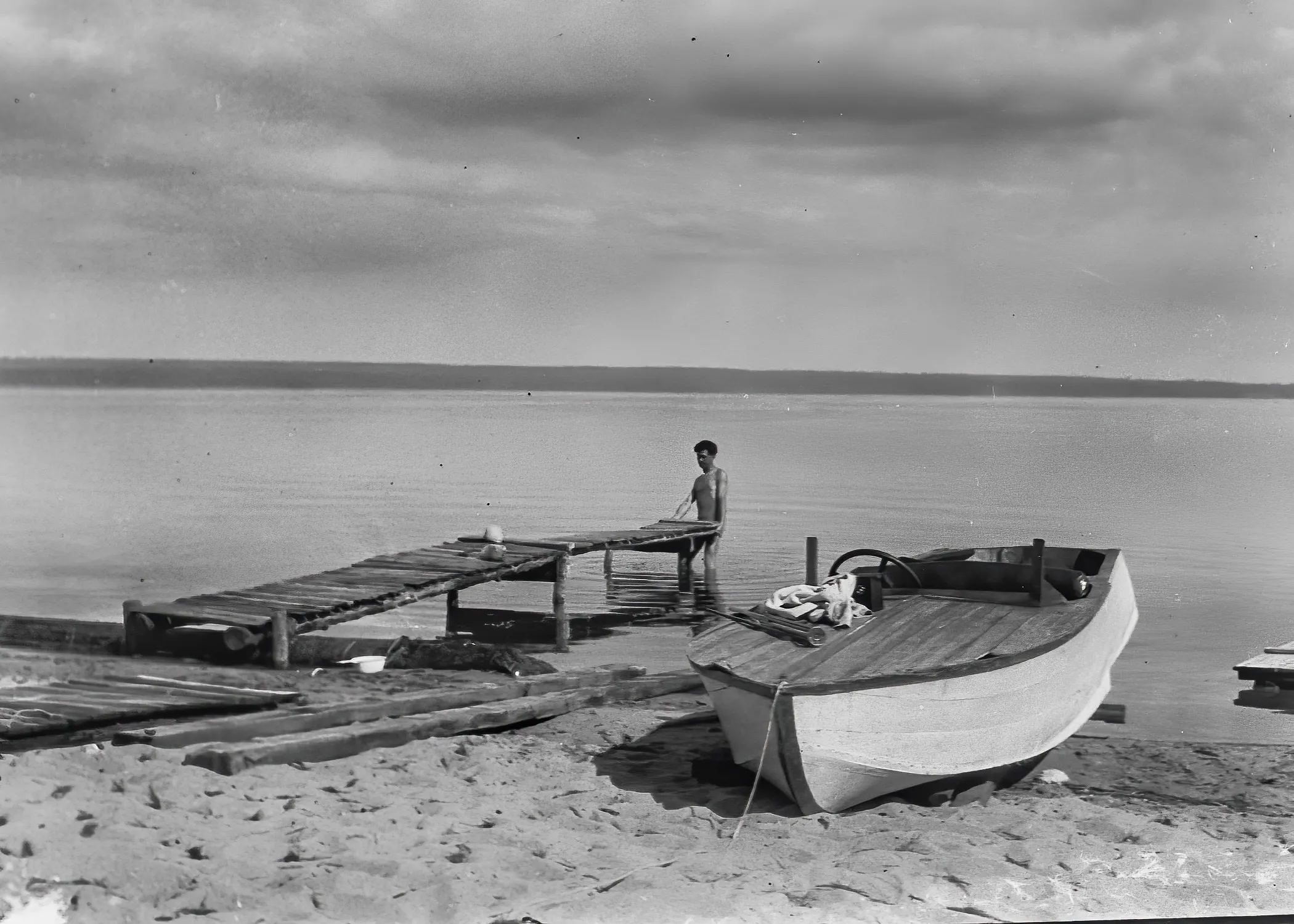
Leonard bringing in the dock, 1928
Charles Leonard’s eldest son Leonard David Eesley, age 24, shirtless and knee-deep in the lake doing the seasonal dock-installation labor. The earliest dated Black Lake photograph here.
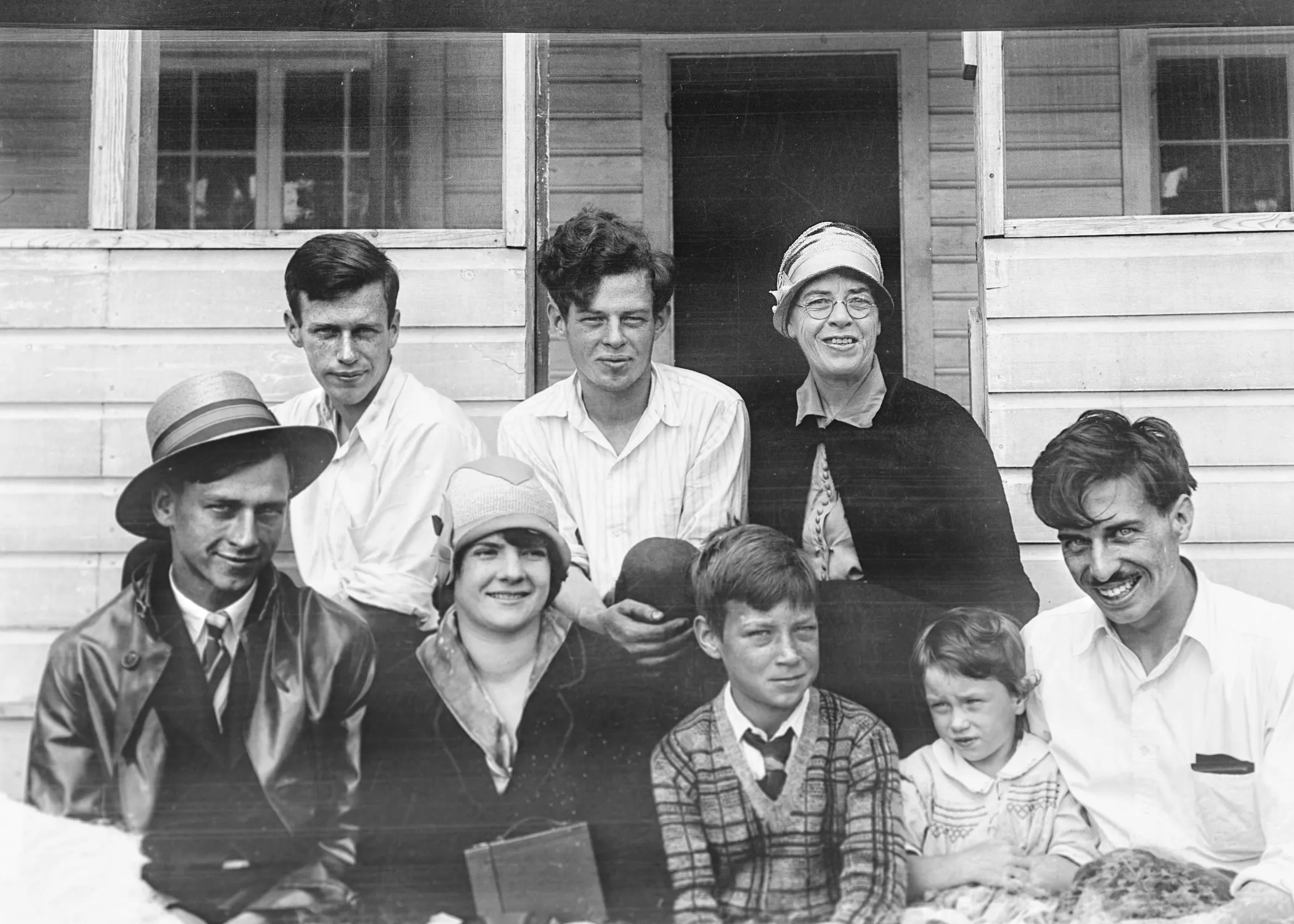
Family group at the cottage with Leonard, c. 1928
Eight people grouped in front of the cottage’s painted clapboard wall on (presumably) the same summer. The older woman in the cloche hat is almost certainly Lillie Dale; the small child in white fits the age window for Helen. Most of the cast is still open.
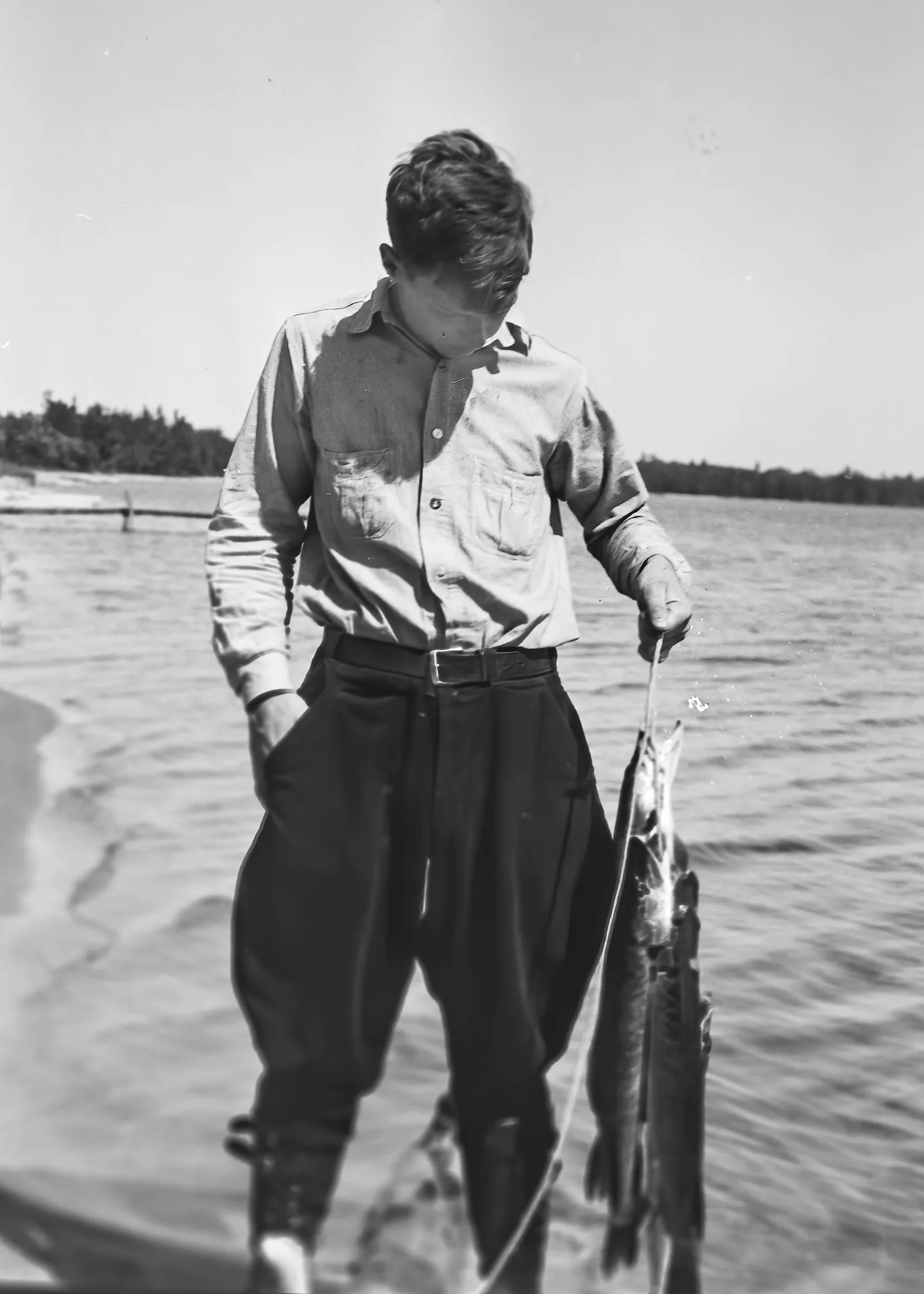
Will at age 19 with a string of fish, c. 1929
Will Eesley standing in the shallows of Black Lake in a pale work shirt and dark trousers tucked into laced boots, holding up a string of two long fish — northern pike by their shape — from his afternoon’s catch. Calm silver water, distant tree-line opposite. The second-earliest dated Black Lake photograph here. Will would have been just out of his teens; ten years before his brother Dale’s drowning on this same lake.
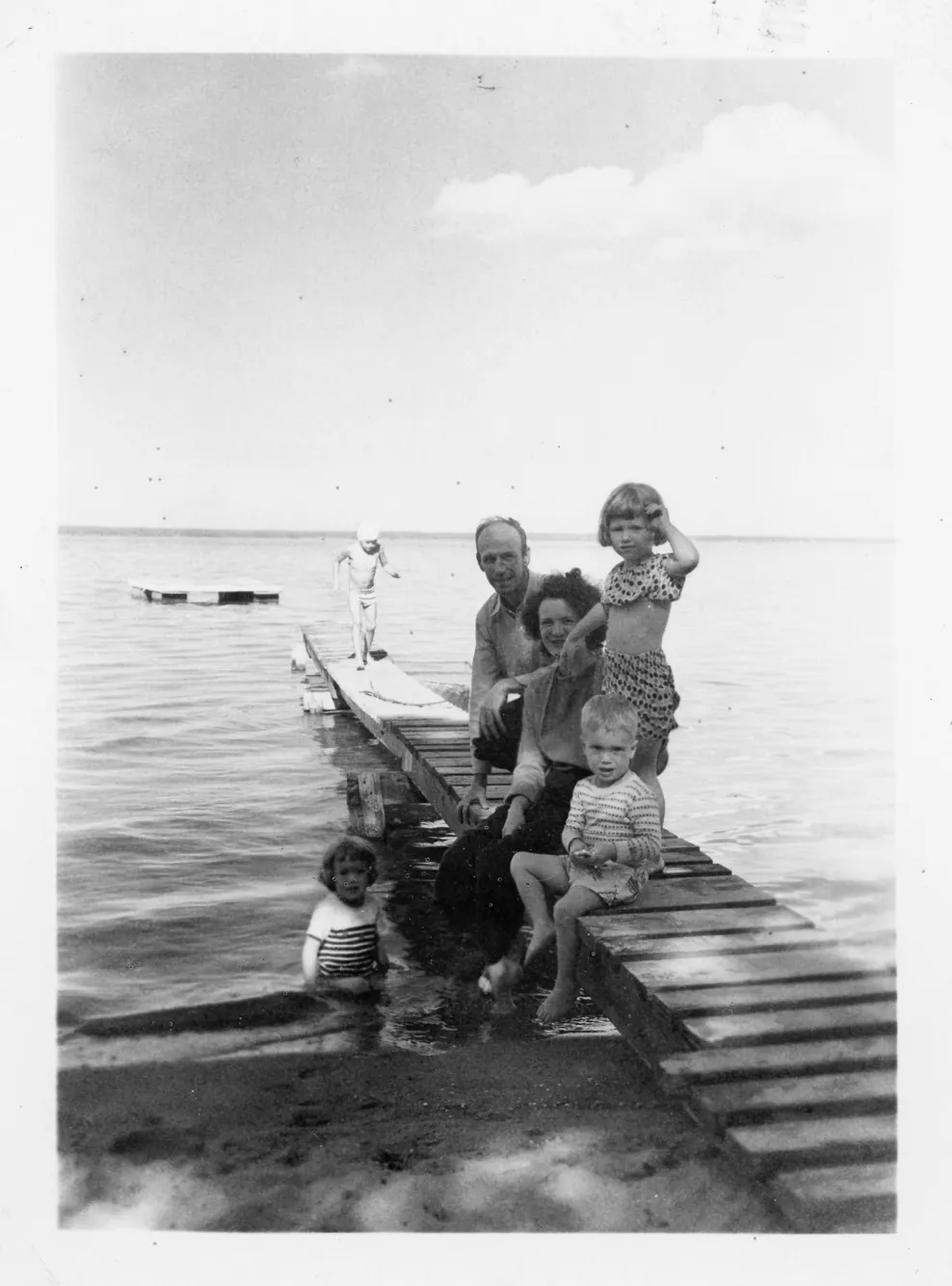
Will and Peggy with Charlie, Jeanne, and Anne on the dock, c. 1950–1952
Will Eesley and Peggy on the dock with three of their young children: little Charlie (Chuck’s father, age three-to-five) sitting on the edge with his feet over the water, Jeanne standing in a polka-dot swimsuit, and Anne as a toddler in the shallows. The next-generation summer at Charles Leonard’s cottage.
After the cottage
The cottage burned in the 1950s and was not rebuilt. The Eesley summer ended. Whatever stayed on at Black Lake after that — family visits, return trips, the lake itself — lives now in family memory. More lake stories from the family’s keeping remain to come.
Sources: family memory transmitted via Roberta Burnes Walker, June 2026; Lillie Dale Eesley’s September 1939 letter to Leonard and Helen Eesley; Dale Eesley’s page; Helen Burnes’s page.