← Part of Letters from Vietnam
letter
Letter to Terrie, 5 November 1970 — fourteen days without mail, the congressman inquiry, and the extension plan
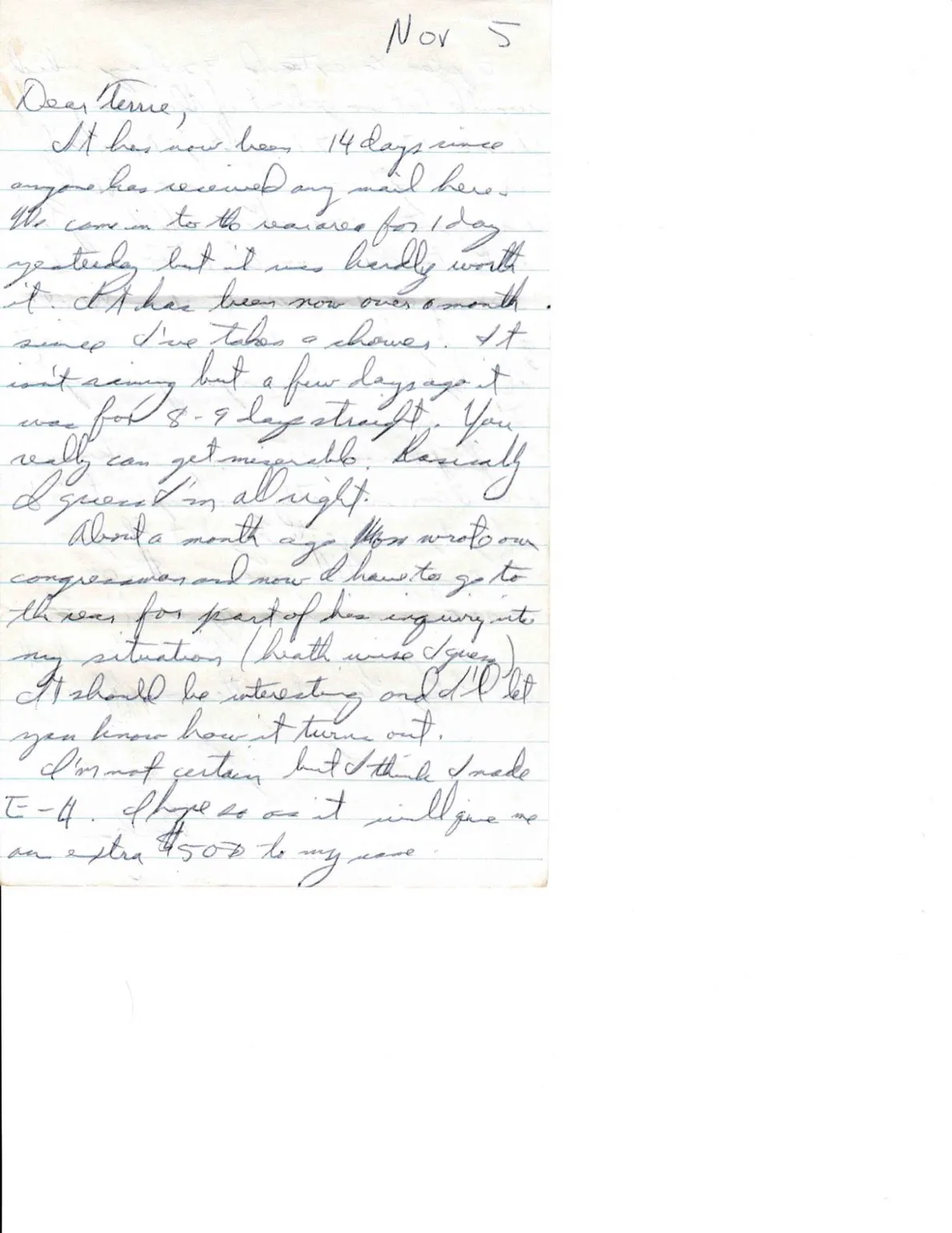
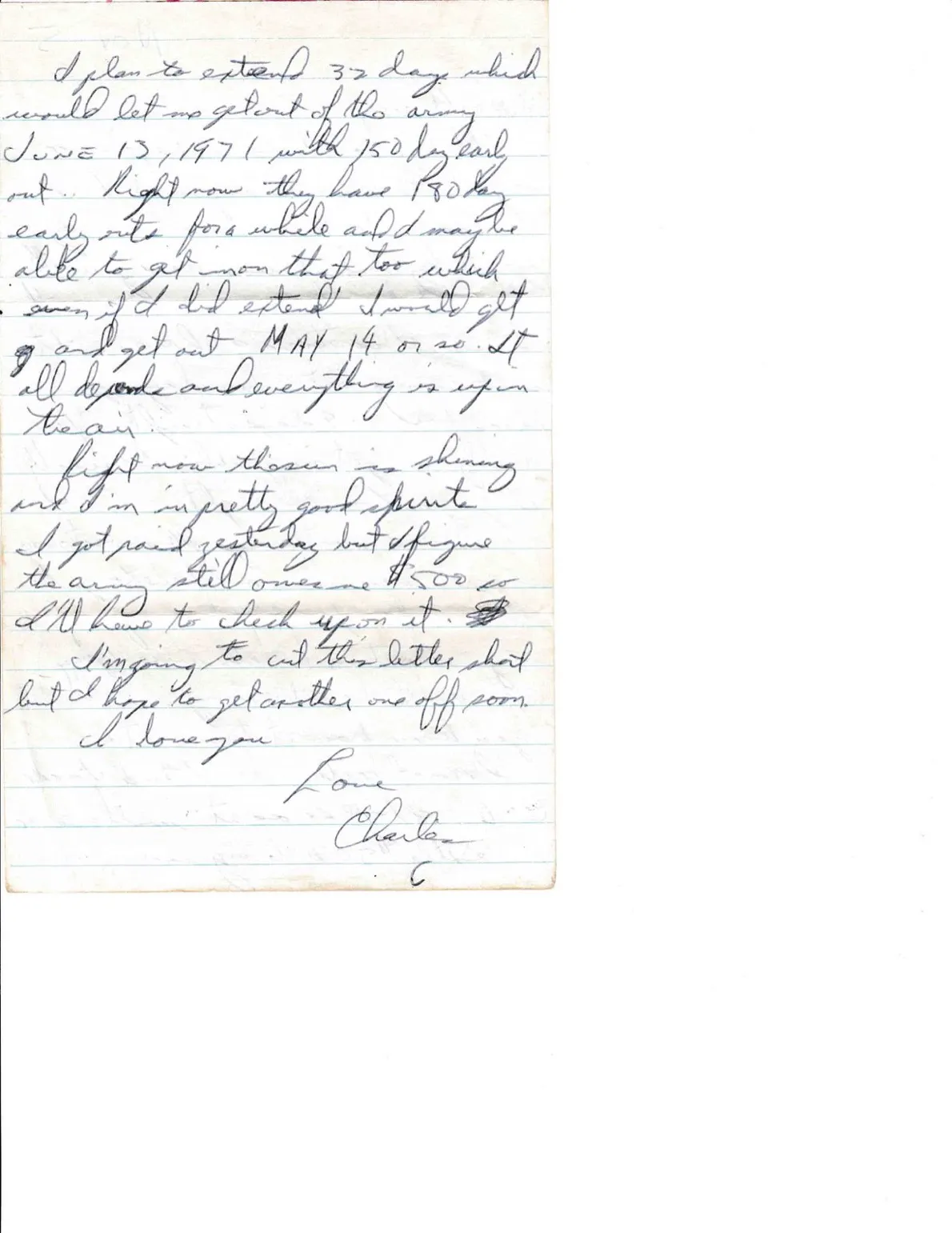
Charlie's two-page letter to Terrie dated 5 November 1970, reassembled from its scans (dad174 page 1, dad175 page 2). Written from the field in the monsoon: fourteen days since anyone there received mail, over a month since he last showered, eight or nine days of straight rain a few days earlier. About a month ago his mother wrote their congressman about his situation (health-wise, he guesses), and now he has to go to the rear as part of that inquiry. He thinks he made E-4, which would add $50 to his pay. He then lays out the extension plan the rest of the tour runs on: he plans to extend 32 days, which would let him out of the army on 13 June 1971 with a 50-day early-out; there is also a 90-day early-out going for a while that, even with the extension, could get him out around 14 May, 'it all depends and everything is up in the air.' The sun is out and he's in good spirits; he figures the army still owes him $500. Signed 'I love you. Love, Charles.'
What the letter is
5 November 1970, written from the field in the monsoon. It carries the physical misery of the line, fourteen days with no mail, a month without a shower, more than a week of unbroken rain, set against the first clear statement of the plan that organizes everything to come. The extension math here, extend 32 days to reach a 13 June 1971 out-date, with a possible 90-day early-out pulling it back toward mid-May, is the origin of the ETS strategy that the 19 January 1971 ETS-extension letter and the whole spring countdown refine and hold to.
Transcription
Nov 5
Dear Terrie,
It has now been 14 days since anyone has received any mail here. We came in to the rear area for 1 day yesterday but it was hardly worth it. It has been now over a month since I’ve taken a shower. It isn’t raining but a few days ago it was for 8-9 days straight. You really can get miserable. Anyway I guess I’m alright.
About a month ago Mom wrote our congressman and now I have to go to the rear for part of her inquiry into my situation (health wise I guess). It should be interesting and I’ll let you know how it turns out.
I’m not certain but I think I made E-4. I hope so as it will give me an extra $50 to my name.
[page 2:] I plan to extend 32 days which would let me get out of the army June 13, 1971 with [a] 50 day early out. Right now they have [a] 90 day early out for a while and I may be able to get in on that too which, even if I did extend, I would get out May 14 or so. It all depends and everything is up in the air.
Right now the sun is shining and I’m in pretty good spirits. I got paid yesterday but I figure the army still owes me $500 so I’ll have to check up on it.
I’m going to cut this letter short but I hope to get another one off soon.
I love you.
Love Charles
What the letter records
The monsoon field. Fourteen days with no mail, a month without a shower, eight or nine days of straight rain, this is the physical baseline of the field tour, stated plainly and then shrugged off (“Anyway I guess I’m alright”).
The congressman inquiry. “About a month ago Mom wrote our congressman” places the start of Peggy McMaster Eesley’s intervention on Charlie’s behalf around early October 1970; here it’s pulling him to the rear for the inquiry. The same congressional-letter campaign surfaces in the 22 February 1971 letter, where his old platoon-mates remember him for it.
The extension plan, first stated. This is where the whole end-of-tour calculation begins: extend 32 days for a 13 June 1971 out-date, with a 90-day early-out possibly pulling it to mid-May. The 19 January 1971 ETS-extension letter and the spring day-counts (“down to 115,” “77 days left”) are all refinements of the arithmetic laid out here in November.
Scans