← Part of Letters from Vietnam
letter
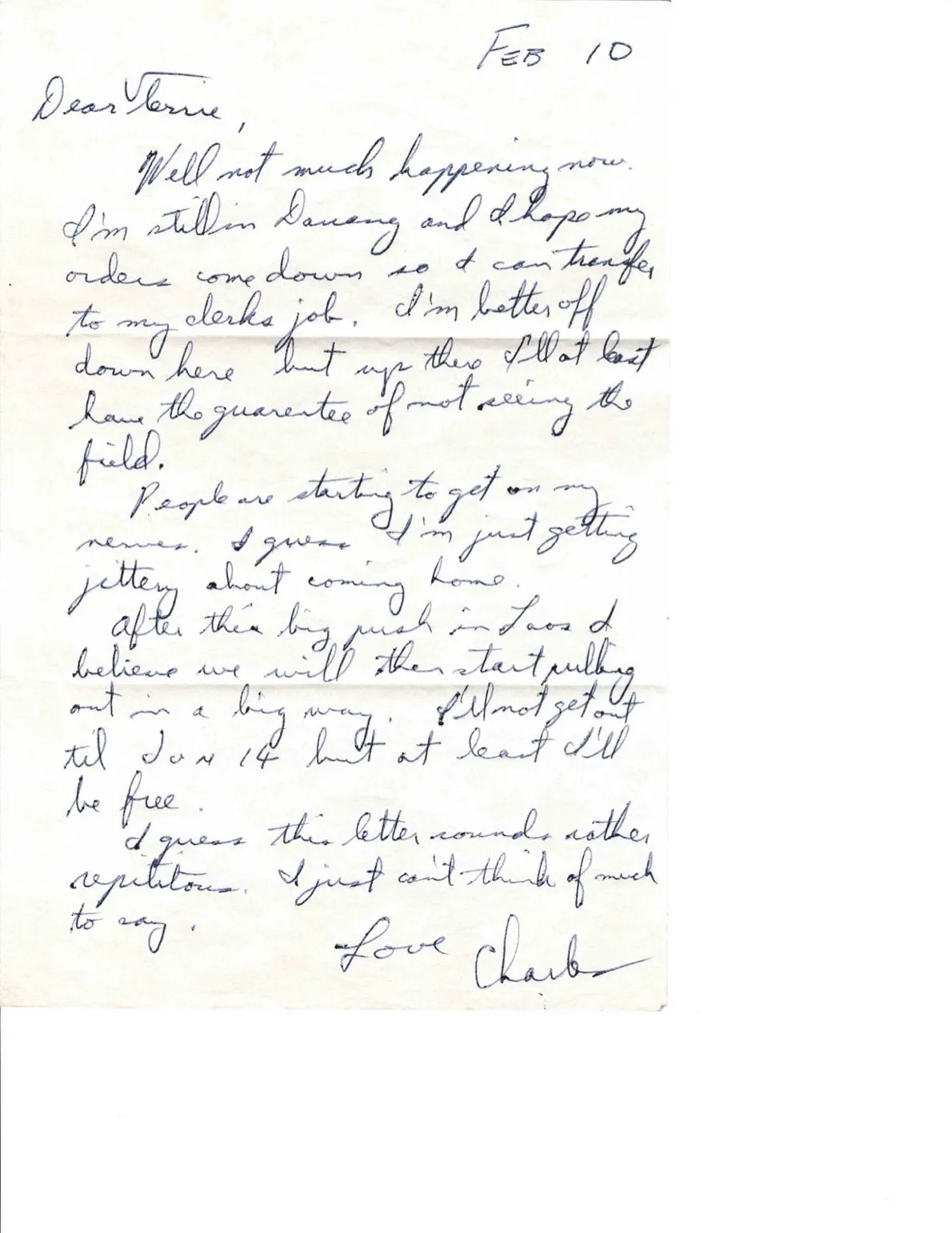
Letter to Terrie, 10 February 1971 — 'I'm still in Danang' (same day as Peggy's congressional letter)
Charlie's letter to Terrie dated 10 February 1971, from Da Nang — written the same day as Peggy McMaster Eesley's 10 February 1971 congressional letter to Terrie from Marietta. The two letters on the same date capture the family's parallel work on Charlie's tour endgame: Charlie waiting in Da Nang for orders to transfer to a clerk's job in the rear; Peggy writing from Marietta with the CO at Camp Eagle's response routed through Congressman Miller. A short steady letter.
What the letter is
10 February 1971. Charlie writes a short steady letter from Da Nang to Terrie at Maryland. The same day his mother Peggy McMaster Eesley writes her own 10 February 1971 letter from Marietta to Terrie at Maryland, enclosing the final letter from the CO at Camp Eagle to Congressman Clarence Miller about Charlie’s tour situation.
The two letters together — Charlie’s and Peggy’s, from opposite sides of the world on the same day, both addressed to Terrie — are the archive’s most concentrated single-day record of the family’s parallel work on Charlie’s tour endgame.
Transcription
Feb 10
Dear Terrie,
Well not much happening now. I’m still in Danang and I hope my orders come down so I can transfer to my clerks job. I’m better off down here but up there I’ll at least have the guarantee of not seeing the field.
People are starting to get on my nerves. I guess I’m just getting jittery about coming home.
After this big push in Laos I believe we will then start pulling out in a big way. I’ll not get out til Jan 14 but at least I’ll be free.
I guess this letter sounds rather repetitious. I just can’t think of much to say.
Love Charles
What the letter records
The clerk’s job. Charlie is waiting for orders to transfer to a clerk’s billet in the rear so that whatever remains of his Vietnam time will be guaranteed off the field — a desk job at Camp Eagle or similar. The transfer doesn’t carry the same risk reduction as the rear-area Da Nang assignment he is on right now, but it is the structural arrangement that takes him off field operations for good.
Lam Son 719 — “this big push in Laos.” “After this big push in Laos I believe we will then start pulling out in a big way.” The big push Charlie names is Operation Lam Son 719, the South Vietnamese ARVN ground invasion of southern Laos that began 8 February 1971 — two days before this letter — with U.S. air support but no U.S. ground troops permitted west of the Vietnamese border. The 101st Airborne, Charlie’s division, provided some of the helicopter lift and ground-fire support from the I Corps side of the border. Lam Son 719 was the test case for Vietnamization — whether the ARVN could conduct a major offensive on its own with American air and logistics backing. The operation became the bloody hinge of the late war; Charlie’s prediction that the U.S. would pull out “in a big way” after it was the conventional wisdom in the field at the time.
The “Jan 14” date. “I’ll not get out til Jan 14.” Charlie’s 19 January 1971 letter had laid out the strategy: extend Vietnam tour by ~32 days to ETS from Vietnam rather than serve stateside. The new exit date of January 14 in this letter is presumably his projected discharge under that extension strategy. ([The ETS-from-Vietnam plan ultimately collapsed against the U.S. drawdown timetable; Charlie returned to the States in 1971 — exact date open research.)
“People are starting to get on my nerves. I guess I’m just getting jittery about coming home.” The shortest characterization of late-tour mood. The combat phase is essentially over for him; what is left is the rear-area waiting for orders, and the ordinary human nerves at the end of a long deployment.
The pairing with Peggy’s letter
What makes this letter structurally important in the archive is the single-day co-arrival with Peggy’s congressional letter. Both letters were written 10 February 1971; both went to Terrie at Maryland; both addressed the same tour endgame. Charlie was working it from the field; Peggy was working it through Congress. The archive’s two opposite-end primary sources line up on one day.
Scans