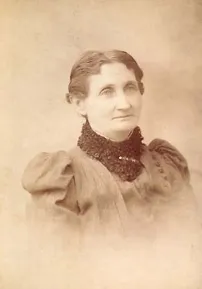
Jennie Goldie Eesley
also known as Jennie Goldie, maiden ('Jeanie' in the older Bean text); 'Jeanie Goldie' in the typewritten Goldie immigration narrative
b. 1836-12-12, Ayr, Scotland (spelled 'Ayre' in the typewritten Goldie narrative)
d. 1911-08-12, 424 Sackville Street, Toronto, Ontario, Canada
Jeanie Goldie was born 12 December 1836 in Ayr, Scotland — the eldest child of David Goldie and Jessie McCall Goldie. The typewritten Goldie immigration narrative gives the family’s crossing in detail.
The 1845 emigration to Montreal
In 1845, David and Jessie Goldie sailed for Canada with Jeanie (then eight) and her younger brother Will — and with Mary and James, Jessie’s two children by an earlier marriage whose father had died some years before. They arrived in Montreal.
Mary, about eighteen, fell in love with a man named Hunter she had met on the boat coming over, and they were married within the year.
James — frail — died before Christmas 1845, in their first year in Canada.
The following year — 14 September 1846 — David Goldie went down to the Montreal docks to see if any friends from Scotland were aboard the Clementine, the ship the family had sailed on the year before. The narrative records what happened: “He underestimated the distance between the boat and the dock and was drowned.” Within twelve months of arriving, the family had lost the patriarch and one of the older children.
Jessie, with two of her children now dead and a husband drowned, longed for Scotland and packed up Will and Jeanie and sailed back. She did not stay long. “Soon realized that there was a greater future in the new country and sailed back to Montreal with her two children.” The eventual settlement in Canada was Jessie’s deliberate second-chance decision after a year of catastrophic loss.
What the crossing was — timber ships and Grosse Île
A Scottish family sailing for Canada in 1845 almost certainly crossed on a timber ship — one of the vessels that carried Canadian lumber to British ports and, rather than sail back empty, took emigrants westbound cheaply on the return leg. These were cargo ships, not passenger ships: “fitting” them for the trade meant little more than nailing up rough plank bunks in the hold. The St. Lawrence passage to Quebec ran six to eight weeks (sometimes far longer), and every ship’s first stop was the Grosse Île quarantine station, on an island about thirty miles below Quebec City, where arrivals were inspected for cholera and typhus before being let upriver to Quebec and on to Montreal. The Goldies passed through in 1845 — two years before Grosse Île’s catastrophic famine-fever summer of 1847, when the little island became a mass grave for thousands — but the quarantine gateway, and the hard timber-ship passage that led to it, were already what a crossing to British North America meant. And for this family the sea voyage was only the first of the hardships: within a year of landing they had buried James and lost David at the Montreal docks.
Will Goldie the inventor, Wilkinsburg, Pennsylvania
Jeanie’s brother Will Goldie became, the narrative records, “an inventor of some note,” and lived the latter half of his life in Wilkinsburg, Pennsylvania. His five children were Jessie, Eva, Will, Bessie, and Mae. His niece Jean Hunter — daughter of his half-sister Mary (the Mary who had married a Hunter in Montreal in 1846) — came to live with him in Wilkinsburg as a special help to the family.
The Goldie-side branch in Pennsylvania ran parallel to the Goldie-Eesley line in Ontario through the second half of the 19th century.
Meeting Albert Eesley at the Goldie flour mill
The Goldie family ran a flour mill in Ontario. Albert Robert Eesley — the Stratford-on-Avon journeyman miller’s son — had crossed from England to work there. “Jeanie Goldie met and married Albert Eesley who had come to work in the Goldie flour mill.” The marriage took place in Ontario in 1861; Jeanie was twenty-four.
The Goldie mill is the same mill on the cover of Mary Bean’s 1985 family history, drawn by Will Eesley a generation later — an architect’s homage to where his grandmother’s family had worked and where his grandparents had met.
What kind of person she was
The Goldie narrative closes its character sketch:
Jeanie was blessed with a very remarkable memory. She frequently went to church, and having heard the sermon, would return home and repeat it almost word for word. She was a woman of superior intelligence. Those who knew her say that she was a wonderful story teller, and if this trait is carried in genes, it showed up in some of her children and grandchildren.
The same passage appears in the Bean text quoted in the older version of this page.
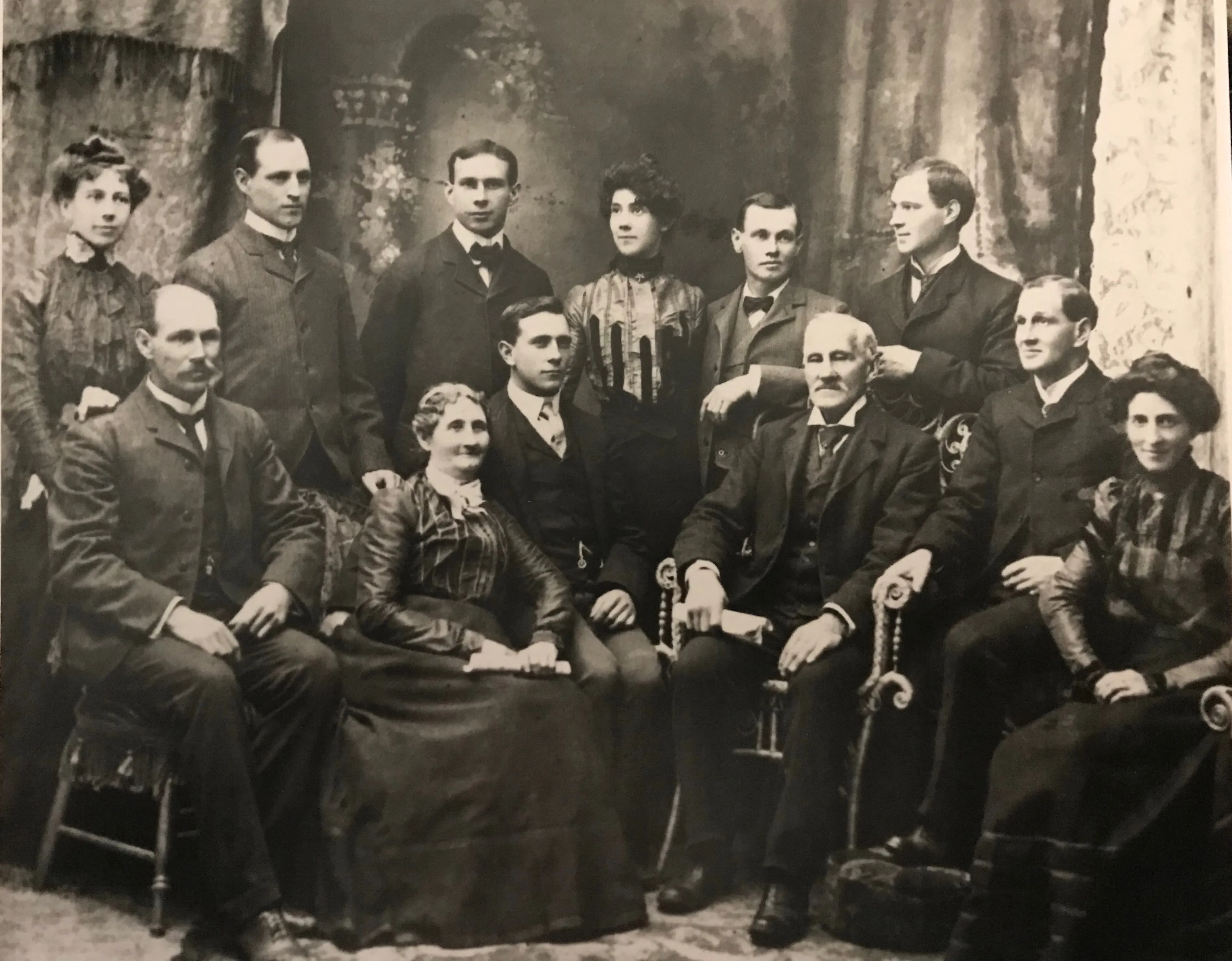
The ten children of Jeanie Goldie and Albert Eesley
Jeanie and Albert had ten children, the narrative records:
John, Hannah (called Anna), William, Alf, Bert, Bessie, Jennie, George, Charles, and Garfield.
In the longer surnamed-and-dated form this archive carries them as:
- John Franklin Eesley — the Plainwell, Michigan flour mill founder.
- Hannah (“Anna”) Eesley Scoon.
- William Eesley (the College Corner schoolteacher).
- Alfred Eesley.
- Albert Robert Eesley Jr. (“Bert”).
- Bessie Eesley.
- Jennie Baxter Eesley.
- George Eesley of Toronto.
- Charles Leonard Eesley — Will Eesley’s father, Chuck’s paternal great-great-grandfather.
- Garfield Eesley.
That is the Eesley generation that runs from the 1860s Goldie-Eesley marriage at the Ontario mill into the late 19th and early 20th centuries across Ontario, Michigan, Ohio, and Toronto.
Death
She lived the rest of her life in Canada and died at 424 Sackville Street, Toronto, Ontario on 12 August 1911, age seventy-four. She was buried in Toronto two days later.
A small open question: 1841 vs 1845
The previous version of this page recorded the family’s arrival in Canada as 1841, age five — following an older Bean-era reading. The typewritten Goldie immigration narrative gives 1845, with corroborating specifics (James’s pre-Christmas-1845 death and David’s 14 September 1846 dock drowning both math from a 1845 arrival). The 1845 date is the one this page now carries; the 1841 reading sits in the page’s edit history as the prior assumption.
Sources: typewritten Goldie immigration narrative (Bean 1985 or related family-compiled history — source attribution pending), surfaced by Chuck Eesley June 2026; Mary Eesley Bean, Eesley Family History, 1985; Dale Eesley / FamilySearch — Jennie Goldie (L2J9-GM1). Crossing context: the timber-ship emigrant trade to British North America and the Grosse Île quarantine station below Quebec (general emigration history).
The Goldie millwrights
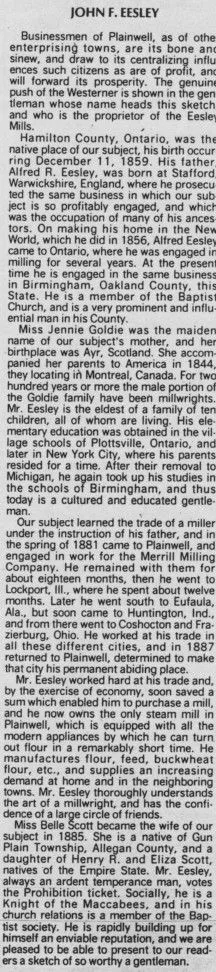
A biographical sketch of her eldest son John Franklin, printed in a Michigan county history in the 1890s, records of her family: “For two hundred years or more the male portion of the Goldie family have been millwrights.”
The Goldies were millwrights in Scotland for two centuries before Jennie sailed. A millwright builds and maintains the mill; a miller works it — so the trade her sons followed may have come down through her family as much as through their father’s, and the Plainwell mill her eldest son built has a Scottish maternal ancestry as much as an English paternal one.
The same sketch gives her birthplace as Ayr, Scotland and her arrival in America as 1844, settling at Montreal.
Appears in
- William Eesley Obituary (College Corner, Ohio), c. 1916 — ancestor-sketch
- Eesley Family History (1985) — register