letter
Letter from Lillie Dale to her son Len, 3 September 1922 — 'Wilbur's leg is that it isn't you'
The earliest letter in the family archive — Sunday 3 September 1922. Lillie Dale Chenoweth Eesley ('Lilly' to family) writes from Grove City, Ohio to her eldest son Leonard David Eesley ('Len'), who is in the middle of a cross-country automobile trip to California (Lillie's 'I hope you all make the trip home without accidents to yourselves or the machine either' suggests Len was traveling with at least one companion, not solo as earlier framings of this letter assumed). The letter is full of small domestic news: fifteen-year-old Wilbur (Will) Eesley has fallen off a roof and broken his leg badly — the family had spent days waiting to see whether tetanus or lockjaw would follow; it didn't. Aunt Ota has been at the house helping. Mafry will be married this month, and Lillie encloses a check for a wedding gift. Most importantly, Lillie asks Len to be sure to visit her cousin Chauncey Chenoweth ('Chant') and his wife Ada at 708 Elmira St., Pasadena — Chant being the son of Lillie's uncle Thomas Chenoweth. Len is starting college that fall, so Lillie also offers to fill out his registration card herself once he sends it back: 'You expect to take the Arts course?' Per Roberta Burnes (June 2026): Will's broken leg came from a fall off a roof; the schizophrenic-episode reference on the Eesley side comes later in the family story (Charles Leonard hospitalized at Harding Hospital, Columbus), the trigger for a separate train trip west that Lillie and Helen — Roberta's mother and Charles Leonard's youngest daughter — took some years after this letter, on which they also visited Chant.
What the letter is
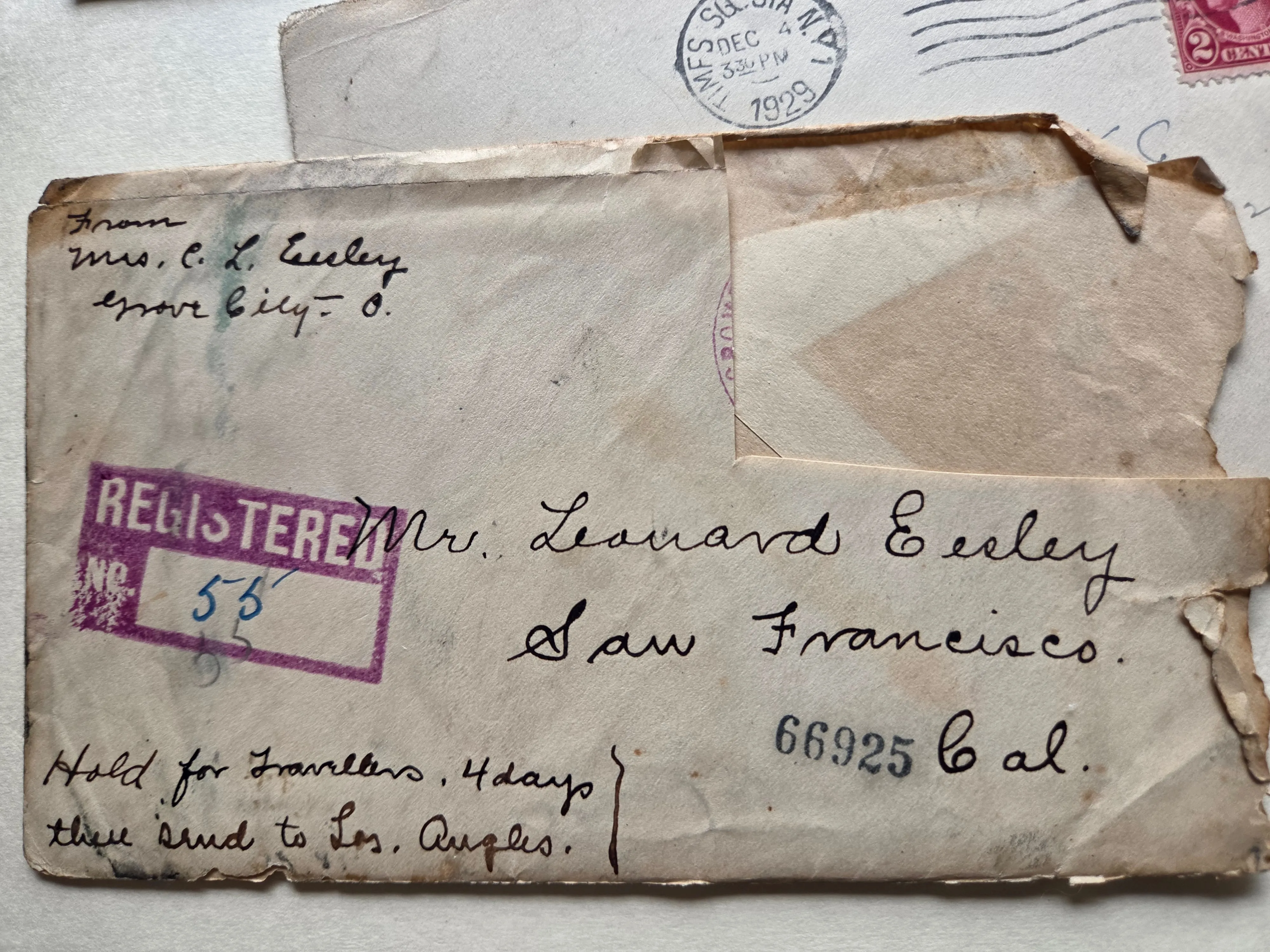
Sunday, 3 September 1922. The earliest dated letter in this archive. Lillie Dale Chenoweth Eesley — called “Lilly” in the family — writes from her home in Grove City, Ohio to her eldest son Leonard David Eesley, known as “Len.” Len is in the middle of a cross-country automobile trip to California — the kind of long-distance road trip a seventeen-year-old in 1922 would make on the slowly-improving American road system in the years before the federal highway program. Lillie’s line later in this letter — “I hope you all make the trip home without accidents to yourselves or the machine either” — suggests Len was not traveling alone: the “you all” implies at least one companion or perhaps a small group of friends on the trip. Earlier framings of this letter as a solo trip have been revised in light of this line (per Roberta Burnes, June 2026). The envelope says: “Hold for Travellers, 4 days — then send to Los Angeles.” The mail itself had to chase him.
The letter survives in the archive because Roberta Burnes preserved it from her grandmother Lillie Dale’s keeping, and shared it with this archive in June 2026.
Envelope
From: Mrs. C. L. Eesley, Grove City — O.
To: Mr. Leonard Eesley, San Francisco. 66925 Cal.
Registered No. 55
Hold for Travellers, 4 days — then send to Los Angeles.
Postmark: West-Jeff-sta. N.Y., DEC [presumed actually SEP] 3, 1922
The misprint or misread of the postmark month is the small piece of envelope-detail that Roberta’s preservation now makes visible. Internal evidence (the letter itself dated 3 September) places it firmly in early September 1922.
Transcription
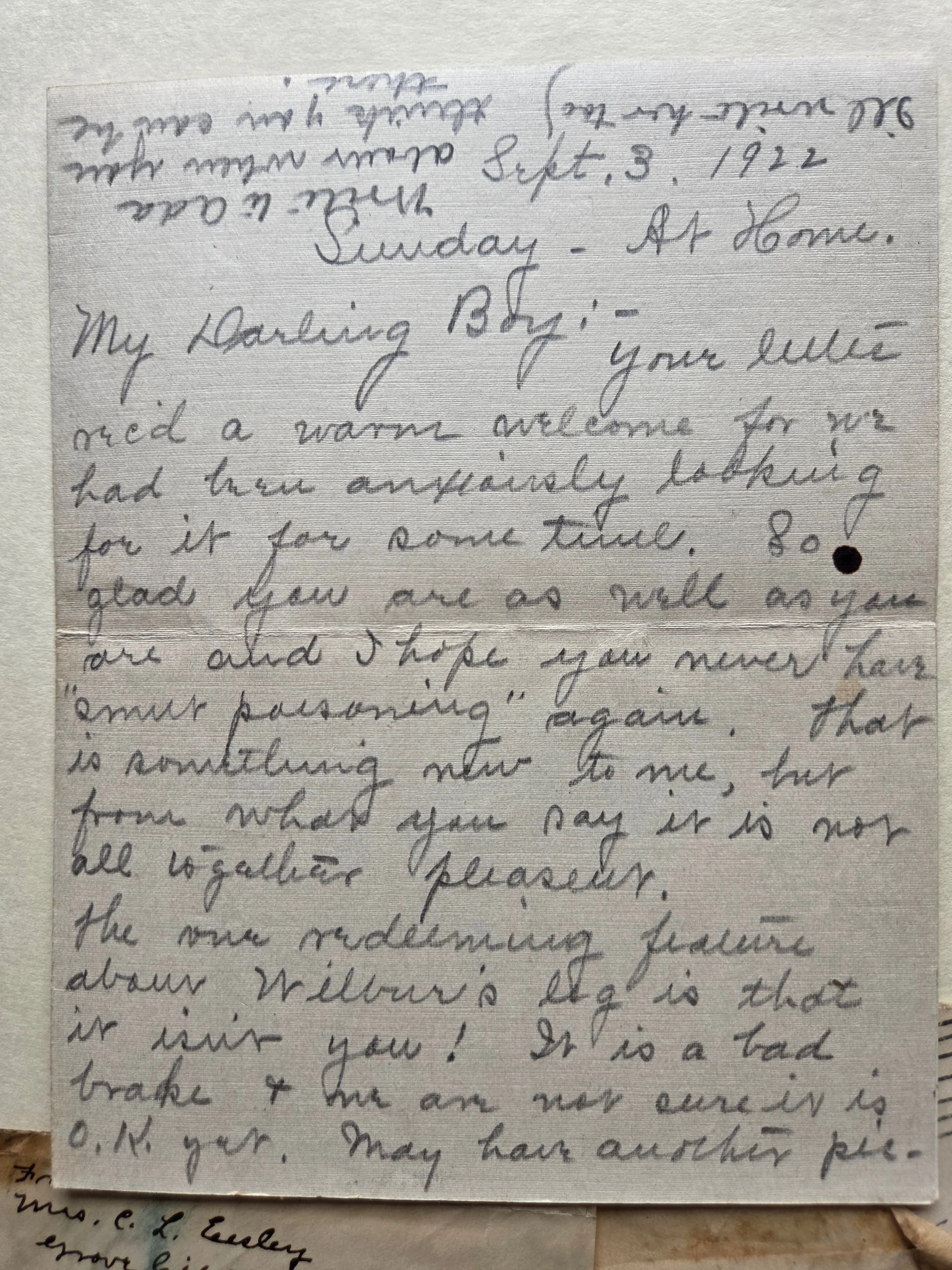
Sept. 3, 1922
Sunday — At Home.
My Darling Boy:
Your letter rec’d a warm welcome for we had been anxiously looking for it for some time. So glad you are as well as you are and I hope you never have “smut poisoning” again. That is something new to me, but from what you say it is not altogether pleasant.
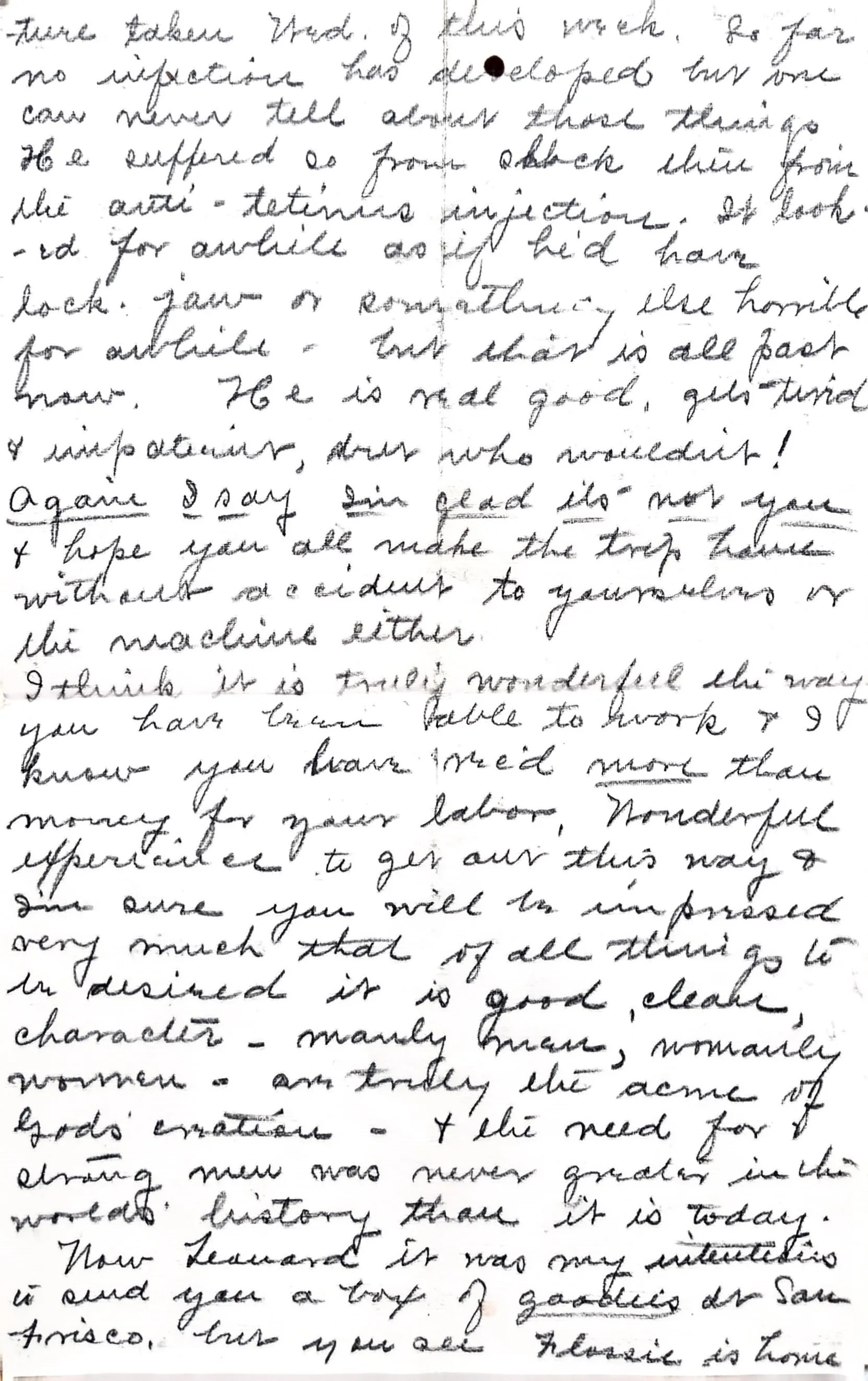
The one redeeming feature about Wilbur’s leg is that it isn’t you! It is a bad brake & we are not sure it is O.K. yet. May have another picture taken Wed. of this week. So far no infection has developed but one can never tell about those things. He suffered so from shock thru from the anti-tetanus injection. It looked for awhile as if he’d have lock-jaw or something else horrible for awhile — but that is all past now. He is real good, just tired & impatient, but who wouldn’t!
Again I say I’m glad it’s not you & I hope you all make the trip home without accidents to yourselves or the machine either.
I think it is truly wonderful the way you have been able to work & I know you have rec’d more than money for your labor. Wonderful experiences to get out this way & I’m sure you will be impressed very much that of all things to be desired it is good, clean character — manly men, womanly women — are truly the acme of God’s creation — & the need for strong men was never greater in the world’s history than it is today.
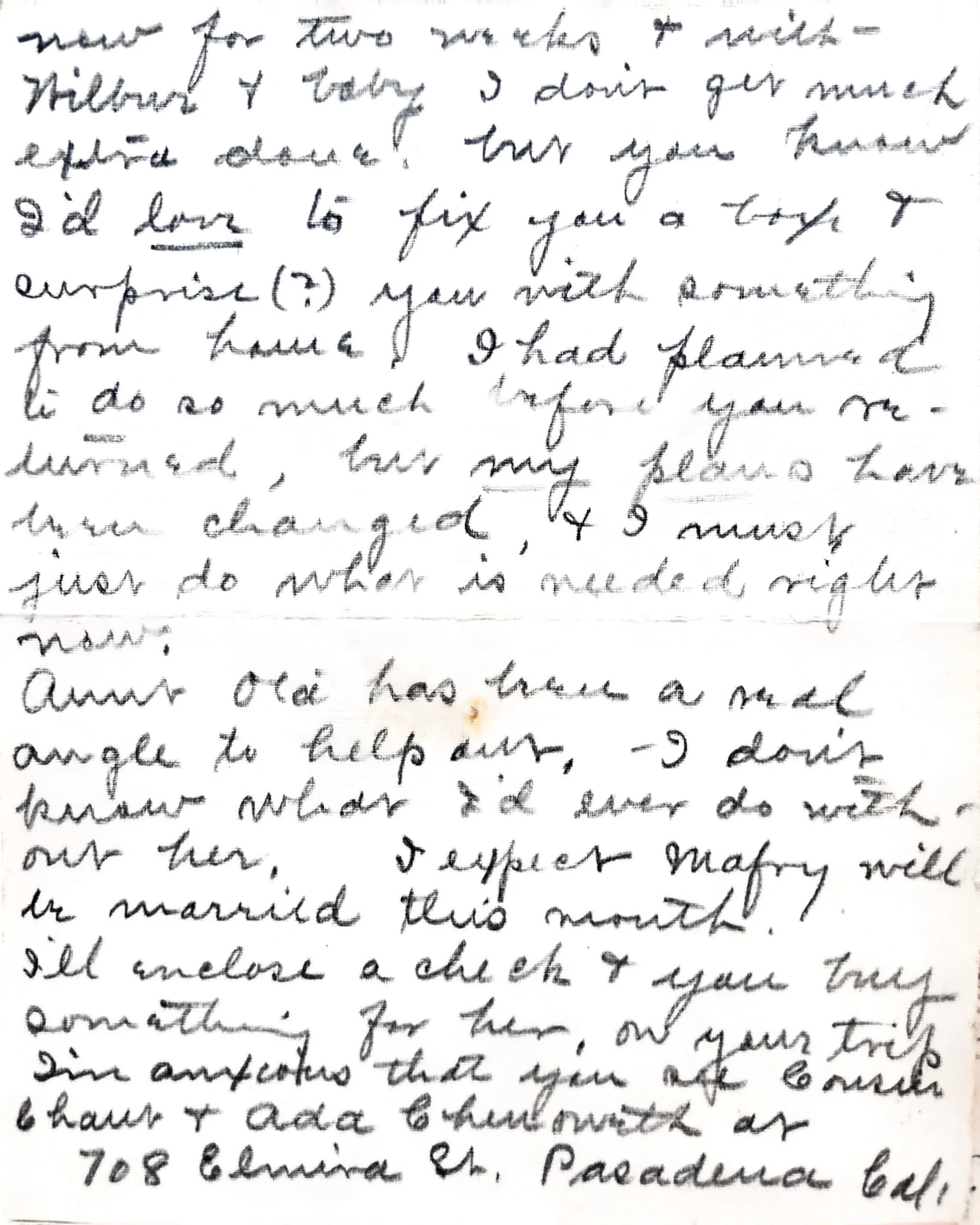
Now Leonard it was my intentions to send you a box of goodies to San Frisco, but you see Flossie is home new for two weeks & with Wilbur & baby I don’t get much extra done. But you know I’d love to fix you a box & surprise (?) you with something from home. I had planned to do so much before you returned, but my plans have been changed, & I must just do what is needed right now.
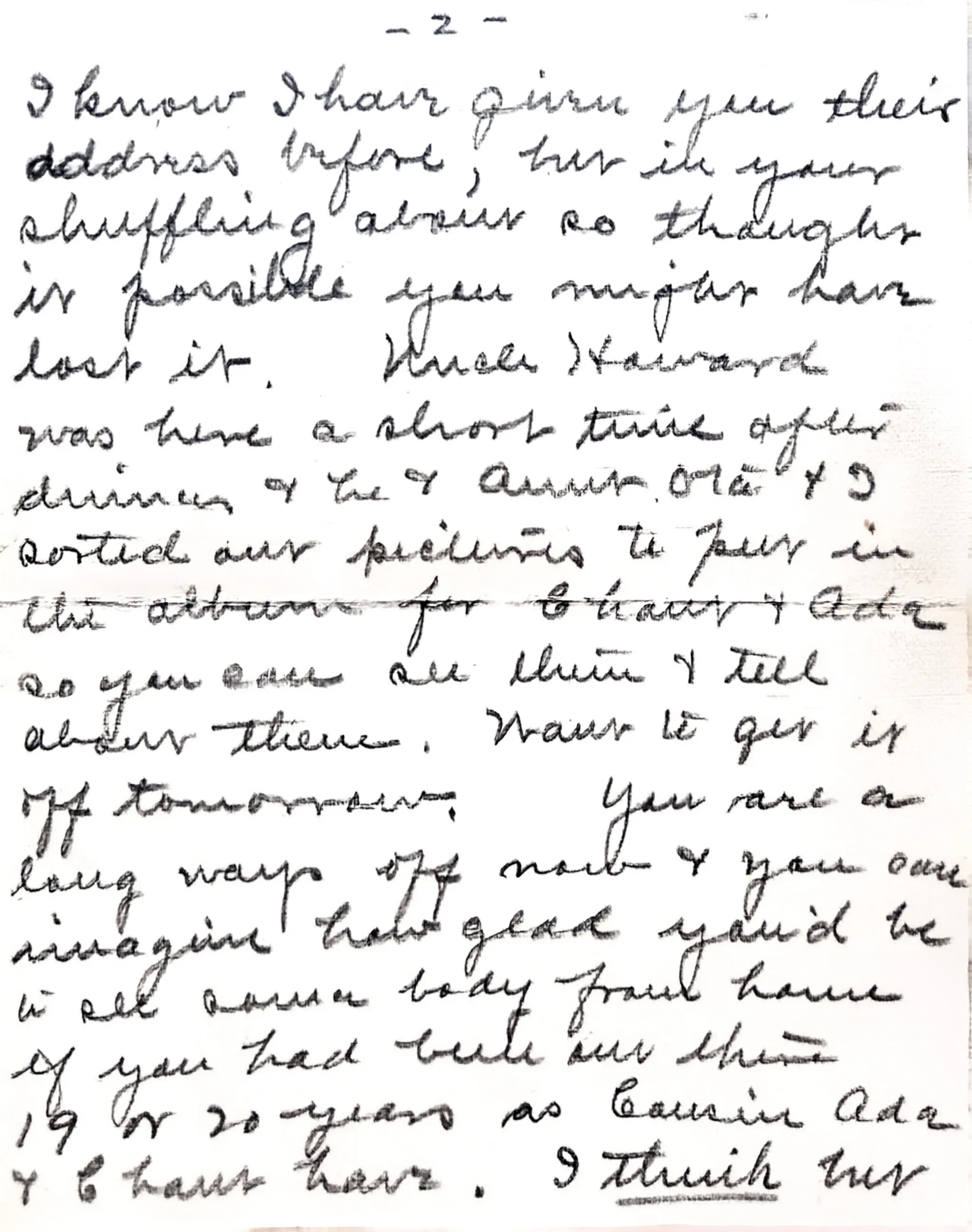
Aunt Ota has been a real angel to help out. — I don’t know what I’d ever do without her. I expect Mafry will be married this month. I’ll enclose a check & you buy something for her on your trip. I’m anxious that you see Cousins Chaunt & Ada Chenoweth at 708 Elmira St. Pasadena Cal. I know I have given you their address before, but in your shuffling about so thought it possible you might have lost it.
Uncle Howard was here a short time after dinner & he & Aunt Ota & I sorted out pictures to put in the album for Chaunt & Ada so you can see them & tell about them. Want to get it off tomorrow.
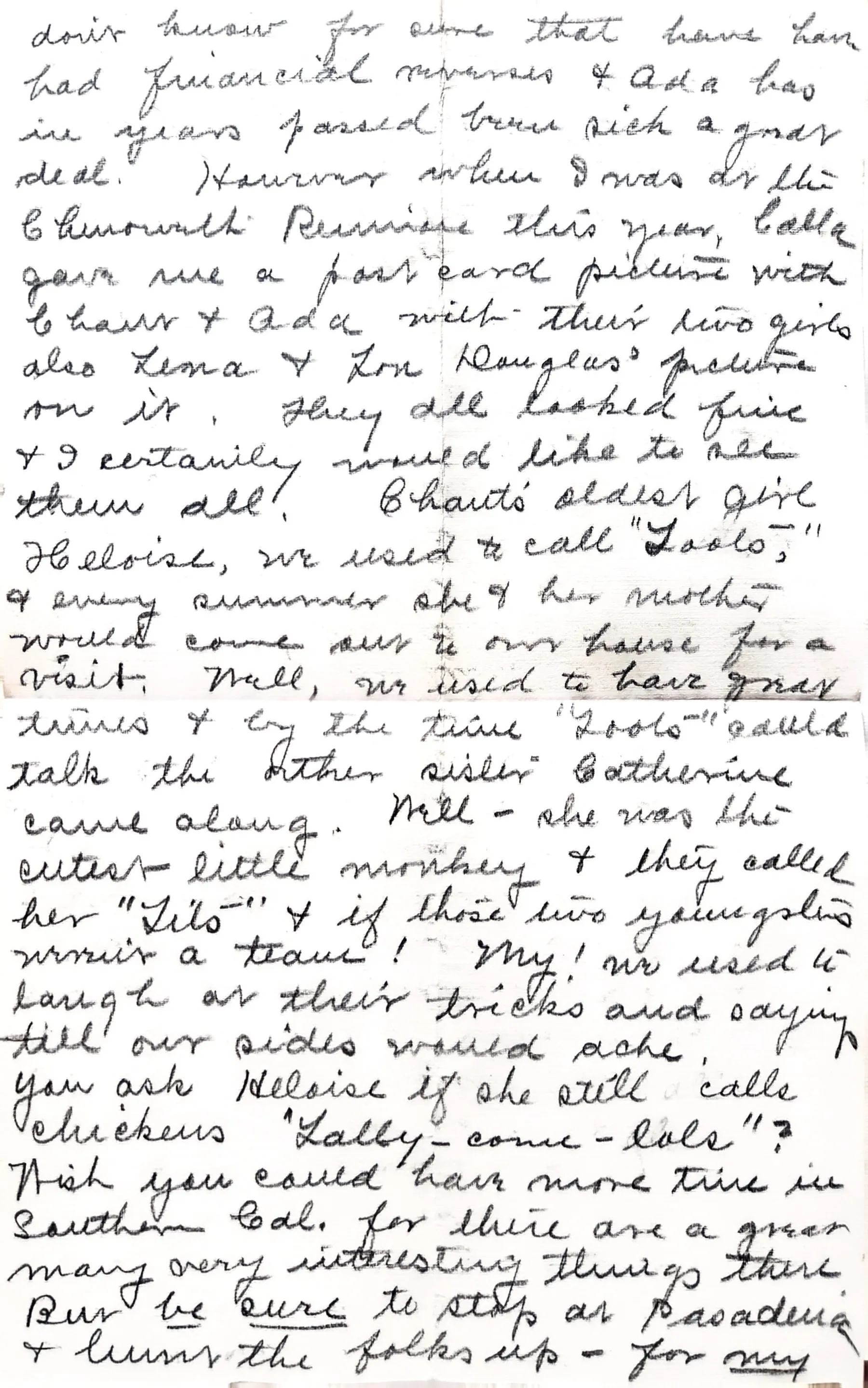
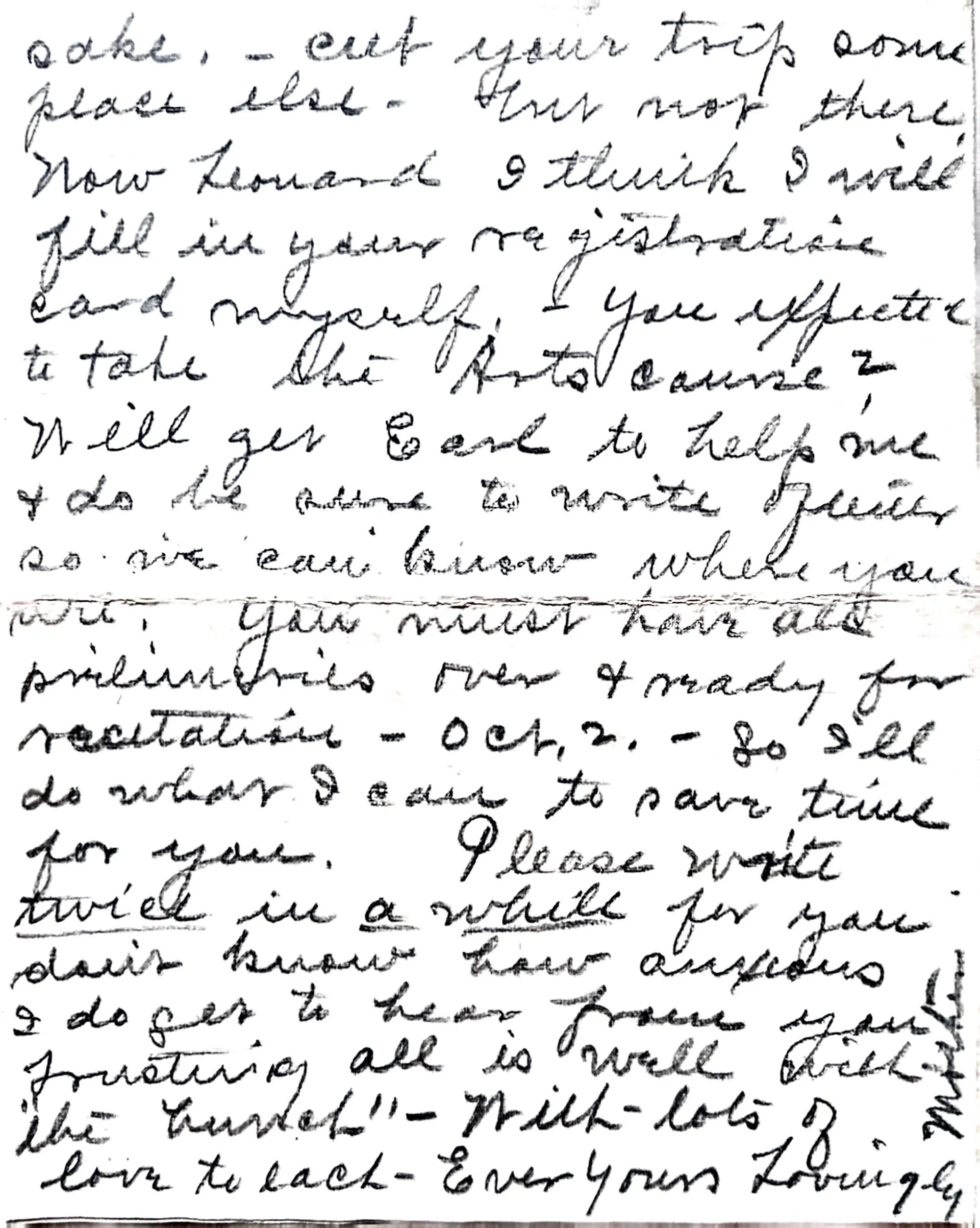
You are a long way off now & you can imagine how glad you’d be to see somebody from home if you had been out there 19 or 20 years as Cousin Ada & Chaunt have. I think they don’t know for sure that times have had financial reverses & Ada has in years passed been sick a great deal. However when I was at the Chenoweth Reunion this year, Calla gave me a postcard picture with Chaunt & Ada with their two girls also Lena & Lon Douglas’ picture on it. They all looked fine & I certainly would like to see them all. Chaunt’s oldest girl Heloise, we used to call “Toots.” & every summer she & her mother would come out to our house for a visit. Well, we used to have great times & by the time “Toots” could talk the other sister Catherine came along. Well — she was the cutest little monkey & they call her “Tits” — & if those two youngsters weren’t a team! My! We used to laugh at their tricks and saying till our sides would ache. You ask Heloise if she still calls chickens “Lalle-come-bo’s”? Wish you could have more time in Southern Cal. for there are a great many very interesting things there. But be sure to stop at Pasadena & hunt the folks up — for my sake, — cut your trip some place else — but not there.
Now Leonard I think I will fill in your registration card myself. You expect to take the Arts course? Will get Earl to help me & do be sure to write often so we can know where you are. You must have all preliminaries over & ready for recitations — Oct. 2. — So I’ll do what I can to save time for you. Please write twice in a while for you don’t know how anxious I do get to hear from you trusting all is well with “the bunch” — With lots of love to each — Ever Yours Lovingly
Mother
What the letter records
What “smut poisoning” is. “I hope you never have ‘smut poisoning’ again. That is something new to me, but from what you say it is not altogether pleasant.” The term — which Lillie puts in scare quotes because Len had just introduced her to it — almost certainly refers to exposure to fungal smut on cereal grain. Smut is the period word for the Ustilago and Tilletia fungi that grow on wheat, oats, corn, and barley, turning grain heads into black masses of spores. Threshers, grain-handlers, and farm laborers in the pre-mechanized harvesting era routinely inhaled clouds of these spores during threshing season, and the resulting respiratory irritation, skin rash, and allergic reactions were known in farm-country English by names like “smut poisoning,” “thresher’s lung,” or “grain itch.” Len’s cross-country trip in the summer of 1922 ran straight through the western harvest belt, and the “truly wonderful the way you have been able to work” line later in this letter suggests he had been taking farm jobs along the route to fund the trip. The most plausible reading is that he picked up smut exposure during one of those farm stints, wrote home about it, and Lillie — whose Grove City life had not put her near a threshing crew — was registering an unfamiliar piece of agricultural slang. It is, in its small way, a piece of period vocabulary the letter preserves.
Will’s broken leg, from falling off a roof. “The one redeeming feature about Wilbur’s leg is that it isn’t you!” Per Roberta Burnes (June 2026), Wilbur (Will) Eesley — aged 15 in September 1922 — had fallen off a roof and suffered a bad break. The letter records the family’s days of waiting to see whether tetanus or lockjaw would follow the bone injury — “it looked for awhile as if he’d have lock-jaw or something else horrible” — before the anti-tetanus injection took and the immediate danger passed. Pre-antibiotic-era injuries of this kind were genuinely dangerous; Lillie Dale’s days of fearful waiting were not overblown. The detail places one of the earliest documented health events in Will Eesley’s long life: at fifteen he came close to lockjaw from a broken leg sustained falling off a roof, and Lillie Dale spent the early autumn of 1922 nursing him at home while her eldest son Len was driving across the country.
The broken leg is also the immediate occasion for Lillie Dale’s recurrent line in this letter: “Again I say I’m glad it’s not you.” Len was on the road with a car (“the machine”), and the parental relief that the danger was Will’s at home and not Len’s far away runs through the letter.
Cousin Chauncey Chenoweth (“Chant” / “Chaunt”) in Pasadena. “I’m anxious that you see Cousins Chaunt & Ada Chenoweth at 708 Elmira St. Pasadena Cal.” Per Roberta Burnes, Chauncey Chenoweth was Lillie Dale’s first cousin — the son of her uncle Thomas Chenoweth. The Pasadena Chenoweths had moved west many years earlier (“19 or 20 years” by Lillie’s count) and Lillie Dale had recently seen their photograph at “the Chenoweth Reunion this year” — the same Chenoweth gathering that produced the c. 1901-02 Chenoweth Reunion at Harrisburg Ohio thread on this site (a different reunion, but the same recurring Chenoweth family pattern). Chauncey’s two daughters were Heloise (called “Toots” as a child) and Catherine (called “Tits”), and Lillie Dale’s recollection of their childhood summers at “our house” in Ohio — “those two youngsters weren’t a team! My! we used to laugh at their tricks and saying till our sides would ache” — is the small piece of pre-photographic family-life record that letters of this kind preserve.
Lillie Dale’s instruction is firm: “Cut your trip some place else — but not there.” Pasadena was the priority. The family connection mattered.
Len’s car trip and college registration. “I’d love to fix you a box & surprise (?) you with something from home” — Lillie Dale wished she could send a care package but Will’s broken leg, the baby, and Flossie being home had absorbed her time.
Per Roberta Burnes Walker, June 2026: Flossie was not Lillie’s sister-in-law; her relationship to the family is open — possibly a cousin.
The most likely identification — surfaced via the Chenoweth Family Association’s online genealogy, Egge’s Descendants of Elijah Jr. and Nancy page (June 2026 lookup) — is one of the two Flossie-nicknamed daughters of Lillie Dale’s second cousin once removed Jeremiah M. “Jerry” Chenoweth (1836-1914), son of Joseph Chenoweth (1798-1869) of Franklin Co., OH (Lillie’s grandfather Elijah Jr.’s brother). Jerry and his wife Statira Grant Wood had two daughters with names that “Flossie” naturally shortens from:
- Florence Chenoweth (b. 12 August 1861, Franklin Co., OH; m. ? Peake) — the literal “Florence → Flossie” name match. She would have been 61 in September 1922.
- Flora D. Chenoweth (b. 14 April 1866, Franklin Co., OH; m. first ? Mitchel, then George A. Ritson; d. 1922). “Flora” is also a common Flossie-source. She would have been 56 in September 1922 — and she died the same year as this letter.
Both are Lillie Dale’s second cousins through her grandfather Elijah Jr. Chenoweth’s brother Joseph. The Flora candidate has the additional pull that her 1922 death is the same year as the letter — if Flora was in declining health in early-to-mid 1922 and was “home for two weeks” at Lillie’s Grove City house in early September, the letter would be documenting an end-of-life visit. The Florence candidate has the cleaner name-match.
Without a photograph captioned “Flossie” in Roberta’s album to confirm visually, and without the 1940s letter collection deciphering the rest of Charles Leonard’s correspondence, the identification rests on the Egge tree’s roster of Lillie’s second cousins as the only documentary candidates with names that shorten to “Flossie.” “Now Leonard I think I will fill in your registration card myself. You expect to take the Arts course? Will get Earl to help me … you must have all preliminaries over & ready for recitations — Oct. 2.” Len was returning home from California to start college in the fall of 1922 with the academic year beginning 2 October. Lillie Dale was offering to fill in his college registration card from home so he wouldn’t have to do it in the few days between his return and the start of classes. The Arts course she names is the standard early-20th-century liberal-arts curriculum at the school he would have attended.
Mafry’s wedding and the enclosed check. “I expect Mafry will be married this month. I’ll enclose a check & you buy something for her on your trip.” The same Mafry Hyatt the Eesley family history carries; her 1922 marriage is now anchored by Lillie’s letter. The enclosed-check-from-home for Len to buy a wedding gift on Mafry’s behalf is the small piece of extended-family logistics the letter preserves.
Aunt Ota and Uncle Howard. Lillie Dale’s relatives helping at the house in Grove City during Will’s recovery. Aunt Ota was “a real angel to help out;” Uncle Howard was over after dinner the day before the letter, helping sort photographs for an album to send to the Pasadena Chenoweths. The picture-album mailing is itself the small piece of period-Americana documentation: family pictures sent across the country to relatives who hadn’t been home in twenty years.
The closing line about character. “Of all things to be desired it is good, clean character — manly men, womanly women — are truly the acme of God’s creation — & the need for strong men was never greater in the world’s history than it is today.” The line is the period register of a religious-conservative midwestern mother writing to her teenage son about character. It is not the kind of line a 2026 reader writes — the gendered framing especially is of its time — but it is the kind of line that runs through the McMaster-side and Chenoweth-side family correspondence the archive carries, and is one of the more visible pieces of the moral vocabulary that the Family threads synthesis essay touches on as the steady character thread on Charlie’s father’s side.
Context — the later schizophrenic-episode trip west
Per Roberta Burnes (June 2026), there is a second, later family trip west that pairs with this 1922 letter: some years after Len’s cross-country road trip, Charles Leonard Eesley had a schizophrenic episode in which he threatened violence; Lillie Dale would not have it and had him hospitalized at Harding Hospital in Columbus. Afterward Lillie Dale and Roberta’s mother — Helen Louise (Eesley) Burnes, Charles Leonard and Lillie Dale’s youngest daughter (born 16 January 1924, two years after this letter, and Wilbur’s youngest sister; not Wilbur’s daughter — per Roberta Burnes, June 2026) — took the train west together, and met Chant on that visit too. The episode is a serious piece of family-health history that had not previously been on this site, and is recorded here with the care that mental-health material in family archives requires: it is part of Charles Leonard’s life, it shaped Lillie Dale’s life, and it should be neither sensationalized nor erased.
Open questions for Chuck (and family confirmation)
- Lillie Dale’s nickname “Lilly” — confirmed by Roberta in this June 2026 note. Worth carrying as a
akafield on Lillie Dale Chenoweth’s page if not yet. - The baby in the letter — “with Wilbur & baby I don’t get much extra done” — was the youngest sibling at home in September 1922. Charles Leonard and Lillie Dale’s children list per Mary Eesley Bean’s 1985 register would name them; this letter places a “baby” in 1922, suggesting a birth in 1920-1922 — which fits the youngest siblings on the existing tree.
- Charles Leonard’s episode — the date and any further family memory of it. This would belong on Charles Leonard’s page, treated with the care the topic requires.
- “Earl” in the registration-card line — “will get Earl to help me” — the family Earl who would have been a household helper or older relation, probably a Chenoweth or Anderson connection rather than the Wildermuth-side Earl Adam.
Pages this letter updates
- Wilbur (Will) Eesley — 1922 broken leg from falling off a roof added as the earliest documented health event of his life.
- Lillie Dale Chenoweth Eesley — voice and biographical character added; her cousin Chauncey Chenoweth (uncle Thomas’s son) and the Pasadena trip thread.
- Leonard David Eesley — 1922 cross-country car trip at age 17 (with at least one companion, per Lillie’s “you all” line), fall 1922 college start.
- Charles Leonard Eesley — later schizophrenic-episode story (separate task, careful framing).
- Mafry Hyatt — 1922 marriage anchored.
- Roberta Burnes — credit for preserving and sharing this letter.
Source: Held by Roberta Burnes; eight original sheets including envelope, scanned and shared June 2026. Files at /src/assets/family/originals/lillie-1922-letter/. Per Roberta’s email of June 2026: Lilly = Lillie Dale Chenoweth Eesley (family nickname); Len = Leonard David Eesley; Will’s broken leg came from a fall off a roof; “Chant” = Chauncey Chenoweth, Lillie’s first cousin via her uncle Thomas Chenoweth.
Scans