← Part of Letters from Vietnam
letter
Letter to Terrie, 2–3 April 1971 — 'Your letter saying your parents are against us meeting in Hawaii'
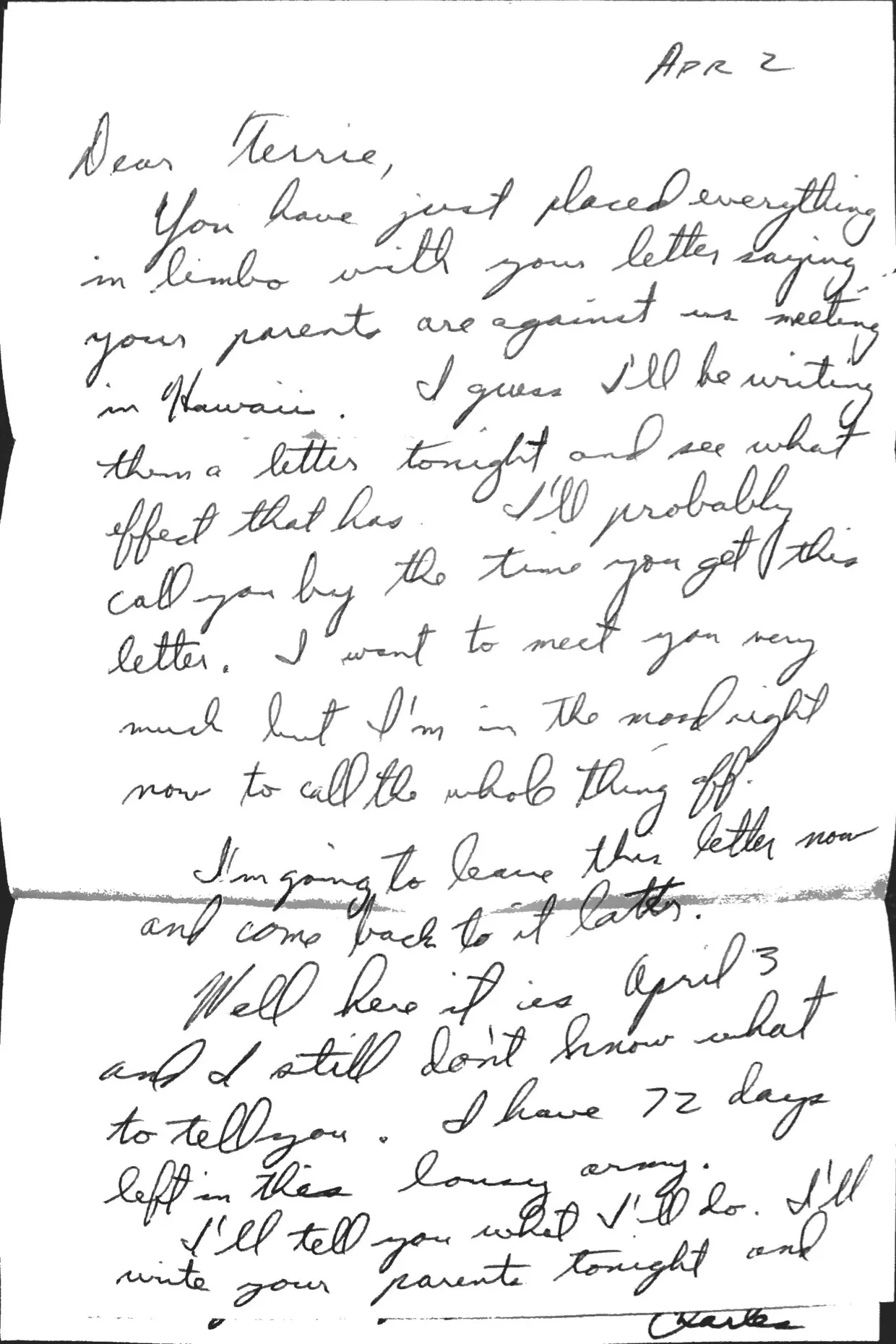
Charlie's two-day letter to Terrie dated 2 April 1971 (started) and 3 April 1971 (completed), reacting to Terrie's letter that her parents had come out against her flying to Hawaii to meet him for R&R. Charlie's first reaction in writing is anger — he is in the mood to call the whole trip off — but he sets the letter aside and comes back to it the next day, by which point he has decided to write Robert Earl and Dorothy directly. The hinge letter in the R&R parental-conflict thread that runs from the 22 March R&R orders to the 29 May 'I'm back from Saigon' letter.
What the letter is
2 April 1971. Charlie writes Terrie a letter that turns into a two-day letter — started in anger on 2 April, set aside, finished on 3 April with a different plan.
Terrie’s parents — Charlie’s future in-laws Robert Earl and Dorothy Wildermuth — have just told her they do not want her to fly to Hawaii to meet Charlie for his R&R in mid-June. Terrie has written Charlie that the trip is now in doubt. Charlie’s first-day response is the angry one. By the second day he has worked out what to do.
The letter is the central hinge of the R&R parental-conflict thread that runs through the spring 1970 letters: it sits between the 22 March R&R orders letter (the plan), the 18 March “I hope they approve” pre-shock letter (the anticipation), the 29 May “17 days left” letter from Saigon (the trip going ahead despite resistance), and the 22 June “your father’s attitude is better” letter (the conflict softening after the trip).
Transcription
April 2
Dear Terrie,
You have just placed everything in limbo with your letter saying your parents are against us meeting in Hawaii. I guess I’ll be writing them a letter tonight and see what effect that has. I’ll probably call you by the time you get this letter. I want to meet you very much but I’m in the mood right now to call the whole thing off.
I’m going to leave this letter now and come back to it later.
Well here it is April 3 and I still don’t know what to tell you. I have 72 days left in this lousy army.
I’ll tell you what I’ll do. I’ll write your parents tonight and…
[the sentence breaks off at the foot of the page, which is signed:] Charles
The two days
The structural shape of the letter is the most telling part. Charlie writes the first paragraph in the immediate flush of finding out — “I’m in the mood right now to call the whole thing off” — and instead of finishing in that mood, he stops, sets the letter aside, and comes back to it the next day, when he can write the practical plan. The two paragraphs sit on the same piece of paper as the documented evidence that he made himself wait twenty-four hours before responding to the conflict.
The “72 days left in this lousy army” line is the bitter side of the calculation. Seventy-two days to R&R was within reach but contingent — if Terrie’s parents held the line and she didn’t come to Hawaii, the seventy-two days led to nothing.
The plan — Charlie writing the in-laws
The second-day decision is to write Robert Earl and Dorothy himself. “I’ll write your parents tonight…” This is the same letter direction Robert Earl’s prior reluctance had previously left open — a young soldier dating the eldest daughter of an Air Force lieutenant colonel, writing the lieutenant colonel directly to advocate for a Hawaii R&R meeting. The letter Charlie wrote to Robert Earl and Dorothy that night is not in this archive; what survives is this April letter in which he announces he is going to write it. The 22 June 1970 letter to Terrie carries the resolution: “I’m glad to hear… that your father’s attitude is better.”
The R&R trip did happen. The Hawaii meeting closed the longest gap of the courtship-during-the-war. The two-day letter on 2–3 April is the moment Charlie shifted from the angry first reaction to the steady plan that got him through it.
Context — the issue was the Hawaii meeting itself, not the war
Per Chuck Eesley June 2026, the Wildermuths’ resistance to Hawaii was about the meeting itself, not the war. Terrie was unmarried; Hawaii R&R meant a week alone with her boyfriend in a hotel; the trip would have been styled around the Army’s “Mrs. Eesley” form-paperwork that the 22 March 1970 letter describes. To traditional parents of the period that arrangement was simply inappropriate for an unmarried couple, regardless of how serious the relationship was or how the family felt about Vietnam. The parental concern was propriety, not politics.
The earlier reading of this letter on this page (now revised) had tried to frame the resistance as part of a Wildermuth-side political stance on the war. That reading was overreach. Robert Earl had served the Air Force for twenty-eight years through three wars and was about to retire honourably in May 1970; the family neither opposed Charlie’s service nor took a public political position on Vietnam this archive can document. They didn’t want their unmarried daughter flying to Hawaii to spend a week alone with her boyfriend, which was a position completely independent of the war.
Both sides of the family were against the trip
The most important line in the parental-Hawaii thread — that both families’ mothers objected to the meeting — is not in this letter but in the 31 March 1971 R&R-planning letter, where Charlie writes:
“My mother is basically against us meeting like this too but she realizes there is nothing she can do. She suggested I write your parents and explain to them why we are meeting.”
(An earlier version of this page had appended those blue-ink sheets here as a “third sheet”; they belong to the 31 March letter — see the source note above.)
Peggy McMaster Eesley was against the Hawaii meeting for the same propriety reasons the Wildermuths were. An earlier framing on the site had cast the Eesley side as supportive and the Wildermuth side as obstructive; the corrected reading is that both families’ mothers shared the same generational reading of an unmarried young woman flying to Hawaii to meet her soldier-boyfriend at a hotel for a week. The difference was tactical: the Wildermuths were prepared to act on their objection by keeping Terrie home; Peggy had concluded that there was nothing she could do, and had pivoted to brokering — first suggesting Charlie write Terrie’s parents to explain, and (the 5 April letter shows) then suggesting they marry in Hawaii during R&R to remove the objection entirely.
The 31 March letter also carries a piece of in-law-relationship wisdom from Charlie himself, two months before his own R&R: “After we are married we probably won’t see them that much but that is no reason to be on bad terms with them.” He was twenty-three; the line is more measured than most twenty-three-year-olds manage about their future in-laws under pressure.
What this 2 April letter uniquely records is the immediate reaction — the anger, the impulse to call the whole trip off, the twenty-four-hour pause, and the decision to write his future in-laws directly. The 5 April 1971 ‘Mom suggested Hawaii marriage’ letter is the natural next-letter read after this one.
Scans